Guide
Pakistan's Vertical Revolution: The End of Speculative Plots and the Rise of High-Density Real Estate in 2026
Milkiyat.com is operated by MILKIYAT.COM ONLINE PORTAL (PRIVATE) LIMITED.
Corporate Unique Identification No. (CUI): 0337118
Incorporated under the Companies Act, 2017, Pakistan.
Guide
Guide

Real Estate Analyst
18 min read
Key Takeaways
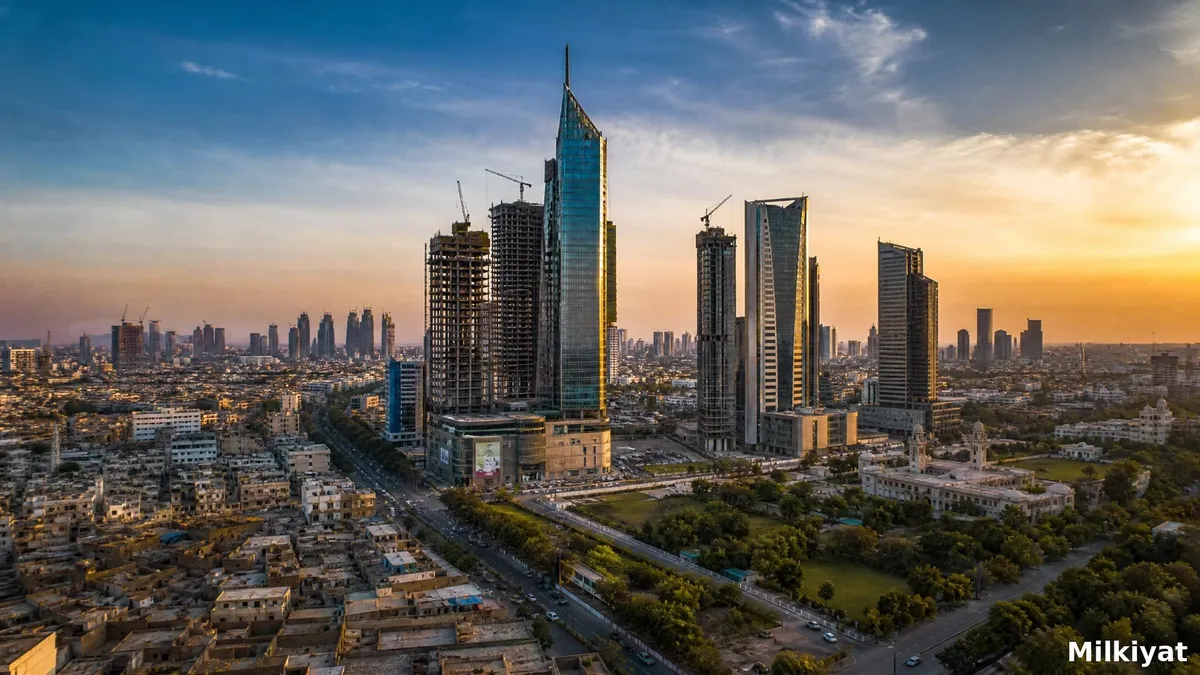
Pakistan's urban real estate sector is undergoing its most profound structural realignment in decades. For nearly half a century, the primary engine of property investment was the trading of residential plots and unallocated land files — a highly unproductive asset class that locked up billions of dollars in dormant capital, enriched speculators, and left millions of ordinary Pakistanis without a home to call their own. By 2026, that era is over.
A structural convergence of macroeconomic stabilization, aggressive taxation bifurcations, and the elimination of the speculative paper-file system is permanently redirecting capital into institutional-grade, high-density vertical developments across Karachi, Lahore, and Islamabad. The State Bank of Pakistan's (SBP) policy rate easing cycle, combined with the Federal Board of Revenue's (FBR) punitive taxation on non-compliant capital, has driven investors toward physical, yield-producing vertical assets. This revolution is playing out against the backdrop of an acute nationwide housing deficit of approximately 10 million units, which continues to expand under the weight of rapid urbanization. [1]
The transition to a modern vertical model remains highly polarized. While premium master-planned developments and central business districts attract significant domestic and diaspora capital, developers must navigate severe municipal infrastructure failures, strict fire safety enforcement campaigns, and volatile construction costs. This report provides an analytical, data-triangulated evaluation of the core dynamics, regional variations, statutory tax systems, and structural bottlenecks defining Pakistan's vertical real estate revolution in 2026.
Explore the Johar Town commercial property market in 2026, including key commercial areas, location factors, buyer considerations, rental demand and investment potential.
Compare Johar Town Phase 1 and Phase 2 to understand property prices, location, accessibility, lifestyle, rental demand and investment potential for buyers in Lahore.
Johar Town Lahore property prices in 2026 vary by location, property type and commercial potential. Explore current house, plot and commercial property trends, key factors and buyer insights.
A complete buyer's guide to Lake Harbour 2 in Downtown Park View City Islamabad, its A-Com 07 lakefront position, FourSquare Developers' track record, the released 538 sq ft unit, booking procedure, a Lake Harbour 1 comparison, and an honest read on investment potential.
Real Estate Analyst
18 min read
Key Takeaways
Pakistan's urban real estate sector is undergoing its most profound structural realignment in decades. For nearly half a century, the primary engine of property investment was the trading of residential plots and unallocated land files — a highly unproductive asset class that locked up billions of dollars in dormant capital, enriched speculators, and left millions of ordinary Pakistanis without a home to call their own. By 2026, that era is over.
A structural convergence of macroeconomic stabilization, aggressive taxation bifurcations, and the elimination of the speculative paper-file system is permanently redirecting capital into institutional-grade, high-density vertical developments across Karachi, Lahore, and Islamabad. The State Bank of Pakistan's (SBP) policy rate easing cycle, combined with the Federal Board of Revenue's (FBR) punitive taxation on non-compliant capital, has driven investors toward physical, yield-producing vertical assets. This revolution is playing out against the backdrop of an acute nationwide housing deficit of approximately 10 million units, which continues to expand under the weight of rapid urbanization. [1]
The transition to a modern vertical model remains highly polarized. While premium master-planned developments and central business districts attract significant domestic and diaspora capital, developers must navigate severe municipal infrastructure failures, strict fire safety enforcement campaigns, and volatile construction costs. This report provides an analytical, data-triangulated evaluation of the core dynamics, regional variations, statutory tax systems, and structural bottlenecks defining Pakistan's vertical real estate revolution in 2026.
Explore the Johar Town commercial property market in 2026, including key commercial areas, location factors, buyer considerations, rental demand and investment potential.
Compare Johar Town Phase 1 and Phase 2 to understand property prices, location, accessibility, lifestyle, rental demand and investment potential for buyers in Lahore.
Johar Town Lahore property prices in 2026 vary by location, property type and commercial potential. Explore current house, plot and commercial property trends, key factors and buyer insights.
A complete buyer's guide to Lake Harbour 2 in Downtown Park View City Islamabad, its A-Com 07 lakefront position, FourSquare Developers' track record, the released 538 sq ft unit, booking procedure, a Lake Harbour 1 comparison, and an honest read on investment potential.
The transition toward high-density vertical developments is supported by a recovering macroeconomic environment. Following a prolonged period of hyperinflation and aggressive monetary tightening, Pakistan's headline inflation has cooled significantly, dropping to 7.3% year-on-year in early 2026. This taming of inflation has enabled the SBP to execute an aggressive monetary easing cycle, lowering the benchmark policy interest rate from a historic peak of 22% down to 11.50% by mid-2026.
The contraction in banking yields has fundamentally changed the cost-of-capital calculations for local investors. During the peak of the interest rate cycle, private capital remained largely parked in secure, double-digit government debt instruments and fixed-deposit bank accounts. Today, with real interest rates adjusting downward, capital is actively migrating back into physical real estate assets in search of inflation-hedged yields. [2]
This capital reallocation is further reinforced by the stabilization of the Pakistani Rupee (PKR), which has maintained a steady trading range of approximately PKR 278 per USD, backed by total liquid foreign exchange reserves of $22.74 billion — comprising $17.22 billion in central bank reserves and $5.52 billion in scheduled commercial banks. This foreign exchange buffer has mitigated currency depreciation risks that previously forced investors to hold capital in foreign currencies or offshore real estate. Simultaneously, workers' remittances have maintained strong inflows, averaging $3.8 billion monthly. This continuous inflow of foreign capital is increasingly flowing into institutional-grade, managed vertical assets such as serviced apartments and branded commercial skyscrapers in metropolitan hubs.
| Macroeconomic Indicator | Value (Mid-2026) | Directional Trend |
|---|---|---|
| SBP Policy Rate | 11.50% | Declining (from 22% peak) |
| Headline Inflation (YoY) | 7.3% | Declining |
| PKR / USD Exchange Rate | ~PKR 278 | Stable |
| Total FX Reserves | $22.74 Billion | Recovering |
| Monthly Remittances | ~$3.8 Billion | Steady |
The primary catalyst for the institutionalization of the real estate sector is the decisive regulatory campaign to eliminate the traditional 'file-trading' system. For decades, developers and property agents marketed unallocated paper certificates representing prospective plots in housing schemes that lacked physical land, zoning approvals, or infrastructure. This system encouraged speculative trading, with files changing hands repeatedly in a shadow economy, leaving retail buyers and overseas Pakistanis highly vulnerable to developer insolvency and outright fraud. [3]
In a coordinated campaign, the National Accountability Bureau (NAB) has mandated the complete abolition of the file-trading system, shifting all legal and financial responsibility directly onto developers. Under the modern enforcement framework, developers are prohibited from marketing or selling any real estate unit that is not linked to a specific, demarcated plot or vertical unit layout on an officially approved master plan.
To achieve compliance, development companies must adhere to strict operational guidelines. Developers must verify that their layout plans are approved and actively indexed on the public portals of relevant provincial authorities — the CDA in Islamabad, LDA in Lahore, or SBCA in Karachi. Transactions cannot be recorded unless the developer provides the buyer with on-site physical demarcation of the specific plot or vertical unit. Developers must also demonstrate absolute ownership of the underlying land through registered title deeds and secure a valid No Objection Certificate (NOC) before soliciting public funds. All transaction payments must be processed through formal banking channels, creating an auditable trail that eliminates cash-based open ledgers.
This structural shift has removed speculative day-traders from the market, stabilizing land-file volatility and redirecting capital into physical, construction-ready high-rise developments. For a deeper analysis of what this means for buyers in the twin cities, read Pakistan's File System Is Ending: What It Means for Islamabad & Rawalpindi Buyers (2026).
To broaden the national tax net, the federal government has implemented a highly polarized tax regime that systematically penalizes non-filers while providing structured concessions to documented active taxpayers. In the proposed federal budget for the upcoming fiscal cycle, the FBR has taken further steps to stimulate documented real estate transactions, including the deletion of Section 7E, which historically taxed deemed income on idle capital assets. Super tax rates have been rationalized, being completely abolished for individuals and entities with earnings under PKR 500 million, and capped at 8% for higher income tiers.
For active tax filers, advance withholding tax rates under Section 236C (collected from the seller) and Section 236K (collected from the purchaser) have been converted to lower flat rates of 2.75% and 1.50% respectively. In contrast, non-filers face punitive withholding tax rates that escalate based on the fair market value of the property. For property transactions exceeding PKR 100 million, non-filers face an advance tax rate of 18.50% on purchases — a spread that ensures compliant investors on the Active Taxpayer List (ATL) retain a distinct margin advantage.
| Transaction Typology & Asset Valuation Bracket | Active Taxpayer (ATL) Filer Rate | Registered Late Filer Rate | Unregistered Non-Filer Rate | Governing Section |
|---|---|---|---|---|
| Purchase: Value ≤ PKR 50M | 1.50% | 4.50% | 10.50% | Section 236K |
| Purchase: PKR 50M–PKR 100M | 2.00% | 5.50% | 14.50% | Section 236K |
| Purchase: Value > PKR 100M | 2.50% | 6.50% | 18.50% | Section 236K |
| Sale: Value ≤ PKR 50M | 4.50% | 7.50% | 11.50% | Section 236C |
| Sale: PKR 50M–PKR 100M | 5.00% | 8.50% | 11.50% | Section 236C |
| Sale: Value > PKR 100M | 5.50% | 9.50% | 11.50% | Section 236C |
| Capital Gains (Post July 1, 2024) | 15.00% Flat | Progressive Normal Slabs | Progressive up to 35% | Section 37 / Div VIII |
To encourage foreign direct investment from the diaspora, a simplified digital compliance mechanism has been established for non-resident overseas Pakistanis. Non-residents holding a National Identity Card for Overseas Pakistanis (NICOP) or a Pakistan Origin Card (POC) who remain in the country for less than 183 days in a fiscal year can access active "filer-equivalent" tax rates through a digital Payment Slip Identity (PSID) system.
The following matrix details pricing levels, rental yields, and structural configurations across primary high-density corridors.
| Corridor / City | Primary Typology | Avg. Valuation (PKR/Sq. Ft.) | Capital Entry Point | Gross Rental Yield | Target Tenant Profile |
|---|---|---|---|---|---|
| New Blue Area, Islamabad | Premium Corporate Suites & Retail | PKR 58,000–110,000 | PKR 50M–300M | 6.50%–7.25% | Multinationals, Retail Brands |
| Sector F-11/G-11, Islamabad | Mid-to-High Rise Residential | PKR 18,000–24,000 | PKR 33M–55M | 5.50%–6.75% | Corporate Executives, Expats |
| Gulberg / MM Alam, Lahore | Serviced Apartments & Mixed-Use | PKR 28,000–39,000 | PKR 18M–45M | 7.00%–8.50% | Digital Nomads, Short-Stay Executives |
| CBD Punjab, Lahore | Grade-A Offices & High-End Retail |
Islamabad's transition to a vertical skyline is driven by a deliberate planning strategy from the Capital Development Authority (CDA) to curb horizontal sprawl and preserve the city's surrounding green spaces. The CDA commission revised its construction bylaws for high-rise buildings, with the core mechanism of reform centering on a progressive scale linking plot size directly to the permissible Floor Area Ratio (FAR).
Under the updated CDA building regulations, commercial plots of 1,000 square yards are granted an FAR of 1:6. Plots measuring up to 3,000 square yards can access an FAR of 1:8, allowing for structural construction of up to 18 storeys. For master-planned, large-scale commercial parcels exceeding 5,000 square yards, the CDA has eliminated traditional height constraints, authorizing an FAR of 1:10 with no specific restriction on the number of storeys, subject to structural engineering vetting and civil aviation clearance. Additionally, commercial and trade centers are now permitted to utilize basement levels for active retail operations.
This zoning flexibility is reshaping key commercial sectors, particularly the New Blue Area, Sector F-10, and Sector G-11. Premium vertical developments incorporate modern home automation, backup power infrastructure, and rainwater harvesting systems. Average prices for 2-bedroom units in these developments range from PKR 36.7 million to PKR 44.5 million, while premium 3-bedroom apartments with Margalla-facing balconies trade upward of PKR 55 million.
The ongoing Apartment vs Plot debate in Islamabad is increasingly leaning toward apartments, as occupancy rates soar above 80% and the CDA has flagged 99 illegal housing schemes in Zone 3 and Zone 4. For buyers seeking safe, legally compliant options, the Top 10 Housing Societies in Islamabad and Rawalpindi guide provides a verified, data-driven ranking.
Lahore's shift toward high-density vertical development is led by state-backed master projects and localized zoning reforms. The primary driver is the Punjab Central Business District Development Authority (PCBDDA), which operates under a unique administrative framework to establish Pakistan's first planned Central Business District. Located near Gulberg and Ferozepur Road, CBD Punjab utilizes a transparent auction-based and escrow-backed joint venture model to bypass developer financing limits and build institutional trust.
A key development within CBD's Business Bay 1 is the 34-storey mixed-use skyscraper by BSM Developers. Spanning 8.73 Kanals and integrating four levels of basement parking, this project features corporate offices, retail spaces for international brands, and luxury residential penthouses. To support the high traffic density generated by these skyscrapers, infrastructure has been expanded via CBD Route 47 — a modern, 4 km, 6-lane signal-free corridor connecting Kalma Chowk, Gulberg to Walton Road, featuring safe pedestrian crossings, cycling tracks, and advanced underpasses.
Concurrently, the Lahore Development Authority (LDA) has amended its Land Use and Building Regulations, authorizing high-rise development on 30-foot to 80-foot wide roads within key residential and commercial sectors, including Raiwind Road, Zafar Ali Road, Johar Town Bypass, and Shaukat Khanum to Khayaban-e-Jinnah. This regulatory shift has accelerated the delivery of premium apartment projects in Gulberg, with price averages hovering at PKR 21,850 per square foot for premium residential stock. These developments deliver net rental yields of 7% to 8%, presenting a strong yield profile compared to the 2% to 4% yields of traditional horizontal bungalows.
Karachi exhibits a highly polarized vertical real estate market. Facing a massive housing deficit and a growing urban population, the metropolitan area has historically been comfortable with apartment living. The highest-tier investments are concentrated along the coastline, specifically in DHA Phase 8 and Clifton, where master-planned developments like the HMR Waterfront and Saima Waterfront are establishing self-sustained vertical communities.
These premium developments offer sea-facing units on flexible multi-year installment structures. Average valuations in DHA Phase 8 have appreciated to PKR 40,000–48,500 per square foot. Despite strong luxury demand, Karachi's vertical development continues to navigate the long-term impact of municipal issues and complex legal battles. Developers are still recovering from the legacy of the Supreme Court's May 2017 absolute ban on high-rise structures beyond ground-plus-two floors — a ban that halted over 500 major projects and stalled approximately PKR 1 Trillion in private capital before its withdrawal in December 2018.
Even with the ban lifted, the SBCA and KWSC enforce strict utility-availability checks. Compulsory Open Space (COS) requirements and setback calculations under the Karachi Building & Town Planning Regulations are heavily audited. Furthermore, residential cooperatives in historic neighborhoods like Bath Island continue to litigate against the commercialization of residential plots, citing the strain on local infrastructure as high-rises are introduced into aging neighborhoods.
The financial feasibility of vertical development remains highly sensitive to volatility in raw material and energy prices. The construction sector experienced severe material cost inflation over the past 18 months, with the cost of completing a standard residential structure rising by over 50%.
High-tensile Grade 60 steel stands at PKR 250,000 to PKR 270,000 per ton, driven up by import tariffs and domestic energy costs. Branded cement has risen to PKR 1,325 to PKR 1,450 per bag, and first-class A-grade bricks are priced at PKR 15,000 to PKR 18,000 per thousand units. The combination of soaring energy tariffs, high import duties on luxury finishes, and escalating labor costs has squeezed net developer margins. For mid-tier vertical projects, the break-even construction cost has surged past PKR 8,500 per square foot.
| Structural Phase | Starter Level (PKR/Sq. Ft.) | Mid-Tier (PKR/Sq. Ft.) | Premium Level (PKR/Sq. Ft.) |
|---|---|---|---|
| Grey Structure (Core Frame & Slabs) | PKR 2,500–2,800 | PKR 3,000–3,500 | PKR 3,800–4,500+ |
| Finishing Works (Interior/Exterior) | PKR 3,000–3,500 | PKR 4,000–5,500 | PKR 6,000–10,000+ |
| M&E / HVAC (High-Rise Infrastructure) | PKR 1,000–1,200 | PKR 1,500–2,200 | PKR 2,500–4,000+ |
| Turnkey Total (Excl. Land Acquisition) | PKR 6,500–7,500 | PKR 8,500–11,200 | PKR 12,300–18,500+ |
The most immediate physical bottleneck threatening the sustainability of Pakistan's vertical real estate revolution is the structural failure of municipal utility distribution grids, particularly water access in Karachi. The city's high-rise developments are heavily dependent on the Greater Karachi Bulk Water Supply Scheme — the K-IV project — designed to deliver 650 MGD from Keenjhar Lake in Thatta in three sequential phases.
Originally budgeted at PKR 25 billion, WAPDA's revised estimates have risen to PKR 171 billion due to design revisions and currency adjustments. Although Phase I has achieved approximately 64% to 67.9% physical progress across its eight contract packages, work has slowed significantly due to a funding shortfall. During the current fiscal cycle, the federal government released only PKR 3.2 billion against the PKR 40 billion required, pushing the realistic completion target to December 2026. Until this infrastructure is fully integrated, vertical developments must rely on expensive private water tankers, which increases building operating expenses and compresses net rental yields.
The regulatory environment for high-rise buildings has become significantly more challenging following a series of municipal audits of safety compliance. Prompted by devastating commercial fires, including the Gul Plaza fire in Karachi, the Ministry of Interior directed the CDA to conduct immediate audits of all public and private high-rise buildings in Islamabad.
The findings revealed systemic gaps: out of approximately 6,500 high-rise structures surveyed in Islamabad, nearly 70% lack functional, code-compliant fire safety and hazard control systems. Over 70% of surveyed buildings had never obtained official fire safety plans, and lacked final Completion and Fire Safety Certificates from the CDA's Building Control Cell. In response, municipal authorities have issued immediate 15-day compliance notices, and the CDA has established a mandatory annual inspection framework. For existing building owners and developers, this regulatory crackdown creates immediate capital expenditure requirements to retrofit automated alarms, sprinkler networks, pressurized stairwells, and emergency exits — directly impacting asset operating margins.
The restructuring of Pakistan's real estate market in 2026 represents a permanent capital migration rather than a temporary cyclical shift. The era of high-yield, zero-effort speculative plot-trading is over, replaced by a system that demands real development, capital expenditure, and institutional compliance.
For investors and high-net-worth individuals, the strategic imperative is to focus capital allocation on rental-yield-producing, completed, or near-completion vertical assets in designated special economic and high-density zones — such as CBD Punjab or Islamabad's New Blue Area. Prioritizing developers with a proven track record of timely delivery, documented title deeds, and clear municipal utility NOCs is non-negotiable. The Top 5 Developers of Pakistan Ranked by Legality and Delivery guide offers a verified starting point for due diligence.
For developers, the transition demands moving financial planning away from a total reliance on pre-sales installment capital. Formulating joint-venture models, leveraging corporate debt markets, or partnering with institutional capital and private equity will ensure execution continuity despite raw material cost fluctuations. Implementing green building practices and self-sustained utility grids — such as solar-battery arrays and rainwater storage systems — will serve as a competitive advantage to safeguard yield stability.
For policymakers, the priority must be unifying provincial building regulations and accelerating public-private municipal projects — particularly critical water and power distribution grids — to keep pace with vertical densification. Systematically easing import tariffs on high-tech elevators and critical fire safety systems will reduce construction cost burdens while directly improving safety standards across cities.
By aligning investment strategy with this macroeconomic, regulatory, and physical reality, market participants can successfully leverage the major structural opportunities presented by Pakistan's rapid urbanization. For a broader perspective on the market's trajectory, read the Real Estate Market 2026 — Stabilizing Housing & Rising Inventory analysis, and explore the Pakistan Rental Market Analysis 2026 for a city-wise breakdown of yields, tenant rights, and ROI benchmarks.
Disclaimer: This article is intended for informational and analytical purposes only. All data points, tax rates, and regulatory details are based on publicly available information as of mid-2026. Readers are advised to conduct independent due diligence and consult qualified legal and financial professionals before making any investment decisions.
Explore these in-depth resources to continue your research:
[1] Milkiyat.com, "Pakistan Rental Market Analysis 2026: City-Wise Trends, Tenant Rights, Property Management & ROI Guide." Available at: https://www.milkiyat.com/articles/pakistan-rental-market-analysis-2026-city-wise-trends-tenant-rights-property-management-roi-guide
[2] Milkiyat.com, "Why Pakistan's Real Estate Market Still Faces a Confidence Crisis." Available at: https://www.milkiyat.com/articles/why-pakistans-real-estate-market-still-faces-a-confidence-crisis
[3] Milkiyat.com, "Pakistan's File System Is Ending: What It Means for Islamabad & Rawalpindi Buyers (2026)." Available at: https://www.milkiyat.com/articles/pakistans-file-system-is-ending-what-it-means-for-islamabad-rawalpindi-buyers-2026
[4] Milkiyat.com, "Real Estate Market 2026 — Stabilizing Housing & Rising Inventory." Available at: https://www.milkiyat.com/articles/real-estate-market-2026-stabilizing-housing-rising-inventory
[5] Milkiyat.com, "New Blue Area Islamabad – Complete Guide 2026 | Location, Investment & Future Potential." Available at: https://www.milkiyat.com/articles/new-blue-area-islamabad-complete-guide-2026-location-investment-future-potential
[6] Milkiyat.com, "Top 10 Housing Societies in Islamabad and Rawalpindi: 2026 Ranking." Available at: https://www.milkiyat.com/articles/top-10-housing-societies-in-islamabad-rawalpindi-2026
[7] Milkiyat.com, "Top 5 Developers of Pakistan Ranked by Legality and Delivery." Available at: https://www.milkiyat.com/articles/top-5-developers-of-pakistan-ranked-by-legality-and-delivery
The transition toward high-density vertical developments is supported by a recovering macroeconomic environment. Following a prolonged period of hyperinflation and aggressive monetary tightening, Pakistan's headline inflation has cooled significantly, dropping to 7.3% year-on-year in early 2026. This taming of inflation has enabled the SBP to execute an aggressive monetary easing cycle, lowering the benchmark policy interest rate from a historic peak of 22% down to 11.50% by mid-2026.
The contraction in banking yields has fundamentally changed the cost-of-capital calculations for local investors. During the peak of the interest rate cycle, private capital remained largely parked in secure, double-digit government debt instruments and fixed-deposit bank accounts. Today, with real interest rates adjusting downward, capital is actively migrating back into physical real estate assets in search of inflation-hedged yields. [2]
This capital reallocation is further reinforced by the stabilization of the Pakistani Rupee (PKR), which has maintained a steady trading range of approximately PKR 278 per USD, backed by total liquid foreign exchange reserves of $22.74 billion — comprising $17.22 billion in central bank reserves and $5.52 billion in scheduled commercial banks. This foreign exchange buffer has mitigated currency depreciation risks that previously forced investors to hold capital in foreign currencies or offshore real estate. Simultaneously, workers' remittances have maintained strong inflows, averaging $3.8 billion monthly. This continuous inflow of foreign capital is increasingly flowing into institutional-grade, managed vertical assets such as serviced apartments and branded commercial skyscrapers in metropolitan hubs.
| Macroeconomic Indicator | Value (Mid-2026) | Directional Trend |
|---|---|---|
| SBP Policy Rate | 11.50% | Declining (from 22% peak) |
| Headline Inflation (YoY) | 7.3% | Declining |
| PKR / USD Exchange Rate | ~PKR 278 | Stable |
| Total FX Reserves | $22.74 Billion | Recovering |
| Monthly Remittances | ~$3.8 Billion | Steady |
The primary catalyst for the institutionalization of the real estate sector is the decisive regulatory campaign to eliminate the traditional 'file-trading' system. For decades, developers and property agents marketed unallocated paper certificates representing prospective plots in housing schemes that lacked physical land, zoning approvals, or infrastructure. This system encouraged speculative trading, with files changing hands repeatedly in a shadow economy, leaving retail buyers and overseas Pakistanis highly vulnerable to developer insolvency and outright fraud. [3]
In a coordinated campaign, the National Accountability Bureau (NAB) has mandated the complete abolition of the file-trading system, shifting all legal and financial responsibility directly onto developers. Under the modern enforcement framework, developers are prohibited from marketing or selling any real estate unit that is not linked to a specific, demarcated plot or vertical unit layout on an officially approved master plan.
To achieve compliance, development companies must adhere to strict operational guidelines. Developers must verify that their layout plans are approved and actively indexed on the public portals of relevant provincial authorities — the CDA in Islamabad, LDA in Lahore, or SBCA in Karachi. Transactions cannot be recorded unless the developer provides the buyer with on-site physical demarcation of the specific plot or vertical unit. Developers must also demonstrate absolute ownership of the underlying land through registered title deeds and secure a valid No Objection Certificate (NOC) before soliciting public funds. All transaction payments must be processed through formal banking channels, creating an auditable trail that eliminates cash-based open ledgers.
This structural shift has removed speculative day-traders from the market, stabilizing land-file volatility and redirecting capital into physical, construction-ready high-rise developments. For a deeper analysis of what this means for buyers in the twin cities, read Pakistan's File System Is Ending: What It Means for Islamabad & Rawalpindi Buyers (2026).
To broaden the national tax net, the federal government has implemented a highly polarized tax regime that systematically penalizes non-filers while providing structured concessions to documented active taxpayers. In the proposed federal budget for the upcoming fiscal cycle, the FBR has taken further steps to stimulate documented real estate transactions, including the deletion of Section 7E, which historically taxed deemed income on idle capital assets. Super tax rates have been rationalized, being completely abolished for individuals and entities with earnings under PKR 500 million, and capped at 8% for higher income tiers.
For active tax filers, advance withholding tax rates under Section 236C (collected from the seller) and Section 236K (collected from the purchaser) have been converted to lower flat rates of 2.75% and 1.50% respectively. In contrast, non-filers face punitive withholding tax rates that escalate based on the fair market value of the property. For property transactions exceeding PKR 100 million, non-filers face an advance tax rate of 18.50% on purchases — a spread that ensures compliant investors on the Active Taxpayer List (ATL) retain a distinct margin advantage.
| Transaction Typology & Asset Valuation Bracket | Active Taxpayer (ATL) Filer Rate | Registered Late Filer Rate | Unregistered Non-Filer Rate | Governing Section |
|---|---|---|---|---|
| Purchase: Value ≤ PKR 50M | 1.50% | 4.50% | 10.50% | Section 236K |
| Purchase: PKR 50M–PKR 100M | 2.00% | 5.50% | 14.50% | Section 236K |
| Purchase: Value > PKR 100M | 2.50% | 6.50% | 18.50% | Section 236K |
| Sale: Value ≤ PKR 50M | 4.50% | 7.50% | 11.50% | Section 236C |
| Sale: PKR 50M–PKR 100M | 5.00% | 8.50% | 11.50% | Section 236C |
| Sale: Value > PKR 100M | 5.50% | 9.50% | 11.50% | Section 236C |
| Capital Gains (Post July 1, 2024) | 15.00% Flat | Progressive Normal Slabs | Progressive up to 35% | Section 37 / Div VIII |
To encourage foreign direct investment from the diaspora, a simplified digital compliance mechanism has been established for non-resident overseas Pakistanis. Non-residents holding a National Identity Card for Overseas Pakistanis (NICOP) or a Pakistan Origin Card (POC) who remain in the country for less than 183 days in a fiscal year can access active "filer-equivalent" tax rates through a digital Payment Slip Identity (PSID) system.
The following matrix details pricing levels, rental yields, and structural configurations across primary high-density corridors.
| Corridor / City | Primary Typology | Avg. Valuation (PKR/Sq. Ft.) | Capital Entry Point | Gross Rental Yield | Target Tenant Profile |
|---|---|---|---|---|---|
| New Blue Area, Islamabad | Premium Corporate Suites & Retail | PKR 58,000–110,000 | PKR 50M–300M | 6.50%–7.25% | Multinationals, Retail Brands |
| Sector F-11/G-11, Islamabad | Mid-to-High Rise Residential | PKR 18,000–24,000 | PKR 33M–55M | 5.50%–6.75% | Corporate Executives, Expats |
| Gulberg / MM Alam, Lahore | Serviced Apartments & Mixed-Use | PKR 28,000–39,000 | PKR 18M–45M | 7.00%–8.50% | Digital Nomads, Short-Stay Executives |
| CBD Punjab, Lahore | Grade-A Offices & High-End Retail |
Islamabad's transition to a vertical skyline is driven by a deliberate planning strategy from the Capital Development Authority (CDA) to curb horizontal sprawl and preserve the city's surrounding green spaces. The CDA commission revised its construction bylaws for high-rise buildings, with the core mechanism of reform centering on a progressive scale linking plot size directly to the permissible Floor Area Ratio (FAR).
Under the updated CDA building regulations, commercial plots of 1,000 square yards are granted an FAR of 1:6. Plots measuring up to 3,000 square yards can access an FAR of 1:8, allowing for structural construction of up to 18 storeys. For master-planned, large-scale commercial parcels exceeding 5,000 square yards, the CDA has eliminated traditional height constraints, authorizing an FAR of 1:10 with no specific restriction on the number of storeys, subject to structural engineering vetting and civil aviation clearance. Additionally, commercial and trade centers are now permitted to utilize basement levels for active retail operations.
This zoning flexibility is reshaping key commercial sectors, particularly the New Blue Area, Sector F-10, and Sector G-11. Premium vertical developments incorporate modern home automation, backup power infrastructure, and rainwater harvesting systems. Average prices for 2-bedroom units in these developments range from PKR 36.7 million to PKR 44.5 million, while premium 3-bedroom apartments with Margalla-facing balconies trade upward of PKR 55 million.
The ongoing Apartment vs Plot debate in Islamabad is increasingly leaning toward apartments, as occupancy rates soar above 80% and the CDA has flagged 99 illegal housing schemes in Zone 3 and Zone 4. For buyers seeking safe, legally compliant options, the Top 10 Housing Societies in Islamabad and Rawalpindi guide provides a verified, data-driven ranking.
Lahore's shift toward high-density vertical development is led by state-backed master projects and localized zoning reforms. The primary driver is the Punjab Central Business District Development Authority (PCBDDA), which operates under a unique administrative framework to establish Pakistan's first planned Central Business District. Located near Gulberg and Ferozepur Road, CBD Punjab utilizes a transparent auction-based and escrow-backed joint venture model to bypass developer financing limits and build institutional trust.
A key development within CBD's Business Bay 1 is the 34-storey mixed-use skyscraper by BSM Developers. Spanning 8.73 Kanals and integrating four levels of basement parking, this project features corporate offices, retail spaces for international brands, and luxury residential penthouses. To support the high traffic density generated by these skyscrapers, infrastructure has been expanded via CBD Route 47 — a modern, 4 km, 6-lane signal-free corridor connecting Kalma Chowk, Gulberg to Walton Road, featuring safe pedestrian crossings, cycling tracks, and advanced underpasses.
Concurrently, the Lahore Development Authority (LDA) has amended its Land Use and Building Regulations, authorizing high-rise development on 30-foot to 80-foot wide roads within key residential and commercial sectors, including Raiwind Road, Zafar Ali Road, Johar Town Bypass, and Shaukat Khanum to Khayaban-e-Jinnah. This regulatory shift has accelerated the delivery of premium apartment projects in Gulberg, with price averages hovering at PKR 21,850 per square foot for premium residential stock. These developments deliver net rental yields of 7% to 8%, presenting a strong yield profile compared to the 2% to 4% yields of traditional horizontal bungalows.
Karachi exhibits a highly polarized vertical real estate market. Facing a massive housing deficit and a growing urban population, the metropolitan area has historically been comfortable with apartment living. The highest-tier investments are concentrated along the coastline, specifically in DHA Phase 8 and Clifton, where master-planned developments like the HMR Waterfront and Saima Waterfront are establishing self-sustained vertical communities.
These premium developments offer sea-facing units on flexible multi-year installment structures. Average valuations in DHA Phase 8 have appreciated to PKR 40,000–48,500 per square foot. Despite strong luxury demand, Karachi's vertical development continues to navigate the long-term impact of municipal issues and complex legal battles. Developers are still recovering from the legacy of the Supreme Court's May 2017 absolute ban on high-rise structures beyond ground-plus-two floors — a ban that halted over 500 major projects and stalled approximately PKR 1 Trillion in private capital before its withdrawal in December 2018.
Even with the ban lifted, the SBCA and KWSC enforce strict utility-availability checks. Compulsory Open Space (COS) requirements and setback calculations under the Karachi Building & Town Planning Regulations are heavily audited. Furthermore, residential cooperatives in historic neighborhoods like Bath Island continue to litigate against the commercialization of residential plots, citing the strain on local infrastructure as high-rises are introduced into aging neighborhoods.
The financial feasibility of vertical development remains highly sensitive to volatility in raw material and energy prices. The construction sector experienced severe material cost inflation over the past 18 months, with the cost of completing a standard residential structure rising by over 50%.
High-tensile Grade 60 steel stands at PKR 250,000 to PKR 270,000 per ton, driven up by import tariffs and domestic energy costs. Branded cement has risen to PKR 1,325 to PKR 1,450 per bag, and first-class A-grade bricks are priced at PKR 15,000 to PKR 18,000 per thousand units. The combination of soaring energy tariffs, high import duties on luxury finishes, and escalating labor costs has squeezed net developer margins. For mid-tier vertical projects, the break-even construction cost has surged past PKR 8,500 per square foot.
| Structural Phase | Starter Level (PKR/Sq. Ft.) | Mid-Tier (PKR/Sq. Ft.) | Premium Level (PKR/Sq. Ft.) |
|---|---|---|---|
| Grey Structure (Core Frame & Slabs) | PKR 2,500–2,800 | PKR 3,000–3,500 | PKR 3,800–4,500+ |
| Finishing Works (Interior/Exterior) | PKR 3,000–3,500 | PKR 4,000–5,500 | PKR 6,000–10,000+ |
| M&E / HVAC (High-Rise Infrastructure) | PKR 1,000–1,200 | PKR 1,500–2,200 | PKR 2,500–4,000+ |
| Turnkey Total (Excl. Land Acquisition) | PKR 6,500–7,500 | PKR 8,500–11,200 | PKR 12,300–18,500+ |
The most immediate physical bottleneck threatening the sustainability of Pakistan's vertical real estate revolution is the structural failure of municipal utility distribution grids, particularly water access in Karachi. The city's high-rise developments are heavily dependent on the Greater Karachi Bulk Water Supply Scheme — the K-IV project — designed to deliver 650 MGD from Keenjhar Lake in Thatta in three sequential phases.
Originally budgeted at PKR 25 billion, WAPDA's revised estimates have risen to PKR 171 billion due to design revisions and currency adjustments. Although Phase I has achieved approximately 64% to 67.9% physical progress across its eight contract packages, work has slowed significantly due to a funding shortfall. During the current fiscal cycle, the federal government released only PKR 3.2 billion against the PKR 40 billion required, pushing the realistic completion target to December 2026. Until this infrastructure is fully integrated, vertical developments must rely on expensive private water tankers, which increases building operating expenses and compresses net rental yields.
The regulatory environment for high-rise buildings has become significantly more challenging following a series of municipal audits of safety compliance. Prompted by devastating commercial fires, including the Gul Plaza fire in Karachi, the Ministry of Interior directed the CDA to conduct immediate audits of all public and private high-rise buildings in Islamabad.
The findings revealed systemic gaps: out of approximately 6,500 high-rise structures surveyed in Islamabad, nearly 70% lack functional, code-compliant fire safety and hazard control systems. Over 70% of surveyed buildings had never obtained official fire safety plans, and lacked final Completion and Fire Safety Certificates from the CDA's Building Control Cell. In response, municipal authorities have issued immediate 15-day compliance notices, and the CDA has established a mandatory annual inspection framework. For existing building owners and developers, this regulatory crackdown creates immediate capital expenditure requirements to retrofit automated alarms, sprinkler networks, pressurized stairwells, and emergency exits — directly impacting asset operating margins.
The restructuring of Pakistan's real estate market in 2026 represents a permanent capital migration rather than a temporary cyclical shift. The era of high-yield, zero-effort speculative plot-trading is over, replaced by a system that demands real development, capital expenditure, and institutional compliance.
For investors and high-net-worth individuals, the strategic imperative is to focus capital allocation on rental-yield-producing, completed, or near-completion vertical assets in designated special economic and high-density zones — such as CBD Punjab or Islamabad's New Blue Area. Prioritizing developers with a proven track record of timely delivery, documented title deeds, and clear municipal utility NOCs is non-negotiable. The Top 5 Developers of Pakistan Ranked by Legality and Delivery guide offers a verified starting point for due diligence.
For developers, the transition demands moving financial planning away from a total reliance on pre-sales installment capital. Formulating joint-venture models, leveraging corporate debt markets, or partnering with institutional capital and private equity will ensure execution continuity despite raw material cost fluctuations. Implementing green building practices and self-sustained utility grids — such as solar-battery arrays and rainwater storage systems — will serve as a competitive advantage to safeguard yield stability.
For policymakers, the priority must be unifying provincial building regulations and accelerating public-private municipal projects — particularly critical water and power distribution grids — to keep pace with vertical densification. Systematically easing import tariffs on high-tech elevators and critical fire safety systems will reduce construction cost burdens while directly improving safety standards across cities.
By aligning investment strategy with this macroeconomic, regulatory, and physical reality, market participants can successfully leverage the major structural opportunities presented by Pakistan's rapid urbanization. For a broader perspective on the market's trajectory, read the Real Estate Market 2026 — Stabilizing Housing & Rising Inventory analysis, and explore the Pakistan Rental Market Analysis 2026 for a city-wise breakdown of yields, tenant rights, and ROI benchmarks.
Disclaimer: This article is intended for informational and analytical purposes only. All data points, tax rates, and regulatory details are based on publicly available information as of mid-2026. Readers are advised to conduct independent due diligence and consult qualified legal and financial professionals before making any investment decisions.
Explore these in-depth resources to continue your research:
[1] Milkiyat.com, "Pakistan Rental Market Analysis 2026: City-Wise Trends, Tenant Rights, Property Management & ROI Guide." Available at: https://www.milkiyat.com/articles/pakistan-rental-market-analysis-2026-city-wise-trends-tenant-rights-property-management-roi-guide
[2] Milkiyat.com, "Why Pakistan's Real Estate Market Still Faces a Confidence Crisis." Available at: https://www.milkiyat.com/articles/why-pakistans-real-estate-market-still-faces-a-confidence-crisis
[3] Milkiyat.com, "Pakistan's File System Is Ending: What It Means for Islamabad & Rawalpindi Buyers (2026)." Available at: https://www.milkiyat.com/articles/pakistans-file-system-is-ending-what-it-means-for-islamabad-rawalpindi-buyers-2026
[4] Milkiyat.com, "Real Estate Market 2026 — Stabilizing Housing & Rising Inventory." Available at: https://www.milkiyat.com/articles/real-estate-market-2026-stabilizing-housing-rising-inventory
[5] Milkiyat.com, "New Blue Area Islamabad – Complete Guide 2026 | Location, Investment & Future Potential." Available at: https://www.milkiyat.com/articles/new-blue-area-islamabad-complete-guide-2026-location-investment-future-potential
[6] Milkiyat.com, "Top 10 Housing Societies in Islamabad and Rawalpindi: 2026 Ranking." Available at: https://www.milkiyat.com/articles/top-10-housing-societies-in-islamabad-rawalpindi-2026
[7] Milkiyat.com, "Top 5 Developers of Pakistan Ranked by Legality and Delivery." Available at: https://www.milkiyat.com/articles/top-5-developers-of-pakistan-ranked-by-legality-and-delivery
| PKR 35,000–55,000 |
| PKR 60M–450M |
| 7.50%–9.00% |
| Corporate HQs, Global Franchises |
| Clifton / DHA Phase 8, Karachi | Luxury Sea-Facing Condominiums | PKR 40,000–48,500 | PKR 31.5M–127M | 4.00%–5.50% | HNWIs, Expats |
| PKR 35,000–55,000 |
| PKR 60M–450M |
| 7.50%–9.00% |
| Corporate HQs, Global Franchises |
| Clifton / DHA Phase 8, Karachi | Luxury Sea-Facing Condominiums | PKR 40,000–48,500 | PKR 31.5M–127M | 4.00%–5.50% | HNWIs, Expats |