News
IHC Upholds CDA Lease Cancellation for One Constitution Avenue: Buyers Lose Ownership Rights in Landmark 2026 Verdict

Real Estate Analyst
Updated 17 min read
One Constitution Avenue IHC Verdict 2026: Buyers Have No Ownership Rights as Court Upholds CDA Lease Cancellation
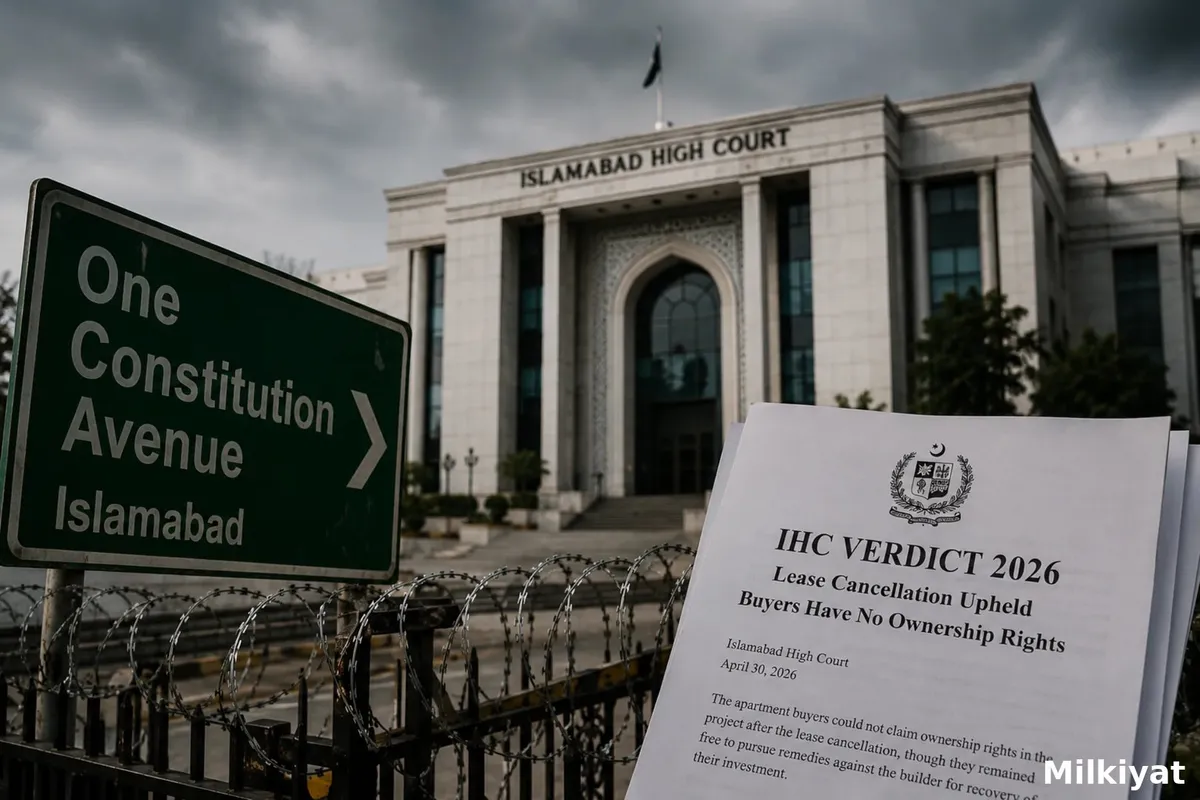
The Islamabad High Court's April 30, 2026 ruling on the One Constitution Avenue IHC verdict 2026 has eliminated ownership claims for hundreds of apartment buyers and sent a shockwave through Pakistan's luxury real estate sector. The court upheld the Capital Development Authority's cancellation of developer BNP (Pvt) Limited's lease, ruled that third-party purchasers hold no independent title, and directed affected buyers to pursue civil claims against the developer — not the state. Here is the full picture.
"The apartment buyers could not claim ownership rights in the project after the lease cancellation, though they remained free to pursue remedies against the builder for recovery of their investment."
— IHC Chief Justice Sardar Muhammad Sarfraz Dogar, Detailed Judgment, May 4, 2026 [1][2]
Three Things Every Investor Must Know Right Now
- The lease is cancelled and the land reverts to CDA. The IHC confirmed that CDA's March 2023 termination of the 13.5-acre One Constitution Avenue lease was entirely lawful. Under the 2018 IHC division-bench judgment — now restored — the land and superstructure vest with the CDA. [3][4]
- Buyers hold no title against the state. The court ruled that sub-lessees and purchasers "sink or sail" with the original lessee, BNP (Pvt) Limited. Third-party ownership claims against the CDA are legally extinguished; the only remedy is civil litigation against the developer. [1][2]
- The battle is still live. The Bank of Punjab, former Air Chief Mujahid Anwar Khan, former ICC Chairman Ehsan Mani, journalist Nasim Zehra, and dozens of flat owners have filed intra-court appeals before the IHC divisional bench. A PM-constituted committee is separately reviewing a government compensation plan. [3][4][5]
Background: A Twenty-Year Saga of Defaults, Conversions, and Courts
To understand the weight of the One Constitution Avenue IHC verdict 2026, you have to go back two full decades — not to May 2026, but to a government auction in March 2005.
How a Five-Star Hotel Became a Legal Quagmire
On March 9, 2005, the Capital Development Authority auctioned a prime 13.5-acre plot at Plot No. 1, Constitution Avenue, Sector G-5/1 — directly opposite the National Library in Islamabad's heavily regulated Red Zone. BNP (Pvt) Limited emerged as the highest bidder at Rs 75,000 per square yard, with a total bid value of Rs 4.88 billion. The original mandate was unambiguous: build a five-star hotel. [6]
An initial payment of Rs 800 million was made, with the remainder to follow in instalments. What happened next was a quiet but consequential pivot. BNP converted the planned hotel into luxury residential apartments and began selling units to private buyers — including some of Pakistan's most prominent public figures — generating approximately Rs 7.19 billion in apartment sales while remitting only Rs 1.22 billion back to the CDA. [6][7]
The CDA later confirmed in writing that "serviced apartments" were permissible only as an ancillary hotel function and were not legal for outright sale. The conversion was not a grey area; it was a contractual violation. [7]
The First Cancellation and the Supreme Court Revival
In July 2016, the CDA cancelled the BNP lease, citing multiple contractual violations including the unauthorised land-use conversion. The Islamabad High Court upheld that cancellation in 2017 and declared the apartment conversion illegal. [6][8]
Then, in January 2019, a three-member Supreme Court bench headed by then-Chief Justice Mian Saqib Nisar set aside the IHC's 2017 judgment and conditionally revived the lease. The terms were strict: BNP was ordered to pay Rs 17.5 billion in instalments over eight years. That Supreme Court order also separately identified the two residential towers and directed the CDA to devise a "viable, fair, transparent, secure and enforceable arrangement" for settling the claims of third-party buyers. [1][8]
That lifeline went largely unused. By the CDA's accounting, BNP paid only Rs 2.9 billion — roughly 16.6 percent of the Rs 17.5 billion liability — over the entire period. [3]
The 2023 Default and Final Cancellation
On February 7, 2023, the CDA issued a formal default notice. BNP had paid the 2021 instalment but failed to meet the 2022 obligation, and a Rs 500 million cheque submitted in partial remedy was dismissed by the court as wholly insufficient. On March 8, 2023, the CDA cancelled the lease for the second and final time. [1][9]
BNP challenged the cancellation in the IHC. The court reserved its judgment in February 2026 and delivered its ruling on April 30, 2026. [3]
"Despite the lapse of 21 years, BNP failed to fulfil its financial obligations. Under the auction terms, ownership rights were contingent upon 100 per cent payment of the land cost."
— CDA's arguments as recorded in the IHC judgment, April 30, 2026 [3][9]
What the Court Actually Ruled: The IHC Judgment Unpacked
The Core Finding on the CDA Lease Cancellation
IHC Chief Justice Sardar Muhammad Sarfraz Dogar delivered the written judgment on May 4, 2026, dismissing all petitions filed by BNP (Pvt) Limited and by investors and other stakeholders. The court held that the CDA's lease cancellation was lawful and fully aligned with the framework the Supreme Court itself had established in 2019. [1][2]
The court noted a "consistent pattern of non-compliance and failure to adhere to agreed timelines." It rejected BNP's argument that administrative delays by the CDA — including delays in handing over possession and approving bank guarantees — absolved the developer of its primary financial obligations. The bench found that the subsequent Supreme Court review order had effectively declared the 2019 revival order "overtaken by time and events," meaning the 2018 IHC division-bench judgment cancelling the lease now stood restored. [2][3]
The Ruling on Buyer Rights: "Sink or Sail" with BNP
The most consequential paragraph of the judgment — Paragraph 30, which is specifically being challenged in the intra-court appeals — states that sub-lessees and purchasers would "sink or sail" with the original lessee. [4][5]
In practical terms, this means the court treated all downstream ownership claims as wholly derivative of the master lease. Once that lease was lawfully terminated, every sub-lease and every sale agreement built upon it collapsed alongside it. Buyers cannot assert ownership against the CDA; they are left with a contractual claim against the party who sold them apartments they may never have had the legal right to sell — the developer, BNP. [1][2]
The court acknowledged this was a severe outcome for buyers who had acted in good faith and clarified that affected purchasers were not without remedy. They may pursue legal proceedings against the developer to recover their investments. [1][2]
Prominent Names, Significant Stakes
The human dimension of this ruling is impossible to separate from its political texture. Apartments in One Constitution Avenue are reportedly owned by PTI founder Imran Khan, senior advocate Chaudhry Aitzaz Ahsan, former caretaker Prime Minister Nasirul Mulk, and former minister Shandana Gulzar, among others. (verification pending — ownership not confirmed through official registry records.) The Bank of Punjab acquired approximately 25,420 square feet on sub-lease for a branch premises, having financed BNP through a loan of approximately Rs 3.5 billion secured against the property. [4][7][9]
Timeline: Two Decades to a Verdict
- March 9, 2005 — CDA auctions 13.5-acre Red Zone plot. BNP (Pvt) Limited wins at Rs 4.88 billion. Mandate: five-star hotel. [6][8]
- 2005–2015 — BNP pays Rs 800 million initial consideration; following the 2005 earthquake, a two-year construction grace period is granted via lease amendment. Hotel concept quietly pivots to residential apartments. [7][10]
- 2016 (July) — CDA cancels lease over contractual violations including unauthorised conversion and payment defaults. [6][8]
- 2017 — IHC upholds cancellation; declares apartment conversion illegal. [8]
- January 9, 2019 — Supreme Court bench under then-CJP Saqib Nisar sets aside 2017 IHC order; conditionally revives lease; orders BNP to pay Rs 17.5 billion over eight years; directs CDA to protect third-party buyer claims. [1][8]
- 2021–2022 — BNP pays the 2021 instalment; defaults on the 2022 instalment; writes to CDA in July 2022 stating it can no longer continue the project or service instalments due to economic conditions. [1][11]
- February 7, 2023 — CDA issues formal default notice. [1]
- March 8, 2023 — CDA cancels lease for the second and final time; takes possession of the site. [1][3]
- February 2026 — IHC reserves judgment after full hearing. [3]
- April 30, 2026 — IHC single-member bench (Chief Justice Sardar Muhammad Sarfraz Dogar) upholds lease cancellation; dismisses all BNP and buyer petitions. [1][2][3]
- May 1, 2026 — CDA conducts late-night operation at the site; eviction notices reportedly served; police deployment around the building. PM Shehbaz Sharif issues Cabinet Division notification staying coercive action. [5][10]
- May 1, 2026 — PM Shehbaz Sharif constitutes high-level committee headed by Law Minister Azam Nazeer Tarar to review all legal and administrative aspects; committee directed to report within one week. [4][5]
- May 4, 2026 — IHC issues detailed written judgment; government announces in principle decision to compensate buyers at original purchase price (verification pending — formal cabinet approval not confirmed as of publication). [1][2][4]
- May 12–16, 2026 — IHC divisional bench (Justice Muhammad Azam Khan and Justice Raja Inaam Amin Minhas) issues notices to CDA on intra-court appeals from Bank of Punjab, apartment owners including Ehsan Mani and Mujahid Anwar Khan, Nasim Zehra, and others. Registrar's Office raises maintainability objections on BOP appeal. [3][4][5]
"BNP paid only Rs 2.9 billion — approximately 16.6 percent of its Rs 17.5 billion liability — over more than two decades, despite operating 240 apartments that generated Rs 7.19 billion in sales revenue."
— Inference based on CDA figures cited before the IHC [3][7]
Legal Implications: What This Verdict Changes for Pakistan Real Estate
CDA's Enforcement Powers Are Significantly Strengthened
This ruling establishes a clear precedent: when a developer defaults on a CDA lease, the authority's right to cancel and reclaim the land is enforceable even when hundreds of downstream buyers have paid good money for units. The 2018 IHC division-bench judgment — now fully restored — vests both the land and the superstructure in the CDA upon termination. [2][3]
For Red Zone developments specifically, and for CDA-administered land more broadly, this significantly strengthens the regulator's hand in future enforcement actions. Developers in Islamabad are now on direct notice that financial default carries existential consequences, not merely civil penalties.
The "Sink or Sail" Doctrine and What Buyers Must Understand
Paragraph 30 of the judgment creates what property lawyers will likely describe as a "trickle-down termination" principle: when the master lease dies, every downstream agreement derived from it dies with it. This is not a new concept in Pakistani contract law, but its application at this scale — affecting approximately 240 apartments in a flagship Islamabad project — gives it unprecedented weight as precedent. [4][5]
The appellants in the intra-court appeals are directly attacking this paragraph, arguing that the Supreme Court's 2019 order had explicitly separated the two residential towers from the remaining land precisely to protect third-party buyers from the developer's failings. If the divisional bench or a higher court accepts this argument, the legal standing of buyers could shift materially. That outcome remains uncertain. [5][17]
Lender Exposure and the Bank of Punjab Appeal
The Bank of Punjab's intra-court appeal raises a separate and important dimension: institutional lender liability. The bank financed BNP through a Rs 3.5 billion loan secured against the property, acquired approximately 25,420 square feet on sub-lease for branch premises, and now faces the prospect of that sub-lease being rendered void. Its appeal challenges the single-bench verdict as "illegal and contrary to the facts." The Registrar's Office has raised maintainability objections, adding procedural uncertainty to an already complex dispute. [3][4][9]
The outcome of this appeal will matter to every financial institution that has extended credit against properties on leased CDA land — a category that extends well beyond One Constitution Avenue.
"The appellants say that a 2019 Supreme Court order had expressly separated the land beneath the two towers from the remainder of the plot to protect third-party buyers — a finding the single bench is now accused of ignoring."
— Inference based on appeal arguments reported before IHC divisional bench [5][17]
Investor Guidance: What Affected Buyers and Prospective Investors Should Do Now
If You Already Own or Hold an Agreement in One Constitution Avenue
Step 1: Preserve your documentation immediately. Gather every payment receipt, sale agreement, sub-lease deed, bank transfer record, and correspondence with the developer. These are the foundation of any civil claim against BNP (Pvt) Limited, and their absence will materially weaken your recovery prospects.
Step 2: Engage a specialist lawyer without delay. The legal landscape here is actively moving. The intra-court appeals may modify or reverse aspects of the single-bench judgment. A lawyer with expertise in both property law and civil recovery can assess your standing under both scenarios — the current ruling and a potential appellate revision.
Step 3: Monitor the divisional bench proceedings and the PM committee. The government has signalled in principle that it will compensate affected buyers at their original purchase price, but a formal cabinet decision had not been confirmed as of this writing. (verification pending.) Tracking the committee's recommendations and the IHC divisional bench's orders will determine whether your path to recovery runs through the courts or through an administrative compensation mechanism.
Step 4: Do not assume the political noise translates into legal protection. PM intervention has stayed immediate coercive action, but a political stay is not a court order. Your legal rights remain governed by the IHC judgment until a higher court or legislative action changes the position. Do not stop pursuing formal legal remedies on the assumption that the committee will resolve everything.
If You Are Considering Buying Property in Islamabad's Red Zone or on CDA Leasehold Land
This verdict should reset your due diligence checklist. Before committing to any purchase:
- Verify that the master lease is active, fully paid up, and not subject to any pending cancellation notice or litigation. Demand the original lease document and a current CDA non-encumbrance certificate.
- Confirm that the developer's land use matches the lease mandate. The conversion of One Constitution Avenue from hotel to residential was the original sin in this case. If what is being sold to you was built for a different purpose than what the lease permits, walk away.
- Check the sub-lease chain. Your title is only as strong as the chain of instruments above it. If the master lease is CDA-held, any weakness at that level propagates directly to your sub-lease.
- Scrutinise financial health of the developer. Demand audited accounts, confirm that all land-cost instalments to the CDA are current, and look for any default notices or pending litigation. This information is not always volunteered; you must ask for it.
The One Constitution Avenue case is a twenty-year case study in what happens when these checks are skipped.
Frequently Asked Questions (FAQ)
Q1: What exactly did the IHC rule about One Constitution Avenue buyer rights?
The IHC ruled that buyers of apartments in One Constitution Avenue do not have independent ownership rights that can be asserted against the CDA. Because their purchase agreements were derived from BNP's master lease — which has been lawfully cancelled — their rights are extinguished in relation to the state. They may still pursue civil claims against the developer, BNP (Pvt) Limited, for the return of their investment or for damages.
Q2: Can the IHC One Constitution Avenue verdict still be reversed?
Yes. Multiple parties, including the Bank of Punjab and prominent apartment owners, have filed intra-court appeals before the IHC's divisional bench. Separately, a Supreme Court challenge remains possible. The PM's high-level committee could also recommend a legislative or administrative solution that changes the practical outcome for buyers. The single-bench verdict is the current legal position, but it is actively under challenge.
Q3: Is the government compensating One Constitution Avenue buyers?
As of publication, the government has announced in principle that it intends to compensate buyers at their original purchase prices, and Prime Minister Shehbaz Sharif constituted a committee headed by Law Minister Azam Nazeer Tarar to formalise a plan. However, a formal cabinet decision and compensation mechanism had not been publicly confirmed. (verification pending.) Buyers should not delay legal action while waiting for this process to conclude.
Why This Verdict Matters Beyond One Building
The One Constitution Avenue saga is not just a story about one developer and one disputed lease. It is a stress test of the entire framework through which CDA land is allocated, developed, and sold to private buyers — and the results are instructive and uncomfortable in equal measure.
For twenty years, this case exposed a gap between what buyers were told and what the law actually guaranteed them. Apartment purchasers paid billions of rupees into a project where the land cost had never been fully settled, the land use had been changed without adequate legal authorisation, and the developer had been warned repeatedly by courts and regulators. The question of who bears that risk — buyers who trusted a CDA-approved project, or the state that supervised its development — is exactly what the intra-court appeals will now force the courts to answer more precisely.
This verdict does not settle that question. What it does settle, at least at the single-bench level, is that in the absence of a fully paid and compliant master lease, downstream buyers cannot look to the CDA for protection. That principle, if it holds on appeal, will permanently reshape how investors, lenders, and lawyers approach leasehold property transactions in Islamabad.
Suggested Image Captions and Alt Text Placeholders
References
-
Express Tribune — "IHC issues detailed verdict in One Constitution Avenue case, rules buyers lack ownership rights." Published May 4, 2026.
turn0search204— https://tribune.com.pk/story/2606327/ihc-issues-detailed-verdict-in-one-constitution-avenue-case-rules-buyers-lack-ownership-rights -
UrduPoint / Pakistan Today — "IHC rules on One Constitution Avenue buyers." Published May 4–5, 2026.
turn0search203— https://www.pakistantoday.com.pk/2026/05/04/ihc-upholds-one-constitution-avenue-lease-cancellation-says-buyers-have-no-ownership-rights -
Dawn — "Bank of Punjab, flat owners challenge IHC verdict on One Constitution Avenue lease cancellation." Published May 2026.
turn0search202— https://www.dawn.com/news/1999492 -
Pakistan Today / Profit Pakistan — "IHC Seeks CDA Reply in One Constitution Avenue Lease Row." Published May 12, 2026.
turn0search205— https://profit.pakistantoday.com.pk/2026/05/12/ihc-seeks-cda-reply-on-one-constitution-avenue-appeals-as-lease-dispute-widens-over-third-party-rights/ -
The Nation / 24NewsHD — "More petitions filed in IHC against lease cancellation of One Constitutional Avenue." Published May 15, 2026. — https://www.24newshd.tv/15-May-2026/petitions-filed-ihc-lease-cancellation-one-constitutional-avenue
-
The Current — "'Took me out at 1AM': Court upholds One Constitution Avenue lease cancellation over 20-year payment default." Published May 1, 2026. — https://thecurrent.pk/took-me-out-at-1am-court-upholds-one-constitution-avenue-lease-cancellation-over-20-year-payment-default/
-
Taseeriat (WordPress analysis) — "The factual breakdown of the One Constitution Avenue affair — who did what, when, and where the blame actually lies." Published May 3, 2026. — https://taseeriat.wordpress.com/2026/05/03/the-factual-breakdown-of-the-one-constitution-avenue-affair-who-did-what-when-and-where-the-blame-actually-lies/
-
Dawn — "IHC upholds Capital Development Authority's decision of canceling One Constitution Avenue lease." Published May 1, 2026.
turn0browsertab201— https://www.dawn.com/news/1996486 -
The Nation — "Private owner defends One Constitution Avenue lease despite cancellation by court." Published May 6, 2026. — https://www.nation.com.pk/06-May-2026/private-owner-defends-one-constitution-avenue-lease-despite-cancellation-court
-
Bloom Pakistan — "IHC Seeks CDA Reply on One Constitution Avenue Residents' Appeals." Published May 2026. — https://bloompakistan.com/ihc-seeks-cda-reply-on-one-constitution-avenue/
-
Dawn — "CDA seizes One Constitution Avenue over default." Published March 9, 2023. — https://www.dawn.com/news/1741129
-
Pakistan Today — "PM halts action on One Constitution Avenue, forms committee after IHC ruling." Published May 1, 2026. — https://www.pakistantoday.com.pk/2026/05/01/pm-halts-action-on-one-constitution-avenue-forms-committee-after-ihc-ruling
-
Pakistan Today — "Govt plans compensation for apartment owners." Published May 4, 2026. — https://www.pakistantoday.com.pk/2026/05/04/govt-plans-compensation-for-one-constitution-avenue-apartment-owners
-
One Constitution Avenue Islamabad: 2026 IHC Verdict & Guide. The Urdu Club. Published May 4, 2026. — https://www.theurduclub.com/2026/05/one-constitution-avenue-islamabad-2026-status-guide.html
-
Pakistan Today — "One Constitution Avenue ruling challenged in IHC." Published May 16, 2026. — https://www.pakistantoday.com.pk/2026/05/16/elite-appellants-move-against-one-constitution-avenue-ruling
This article was produced by the Milkiyat Investigative Desk. It is intended for informational purposes and does not constitute legal advice. Tax rates and legal standings referenced in this article are subject to change. Readers should consult a qualified property lawyer before taking any action based on information in this report.