News
The End of Pakistan’s Real Estate File System by NAB: A Complete Guide for Buyers & Developers (2026)

By wajahat Ali
Real Estate Analyst
Updated 4 min read
ShareWhatsApp
Milkiyat.com is operated by MILKIYAT.COM ONLINE PORTAL (PRIVATE) LIMITED.
Corporate Unique Identification No. (CUI): 0337118
Incorporated under the Companies Act, 2017, Pakistan.
News
By wajahat Ali
Real Estate Analyst
Updated 4 min read
News
By wajahat Ali
Real Estate Analyst
Updated 4 min read
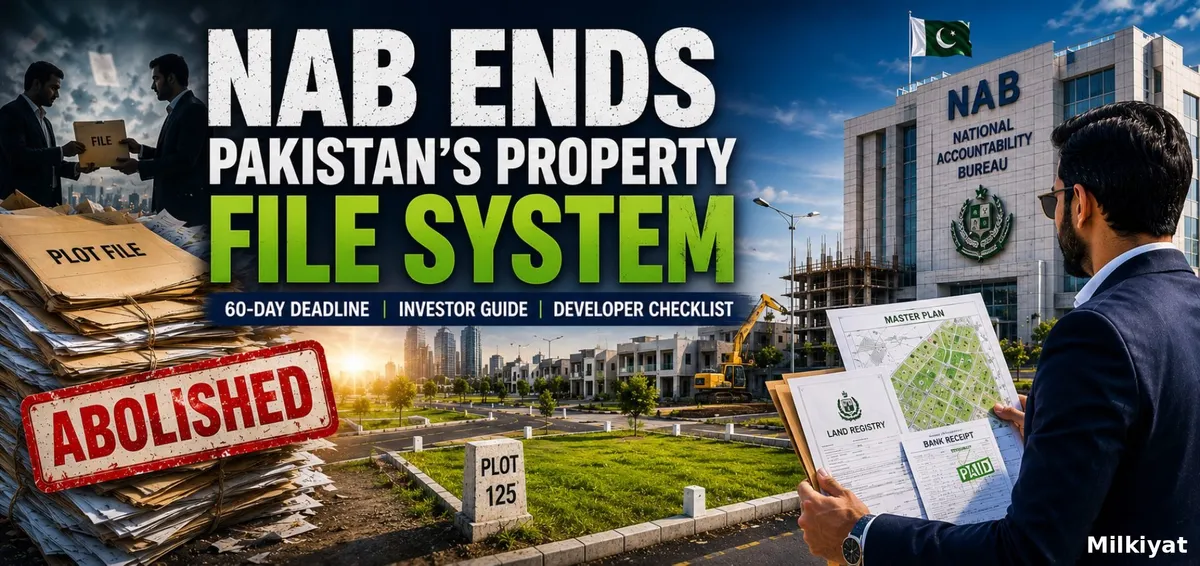
The National Accountability Bureau (NAB) has announced a historic shift in Pakistan’s property sector: the traditional "file system" will be completely abolished. Within a strict 60-day timeline, the practice of trading unverified paper allotments without physical land possession will end. For decades, the file system fueled speculative "file flipping," double-selling, and devastating fraud—particularly targeting overseas Pakistanis. With NAB shifting 100% of the legal and financial responsibility onto developers, the rules of the game have officially changed. Here is exactly how to navigate this new era safely, whether you are an investor looking to buy or a developer trying to stay out of legal trouble.
With paper files being phased out, your investment strategy must shift from buying promises to buying proven, physical assets. Use this step-by-step process before parting with your money.
1. Verify Development Authority Approval
Step 1: Check the Master Plan
Never buy into a society based on a marketing brochure. Visit the official portal of the relevant authority (e.g., CDA in Islamabad, LDA in Lahore, KDA in Karachi). Verify that the society's layout plan (LOP) is approved and that the specific block you are buying exists on the official map.
2. Demand the Plot Number & Physical Possession
Step 2: No More Vague 'Files'
Refuse to buy an unallocated "file." Demand a specific plot number tied to a physical piece of land. Ask the developer to show you the physical demarcation of the block and the plot on-site.
3. Audit the Developer's Land Ownership
Step 3: Check the Registry
Ensure the developer actually owns the land they are selling. Request to see the land registry (Registry or Inteqal) and a valid No Objection Certificate (NOC). Under the new NAB rules, developers cannot sell plots on land they have only "leased" or shook hands on without legal transfer.
4. Use Documented Banking Channels Only
step 4: Secure the Paper trail
Never pay for real estate in raw cash or through unverified open ledgers. Make all payments via cross-checks, pay orders, or direct bank transfers strictly addressed to the registered corporate account of the development company. Keep every single digital receipt.
NAB, the FIA, and provincial anti-corruption departments are actively enforcing these reforms, backed by a staggering Rs. 2.962 trillion in recent recoveries. To avoid severe legal scrutiny, asset freezes, or blacklisting, developers must immediately audit their operations against this checklist:
While this transition period will cause some short-term confusion and resistance from speculative day-traders, it is a massive win for the long-term health of Pakistan's economy. For more details guide about File System in Pakistan, visit the following guide on Milkiyat.com.
At Milkiyat.com, we believe Pakistan’s real estate future belongs to transparency, verified ownership, and informed investors. The era of paper promises is ending the era of accountable development has begun.
The National Accountability Bureau (NAB) has announced a historic shift in Pakistan’s property sector: the traditional "file system" will be completely abolished. Within a strict 60-day timeline, the practice of trading unverified paper allotments without physical land possession will end. For decades, the file system fueled speculative "file flipping," double-selling, and devastating fraud—particularly targeting overseas Pakistanis. With NAB shifting 100% of the legal and financial responsibility onto developers, the rules of the game have officially changed. Here is exactly how to navigate this new era safely, whether you are an investor looking to buy or a developer trying to stay out of legal trouble.
With paper files being phased out, your investment strategy must shift from buying promises to buying proven, physical assets. Use this step-by-step process before parting with your money.
1. Verify Development Authority Approval
Step 1: Check the Master Plan
Never buy into a society based on a marketing brochure. Visit the official portal of the relevant authority (e.g., CDA in Islamabad, LDA in Lahore, KDA in Karachi). Verify that the society's layout plan (LOP) is approved and that the specific block you are buying exists on the official map.
2. Demand the Plot Number & Physical Possession
Step 2: No More Vague 'Files'
Refuse to buy an unallocated "file." Demand a specific plot number tied to a physical piece of land. Ask the developer to show you the physical demarcation of the block and the plot on-site.
3. Audit the Developer's Land Ownership
Step 3: Check the Registry
Ensure the developer actually owns the land they are selling. Request to see the land registry (Registry or Inteqal) and a valid No Objection Certificate (NOC). Under the new NAB rules, developers cannot sell plots on land they have only "leased" or shook hands on without legal transfer.
4. Use Documented Banking Channels Only
step 4: Secure the Paper trail
Never pay for real estate in raw cash or through unverified open ledgers. Make all payments via cross-checks, pay orders, or direct bank transfers strictly addressed to the registered corporate account of the development company. Keep every single digital receipt.
NAB, the FIA, and provincial anti-corruption departments are actively enforcing these reforms, backed by a staggering Rs. 2.962 trillion in recent recoveries. To avoid severe legal scrutiny, asset freezes, or blacklisting, developers must immediately audit their operations against this checklist:
While this transition period will cause some short-term confusion and resistance from speculative day-traders, it is a massive win for the long-term health of Pakistan's economy. For more details guide about File System in Pakistan, visit the following guide on Milkiyat.com.
At Milkiyat.com, we believe Pakistan’s real estate future belongs to transparency, verified ownership, and informed investors. The era of paper promises is ending the era of accountable development has begun.
RDA inflows reached $14.906 billion in August, reflecting stronger overseas investment and growing confidence in Pakistan’s real estate and development sector.
Up to 50mm of rain hit Islamabad as CDA teams carried out dewatering and drainage operations at waterlogging points, highlighting the capital’s recurring monsoon drainage problems.
Pakistan’s LNG supply shock is increasing pressure on gas, electricity and construction costs, adding another major risk for developers, businesses and property owners.
Pakistan’s FX reserves have climbed to a record $21.4 billion after the $3 billion Eurobond inflow, strengthening the outlook for currency and import-cost stability.
RDA inflows reached $14.906 billion in August, reflecting stronger overseas investment and growing confidence in Pakistan’s real estate and development sector.
Up to 50mm of rain hit Islamabad as CDA teams carried out dewatering and drainage operations at waterlogging points, highlighting the capital’s recurring monsoon drainage problems.
Pakistan’s LNG supply shock is increasing pressure on gas, electricity and construction costs, adding another major risk for developers, businesses and property owners.
Pakistan’s FX reserves have climbed to a record $21.4 billion after the $3 billion Eurobond inflow, strengthening the outlook for currency and import-cost stability.