News
KP Government Signals Major Infrastructure Pivot with PKR 500 Million Hazara Tourism Push

Real Estate Analyst
8 min read
PESHAWAR — In a strategic move to reposition northern Khyber Pakhtunkhwa (KP) as a premier hub for sustainable investment and international travel, Chief Minister Muhammad Sohail Afridi has directed the immediate development of new tourist destinations in the remote valleys of Kolai-Palas and Allai. This initiative marks a significant shift towards unlocking the alpine economies of the Hazara Division.
To bolster this vision, the provincial administration has earmarked a targeted allocation of PKR 500 million under the Khushhal Hazara Package [1]. This substantial capital injection will strategically overlay the 139 active development schemes currently underway within the division under the Provincial Annual Development Programme (ADP) [2]. Beyond mere scenic promotion, the provincial strategy directly links high-altitude tourism to robust infrastructure development, modern land administration, and long-term security for institutional real estate investments.
1. Economic Impact and Capital Allocation
To fully grasp the scale of this intervention, it is essential to consider the broader public finance framework of the province. For the current fiscal period, the total provincial budget stands at an outlay of PKR 2.17 trillion, with PKR 524 billion allocated for the overall ADP [2].
Within the primary ADP, physical infrastructure commands the largest share of capital:
- Roads represent 14.30% (PKR 52.79 billion).
- Water, sanitation, and clean drinking water combine for 9.44%.
- The baseline provincial allocation for the tourism sector stands at 1.15% (PKR 1.124 billion).
The PKR 500 million Khushhal Hazara Package, therefore, represents a localized boost equivalent to nearly 44% of the province's standard annual tourism budget. Developing rugged, high-altitude terrain necessitates significant upfront civil engineering before commercial services can operate. Consequently, the provincial government is employing a 65% to 35% capital allocation model:
- Hard Infrastructure Focus (65% / PKR 325 million): Dedicated to the widening of mountain link roads, construction of steel suspension bridges, structural landslide mitigation, and seasonal monsoon defense systems.
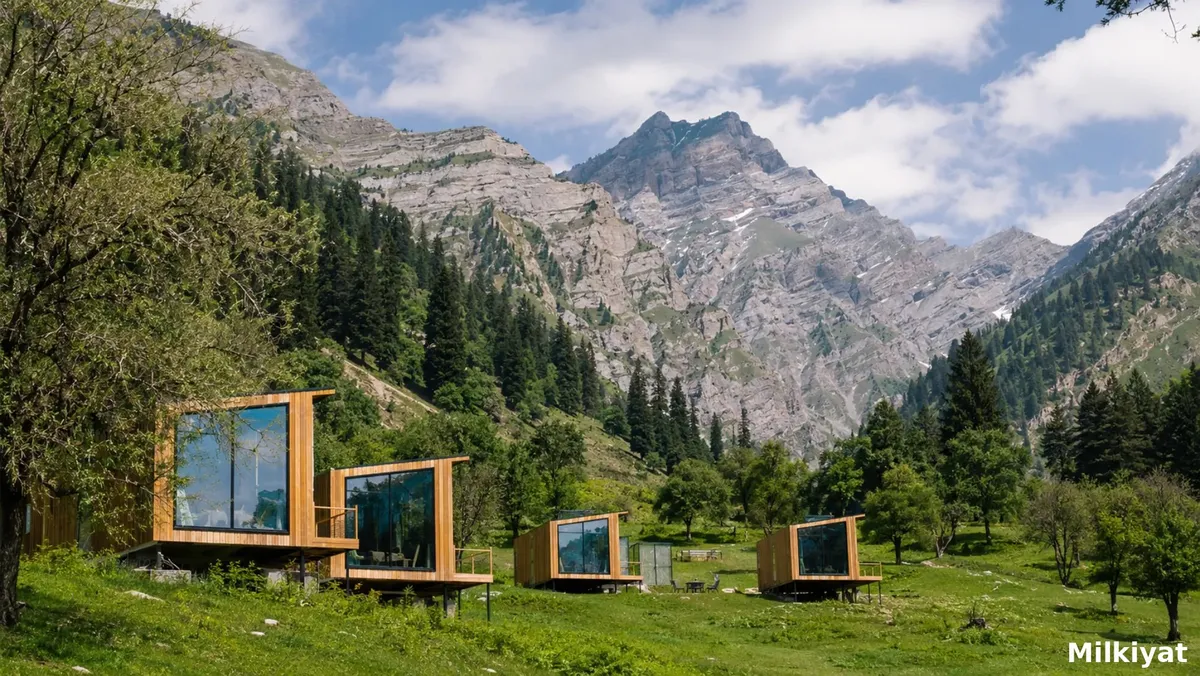
- Hospitality & Soft Services Focus (35% / PKR 175 million): Allocated for the installation of modern camping pods, localized traffic management systems, and hospitality training for local communities.
Sectoral Allocations and Overlay Projections
| Development Sector | Baseline ADP Share (%) | Hazara Division Active Interventions | Targeted Package Allocation |
|---|---|---|---|
| Provincial Roads | 14.30% | High-altitude access roads, link routes from the Karakoram Highway (N-35), and safety barriers. | PKR 325,000,000 |
| Provincial Tourism | 1.15% | Development of Kopra Meadows, eco-pods, and hospitality training infrastructure. | PKR 175,000,000 |
| Water & Sanitation | 9.44% | Clean drinking water supply schemes and regional sanitation in tourist corridors. | Integrated via parallel ADP utility grids |
2. Unlocking the Eco-Tourism Frontier: Kolai-Palas and Allai
The provincial directives specifically target two ecologically pristine regions, Kolai-Palas and Allai, each offering distinct opportunities for high-value tourism and sustainable hospitality setups [1].
Kolai-Palas (Palas Valley)
The Palas Valley spans approximately 1,400 square kilometers, with an elevation profile ranging from 640 meters at the Indus River bed to towering peaks of 5,151 meters. It boasts the largest remaining contiguous temperate forest in Pakistan, covering over 400 square kilometers. As a globally recognized biodiversity hotspot, it supports the world's largest known population of the endangered Western Tragopan pheasant, alongside Persian leopards and Himalayan black bears [3].
- Tourism Niche: Low-impact wilderness eco-tourism, controlled trekking, and wildlife conservation tourism.
- Logistical Challenges: Access currently relies on a challenging 40 km jeep track from Pattan on the Karakoram Highway, highly vulnerable to rockfalls and landslides due to fragile shale and claystone formations.
Allai Valley
Located in the Battagram District, Allai Valley presents a more open, accessible alpine landscape. Bounded by mountain ranges exceeding 15,000 feet, the valley features expansive alpine meadows—such as the Kopra Meadows—giant waterfalls, and pristine highland waters like Pari Lake.
- Tourism Niche: Adventure camping, recreational trekking, and potential astrotourism due to zero light pollution in highland zones.
- Logistical Challenges: Situated roughly two hours from Oghuz Banda and 80 km from Mansehra, the access roads require widening past Thakot to handle heavy peak-season traffic flows without causing bottlenecks.
3. Land Administration and Property Valuation Security
For forward-thinking developers tracking investment opportunities on Milkiyat.com, clear land titles are an ultimate prerequisite for deploying capital. The provincial government is proactively addressing historical land risks through two major initiatives.
Resolving the Chor Mali and Baleej Valley Boundary Dispute
Chief Minister Afridi has ordered the immediate formation of an administrative commission to establish a permanent boundary resolution between the Chor Mali Valley (Kolai-Palas) and the Baleej Valley (Battagram). Historically rooted in overlapping tribal claims to summer pastures and forest timber rights, this ambiguity has previously stalled commercial development. A formal, legally binding demarcation will eliminate jurisdictional risks, providing institutional hospitality groups the security needed to acquire land safely.
The Catalyst of 100% Land Record Digitization
The legacy paper-based Patwari system historically created a non-transparent ecosystem prone to title duplication, long verification delays, and real estate fraud. The Board of Revenue has dismantled this bottleneck by achieving 100% digitization of land records in both the Abbottabad and Battagram districts [4]. Significant progress is also recorded in neighboring districts:
- Abbottabad: 100% Completed
- Battagram: 100% Completed
- Haripur: 97% Completed
- Mansehra: 90% Completed
By transitioning physical records into a centralized Geographic Information System (GIS) database, the state enables buyers to verify property titles instantly. This transparency drastically lowers transaction costs, shortens title transfer timelines to a single day, and empowers developers to safely secure bank financing using verified digital land deeds.
Mitigating the Burden of Land Litigation
According to data from the Pakistan Institute of Development Economics (PIDE), land-related disputes account for 60% to 70% of all civil litigation in Pakistan's courts [5]. These legal battles carry a severe microeconomic cost, frequently consuming up to 79% of an average household's annual income and locking up roughly one-sixth of rural economic productivity in legal gridlock.
By establishing secure, computerized land registries, the provincial government is actively mitigating these investment risks, creating a safe, highly liquid market for buyers exploring the Hazara Division real estate market.
4. Governance Accountability and Security Infrastructure
A stable security environment and transparent governance are vital to sustaining long-term tourism growth. The provincial administration is leveraging digital tracking tools alongside expanded public safety infrastructure to build investor confidence.
Redressal Performance via the Pakistan Citizen Portal
The primary tool for monitoring administrative accountability is the Pakistan Citizen Portal (PCP). In the Hazara Division, the portal has registered an 89% resolution rate, successfully settling 1,879 out of 2,111 public complaints [6]. To ensure these metrics translate into real, physical progress rather than simple digital closures, the district administrations have launched an "Open Door Policy." Over 100 Khuli Kacheries (open public forums) have been conducted across the division, bypassing bureaucratic gatekeepers and allowing local communities to voice infrastructure and utility complaints directly to senior officials.
Strategic Security and Policing Reforms
To safeguard the expanding tourist corridors, the provincial law and order budget was expanded to PKR 164.52 billion, funding advanced surveillance tools and regional safety operations [7]. In the Hazara Division, this strategy is anchored by 20 fully operational Police Facilitation Centers, with six additional hubs currently under construction to streamline public assistance and protect transit routes.
5. Frequently Asked Questions (FAQ)
What is the primary focus of the Khushhal Hazara Package?
The package is a targeted regional development fund. Specifically, PKR 500 million has been explicitly ring-fenced to fast-track high-quality tourism infrastructure, optimize road access, and establish premium hospitality services in the Hazara Division.
Where exactly are the new tourist destinations being developed?
The provincial government has directed authorities to focus immediate development, infrastructure upgrades, and environmental profiling on the high-potential valleys of Kolai-Palas and Allai.
Why is the tourism package split 65% to 35%?
High-altitude alpine terrain requires extensive civil engineering to ensure safety and access. The government is spending 65% (PKR 325 million) on hard infrastructure like road widening, bridge reinforcement, and landslide safety measures. The remaining 35% (PKR 175 million) funds soft services like modern camping pods, visitor digital mapping, and hospitality management.
How does the boundary dispute resolution impact real estate buyers?
The undefined border between Chor Mali Valley and Baleej Valley previously created legal risks for land buyers. The new boundary commission will permanently settle these lines in the official revenue records, removing legal gray areas and securing private property investments. Investors can read more about avoiding ownership friction in our property verification guides.
What is the status of land record safety in Hazara?
Land records are now completely digitized (100%) in Abbottabad and Battagram, 97% complete in Haripur, and 90% complete in Mansehra. This digital shift prevents title tampering and double-allocation fraud, offering a transparent ecosystem for property transactions.
How effective is the Pakistan Citizen Portal in resolving local issues?
The portal maintains a high 89% resolution rate in the region, clearing 1,879 complaints. To ensure these are physical, on-the-ground resolutions rather than just closed database files, the government runs parallel Khuli Kacheries (open public forums) for direct public verification.
References
- Hazara Region Tourism Integration Plan & Capital Allocations — Khyber Pakhtunkhwa Tourism Department https://kptourism.com/ (accessed 2026)↑↑
- Khyber Pakhtunkhwa Annual Budget Estimate and ADP Overview FY 2026-27 — Finance Department, Government of Khyber Pakhtunkhwa https://www.finance.gkp.pk/ (accessed 2026)↑↑
- Pakistan: Khyber Pakhtunkhwa Integrated Tourism Development Project (KITE) Environmental Profile — The World Bank Group https://projects.worldbank.org/ (accessed 2025)↑
- Cadastral Modernization and Digitization Report: Abbottabad & Battagram Districts — Board of Revenue, Government of Khyber Pakhtunkhwa https://www.tehsildar.kp.gov.pk/ (accessed 2026)↑
- The Economic Burden of Land Litigation in Pakistan's Civil Courts — Pakistan Institute of Development Economics (PIDE) https://pide.org.pk/ (accessed 2025)↑
- Hazara Division Grievance Redressal Annual Performance Report — Prime Minister's Performance Delivery Unit (PMDU), Pakistan Citizen Portal https://web.pmo.gov.pk/ (accessed 2026)↑
- KP Police Security Infrastructure & Public Service Delivery Report — Khyber Pakhtunkhwa Police Department https://kppolice.gov.pk/ (accessed 2026)↑