News
Decentralized Solar Infrastructure: Transforming Rural Sindh from Dead Capital to Digital Connectivity

Real Estate Analyst
14 min read
The vast, arid expanse of Sindh presents one of the most striking infrastructural paradoxes in modern South Asia. Beneath the rolling sand dunes of Tharparkar lies one of the world's largest lignite coal reserves[1]—a monumental energy source that daily feeds baseload electricity into Pakistan’s national grid. Yet, for decades, the indigenous communities living directly above these multi-billion-dollar energy fields have spent their nights in absolute darkness, bypassed by the very transmission lines that carry power to the urban centers of Karachi and Lahore.
Today, that paradox is being systematically dismantled. Not through massive, high-voltage pylons, but through decentralized, off-grid solar technology.
In a quiet but deeply significant milestone for rural electrification, the Government of Sindh recently distributed Solar Home System (SHS) kits to 140 highly vulnerable, off-grid households. Ceremonies held in Taluka Mithi and Mirpur Mathelo marked the delivery of these micro-grids to 118 eligible households in the Tharparkar district and 22 in the Ghotki district.[2]
This deployment, executed under the provincial government’s "Roshan Ghar – Roshan Sindh" initiative, is not merely a charitable handout. It is the operational edge of a massive, mathematically rigorous infrastructure campaign backed by the World Bank. Known as the Sindh Solar Energy Project (SSEP), this initiative aims to bypass the faltering national grid entirely, delivering clean, sustainable energy directly to 275,000 low-income households across all 30 districts of Sindh.[3]
For real estate analysts, urban planners, and economic observers, this initiative represents far more than an environmental victory. The introduction of reliable electricity to "dead capital"—isolated rural land with no utility access—fundamentally alters the demographic gravity of the province. It anchors rural populations, curbs desperate urban migration, and initiates a profound upward revaluation of rural property assets.
This comprehensive investigation explores the architecture of the SSEP, the economic genius of its redesigned subsidy model, the logistical friction of its deployment, and its far-reaching implications for Pakistan's evolving real estate and energy markets.
The Architecture of the Sindh Solar Energy Project
To fully grasp the significance of 140 solar kits arriving in Mithi and Mirpur Mathelo, one must trace the funding and strategic framework back to its origins.
Pakistan has spent over a decade crippled by a circular debt crisis, largely driven by an over-reliance on imported thermal fuels (LNG, furnace oil, and imported coal). The cost of generating power, transmitting it across aging infrastructure, and suffering immense line losses has made grid expansion into deep rural areas economically unviable for the state. Recognizing this, the World Bank’s Board of Executive Directors approved the Sindh Solar Energy Project in June 2018, which officially became effective in January 2019.[4]
The SSEP is a highly structured $105 million financial vehicle. The International Development Association (IDA) extended a $100 million credit facility, while the Government of Sindh provided $5 million in counterpart funding.[4] The project was engineered to attack energy poverty across three distinct market segments: utility-scale generation, distributed urban solar, and off-grid rural deployment.
| SSEP Component | Strategic Objective | Financial Allocation | Target Metric |
|---|---|---|---|
| 1: Utility-Scale Solar | Development of large-scale, publicly owned solar parks and competitive private sector auctions. | $40.00 Million | 400 MW |
| 2: Distributed Solar | Installation of PV systems on public sector buildings, hospitals, and schools via net-metering. | $25.00 Million | 20 MW |
| 3: Solar Home Systems (SHS) | Deployment of heavily subsidized, off-grid kits to vulnerable, low-income rural households. | $30.00 Million | 275,000 households |
| 4: Capacity Building | Technical assistance, training for technicians, and funding for the Project Management Unit. | $10.00 Million | Institutional scaling |
Data reflects the structural blueprint of the SSEP.[4]
The recent distributions in Tharparkar and Ghotki fall under the mandate of Component 3. While the original target was to reach 200,000 households, the escalating cost of grid electricity and deepening rural energy poverty prompted policymakers to push the operational target to 275,000 households. This expansion transforms the SSEP from a pilot program into one of the most expansive off-grid electrification efforts in the developing world.
The Economic Pivot: From Aid Dependency to Ownership
The journey of Component 3 from the drawing board to the desert sands has been anything but smooth. The evolution of its economic model serves as a masterclass in the realities of deploying subsidized infrastructure in deeply impoverished regions.
When the SSEP first attempted to roll out Solar Home Systems in 2022, the project utilized a heavily bureaucratic installment model. The government proposed a 40% initial subsidy, expecting the desperately poor households to pay off the remaining 60% of the kit’s value over staggered installments. This model crashed against the realities of rural banking. Unbanked populations with volatile, seasonal agricultural incomes could not maintain regular micro-payments. As a result, the rollout stalled immediately.
Then, the super-floods of 2022 hit. The deluge inundated one-third of Pakistan, disproportionately devastating Sindh, destroying millions of homes, and wiping out rural livelihoods. In the desperate aftermath, the provincial government made an emergency pivot: they decided to distribute the solar kits entirely for free to aid the recovery.
While well-intentioned, this "free distribution" triggered a classic economic distortion. In a highly distressed economy, households provided with high-value, liquid assets without any personal financial stake will inevitably monetize them. Almost immediately, "free" government-issued solar kits began appearing on the secondary commercial market, sold by impoverished recipients who needed immediate cash for food and shelter more than they needed electricity.
Recognizing that pure asset transfers fail without a psychological and financial anchor, the Sindh Energy Department enacted a brilliant structural redesign under the Solar Policy 2024. The project abandoned both the complex installment plan and the flawed free-distribution model in favor of a heavily subsidized co-payment structure:
- The 80% Subsidy: The provincial government absorbs roughly 80% of the total system cost, which, factoring in international procurement, transport, and federal duties, is estimated at approximately Rs 55,000 per kit.
- The Rs 6,000 Co-Payment: To take possession of the kit, eligible beneficiaries are required to deposit a nominal, one-time sum of Rs 6,000 directly into a designated bank account.
This Rs 6,000 copayment is the linchpin of the redesigned project. It ensures the beneficiary has tangible "skin in the game." By forcing the recipient to invest a meaningful—but attainable—amount of their own capital, the household transitions from a passive recipient of state aid to an active owner of infrastructure. This ownership premium drastically reduces the likelihood of the system being liquidated on the black market and organically incentivizes the family to clean, maintain, and protect the hardware.
The Federal Friction: Taxes on the Poor
Despite this elegant redesign, the project faces ongoing fiscal friction from the federal government. The true "head price" of the imported kits is severely inflated by federal import duties and sales taxes, which account for roughly Rs 17,000 of the total cost. The provincial government actively lobbied the Federal Board of Revenue (FBR) to waive these duties, arguing that taxing off-grid solar equipment destined for the absolute poorest demographics contradicted the national goal of energy resilience. The FBR, constrained by aggressive revenue targets and domestic tax collection mandates, refused to grant the waiver. Consequently, the Sindh government has had to absorb these federal taxes into its subsidy budget, straining the overall financial efficiency of the SSEP.
Engineering for the Desert: The Hardware Revolution
Deploying sensitive electronic equipment into the remote stretches of Tharparkar—an environment defined by extreme thermal volatility, pervasive fine dust, and aggressive wind erosion—requires industrial-grade resilience. The Project Management Unit (PMU) of the SSEP wisely avoided cheap, disposable off-the-shelf components, instead mandating that all systems meet rigorous global VeraSol certifications.
The kits handed over in Mithi and Mirpur Mathelo are not mere toys; they are sophisticated, integrated micro-grids designed to survive the harsh reality of rural Sindh.
| Component | Technical Specification | Operational Benefit in Rural Sindh |
|---|---|---|
| Solar Panel | 80W - 100W (Max 35V DC) | High efficiency, perfectly safe low-voltage DC operation preventing household electrical fires. |
| Battery | 18AH Lithium-Iron Phosphate (LiFePO4) | Heat resistant, deep-cycle capable, long lifespan (3-5 years) compared to fragile lead-acid. |
| Controller | Smart Power Management Unit | Prevents overcharging/deep-discharging, ensuring the battery is not accidentally destroyed by the user. |
| Lighting | 3x LED Bulbs (min 1680 lumen-hours) | Eliminates toxic kerosene lamps, extending productive evening hours for education and cottage industries. |
| Cooling & Comms | 18-inch DC Pedestal Fan + USB Ports | Mitigates severe heatstroke risks during summer; integrates households into the digital mobile economy. |
Technical standards mandated by the SSEP PMU and VeraSol certification guidelines.
Navigating the Last Mile: Data-Driven Distribution
Infrastructure projects of this magnitude rarely fail in the procurement phase; they fail in the "last mile" of delivery. Distributing hundreds of thousands of delicate technological assets across a province nearly the size of England requires a clinical, data-driven approach.
To ensure the kits reach the absolute poorest, the SSEP bypassed local political referrals and anchored its targeting algorithm entirely to the federal Benazir Income Support Programme (BISP) database. The eligibility matrix specifically isolates households with a Proxy Means Test (PMT) score falling between 21 and 50. This specific statistical band identifies families that are deeply marginalized and living below the poverty line, yet possess just enough baseline economic activity to manage the Rs 6,000 co-payment and care for the system.
In Tharparkar and Ghotki, the Sindh Rural Support Organization (SRSO) operated as the primary executing agency.[2] Their contractual mandate extended far beyond simply handing over a cardboard box. Before any household received a kit, SRSO mobilizers were required to conduct vital awareness training on optimal panel angling, battery sequencing, and safe maintenance.[2]
Tharparkar and Ghotki: The Frontlines of Energy Poverty
The selection of Tharparkar and Ghotki for the recent distribution ceremonies provides a stark look at the two very different faces of energy poverty in Pakistan.
Tharparkar is defined by its brutal geography. It is a vast, rolling tropical desert where rainfall is so infrequent that severe drought is a generational expectation. The indigenous Thari people largely exist as nomadic or semi-nomadic pastoralists. Attempting to string high-voltage transmission lines and install transformers to connect scattered, temporary hamlets of five to ten mud houses is economically impossible for state utility companies.
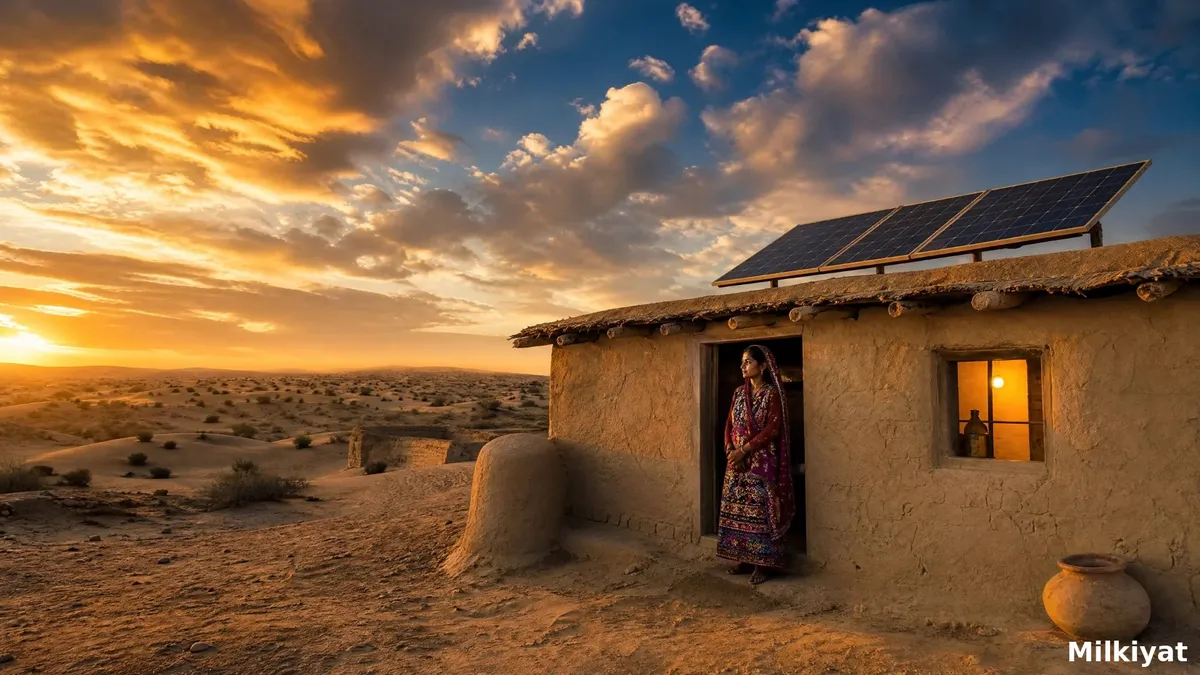
For the 118 households in Mithi, the off-grid solar kit is nothing short of a generational leap. Before this intervention, these families relied on highly toxic kerosene lamps or the burning of scrub biomass for rudimentary lighting. By replacing open flames with clean LED lighting, the SSEP instantly eliminates a major cause of indoor air pollution, respiratory disease, and devastating household fires. Furthermore, the inclusion of a mobile charging port integrates these isolated communities into the digital age. A charged smartphone allows a Thari pastoralist to access digital banking, check agricultural market prices for livestock, and maintain emergency communications during extreme weather events.
Ghotki, located in northern Sindh, is an entirely different landscape. It is heavily integrated into the agricultural grid, a hub of sugarcane and fertilizer production. Here, the grid physically exists, but it is crippled by systemic failure. Due to massive generation shortfalls and chronic circular debt, the national grid subjects rural areas like Ghotki to brutal load shedding, often cutting power for 14 to 18 hours a day during the peak of summer.
For the 22 households in Mirpur Mathelo, the SHS kit is not about establishing a first-time connection; it is about building resilience. When the grid collapses on a 45°C afternoon, the off-grid lithium battery seamlessly kicks in, keeping the DC pedestal fan spinning and the lights on, providing a crucial safety net against heatstroke and absolute darkness.
Real Estate Ramifications: How Solar Transforms "Dead Capital"
While the SSEP is engineered as a humanitarian energy intervention, its secondary effects are sending massive ripples through the macroeconomic and real estate ecosystems of Pakistan. For platforms like Milkiyat.com and the broader community of property investors and analysts, the electrification of rural Sindh represents a fascinating case study in asset upgradation.
In classical real estate economics, land that lacks access to baseline utilities—specifically water and electricity—is classified as "dead capital." It cannot be optimally farmed, it cannot support commercial micro-enterprise, and its valuation remains permanently stagnant. By independently powering 275,000 households across 30 districts, the provincial government is injecting baseline utility into vast swathes of previously undervalued rural land.
This infrastructure push intersects perfectly with a profound structural shift currently underway in Pakistan’s broader investment landscape. Following the aggressive tax reforms in the Finance Bill 2026, which heavily penalized speculative "paper-file" plots and tightened regulations on non-filers, domestic capital is rotating. Investors who previously parked billions in stagnant gold bullion or empty urban plots are increasingly seeking yielding, physical assets. For a deep dive into how recent tax relief is reshaping capital flows, see Milkiyat's analysis on How the Abolition of Section 7E and Flat Advance Tax Rates Are Reviving Pakistan's Real Estate Market.
While institutional capital floods into high-density vertical real estate in Islamabad and Lahore, the rural dynamic is also shifting. An electrified rural property—even one powered by an independent 100W micro-grid—is no longer "dead." It becomes a viable base of operations.
The importance of establishing clear legal title to these newly valuable assets cannot be overstated; buyers should consult our 2026 Guide to Verifying Property Ownership in Pakistan to ensure their investments are secure.
Anchoring the Demographic Shift
Perhaps the most crucial macroeconomic impact of the SSEP is its ability to halt desperate rural-to-urban migration. The absence of reliable electricity is a primary catalyst forcing families off their ancestral lands. When a family cannot keep their children cool in the summer, cannot read at night, and cannot power a basic mobile phone to conduct business, they inevitably migrate to the overcrowded, informal settlements (katchi abadis) of Karachi or Hyderabad. This exodus places catastrophic strain on urban municipal infrastructure and deeply distorts urban real estate markets. For a broader perspective on how global housing markets are navigating these structural shifts, refer to our report on the Real Estate Market 2026: Stabilizing Housing & Rising Inventory.
By stabilizing the energy supply at the village level, the SSEP acts as a demographic anchor. It makes rural living sustainable. Furthermore, evening lighting fundamentally alters the rural economy, particularly for women. Gender dynamics shift rapidly when female household members can utilize the evening hours for income-generating cottage industries (such as traditional Sindhi embroidery and tailoring) rather than spending daylight hours foraging for firewood. This increases the aggregate household income, generating localized capital that is inevitably reinvested into physical home improvements, cementing the value of the rural real estate.
Forging a Sustainable Future
The recent distribution of solar kits to 140 households in Tharparkar and Ghotki is a localized victory that heralds a much broader structural transformation in Pakistan. The Sindh Solar Energy Project, despite navigating a historical gauntlet of a global pandemic, catastrophic super-floods, and crippling federal import restrictions, is successfully executing one of the most vital off-grid electrification campaigns on the continent.
The strategic brilliance of the project lies in its adaptive redesign. By discarding unmanageable micro-installments and chaotic free distributions in favor of a disciplined, Rs 6,000 co-payment model, the government has forged a system based on true ownership. By leveraging the data-driven BISP registry and partnering with veteran NGOs like the SRSO, they have created a transparent pipeline to deliver cutting-edge lithium-ion energy solutions directly to the marginalized.
Beyond the immediate, life-altering provision of light and cooling, the true success of this initiative is measured in its socio-economic shockwaves. By electrifying the remote desert hamlets and the agricultural peripheries, the SSEP is effectively upgrading rural real estate from dead capital to viable assets. It is stabilizing vulnerable demographics, preventing distressed urban migration, empowering women to engage in evening micro-economies, and shielding the national economy from the volatile costs of imported fuels.
As the provincial government races toward its operational deadlines, aiming for an aggressive target of deploying 400 kits per district every single week, the "Roshan Ghar – Roshan Sindh" initiative stands as a powerful testament to the future. It proves that the solution to a broken, centralized energy grid is not necessarily a bigger grid, but rather the empowerment of the individual household, one solar panel at a time.
References
- Old King Coal Fiddles, Thar's Land Goes Under — Asian Dispatch https://asiandispatch.net/old-king-coal-fiddles-thars-land-goes-under/ (accessed n.d.)↑
- 118 households in Tharparkar, 22 in Ghotki receive solar home system Kits — Associated Press of Pakistan https://www.app.com.pk/sindh/118-households-in-tharparkar-22-in-ghotki-receive-solar-home-system-kits/ (accessed n.d.)↑↑↑
- Govt launches Phase-II of 275,000-home solar project across Sindh — Dawn News https://www.dawn.com/news/1992058 (accessed n.d.)↑
- Sindh Solar Energy Project (SSEP) Implementation Status & Results Report — World Bank https://documents1.worldbank.org/curated/en/099050523063038299/pdf/P15971201ee4780650b1b20ba9c7da4e280.pdf (accessed 2023)↑↑↑