Guide
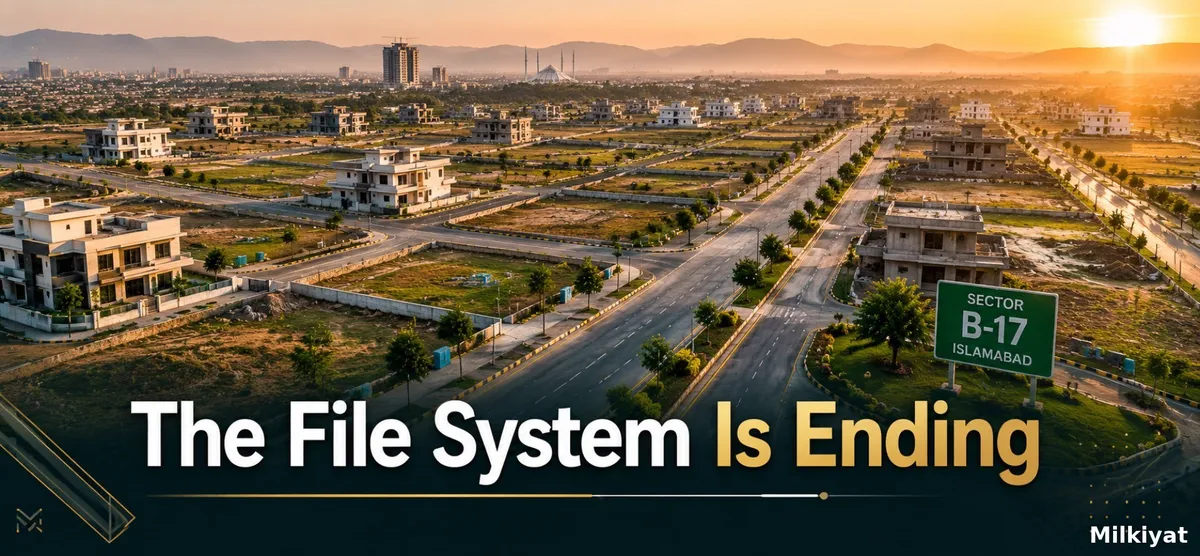
Pakistan's File System Is Ending: What It Means for Islamabad & Rawalpindi Buyers (2026)

By wajahat Ali
Real Estate Analyst
7 min read
For decades, the "plot file" was the real currency of Pakistani real estate. You didn't buy land, you bought a piece of paper promising a future plot, traded it for a quick markup, and often never saw the ground it referred to. That era is now being dismantled, piece by piece, through 2026.
This isn't a single dramatic ban. It's a rolling set of federal, provincial, and authority-level changes that together are squeezing the file-trading model out of the market. If you hold files, are mid-purchase, or are considering a housing society in Islamabad or Rawalpindi, here's what has actually changed and what's still just proposed as of June 2026.
Why the File System Became a Problem
The model existed because developers rarely owned or had developed all their advertised land upfront. They sold files — documents acknowledging a future plot of a given size and once a "ballot" assigned real plot numbers, file-holders could cash out or build.
It worked well for low-cost speculation, but it was also easy to abuse:
- Over-selling: developers issuing more files than their actual land bank could support
- Fictitious phases: files sold for sectors or blocks that were never legally acquired
- Duplicate bookings: the same file serial number issued to more than one buyer
These patterns are exactly what 2026's reforms target, and what Milkiyat.com's investigations into schemes like the unauthorized "Park View City Rawalpindi" listings have flagged before regulators caught up.
The 2026 NAB Reform Package
NAB Chairman Lt Gen (retd) Nazir Ahmed Butt first signaled the shift in late April 2026, saying reform proposals targeting the file culture would go before the federal cabinet within roughly two months, with full responsibility shifted onto developers once implemented. He followed up on June 9, addressing the Lahore Chamber of Commerce and Industry with a more detailed package:
- Future projects to operate under a regulated system for plot ownership and transfers
- Payments steered toward formal banking channels, with cash transactions discouraged
- Housing schemes barred from selling more plots than exist in their approved land banks, with verified, transparent inventories required
- A one-window mechanism in development to cut regulatory delays for legitimate developers
NAB has also referred a number of fraud cases to the FIA and anti-corruption departments, and separately distributed PKR 462 million to people affected by failed housing schemes. Worth noting: this is still a reform in progress, headed toward cabinet approval — not a single law that has already taken effect nationwide. Treat anyone claiming "the file system is now 100% illegal" with caution until the framework is formally notified.
What's Already Changing on the Ground in Islamabad & Rawalpindi
National announcements are one thing, what matters more for twin-cities buyers is what CDA and RDA have actually rolled out.
CDA's Digital Property Processing System
In January 2026, CDA launched formal digital processing of property matters, starting with Sector D-12. Officials described it as the authority's first real transition away from manual filing toward a structured digital workflow, with further sectors expected to follow. If you're buying in a CDA sector, it's worth checking whether digital processing has reached your sector yet, since it directly affects how quickly transfers and approvals move.
RDA's Green Property Certificate
For Rawalpindi specifically, the bigger shift has already happened. As of mid-2026, the RDA Green Property Certificate, issued through the Punjab Land Records Authority, is the only legally recognized proof of ownership in RDA-regulated housing schemes — private developer allotment letters and file records are no longer accepted on their own. We've broken down exactly how to verify this step by step in our Twin Cities verification guide.
Active Enforcement, Not Just Paperwork
CDA has also been sealing unapproved projects in Zones III and IV for violating sections of the CDA Ordinance 1960 — proof that the "no more selling beyond your land bank" rule from NAB's package is already being enforced locally, not just promised. Milkiyat.com tracks flagged and sealed schemes as they're reported, which is worth checking before you commit to a token payment.
Tax Relief in Budget 2026-27
Alongside the file-system crackdown, the federal budget made property transactions meaningfully cheaper for documented buyers and sellers:
- Section 7E abolished entirely — the 1% annual "deemed income" tax on idle property is gone
- Section 236C (seller's advance tax) cut from a 4.5%–5.5% range to a flat 2.75% for active filers
- Section 236K (buyer's advance tax) cut from a 1.5%–2.5% range to a flat 1.5% for active filers
Non-filers don't get the same relief and continue to face materially higher rates — another reason becoming an active tax filer now pays off directly at the registry desk. [TODO: link to a Milkiyat tax/filer-status explainer if one exists] For a full breakdown of how filer status affects your total transfer cost, see Milkiyat's property tax guide.
Action Plan: Protecting Your Investment in 2026
1. Audit what you actually hold. Separate files in projects that have completed balloting and have assigned plot numbers from files still floating on paper with no physical allocation.
2. Confirm the authority and the NOC. Check whether your scheme falls under CDA, RDA, or PHATA, and verify its NOC status directly with that authority on Milkiyat.com's NOC verification walkthrough covers the exact steps for each.
3. Get the right certificate. In RDA-regulated schemes, that means a Green Property Certificate via PLRA, not just a developer's allotment letter.
4. Push for mutation once you're allotted. Don't sit on a paid-up file — clear dues, secure the allotment letter, and start the Intiqal process so your name is on the actual land record.
5. Reallocate out of unverified files. If a project shows no land bank coverage, no NOC, and no digital processing footprint, treat that as a warning sign rather than a buying opportunity, even at the cost of a smaller loss now. Browse CDA- and RDA-verified listings on Milkiyat.com to compare against anything you're currently holding.
The Bottom Line
The file system isn't dying in one stroke — it's being squeezed out sector by sector, certificate by certificate. CDA's digital rollout, RDA's Green Certificate requirement, and NAB's developer-liability push are all pointing the same direction: toward verified, bank-traceable, on-ground ownership. For genuine buyers and overseas Pakistanis, that's a healthier market. For anyone still holding speculative paper in an unapproved scheme, 2026 is the year to get out or get verified.
For ongoing coverage of how these reforms affect specific Islamabad and Rawalpindi housing societies, keep checking Milkiyat.com.
Frequently Asked Questions
Has Pakistan officially banned the property file system? Not as a single nationwide law yet. NAB's chairman said in April 2026 that reform proposals would go before the federal cabinet within two months, and a fuller package was outlined in June 2026. It's being phased in through regulatory and provincial action rather than one instant ban.
What happens to plot files I already own? Existing files aren't automatically cancelled, but their value now depends on whether the underlying project has a valid NOC, a land bank that actually covers the file, and a clear path to balloting.
Is the RDA Green Property Certificate mandatory in Rawalpindi? Yes. As of mid-2026, it's the only legally recognized proof of ownership in RDA-regulated housing schemes — developer allotment letters alone are no longer sufficient.
Has CDA gone fully digital in Islamabad? Partially. The Digital Property Processing System launched in Sector D-12 in January 2026, with further sectors expected to follow over time.
What is Section 7E and is it still in effect? It was a 1% annual tax on the deemed income of idle immovable property. It was fully abolished in Budget 2026-27.
What are the new 236C and 236K property tax rates? 236C (seller's tax) is now a flat 2.75% for active filers, down from a 4.5%-5.5% range. 236K (buyer's tax) is now a flat 1.5% for active filers, down from a 1.5%-2.5% range. Non-filers still pay more.