Guide
What is CDA? The Ultimate Investor’s Guide to Islamabad’s Capital Development Authority
Guide
Explore Quaid Block, Bahria Town Lahore, with insights into its location, residential properties, nearby facilities, connectivity and property-buying considerations.
Real estate agent, property dealer or broker? Discover how these professionals differ in Pakistan, their responsibilities, commission structures and legal requirements.
Explore Sher Shah Block, Bahria Town Lahore, with insights into its location, residential properties, nearby facilities, connectivity and property-buying considerations.
A society plot is held from the society, not directly from a government authority. This guide explains who regulates Karachi’s cooperative housing societies, what the 2020 law requires and how to verify a society plot.

By wajahat Ali
Real Estate Analyst
Updated 10 min read
This guide covers Pakistan's Capital Development Authority, which governs Islamabad. Not to be confused with the Child Development Associate credential, the Cooperative Development Authority (Philippines), or other bodies also abbreviated CDA.
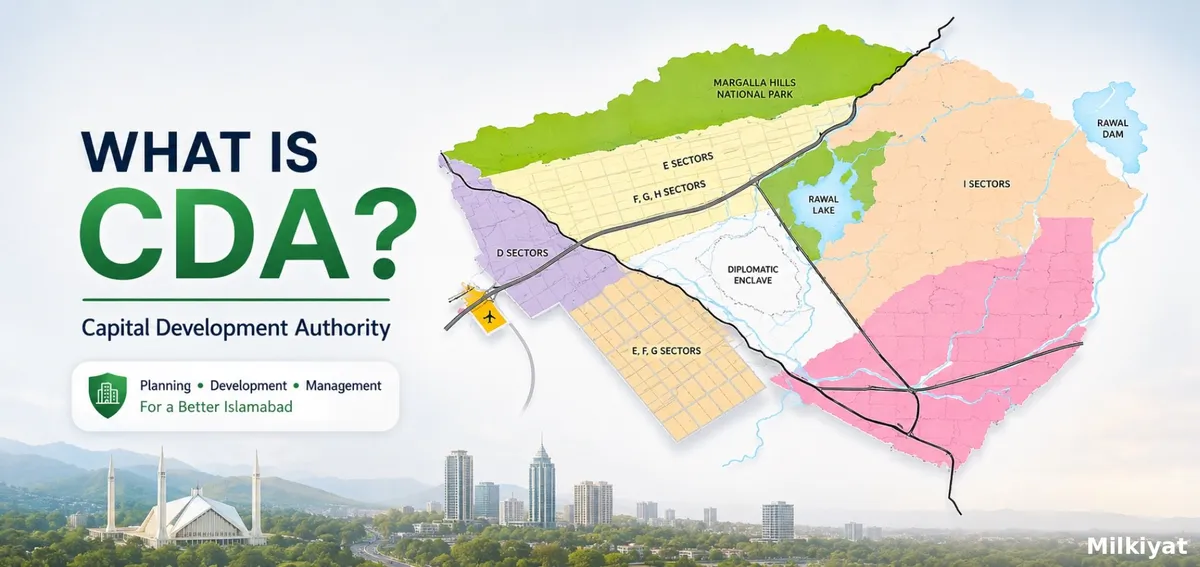
Definition: The Capital Development Authority (CDA) is a federal statutory corporation and urban planning regulation body that exercises executive administrative jurisdiction over the Islamabad Capital Territory (ICT). Established on June 14, 1960, via the CDA Ordinance, it serves as the absolute custodian of Islamabad's grid-based Master Plan, property title registries, building bylaws, and private development approvals.
To ensure systematic metropolitan growth, the CDA manages the federal capital through five highly specialized, autonomous administrative wings:
The Planning & Design Wing enforces the macro-layout of Islamabad, ensuring strict segregation across the city's commercial, residential, industrial, and diplomatic sectors. It protects the city's grid blueprint and reviews structural layouts against modern seismic safety codes.
The Engineering Wing is responsible for building and maintaining the physical backbone of developed federal sectors. This mandate encompasses the construction of principal highways, flyovers, public monuments, bulk water supply corridors, and underground sewerage grids.
The Estate Wing acts as the primary legal registrar for urban property records within developed sectors. It conducts public commercial plot auctions, maintains the official Record of Rights, verifies file authenticity to prevent double-allotment fraud, and processes biometric property transfers through its One-Window Operation (OWO).
The Environment Wing maintains the ecological microclimate of the capital. It holds direct regulatory oversight of the protected Margalla Hills National Park, manages seasonal urban forestry initiatives, and maintains milestone recreational spaces including Fatima Jinnah Park (F-9), Lake View Park, and Shakarparian.
Due to rapid urban sprawl, the CDA actively regulates private developers operating within the federal capital boundaries. It enforces strict compliance audits before granting an official No Objection Certificate (NOC), protecting public and overseas investment from structural fraud. Before booking any of the plots for sale in Islamabad offered in private schemes, buyers should check that the society holds a valid CDA NOC and not just an approved layout plan.
The CDA divides the Islamabad Capital Territory into five distinct administrative zones, each governed by an entirely different set of land-use laws and building bylaws:
| Capital Zone | Geographical Coverage & Primary Focus | CDA Regulatory Status & Development Rules |
|---|---|---|
| Zone 1 | Established urban sectors (E, F, G, H, I series) | Maintained and developed strictly by the CDA directly. No private housing societies allowed. |
| Zone 2 | North-western expansion corridors (near the Motorway) | Designated area open to approved private and cooperative housing developments. |
| Zone 3 | Margalla Hills National Park & protected watersheds | High-restriction conservation zone. All private and commercial residential construction is strictly banned. |
| Zone 4 | Islamabad Highway, Park Road, & Murree Expressway links | Largest geographic zone. Optimized for agro-farming schemes, luxury villas, and private projects. |
| Zone 5 | Islamabad Highway extending south toward Rawat & Kahuta | Major hub for large-scale private, corporate, and cooperative residential housing schemes. |
For buyers, the zone matters as much as the sector. A house for sale in Islamabad in Zone 1 sits on land developed and recorded by the CDA itself. Properties in Zones 2, 4, and 5 depend on whether the private society behind them has completed the CDA's approval process.
Real estate investors frequently face boundary confusion, particularly along the twin-city border or when translating investment strategies from Lahore to Islamabad. The tables below detail these crucial distinctions:
CDA vs RDA boundary line is a primary risk factor for investors, as many projects use "Islamabad" in marketing campaigns despite holding their legal registration in Rawalpindi.
| Feature Matrix | Capital Development Authority (CDA) | Rawalpindi Development Authority (RDA) |
|---|---|---|
| Primary Jurisdiction | Islamabad Capital Territory (ICT) only. | Rawalpindi District boundaries (incl. Tehsils like Gujar Khan, Taxila). |
| Legal Architecture | Governed by Federal Law (CDA Ordinance 1960). Answers to the Federal Ministry of Interior. | Governed by Provincial Law (Punjab Development of Cities Act 1976). Answers to the Punjab Cabinet. |
| Development Profile | Functions as a direct master developer. Clears, designs, and builds state sectors natively. | Functions primarily as a planning regulator. Relies heavily on private/cooperative sectors for town development. |
| Urban Morphology | Enforces rigid, rectangular, grid-based sector layouts with high green-cover mandates. | Manages radial, organic, and historical urban expansions alongside peri-urban expansions. |
| Investor Risk Factor | Highly strictly policed; any deviation from layout plans leads to immediate project sealing. | Overlapping borders mean properties near the GT Road corridor require careful coordinate checking. |
This highlights the structural operational differences between the federal capital territory and a premier provincial metropolis.
| Feature Matrix | Capital Development Authority (CDA) | Lahore Development Authority (LDA) |
|---|---|---|
| Primary Jurisdiction | Islamabad Capital Territory (ICT). | Lahore Division (Lahore, Sheikhupura, Kasur, Nankana Sahib districts). |
| Commercialization | Highly restrictive policy. Commercial ventures are strictly confined to localized Markaz grids and the Blue Area. | Flexible commercialization corridors. Allows conversion of residential plots into commercial fronts via structured fee systems. |
| Vertical Density | Historically restrictive height limits, closely linked to security corridors and seismic protection laws. | High density focus. Strongly incentivizes vertical growth and high-rise apartment frameworks in specific hubs. |
| Bylaw Setbacks | Non-negotiable front, rear, and lateral building setbacks on residential plots to protect air/light lines. | Variable structural setback rules based on lane width and specific residential zone sub-classes. |
These height and density rules shape Islamabad's housing mix. High-rise projects are limited to approved locations, so anyone comparing an apartment for sale in Islamabad should check that the building's floor count matches its CDA-approved plan.
The CDA does not merely observe real estate inside the capital territory—it controls every step of development. Any individual or corporate enterprise looking to alter a square foot of land must clear the authority's multi-layered control grid.
To eradicate the risk of predatory "file-system" scams where developers sell imaginary plots on paper, the CDA mandates a two-stage approval workflow:
Stage 1: Layout Plan (LOP) Approval: The developer must present clear, undisputed land titles covering the entire planned footprint. The CDA audits the architectural plans to ensure internal streets meet minimum width mandates (usually 40 feet minimum for streets and 100 feet for boulevards) and that non-negotiable land percentages are reserved for parks, public schools, and masjids. An approved LOP does not give legal permission to market or sell property.
Stage 2: No Objection Certificate (NOC) Issuance: To secure the final NOC, the developer must mortgage a specific percentage of their physical plots directly to the CDA as a financial guarantee for development execution. They must also obtain verified utility clearances from federal providers (IESCO for electricity, SNGPL for gas). Only upon NOC issuance is a society legally permitted to execute bookings. Looking for the updated list of CDA-approved and illegal housing societies? Explore the detailed guide available on Milkiyat.com.
Before construction begins on any plot, structural designs must be cleared by the BCD.
The CDA coordinates with external agencies to enforce its regulations and stop unapproved projects:
A major pitfall for property buyers is confusing the Capital Development Authority (CDA) with the Metropolitan Corporation Islamabad (MCI).
The full form of CDA is the Capital Development Authority, located in Islamabad, Pakistan.
You can check a society's legal status by visiting the official CDA website portal (cda.gov.pk), navigating to the "Private Housing Schemes" section, and cross-referencing the project's name against their active lists of Approved, Under Process, and Illegal projects.You can also check it in the detailed guide available on Milkiyat.com.
Yes, under the CDA Ordinance of 1960, the authority holds full legal power to conduct enforcement operations, demolish unapproved structures, and seal illegal real estate offices operating without a valid NOC within the Islamabad Capital Territory.
Buyers evaluating CDA sectors can browse verified Islamabad property listings on Milkiyat.com, cross-checked against CDA's own approval and zoning records.
This article is for informational purposes only and does not constitute financial or legal advice.Always conduct independent due diligence and consult a licensed real estate professional before making any investment decision.