News
SpaceX Goes Public at $1.77 Trillion — and Remakes the Economics of Land, Both Here and Beyond

Real Estate Analyst
27 min read
SpaceX Goes Public at $1.77 Trillion — and Remakes the Economics of Land, Both Here and Beyond
From a corporate town on the Texas Gulf Coast to contested property law on Mars, the world's most valuable aerospace company is rewriting the rules of real estate across two planets
"SpaceX's operations are currently carried out across 12 major properties in six states." — CoStar News, June 11, 2026
Executive Summary
- Historic IPO: SpaceX raised $75 billion at a $1.77 trillion valuation on the Nasdaq on June 12, 2026 — the largest initial public offering in market history — with shares opening at $150 before closing at $161, a 19% premium over the $135 offer price.
- The Starlink Engine: Starlink generated $11.4 billion in revenue in 2025, accounting for 61% of SpaceX's total sales and producing $4.4 billion in operating profit — making it the only genuinely profitable segment of the company and the load-bearing pillar of its $1.77 trillion valuation.
- The Starbase Effect: The incorporation of Starbase, Texas as a formal city in May 2025 created what may be the first modern corporate municipality in the United States, with SpaceX employees running its government, SpaceX owning nearly all its land, and SpaceX now seeking to annex an additional 7,133 acres.
- Earth Real Estate Impact: SpaceX's 12 major properties across six states are fuelling aerospace-driven land value shifts in Brownsville, Texas; Brevard County, Florida; and the Hawthorne corridor of Los Angeles — with the company's $1.8 billion Florida expansion already reshaping Space Coast real estate.
- Mars Property Debate: No enforceable legal framework for private Mars land ownership exists. The 1967 Outer Space Treaty prohibits national sovereignty over celestial bodies but leaves private appropriation in a studied legal ambiguity that SpaceX's long-term Mars plans will eventually force the world to resolve.
- Investment Implications: SpaceX's IPO has drawn $75 billion in new capital toward a company betting simultaneously on satellite internet dominance, orbital data centres, and human Mars colonisation — a portfolio of ambitions that makes conventional equity valuation nearly impossible, and that is precisely what makes it the most consequential public offering of the decade.
The Big Picture
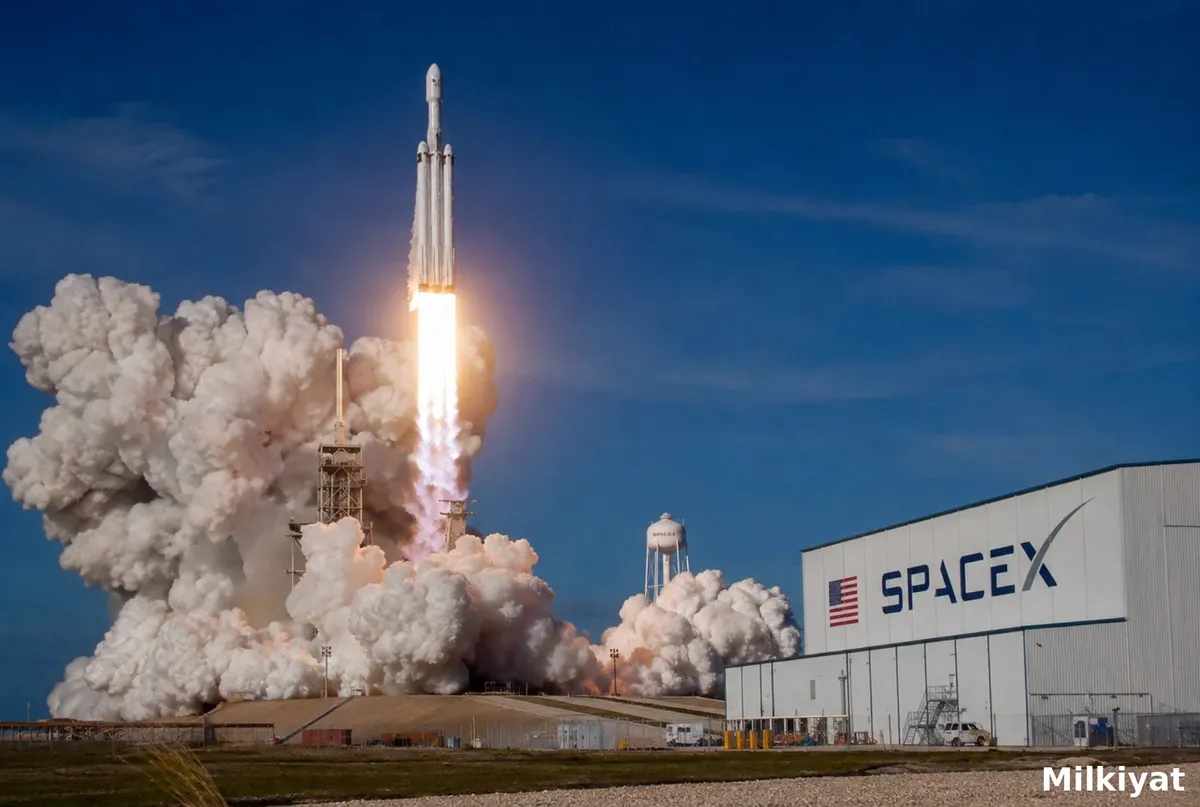
On the morning of June 12, 2026, a Falcon 9 rocket lifted off from Kennedy Space Center in Florida carrying another batch of Starlink satellites into low Earth orbit. It was, by SpaceX's own standards, entirely routine. The company had already conducted dozens of launches this year, and it would conduct more before the month ended. What made that particular launch different was not the rocket or the payload. It was the timestamp: the same morning, in New York, SpaceX shares were being priced at $135 and sent into the world's markets under the ticker SPCX.
By day's end, those shares had closed at $161. SpaceX was valued at something above $2 trillion. Elon Musk, who owns 42% of the company's equity and controls 79% of its voting rights, had built the most valuable aerospace company in human history — and had done so while also building a city, reinventing satellite internet, accumulating a twelve-property national real estate footprint, and talking, with what can no longer be dismissed as mere rhetoric, about colonising Mars.
The SpaceX story has always been easier to write as mythology than as economics. The mythology is compelling: a Silicon Valley entrepreneur who read too much Robert Heinlein, who told NASA that he could build rockets cheaper and better, who got laughed at and then proved everyone wrong so comprehensively that he became, for a time, the world's richest man. The economics are messier, more contingent, more instructive.
What the S-1 filing, published in May 2026, finally made clear is that SpaceX is at its core a satellite internet company that also builds rockets. Starlink is the only segment that makes money. The launch business, for all its prestige and market dominance, is growing slowly. The vision of Mars colonisation remains a line item on a roadmap that even optimists place at least a decade away from any practical reality.
And yet the IPO was priced at a price-to-sales ratio of roughly 60 — placing it among the most richly valued large-cap companies ever listed — because investors were not buying the 2025 income statement. They were buying the 2035 one. They were buying Starship. They were buying space-based data centres. They were buying, in the most literal financial sense, the idea that Mars might one day generate revenue.
That bet has an address on Earth, too. Understanding where SpaceX has built its physical empire — and what happens to the land around it — is as important to the investment thesis as understanding its satellite constellation.
Why SpaceX Is Trending Now
SpaceX has been trending, in various forms, for a decade. But the convergence of events in the first half of 2026 has pushed it to a different level of public and investor attention.
The IPO is the immediate catalyst. SpaceX raised $75 billion in the biggest initial public offering on record, with shares priced at $135 and a valuation soaring to around $1.75 trillion, making it one of the 10 biggest listed companies on Earth. That single data point — the sheer scale of the number — has penetrated audiences that have never previously tracked space industry news: retail investors, sovereign wealth funds, and ordinary savers who found themselves wondering whether they had missed the SpaceX trade.
But the IPO is the occasion, not the cause. Several deeper trends have been building toward this moment.
Starlink crossed 10 million active customers in February 2026, spanning 160 countries, territories, and markets — a figure that, just three years ago, would have seemed impossibly optimistic. The economics of that subscriber base, once the company began raising prices by up to $10 per month in May 2026, started to look like something the public markets could model and value. A satellite internet company with a growing, geographically diversified customer base and structurally expanding margins is a story that Wall Street knows how to tell.
Simultaneously, SpaceX's merger with xAI — Musk's artificial intelligence company — in February 2026 added a third narrative layer to a company already carrying two extremely large ones. The combined entity, valued at approximately $1.25 trillion at deal close, now spans rockets, satellite internet, and artificial intelligence infrastructure, with Musk suggesting that space-based data centres — running AI workloads from orbit — could represent a significant new revenue opportunity.
Space stocks extended their losses after SpaceX began trading on the Nasdaq. Firefly Aerospace sank more than 18%, while Rocket Lab, Redwire, and Intuitive Machines dropped at least 10% each. The gravitational pull of SpaceX's valuation is compressing multiples for everyone else in the sector.
The IPO Moment and Market Shockwaves
The financial architecture of the SpaceX IPO is worth examining closely, because the numbers reveal both the scale of the opportunity and the scale of the bet required to justify current pricing.
SpaceX brought in $18 billion in revenue in 2025 on a consolidated basis, with a net loss of $4.9 billion. Its adjusted EBITDA came in at $6.58 billion for the year. The revenue is real and growing; the GAAP net loss reflects the extraordinary capital expenditure of Starship development and the xAI integration.
The Connectivity segment generated $11.4 billion in revenue in 2025 — representing 61% of total company revenue — and $4.4 billion in operating profit, making it the company's dominant financial engine. The launch business, which controls approximately 82% of the global commercial launch market, generated $4.1 billion in 2025 — significant in absolute terms, but growing more slowly than Starlink, and increasingly treated by management as a means of delivering Starlink satellites rather than as a standalone revenue priority.
The Google relationship disclosed during SpaceX's IPO roadshow changed the valuation conversation materially. With the addition of the Google deal disclosed during SpaceX's roadshow, the company more than doubled its revenue projections for 2026. One portfolio manager estimated that SpaceX could reach $200 billion in revenue by 2030, a forecast he described as conservative.
Tesla shed about 2% on Friday as investors' attention shifted to the SpaceX market debut. Elon Musk's aerospace and defence conglomerate surpassed a $2 trillion valuation and is now worth more than his automaker Tesla, which had a market capitalisation of about $1.2 trillion.
The bearish case, which is not without merit, centres on that price-to-sales ratio. A price-to-sales ratio of 60 at IPO rivals the most richly valued tech companies, raising questions about sustainability and leaving little margin for error if any segment underperforms expectations. Several analysts have flagged that the valuation assumes not just continued growth but near-flawless execution across multiple simultaneous, complex initiatives — satellite internet scale, Starship commercialisation, orbital data centres, and Mars — in a company run by a chief executive whose attention is famously distributed across multiple enterprises.
The counter-argument is that SpaceX has a track record of executing things that most analysts believed were impossible, and that the revenue projections being used to justify the multiple may themselves be conservative if Starship fully delivers.
Starship, Starlink, and the New Space Economy
To understand SpaceX's current momentum, you have to understand the relationship between these two products — Starlink and Starship — and why that relationship is the central thesis of the entire enterprise.
Starlink is the business. It is the thing that generates cash flow, that pays salaries, that funds the engineering teams working on everything else. Starlink's EBITDA margin climbed from 41% in 2023 to 63% in 2025 — performance that far exceeds the margins of traditional satellite operators, which typically hover around 20%. As SpaceX's vice president of commercial sales noted in a company briefing, "2025 and 2026 are likely to represent the peak of Falcon launch activity, with the company planning to progressively shift missions to Starship as the next-generation vehicle matures."
Starship is the bet. The world's most powerful rocket — standing 122 metres tall, capable of carrying 100 to 150 metric tonnes to low Earth orbit — is designed to reduce per-kilogram launch costs by an order of magnitude. If it works as advertised, it would not just lower SpaceX's Starlink replenishment costs; it would transform the economics of every activity in orbit, from space-based solar power to the kind of orbital data centres that SpaceX is now explicitly targeting with its post-IPO capital.
The Starship-Starlink relationship also underpins the Mars argument. In 2026, SpaceX's total revenue is projected to land between $22 billion and $30 billion, a significant jump from 2025, largely driven by Starlink, which is adding 1.5 million new customers monthly. That revenue gives Musk a financial runway to fund Starship development without depending on outside investors — a fact that was material to SpaceX's ability to stay private as long as it did, and that will remain material to its ability to fund long-duration missions like Mars.
The competitive landscape for Starlink deserves acknowledgment. Competition is on the rise: OneWeb, operated by France's Eutelsat, has a constellation of more than 600 satellites. Amazon has sent up more than 300 satellites as it inches toward its Leo service, with a planned constellation of roughly 7,700 satellites. Jeff Bezos' Blue Origin plans to deploy about 5,400 satellites beginning in late 2027. China's Guowang, with around 163 satellites, is aiming to build a mega constellation. SpaceX named more than 20 companies as competitors to Starlink in its prospectus. The question of whether Starlink's first-mover advantage is durable or temporary will determine whether the $1.77 trillion valuation is visionary or excessive.
Real Estate Angle #1 — Earth: The Starbase Effect
There is a stretch of coastline in Cameron County, at the southernmost tip of Texas, where the Rio Grande meets the Gulf of Mexico, that looked, not long ago, like one of the more forgotten corners of the American Sun Belt. Boca Chica was a hamlet: a few dozen houses, a beach beloved by birders and off-road vehicle enthusiasts, a borderlands quiet that suited its relative remoteness from Brownsville, the nearest city of any size.
SpaceX began acquiring land there in 2014. By 2021, Elon Musk was publicly proposing that the area be incorporated as its own city. By May 2025, it was one.
The proposal to incorporate the city passed 212–6 in a May 3, 2025 election; formal incorporation of the City of Starbase occurred once legal formalities were completed. SpaceX holds ownership of nearly all the land comprising Starbase, including residential structures, apart from a few exceptions noted in the incorporation documents. The first government officials elected to lead Starbase are all SpaceX employees: Mayor Bobby Peden, aged 36, and city commissioners Jordan Buss and Jenna Petrzelka.
The implications of that last sentence are worth dwelling on. Starbase is, as things currently stand, a municipality governed entirely by employees of a single private corporation, on land almost entirely owned by that corporation, whose residents are almost entirely employees of that corporation. Starbase is a Type C city, which is a municipality category of under 5,000 people that includes allowing officials to impose a property tax of up to 1.5%. The city also gained, through incorporation, the power to handle permits and initiate construction projects — powers that had previously required negotiation with Cameron County and that SpaceX had found limiting.
The ambitions extend further. A proposal would allow Starbase city officials to annex 7,133 acres of land near Boca Chica Beach, some of which local outlets reported are state and federally-protected. The annexation attempt — considered at a February 2026 commission meeting — represents SpaceX's effort to extend the regulatory perimeter of its operations, bringing more land under a governance structure it effectively controls.
SpaceX's operations are currently carried out across 12 major properties in six states — Texas, California, Washington, Florida, Tennessee, and Mississippi. The CoStar analysis, published alongside the IPO, frames those properties as the terrestrial foundation of a company whose stated long-term goal is to render Earth-based real estate merely the first chapter of a multi-planetary property story.
On Florida's Space Coast, the impact is already being quantified. SpaceX is planning to invest at least $1.8 billion to build new Starship launchpads and processing facilities on Florida's Space Coast, with the project expected to bring an estimated 600 new full-time jobs to the region by 2030. Brevard County, where employment from aerospace and related sectors tracks closely with Kennedy Space Center activity, has historically seen housing demand correlate with launch programme momentum. A sustained SpaceX expansion of this scale — involving a Gigabay facility of 815,000 square feet for assembling Starship rockets — represents the kind of anchor investment that reshapes regional housing markets over a five-to-ten year cycle.
In Hawthorne, California, where SpaceX still operates its mature Falcon 9 production ecosystem, the aerospace employer dynamic has long shaped the South Bay commercial real estate market. SpaceX has largely kept Hawthorne as the centre of its mature rocket-production ecosystem while expanding newer business lines to other regions with existing infrastructure and specialized talent, making Southern California the engineering foundation of a broader national network. The company's lease flexibility there — it leases at least part of its Hawthorne footprint from Link Logistics — gives it the optionality to scale without the fixed cost of ownership as its manufacturing gravity continues its eastward migration toward Texas.
The broader pattern is familiar to anyone who has studied the economic geography of the American aerospace sector: where launch infrastructure concentrates, housing demand follows. Engineers earning aerospace salaries need housing within commute distance of facilities that cannot, by their nature, be located in urban centres. The historical precedent is Huntsville, Alabama, where NASA's Marshall Space Flight Center anchor tenant status turned an agricultural town into one of America's fastest-growing engineering employment markets over the course of a generation.
Starbase is attempting something more radical — not just locating near a town, but becoming the town, owning the governance, writing the zoning rules, and setting the property tax rate. Whether that model proves legally sustainable, environmentally viable, or socially acceptable in the long run is a question that neither the Cameron County commissioners nor the state of Texas has yet definitively answered.
Real Estate Angle #2 — Mars: Law, Economics, and Speculation
Every week, somewhere on the internet, someone is selling land on Mars. The prices are modest — a few dozen dollars per acre — the certificates are handsome, and the legal basis is, to put it charitably, non-existent. The vendors of these products are not committing fraud in the conventional sense; they are selling a novelty item, a conversation piece, a speculative bet on a future that may or may not arrive. The actual title to Martian land that these transactions purport to convey is legally worthless under any existing framework of international law.
And yet the question of who will own land on Mars — when, not if, humans get there — is among the most consequential and genuinely unresolved legal questions in the history of property rights. SpaceX's IPO, and the serious capital it has attracted into the Mars colonisation thesis, has moved that question from the pages of academic law journals into financial prospectuses.
Understanding it requires starting with the 1967 Outer Space Treaty — the foundational document of international space law, signed by 117 countries, including every major spacefaring nation.
Article II of the Treaty is clear: "Outer space, including the Moon and other celestial bodies is not subject to national appropriation by claim of sovereignty, by means of use or occupation, or by any other means." No nation can own Mars. No government can plant a flag, declare jurisdiction, and begin distributing parcels to its citizens.
What the Treaty does not clearly resolve is whether private individuals and corporations are bound by the same prohibition. Some interpret Article II to cover and prohibit appropriation by all parties, while others believe it leaves the door open to private appropriation. Under the latter interpretation, private persons and corporations could debatably claim land on Mars as private property.
The 1979 Moon Agreement attempted to close this ambiguity by explicitly prohibiting private property on the Moon and other celestial bodies, and by mandating an egalitarian distribution of resource profits. But the Moon Agreement has been signed by relatively few states and notably not by the United States, Russia, or China — the three countries capable of actually getting humans to other celestial bodies. Its practical authority over the coming era of space settlement is limited.
If a company like SpaceX lands on Mars, the Outer Space Treaty would potentially not restrict its ability to claim land. At that point, it is unclear what the legal policies governing ownership would be. In that situation, a process loosely similar to westward expansion could be utilised, wherein a larger entity distributes land to newcomers. This could be extremely lucrative for SpaceX.
The economic logic of Martian real estate — if it ever becomes real — inverts almost everything we know about Earth-based property valuation. On Earth, value correlates with centrality, infrastructure access, and proximity to economic activity. On Mars, the concept of real estate flips the paradigm of property value on Earth. The most valuable locations would not be the most scenic or the most central; they would be the sites with the most favourable combination of subsurface ice access, solar exposure, minimal radiation shielding requirements, and geological stability for habitat construction. The equatorial lowlands, where atmospheric pressure is marginally higher and temperatures marginally less extreme, would likely command premium status. The lava tubes that NASA scientists have identified as potential shelter sites would become the equivalent of Manhattan penthouses — naturally shielded from radiation, thermally stable, and structurally ready for habitation.
The question of who captures that value — and under what legal framework — remains, as of June 2026, entirely open.
The Outer Space Treaty and Property Rights
The legal architecture governing space property rights is frozen in the geopolitical amber of 1967. The Outer Space Treaty was negotiated during the Cold War, between superpowers primarily interested in preventing each other from militarising the Moon and secondarily interested in establishing a framework for peaceful exploration. The possibility that a private American company might spend $75 billion going public on the understanding that it would one day establish permanent human settlements on Mars was not a scenario the treaty's drafters were equipped to anticipate.
As of January 2026, 61 nations had signed the Artemis Accords, with Oman joining after Portugal. The Accords, a US-led framework for Moon exploration, include language stating that extracting space resources "does not inherently constitute national appropriation" under the Outer Space Treaty. This has been interpreted by supporters as opening the door for rights in extracted resources — analogous to how mining rights work under Earth law. Critics argue the interpretation is convenient and legally unsupported.
Article I of the Outer Space Treaty states that the use of outer space "shall be carried out for the benefit and in the interest of all countries, irrespective of their degree of economic or scientific development, and shall be the province of all mankind." The tension between that language and the prospect of SpaceX distributing Martian land claims to paying colonists is not theoretical. It is the defining legal question of the coming era of space settlement.
One strand of legal thought, advanced by scholars including Glenn H. Reynolds and Robert P. Merges, holds that states are prohibited not just from claiming sovereignty themselves but from granting quasi-sovereign or exclusive property rights to corporations subject to their jurisdiction. Under this reading, the US government could not legally recognise SpaceX's Mars land claims even if it wanted to. A contrary strand holds that the Treaty's silence on private actors is not a prohibition but a gap — and that, under the principle that everything not explicitly prohibited is permitted, private property on Mars is legally tenable.
The US Space Act of 2015 took a cautious first step in this direction, authorising US citizens to "own, transport, use, and sell" any asteroid or space resource they extract, while explicitly disclaiming any US sovereign claim to the celestial body itself. The Mars analogy would presumably follow a similar structure: a US company or citizen could own what they dig up or build, but not the underlying territory.
Whether that framework satisfies the practical needs of a Martian colony — which would require some form of territorial governance, some mechanism for resolving land disputes, some authority capable of enforcing contracts and protecting property from interference — is a question that SpaceX's S-1 filing does not address, for the simple reason that no one has answered it yet.
Expert Opinions and Analyst Commentary
The financial community is deeply divided on whether the SpaceX valuation is a reasonable forward-looking bet or an extraordinary speculative excess.
The bull case was articulated most clearly during the IPO roadshow. One portfolio manager estimated that SpaceX could reach $200 billion in revenue by 2030 — a forecast he described as "conservative." Under that scenario, with margin expansion driven by Starship's lower launch costs and Starlink's continued subscriber growth, a $2 trillion valuation begins to look less like a fever dream and more like a discounted future cash flow estimate.
The bear case is grounded in the present income statement. Bearish analysts warn of potential corrections to $75 per share, based on fundamental metrics. A company that reported a GAAP net loss of $4.9 billion in 2025, against revenues of $18 billion, trading at 60 times sales, is making a claim on investor patience that not every market environment will support.
Institutional real estate analysts, meanwhile, are focused on a more immediate and quantifiable question: what SpaceX's expansion does to land values near its facilities. The historical pattern — documented at NASA's Marshall Space Flight Center in Huntsville, at the Jet Propulsion Laboratory corridor in the San Gabriel Valley, and at the original Cape Canaveral complex — is that high-wage aerospace employment generates durable housing demand premiums in surrounding markets. SpaceX's expansion at its McGregor, Texas rocket engine testing complex — described in its S-1 as the world's most active rocket development and testing facility — and its $1.8 billion Florida Space Coast commitment are both large enough to move regional housing markets materially.
On the Mars property rights question, legal scholars are broadly aligned that the current international framework is inadequate for the world it will soon be asked to govern. International space law needs to evolve alongside advancements in space technology to prevent future conflicts over property rights. The Artemis Accords represent the leading edge of that evolution, but their status as bilateral political commitments rather than ratified international treaties means their authority is persuasive rather than binding.
The analogy to the Antarctic Treaty System — which has successfully managed territorial claims on a remote, hostile, and scientifically valuable territory for more than six decades — is frequently invoked by international law scholars as a model that could be adapted for Mars. Like the Outer Space Treaty, the Antarctic Treaty prohibits national territorial claims. Unlike the current space law regime, it has developed a sophisticated governance infrastructure that has survived decades of competing national interests. Whether that model scales to a planet 55 million kilometres away is a question that remains, as yet, unanswered.
Risks, Unknowns, and Global Implications
The risks of the SpaceX investment thesis are multiple, material, and worth stating without the hedging that sometimes accompanies discussion of a company whose founder has repeatedly defied the conventional risk assessments applied to his ventures.
Starship execution risk. The entire forward valuation hinges on Starship delivering on its promise of dramatically lower per-kilogram launch costs. Starship has achieved notable milestones but has also suffered multiple high-profile failures. The transition from a test vehicle to a commercially operational heavy-lift system involves engineering challenges that have humbled programmes with far longer runways than SpaceX has allowed itself.
Starlink competition. Amazon, Blue Origin, Eutelsat OneWeb, China's Guowang, and more than 20 other competitors named in SpaceX's own prospectus are building satellite internet capacity. If Amazon's Kuiper service achieves competitive performance at competitive pricing — as Bezos has the resources to ensure it does — Starlink's market share and pricing power may compress faster than current projections assume.
Regulatory and geopolitical risk. SpaceX's relationship with the US government — its largest customer — is inextricably bound up with its founder's political relationships. Government contracts can be reviewed, rebid, or redirected. The company's Starshield national security programme, expected to contribute $3.2 billion in 2026 revenue, operates in a budget environment subject to political cycles.
The Starbase governance question. The legal and ethical questions raised by a private corporation running a municipality — including the power of eminent domain, control over beach access, and the authority to annex thousands of acres of state and federally-protected land — are not resolved. Starbase's incorporation has invited scrutiny regarding environmental impacts, including SpaceX's operational practices, which have previously resulted in fines for wastewater dumping and concerns about effects on local habitats and endangered species.
The Mars timeline. Even the most optimistic internal SpaceX projections place meaningful human presence on Mars at least a decade away. A decade of continued Starship investment, without a commercially viable Mars revenue stream, requires Starlink to sustain cash generation at a level that assumes continued subscriber growth in a becoming more competitive market.
Systemic market risk. At a $2 trillion market capitalisation, SPCX is now a systemic factor in global equity markets. Alphabet may be one of the biggest hidden winners in the SpaceX IPO, owning a stake in the company. The interconnections between SpaceX's market value and the broader technology equity complex mean that SPCX volatility — in either direction — will be felt beyond the aerospace sector.
Conclusion: What This Means for the Next Decade
On June 12, 2026, a rocket company from South Texas became one of the most valuable enterprises on Earth. It did so on a promise that is simultaneously financial and philosophical: that the economics of space, if you build the right infrastructure and grow the right subscriber base and develop the right heavy-lift vehicle, eventually become self-sustaining. That the frontier pays for itself.
The terrestrial implications of that bet are already visible and already affecting real estate markets. While SpaceX founder Elon Musk's long-term goal is to make Mars a new real estate frontier, the company's record-breaking IPO had more immediate implications for data centres, both terrestrial and in Earth's orbit. The $75 billion raised gives SpaceX the capital to expand its 12-property national footprint, build out its Starship manufacturing infrastructure, invest in orbital compute capacity, and fund the Mars programme to a point of no return.
For real estate markets on Earth, the pattern is already established: aerospace anchors beget housing demand, housing demand begets commercial development, commercial development begets the kind of community infrastructure that transforms a launch site into an economic region. The Space Coast knows this. Huntsville knows this. Starbase, Texas — if it survives its legal and political challenges — will know it in a decade.
For the question of Mars property rights, the IPO has moved the timeline. A company with $75 billion in fresh capital and a $2 trillion market capitalisation has a very different capacity to fund interplanetary transport than a private company dependent on government contracts and periodic insider share sales. The legal framework for Martian property rights has always been a question of "when will this matter?" The SpaceX IPO has brought that moment measurably closer.
And for the investors, the homeowners near SpaceX facilities, the legal scholars tracking the Outer Space Treaty, and the amateur astronomers in South Texas who stand on Boca Chica Beach to watch Starship test flights — all of them are now shareholders, whether they own a single share of SPCX or not, in an experiment whose outcome will define the economic geography of this century. The only thing more remarkable than the $1.77 trillion valuation is how uncertain, and how genuinely consequential, the underlying bet remains.
Appendix: Key Data Table
| Metric | Value (2025 / 2026) | Source |
|---|---|---|
| SpaceX total revenue (2025) | $18.67 billion | SpaceX S-1 Filing |
| Starlink revenue (2025) | $11.4 billion (61% of total) | SpaceX S-1 Filing |
| Starlink operating profit (2025) | $4.4 billion | SpaceX S-1 Filing |
| SpaceX GAAP net loss (2025) | $4.9 billion | SpaceX S-1 Filing |
| Adjusted EBITDA (2025) | $6.58 billion | SpaceX S-1 Filing |
| IPO price | $135/share | Nasdaq, June 12, 2026 |
| IPO valuation | $1.77 trillion | CNBC, June 12, 2026 |
| Day-one close | $161/share (+19%) | CNBC, June 12, 2026 |
| Starlink active customers | 10 million+ (Feb 2026) | SpaceX official announcement |
| Countries served by Starlink | 160 | SpaceX S-1 Filing |
| SpaceX properties (US) | 12 major properties / 6 states | CoStar, June 2026 |
| Florida expansion commitment | $1.8 billion | Florida Governor's office |
| Starbase city size | ~1.6 sq miles | Fox Business |
| Proposed Starbase annexation | 7,133 acres | USA TODAY / Cameron County |
| Outer Space Treaty signatories | 117 countries | UN OOSA |
| Artemis Accords signatories | 61 nations (Jan 2026) | New Space Economy |
This feature was produced by the Milkiyat News Desk. All financial figures cited are drawn from SpaceX's S-1 and Amendment No. 1 SEC filings, CNBC, NPR, CoStar, Sacra, Bloomberg, and other verified public sources as referenced throughout the text. This article does not constitute financial or legal advice.