Guide
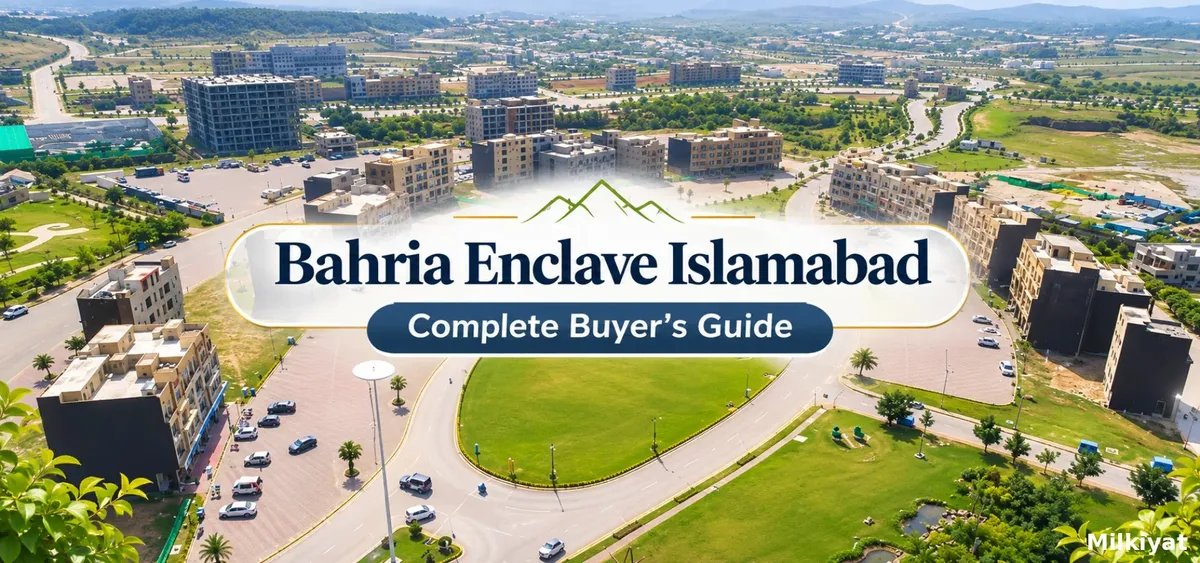
Bahria Enclave Islamabad: Complete Buyer's Guide
Guide
Explore 1 bed apartment prices in Park View City Islamabad, including project comparisons, apartment sizes, price per sq ft, lake-facing views and buying options.
Explore apartments for sale in Park View City Islamabad, including 1, 2 and 3-bed units, project details, price comparisons, payment plans and buyer guidance.
A tenant guide to renting an office in F-10 Islamabad covering Markaz plazas, sizes, floors, rent benchmarks, approved use, agreements and a checklist.
A tenant guide to renting a shop in F-10 Islamabad covering Markaz plazas, sizes, floors, rent benchmarks, approved use, agreements and a checklist.

By Mariam Khan
Real Estate Analyst
19 min read
Bahria Enclave Islamabad is one of the few large gated communities that sits inside the capital's own territory rather than on the Rawalpindi side. It is spread across the green foothills east of Islamabad, between Park Road and the Simly Dam road, and has become a serious option for families who want a planned neighbourhood with Margalla views, wide roads and its own commercial and civic facilities. Buyers looking at the Bahria Enclave society page will see everything from 5 marla plots to 2 kanal houses, spread across more than twenty sectors.
That variety is also what makes the society confusing for first-time buyers. Two plots of the same size can differ a lot in price because one sits in a developed, possession-ready sector and the other is on a hill slope still waiting for roads. This guide explains where the society is, how the sectors compare, what its approval status with the Capital Development Authority (CDA) actually says, and what to check before you pay a token. If you are ready to look at stock, you can browse the latest plots for sale in Bahria Enclave alongside this guide.
Bahria Enclave is a private housing scheme developed by Bahria Town (Pvt) Ltd, the same group behind Bahria Town Rawalpindi–Islamabad and Bahria Town Karachi. Unlike Bahria Town's Phase 1–8 on the GT Road and Expressway side, Bahria Enclave was planned as a quieter, greener community on the eastern edge of Islamabad, in CDA's Zone IV. For a closer look at daily life, landmarks and surroundings, the Bahria Enclave area guide covers the neighbourhood in detail.
According to the CDA's own record, the Phase-I scheme covers roughly 12,543 kanal. The developer's Letter of Permission (LOP) from CDA is listed as approved on 16 July 2011, which is broadly when large-scale development began. Since then, the society has grown in stages, sector by sector, which is why some parts of Bahria Enclave look fully settled while others are still mostly empty plots.
What sets Bahria Enclave apart from most societies in Zone IV is the amount of built infrastructure already on the ground. The developer's official project page lists a Beaconhouse school, a hospital, a zoo and one of the country's largest bird aviaries, themed parks, a Trafalgar Square-style plaza, restaurants and commercial areas, and its Islamabad corporate office sits inside the society in Sector I. Thousands of families already live in the older sectors, so buyers in developed blocks are buying into a working neighbourhood, not a promise.
It suits less well buyers who need to commute daily to the airport or to Rawalpindi's commercial centres, and buyers who want a fully approved, NOC-holding society with no regulatory question marks (more on that below).
On the Bahria Enclave Islamabad map, the society sits east of the Islamabad Highway, beyond Chak Shahzad and Bani Gala, in the rolling area that leads towards Simly Dam. It lies opposite Park View City and near localities such as PTV Colony, Farash Town and Alhamra Town.
The developer describes the drive to central Islamabad as about 20 minutes in normal traffic. In practice, it depends on which sector you live in and the time of day, since the Park Road and Chak Shahzad junctions get busy in rush hours.
The Bahria Enclave Islamabad map is easiest to read in three parts:
When you study a plot on the map, check three things: its distance from the main gate and the Civic Centre, whether it is on the main boulevard or an inner street, and whether the land is at road level. In Bahria Enclave's hilly terrain, a plot that sits below road level may need filling before construction, which adds real cost.
The society is divided into lettered sectors from A to P, with sub-sectors including B1, B2, C1, C1 Extension, C2, C3 and F1. There is also a separate Phase 2 (Bahria Enclave 2), which is marketed and listed on its own. Development status varies widely across the Bahria Enclave sectors, so the sector you choose matters more than almost any other decision.
The overview below is based on how each sector is generally described in the market. Possession and development status change over time, so always confirm the current status of a specific plot with the society office before buying.
Sector A – The most established sector, next to the main entrance, with civic and commercial facilities close by. It carries 7 marla, 10 marla, 1 kanal and 2 kanal plots, and is a common choice for people who want to build and move in soon. Some 10 marla plots near the settlement edges need filling, so check the level.
Sector B, B1 and B2 – Sector B and its sub-sectors offer smaller sizes (5, 8 and 10 marla) along with 1 kanal plots. B1 is developed and has some small commercial plots. B2 is home to schools, which makes it popular with families. Parts of Sector B face a village and some plots sit below ground level.
Sector C, C1, C2 and C3 – Often seen as the prime residential part of Bahria Enclave, with some of the society's higher prices. Sector C has 10 marla, 1 kanal and 2 kanal plots and a commercial strip on the main avenue opposite the zoo. C1 has one of the most active 10 marla house markets in the society, and C2 and C3 also have steady house demand. C1 Extension offers 10 marla plots at a lower price point than C1.
Sector E – Near the main entrance beside Sector A, mainly 1 and 2 kanal plots. Possession has been given, but parts of the sector are below road level, which slows investor interest.
Sector G – Level land without the depth issues of the hill sectors, with 5 and 10 marla residential plots and commercial plots. A balanced choice for both building and holding.
Sector H – One of the most heavily built-up sectors, dominated by 5 and 8 marla plots, with boulevard 5 marla plots and 8 marla commercial plots. Builders are active here, so ready 5 marla houses are common.
Sector I – Mainly 5 and 10 marla plots with an established 5 marla house market. Bahria Town's corporate office is here. Some areas needed land filling, so plot-by-plot checks are important.
Sector J – Faces the Civic Centre, which keeps demand stable. Offers 10 marla and 1 kanal plots.
Sector F and F1 – Hill sectors. F sits on a hilltop with views and offers 10 marla and 1 kanal plots. F1 is on a slope, with 5 and 10 marla plots and shallower plot depths. Development here has historically been slower because of the rocky terrain.
Sector K and L – Low-density, kanal-focused sectors. K has 10 marla and 1 kanal plots and is partly developed. L is kanal-heavy (1 and 2 kanal) and has seen limited listing activity.
Sector M – Has direct access from Simly Dam Road and an active 10 marla house market, along with 1 kanal plots. It is associated with the Bahria City Centre project.
Sector N – A popular budget sector with Margalla and Murree hill views, offering 5, 8 and 10 marla plots and commercial plots along the 150-foot avenue. Solid land with little filling needed, which is one reason plots here tend to move quickly.
Sector O and P – The newest sectors, with 5 marla, 10 marla and 1 kanal plots. Development is at an early stage, so these are long-term holds rather than build-now options.
| Sector group | Typical plot sizes | Development stage | Best for |
|---|---|---|---|
| A, E | 7 marla – 2 kanal | Settled, near entrance | Building and living now |
| B, B1, B2 | 5 marla – 1 kanal | Mostly developed | Families, smaller budgets |
| C, C1, C2, C3 | 10 marla – 2 kanal | Developed, prime | End users, house buyers |
| G, H, I, J | 5 – 10 marla, some 1 kanal | Developed, built-up | Builders, 5 marla house buyers |
| F, F1 | 5 marla – 1 kanal | Hill terrain, slower | View seekers, patient investors |
| K, L | 10 marla – 2 kanal | Partly developed | Kanal plot buyers |
| M, N | 5 marla – 1 kanal | Active, growing | Budget buyers, mid-term investors |
| O, P |
This is the question most buyers ask first, and the honest answer has two parts.
The layout was permitted. On the CDA housing scheme record for Bahria Enclave Phase-I, the sponsor is listed as M/s Bahria Town (Pvt) Ltd, the zone as Zone 4, and the Letter of Permission (LOP) status as "Approved", dated 16 July 2011. An LOP is the authority's permission to plan and develop a scheme on the approved layout.
The final NOC is not shown as issued. The same CDA record lists the No Objection Certificate (NOC) status as "Not Issued", with the status date shown as 25 November 2025. The page also carries two show-cause notices issued to the sponsor, dated 16 March 2026 and 31 March 2026. CDA's record does not explain what those notices relate to.
So, is Bahria Enclave CDA approved? It holds a CDA-approved LOP and is a recognised scheme in CDA's records, but according to CDA's own page, it does not currently hold a final NOC for Phase-I. You may see older market material say that the society has a full NOC, or that certain sectors have one; the CDA record is the reference to rely on, and it can change, so check it again close to your purchase date.
Bahria Enclave offers a wide spread of property, which is part of its appeal.
Residential plots: 5 marla, 7 marla, 8 marla, 10 marla, 12 marla, 1 kanal and 2 kanal. The 5 and 10 marla categories have the most listings and the most liquid resale market. Kanal plots are concentrated in Sectors A, C, E, F, K and L.
Houses: Ready houses are most common in the developed sectors. Sector H and Sector I have strong 5 marla house markets, while C1, C2 and M are known for 10 marla houses. Buyers who would rather skip construction can compare houses for sale in Bahria Enclave by sector and size.
Commercial plots: Mostly 4, 5 and 8 marla, located on main avenues and in commercial zones in Sectors A, B1, C, G, H and N.
Apartments: A smaller segment, available in a few projects within the society, suited to buyers with lower budgets or those looking for rental units.
Within any size, the plot's position changes its price:
Prices in Bahria Enclave move with three factors more than anything else: the sector's development and possession status, the plot's size and category, and the land level.
In broad terms:
Because Bahria Enclave prices change quickly and differ plot by plot, the most reliable way to judge a fair price is to compare live listings of the same size in the same sector, then adjust for boulevard, corner or level differences. Treat any single "society rate" with caution; a 10 marla plot in C1 and a 10 marla plot in F1 are effectively different products.
Bahria Enclave is built around the idea of a self-contained community. The main features include:
The landscape itself is part of the appeal. Many sectors look out over the Margalla Hills and the green belt towards Simly Dam, and the society has kept large areas of greenery, which is rare at this scale within Islamabad.
Buyers looking at Bahria Enclave often compare it with two nearby choices:
The right choice depends on your budget, commute, and how much weight you place on approval status, development stage and lifestyle features.
Who developed Bahria Enclave?
Bahria Enclave was developed by Bahria Town (Pvt) Ltd. CDA's record lists the company as the scheme's sponsor.
Which zone of Islamabad is Bahria Enclave in?
It is in CDA's Zone IV, east of the Islamabad Highway, near Chak Shahzad, Bani Gala and Park Road.
Does Bahria Enclave have a CDA NOC?
CDA's record shows an approved Letter of Permission (July 2011) for Phase-I, but lists the final NOC as "Not Issued". Check the CDA record and the society office for the latest position before buying.
Which is the best sector in Bahria Enclave?
For living now, Sectors A, C, C1 and J are popular because they are developed and close to facilities. For mid-term investment at lower prices, buyers often look at N, G and H. The best sector depends on your budget and timeline.
What plot sizes are available?
Residential plots range from 5 marla to 2 kanal, with commercial plots mostly in 4, 5 and 8 marla sizes.
Is Bahria Enclave good for families?
Yes, especially in the developed sectors, which have schools, a hospital, parks and markets within the society.
Is Bahria Enclave 2 the same society?
Bahria Enclave 2 (Phase 2) is a separate phase listed and marketed on its own, so check its status and prices separately.
Bahria Enclave offers something few societies in Islamabad can match: a large, green, gated community inside the capital's boundary, with working schools, a hospital, parks and markets in its established sectors. Its biggest strengths are its settled core, its wide range of plot sizes and its strong resale demand in the 5 and 10 marla categories. Its main weaknesses are the uneven development across its sectors and the unresolved final NOC on CDA's record, which every buyer should factor into their decision.
The smartest way to buy here is to choose the sector first, verify the plot and file thoroughly, and compare prices only with similar plots nearby. Milkiyat brings Bahria Enclave listings, sector-level detail and verified local agents together in one place, so you can compare options side by side and buy with clearer information.
| 5 marla – 1 kanal |
| Early stage |
| Long-term investors |