Guide
Bahria Town Sector F Lahore: Blocks, Development & Approval

By Anza Gulzar
Real Estate Agent
11 min read
Bahria Town Sector F Lahore: Blocks, Development & Approval
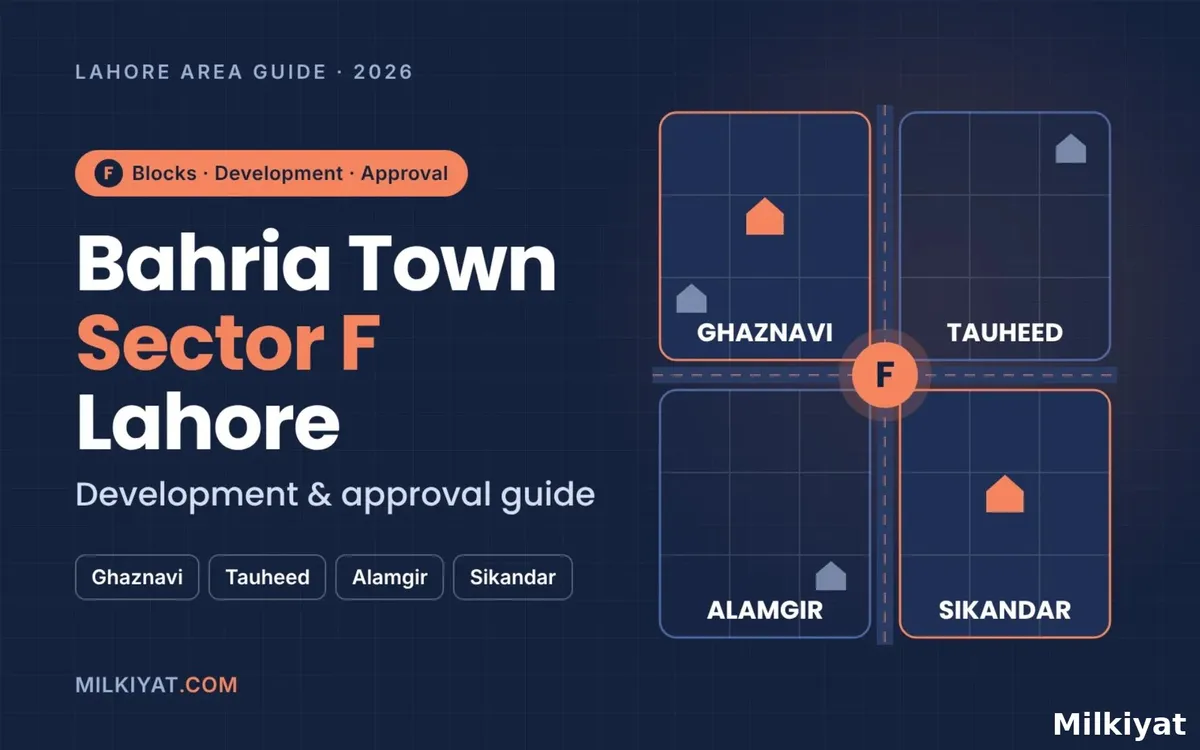
Bahria Town Sector F Lahore is a property market that buyers and investors may consider when exploring residential plots and development opportunities in Bahria Town. Before making a decision, however, it is important to understand how individual blocks differ, what development has actually been completed and how to verify the approval status applicable to a specific property. Ghaznavi Block, Tauheed Block and Alamgir Block are among the names buyers may encounter while researching Sector F, but a block name alone does not establish a plot's possession, development or legal status.
Anyone comparing opportunities across the city can explore Milkiyat's Lahore property guide for a wider understanding of the local market. Buyers considering a completed residential property can also review houses for sale in Lahore to compare buying a house with purchasing a plot and arranging construction separately.
This guide focuses specifically on Sector F's blocks, development considerations, possession claims and approval verification. It explains what buyers should check before treating a property as ready for construction or suitable for investment, while distinguishing verified documentation from claims that require further confirmation.
1. Understanding Bahria Town Sector F Lahore
Bahria Town Lahore comprises multiple sectors, residential blocks, commercial areas and supporting infrastructure. Sector F is discussed within this broader development, but its individual blocks and properties should not automatically be assumed to share identical development conditions.
Ghaznavi, Tauheed and Alamgir are relevant block names for buyers researching Sector F. Other names may also appear in maps, property advertisements and allocation documents. Buyers should confirm the exact block and plot identification using the applicable map and records rather than relying on a general description supplied by a seller or agent.
Three separate questions should guide the initial assessment:
- Blocks: Where is the property located, and does its recorded block match its actual location?
- Development: What infrastructure is physically available around the plot?
- Approval: What regulatory status applies to the exact land parcel and property?
These questions are related, but they are not interchangeable. Visible development does not automatically establish regulatory approval, while a property described as approved may still require separate confirmation of ownership, possession and construction eligibility.
2. Major Blocks in Sector F
Block-level research is useful because location, surrounding development and access can influence a property's practical value. Nevertheless, buyers should evaluate each plot individually.
| Block | What to investigate |
|---|---|
| Ghaznavi Block | Exact plot location, road access, development and possession documentation |
| Tauheed Block | Block identification, allocation or ownership records, development and transfer conditions |
| Alamgir Block | Infrastructure, construction readiness, plot identification and applicable approvals |
This comparison is a due-diligence framework, not a declaration that any block has a particular verified development or possession status.
Ghaznavi Block
When researching Ghaznavi Block, buyers should begin by confirming the plot number and its location on the applicable map. The seller's documents should correspond to the property being offered, and the plot should be identifiable on the ground where applicable.
Next, inspect the surrounding streets and infrastructure. Check road access, drainage, nearby construction and the availability of relevant utilities. Ask whether possession has formally been granted and obtain confirmation from the relevant office.
A property listing that uses the words “developed” or “possession available” should not replace these checks. The exact plot may have different conditions from another property within the same block.
Tauheed Block
Buyers considering Tauheed Block should establish whether the advertised property is in the original block or a separately identified extension. Similar names do not guarantee identical location, documentation or development conditions.
Request the exact plot number and block identification, then compare these details with the relevant records. If the property is being marketed through an allocation or file, clarify its nature and transfer eligibility before making a payment.
Development should also be assessed on site. A general statement about the surrounding area does not establish whether the specific property is ready for construction.
Alamgir Block
Alamgir Block should be assessed using the same plot-specific approach. Buyers planning to build should examine the road, surrounding development, infrastructure and any construction requirements that apply to the property.
A plot may be physically identifiable without being ready for immediate construction. Obtain written confirmation of the relevant possession conditions and establish whether any charges, approvals or other requirements remain outstanding.
Comparisons between Alamgir and other Sector F blocks should use properties of similar sizes and comparable documentation and development conditions.
3. Development Status: What Buyers Need to Establish
Development status is one of the central considerations when evaluating Bahria Town Sector F Lahore. However, the condition of a sector cannot reliably be established through a single general statement. Infrastructure may differ by block, street and individual plot.
A proper assessment should cover the following areas.
Roads and access: Check whether the approach roads and internal streets are physically usable. Note incomplete roadwork, restricted access or other visible issues.
Drainage and sewerage: Establish whether the relevant infrastructure is available and operational. Do not assume that a completed-looking street necessarily has fully functional services.
Water and electricity: Ask which services are available, what connection arrangements apply and whether installation or connection charges remain payable.
Surrounding construction: Observe nearby houses, occupied properties and ongoing development. These provide context about the immediate environment but do not guarantee the status of the plot being considered.
Construction readiness: Confirm the requirements for building on the specific property. Development visible nearby does not independently establish construction eligibility.
Outstanding payments: Request a statement of any unpaid development or service charges that may affect the transaction.
Record the findings from a site visit and compare them with the information supplied by the seller. If an important claim cannot be confirmed, treat it as unresolved rather than assuming that it is correct.
4. Sector F Possession: Verification Before Purchase
Possession is often a major consideration in residential property transactions, but buyers should clarify precisely what a possession claim means.
There are three important distinctions.
- Physical identification: The plot can be located and matched to the relevant plot number and records.
- Formal possession: The applicable developer or authority has confirmed possession under the relevant terms.
- Construction readiness: The property meets the requirements applicable to construction, including any necessary payments, approvals and infrastructure conditions.
These are separate matters. A seller may be able to point out a plot on the ground without providing sufficient evidence of formal possession. Likewise, possession does not remove the need to verify ownership, transfer eligibility or construction requirements.
Before purchasing in Ghaznavi, Tauheed or Alamgir Block, ask for documentary confirmation of the property's status. Verify the information directly with the relevant office and clarify whether the existing owner can complete the proposed transfer.
A buyer should not assume that possession is available throughout Sector F merely because a listing or agent makes a general statement about the sector.
5. Approval Status: How to Verify the Relevant Records
Approval is a separate and essential part of property due diligence. Buyers should not infer the regulatory status of an individual plot from the name or reputation of a housing development.
For Sector F, the relevant question is whether the exact land parcel and property fall within the applicable approved area and whether the documents presented correspond to that location.
The verification process should include:
- Identifying the exact sector, block and plot.
- Obtaining the relevant map and ownership or allocation records.
- Checking the applicable approval record and its boundaries.
- Confirming that the documents refer to the same land parcel.
- Investigating any restrictions, disputes or unresolved obligations.
- Clarifying the requirements for transfer and construction.
Where a seller presents an approval document, check its relevance to the specific property instead of relying on its title alone. If the records are unclear or inconsistent, seek clarification from the relevant authority or a qualified property professional before committing funds.
For broader context, read Milkiyat's guide on Bahria Town Lahore's LDA approval status by sector. This provides a starting point for research, but the status applicable to an individual property should still be confirmed against the relevant records.
Important: Development, possession, ownership and approval are distinct checks. A satisfactory result in one area does not automatically establish the others.
6. How Block Development Affects Property Comparisons
Differences in development and documentation can affect the way buyers compare properties. A plot with accessible roads and confirmed possession may have different practical advantages from a plot requiring further work or verification.
Rather than comparing only the advertised prices, consider:
| Factor | Why it matters |
|---|---|
| Plot location | Determines access and the immediate surroundings |
| Road condition | Affects practical accessibility |
| Infrastructure | Influences usability and potential additional expenditure |
| Possession | Helps establish whether the property can be handed over under the applicable terms |
| Approval records | Helps identify regulatory issues requiring investigation |
| Ownership documents | Establishes whether the seller's entitlement can be verified |
| Outstanding charges | Changes the effective acquisition cost |
| Construction requirements | Determines whether the buyer can proceed with the intended use |
A cheaper property should not automatically be considered better value. If it has unresolved documentation or requires significant additional expenditure, its effective cost and risk may be different from those of a comparable property.
Buyers exploring alternative residential investments can also review plots and files for sale in Lahore and compare the options against the conditions identified during their Sector F research.
7. Common Misunderstandings About Sector F
Several assumptions can lead to confusion during property research.
Assuming the entire sector has one development status: Development may differ between blocks and streets. Inspect the specific location.
Treating possession as proof of approval: Possession and regulatory approval are different matters. Verify both independently.
Relying only on an agent's statement: Ask for documents and confirm critical information with the relevant office.
Confusing an allocation with an on-ground plot: Establish the nature of the property being purchased and confirm the applicable transfer conditions.
Assuming nearby construction guarantees readiness: The condition of neighbouring properties does not establish the status of the individual plot.
Using outdated information: Approval, development, fees and possession conditions may change. Confirm the current position before publishing a claim or completing a purchase.
8. Frequently Asked Questions
Which blocks should buyers research in Bahria Town Sector F Lahore?
Ghaznavi, Tauheed and Alamgir are relevant block names for Sector F research. Buyers should confirm the exact location and documentation of the individual property before drawing conclusions about its suitability.
Is possession available throughout Sector F?
A blanket claim should not be assumed. Possession must be confirmed for the individual plot through the applicable documentation and relevant office.
Is Bahria Town Sector F Lahore approved?
The applicable approval status should be verified against the exact land parcel, block and plot. Buyers should not rely solely on a general society name, agent statement or development activity.
Does development mean that a plot is ready for construction?
Not necessarily. Construction readiness depends on the property's possession, applicable permissions, outstanding requirements and the availability of necessary infrastructure.
What documents should buyers check?
Relevant records may include the ownership or allocation documents, plot identification, applicable approval information, possession confirmation, transfer requirements and a statement of outstanding dues. The precise requirements should be confirmed with the relevant office.
How should buyers compare Ghaznavi, Tauheed and Alamgir blocks?
Compare individual plots using consistent criteria: location, access, development, possession, documentation, outstanding charges and applicable approval records. Avoid assuming that one block's status automatically applies to another.
Conclusion
Bahria Town Sector F Lahore should be evaluated through three connected but separate considerations: its individual blocks, the development available on the ground and the regulatory status applicable to the property.
Ghaznavi, Tauheed and Alamgir provide useful starting points for block-level research, but the exact plot matters more than the name alone. Buyers should verify possession, inspect infrastructure, establish ownership and transfer eligibility, and confirm the relevant approval records before making a financial commitment.
A careful, evidence-based assessment is more useful than relying on general claims about the sector. Where current information cannot be confirmed, it should remain unverified until the relevant records are obtained.