News
Balochistan Flood Housing Project Cut to 69,000 Homes Amid Fraud Investigation

By Mariam Khan
Real Estate Analyst
4 min read
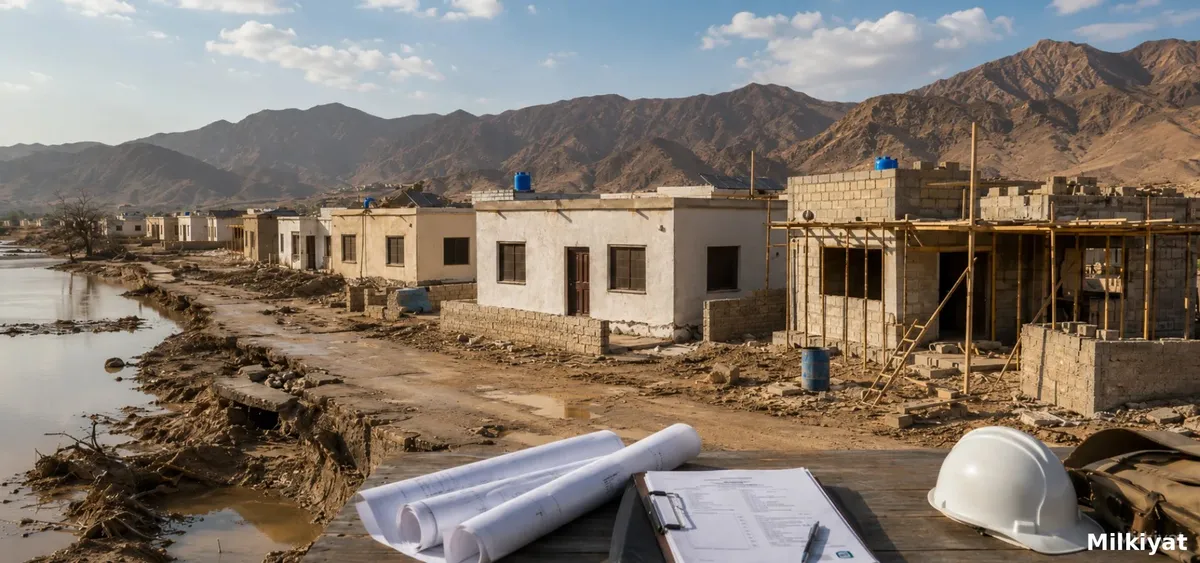
The government has quietly restructured the Rs115 billion, World Bank-funded Integrated Flood Resilience & Adaptation Project (IFRAP), capping its housing component at approximately 69,000 homes even though more than 134,000 verified flood-affected families in Balochistan had been registered for assistance, according to Dawn, published 10 August 2026. Bloom Pakistan corroborated the restructuring the same day.
Why the Project Was Restructured
The project steering committee (PSC), led by Planning Minister Ahsan Iqbal and Balochistan Chief Minister Sarfraz Bugti, capped the $155 million housing component of the $400 million IFRAP at roughly 69,000 homes at its June 22-23 meeting, and formally declined a proposed $180 million in additional World Bank financing that could have extended reconstruction to the remaining registered families. The remaining housing funds are being redirected toward roads and irrigation projects instead.
Allegations of Record Tampering and Duplicate Claims
Dawn reported that official documents and background discussions point to investigations into alleged record tampering, duplicate claims, and multiple payments issued for the same housing units, with recorded attempts to disrupt those probes. PSC meeting minutes show Ahsan Iqbal raised concern over "misreporting" of completed houses — the number presented to the prime minister was 15,000, while official reports showed only 8,694 completed. Both the planning minister and the Balochistan chief minister have ordered an independent, high-level inquiry, and the Planning Commission has proposed satellite imagery as a verification method going forward. The commission also acknowledged serious corruption charges against certain officials, though its fact-finding committee reportedly could not access relevant records held in Balochistan.
A Broken Promise After the 2022 Floods
Following the devastating 2022 floods, Pakistan secured more than $9 billion in international pledges at the January 2023 Geneva Conference. IFRAP was designed as a community-led, owner-driven housing reconstruction model for Balochistan, and Prime Minister Shehbaz Sharif had publicly promised a resilient house for every family that lost one. According to the World Bank's official announcement, the project was originally structured to benefit roughly 2.7 million people across Balochistan's calamity-declared districts, and its official project site describes it as a $400 million initiative spanning 32 districts.
Sindh's Comparable Project Tells a Different Story
The commission pointed to a structurally similar programme, the Sindh People's Housing for Flood Affectees (SPHF), involving roughly $3 billion in funding and over 2 million home reconstructions, which continues without a comparable funding cut — though the Planning Commission says it remains unhappy about the absence of third-party verification there too. Officials say the two projects aren't directly comparable: IFRAP is a federal budget project financed through a single World Bank loan with strict compliance requirements, while Sindh's programme borrows directly from multiple lenders through a Section 42 non-profit entity with more flexible disbursement rules.
What This Means for Affected Families and Verification
For the roughly 65,000 registered families who may now fall outside the capped housing allocation, this restructuring effectively closes off the path to a subsidised resilient home under IFRAP, absent a policy reversal following the ordered inquiry. Families and local officials navigating housing reconstruction claims should watch for how the satellite-imagery verification process is implemented, since it may become the basis for resolving disputed completion figures. This story underscores a broader theme in Pakistan's post-disaster housing efforts — the gap between pledged international financing and verified, on-the-ground delivery — a pattern also visible in ongoing land-record and ownership-verification pushes elsewhere in the country, including milkiyat.com's coverage of Rawalpindi's land revenue division reforms aimed at reducing documentation-driven disputes.
Sources
- Dawn — "Rs115bn WB-funded rehabilitation project restructured quietly", 10 Aug 2026: https://www.dawn.com/news/2021814/rs115bn-wb-funded-rehabilitation-project-restructured-quietly
- Bloom Pakistan — "World Bank's Rs. 115 Billion Balochistan Flood Project Restructured", 10 Aug 2026: https://bloompakistan.com/world-banks-rs-115-billion-balochistan-flood-project-restructured/
- World Bank — "Post-Floods Reconstruction and Building Climate Resilience: World Bank Approves $213 Million for the Flood-Affected Communities of Balochistan" (official press release): https://www.worldbank.org/en/news/press-release/2023/05/25/post-floods-reconstruction-and-building-climate-resilience-world-bank-approves-213-million-for-the-flood-affected-commun
- IFRAP — Official Project Website: https://ifrap.org.pk/about-ifrap/
- Business Recorder — "2022 floods: $10.9bn aid received against $30bn losses": https://www.brecorder.com/news/40321711