Blog
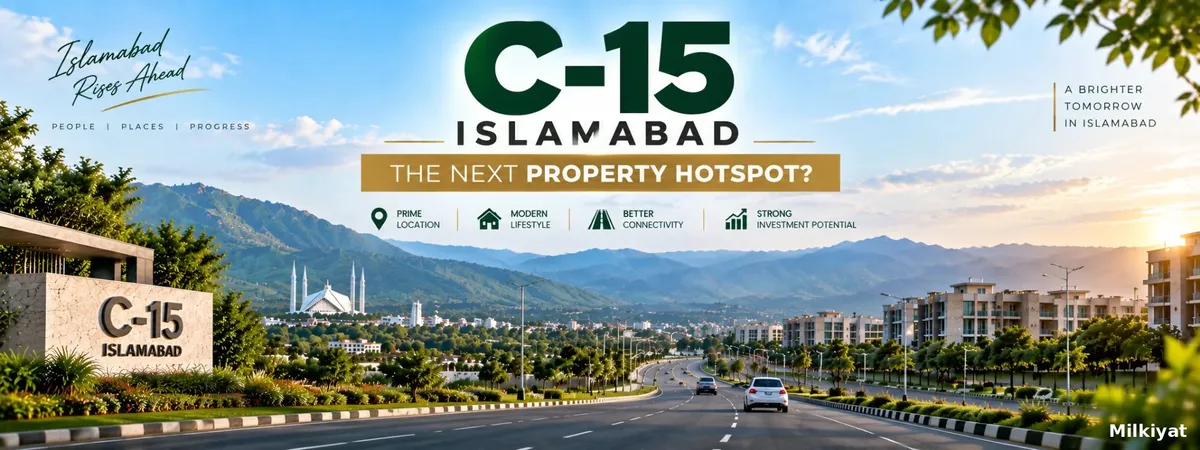
C-15 Islamabad: The Next Property Hotspot?

By Bibi Masooma
Real Estate AnalystVerified author
11 min read
Short Answer:
Not yet, based on the current record. C-15 Islamabad remained on CDA's list of partially or fully stalled sectors as of the mid-2026 review, with legal and compensation issues still unresolved. At the same time, the sector has seen real infrastructure development activity and shares a 2008 land sharing origin with C-14, which became a stronger property market after CDA prioritised its development. Whether C-15 Islamabad becomes the next property hotspot depends on future CDA decisions and sustained development progress not on anything that has been officially confirmed yet.
C-15 Islamabad: Why It Is Being Watched
“Next property hotspot” is not yet a confirmed description of C-15. The sector has genuine factors that make it worth monitoring, but its future depends on development progress, legal resolution, CDA priorities, and eventual movement toward possession.
| Factor | Current Position | What It Means |
|---|---|---|
| CDA involvement | Confirmed | Provides an institutional development framework. |
| Infrastructure work | Ongoing | Shows real development activity, but not a finished sector. |
| Legal position | Unresolved issues remain | Creates uncertainty around the development timeline. |
| Possession | Not yet at mature residential stage | Investors should expect a longer holding period. |
| Liquidity | Relatively limited | Quick resale should not be assumed. |
| Future potential | Possible, not guaranteed | C-15 could strengthen if CDA resolves key issues and accelerates development. |
| Investment view | Watch-and-wait for most buyers | Decisions should be based on verified progress rather than “next hotspot” marketing claims. |
The key takeaway is that C-15 has a credible case for future potential, but it has not yet earned the certainty associated with an established property hotspot. Buyers should focus on measurable milestones rather than predictions, especially legal resolution, infrastructure completion, CDA prioritisation, possession progress, and improving market liquidity.
The Optimistic Case, and Why It's Not Crazy
C-15 sits in the same 2008 land-sharing cluster as C-14, a sector that spent years stalled before CDA's current leadership made it a possession-handover priority in early 2026. That's a real, documented precedent, not a hypothetical comparison invented to make C-15 sound better.
CDA has also put real money behind C-15 specifically, not just words. A Rs 67 million tender issued in November 2025 for road infrastructure, culverts, and remaining development work is a formal, dated, financial commitment, the kind of thing that shows up in CDA's own procurement records rather than just in a press quote. For a broader look at how these development factors can affect C-15 Islamabad property prices and investment decisions, see our C-15 Islamabad Property Prices 2026 guide.
And underneath all of this sits a structural advantage that private housing schemes simply can't match: the land itself runs through CDA's own title, not a private developer's collection of purchase agreements from individual landowners. That single fact can reduce a major category of ownership risk, although it does not remove the legal, development, timeline, or liquidity risks that still need to be assessed.
The Honest Problem
Here's what the optimistic case tends to leave out, deliberately or otherwise: as of a mid-2026 Dawn report, C-15 was still grouped with sectors CDA itself classified as "partially or fully stalled," pending further review at a subsequent meeting. That's CDA's own characterisation of its own sector, not a skeptic's outside assessment. When the authority developing a sector describes it, in its own internal reviews, as needing further discussion before action, that's a meaningfully different situation from a sector already in its "final stages" of development, the language CDA has used for C-14. CDA's official development update on C-15 and other new sectors also provides useful context on the development work being undertaken.
The bigger issue underneath that classification isn't just administrative slowness, it's legal and financial. The Islamabad High Court ruled that CDA must pay cash compensation, rather than plots, to land-affected people in sectors acquired under this 2008 land-sharing arrangement, a decision that leaves CDA working through billions of rupees in payouts across multiple sectors, C-15 among them. Legal and compensation issues of this scale don't resolve on a marketing timeline, or even necessarily on CDA's own preferred timeline, they resolve when the money is actually budgeted, the claims are actually verified, and the payouts are actually made. There's no public date attached to when that process completes for C-15 specifically.
What "Becoming C-14" Would Actually Require
It's worth being precise about what C-14's turnaround actually consisted of, because "C-15 could be the next C-14" is a claim that only means something if you understand what happened the first time. C-14's turnaround wasn't a natural, inevitable consequence of time passing or the broader Islamabad market improving. It happened because CDA's chairman made C-14 a specific, named priority, backed that priority with regular, publicly reported follow-up meetings, tracked concrete infrastructure milestones like electricity completion percentages and street signage installation, and pushed the sector through a compressed handover timeline once the groundwork was in place. Our C-14 development update looks at the development decisions and what they could mean for Islamabad property investors.
For C-15 to follow a genuinely comparable arc, three specific things would need to happen, roughly in this sequence. CDA would need to resolve the sector's remaining Built-Up Property compensation claims, since possession generally can't be finalised while land remains tied up in active compensation disputes. CDA would then need to formally reclassify C-15 out of "stalled" status in one of its internal reviews, the same kind of administrative shift, from general mention to specific chairman-led priority, that preceded C-14's own acceleration. And the funded road and culvert work from the November 2025 tender would need to actually finish, ideally with CDA publicly confirming the sector has entered its "final stages," the same phrase applied to C-14 at an equivalent point in its own journey.
None of that is impossible. C-14 proves CDA is institutionally capable of executing exactly this kind of turnaround when it chooses to. But none of it has happened yet for C-15, and there's no announced timeline suggesting exactly when, or even whether, it will.
If you're weighing a purchase specifically because C-15 "could be the next C-14," treat that as a real possibility worth monitoring, not as a current fact. The gap between "could be" and "is" is doing a lot of work in that sentence, and it's the exact gap a good sales pitch is designed to make you forget about.
What C-15 Would Need to Match C-14
| Key Requirement | What It Means for C-15 |
|---|---|
| Legal resolution | Remaining compensation and BUP claims need to be resolved. |
| CDA prioritisation | C-15 would need clear, dedicated development focus from CDA. |
| Infrastructure completion | Funded road and culvert works would need to progress toward completion. |
| Possession pathway | CDA would need to confirm that the sector is moving toward possession. |
| Investor takeaway | “Next C-14” remains a possibility, not a confirmed outcome. |
Why This Kind of Comparison Gets Made So Often
It's worth understanding why "the next [successful sector]" framing is so common in Islamabad's property market generally, because it's not unique to C-15. Once any sector achieves a visible, well-publicised turnaround, like C-14's move from stalled to possession-stage, market participants naturally start looking for the next candidate that shares enough surface similarities to justify the comparison. Shared origin, shared numbering, shared geography, all of these make for a plausible-sounding pitch. But plausibility isn't the same as confirmation, and the sectors that actually get prioritised next are determined by CDA's own internal decision-making process, budget allocation, and political and administrative priorities, factors that are genuinely difficult for an outside observer to predict with confidence.
This doesn't mean the comparison is worthless, C-15 genuinely does share meaningful structural similarities with C-14 that a completely unrelated sector wouldn't share. It means the comparison should be treated as one input into your thinking, alongside the specific, current facts about C-15's own stalled status and unresolved legal issues, rather than as a substitute for those facts.
Who Should Actually Be Watching This Sector
This is realistically a watch-and-wait situation for most buyers, rather than an act-now one, unless you specifically want CDA-backed land title at what may be a lower current cost than a possession-stage sector, and you're genuinely comfortable holding through an unclear, potentially multi-year timeline without needing liquidity from this specific position. Our C-15 investment assessment walks through exactly who that profile does and doesn't fit, including the key risks, timeline considerations, and factors investors should assess before buying.
For anyone who needs a clearer timeline today, whether because they need a place to actually build and live soon, or because they need the option to resell relatively quickly if circumstances change, sectors already past this stage, like C-14, carry meaningfully less of this specific kind of uncertainty, even if the entry cost may now be somewhat higher than C-15's current pre-possession pricing.
What to Watch For
If you're genuinely interested in C-15's trajectory rather than looking for a reason to buy today, the useful move is to watch CDA's own announcements specifically, rather than marketing claims from any party with a file to sell. Three concrete, checkable signals would actually move C-15 from "could be" to "is": a resolution of the sector's Built-Up Property compensation issue, announced by CDA or reflected in a court filing; a reclassification decision similar to what happened with C-14, moving the sector from general mention to active, prioritised development; and completion updates on the funded road and culvert tenders, ideally with CDA using the same "final stages" language it eventually used for C-14.
None of these signals require insider information to track, they're the kind of thing that shows up in CDA's own gallery announcements and in Dawn's ongoing coverage of CDA's board meetings. Checking back on these specific markers periodically is a considerably more reliable strategy than trying to time a purchase around a broker's confident-sounding prediction.
The Broader Pattern Worth Recognising
Zoom out from C-15 specifically, and a broader, useful pattern emerges about how Islamabad's stalled sectors tend to resolve over time. CDA's 2008 land-sharing sectors, the batch that includes C-13, C-15, C-16, D-13, E-13, and F-13, sat largely dormant for well over a decade before any of them saw meaningful movement. C-14's turnaround shows that dormant status isn't necessarily permanent, but it also shows that the trigger for change tends to be a specific, identifiable administrative decision, not simply the passage of time or rising demand elsewhere in the city. Sectors don't develop themselves; a chairman, a board meeting, and a budget allocation do.
This matters for how you should think about any sector currently described as "the next" something. The label reflects genuine structural similarity to a sector that already succeeded, and that's worth taking seriously as one piece of evidence. But it doesn't reflect a confirmed decision that the same administrative attention is coming, and that specific gap, between structural similarity and confirmed prioritisation, is exactly where a buyer's due diligence needs to focus.
C-15 Islamabad Development: What to Watch
Watching CDA's own announcements, rather than relying on marketing claims, remains one of the most reliable ways to track C-15 Islamabad's actual development progress. Official updates can help buyers and investors distinguish between confirmed infrastructure work, administrative decisions, and future expectations. For anyone following the sector, changes in CDA's development priorities, legal and compensation matters, infrastructure progress, and possession-related announcements are the key signals worth monitoring.
Frequently Asked Questions
1. Is C-15 currently a property hotspot?
No, not by CDA's own classification. As of the most recent reporting, it remained grouped among partially or fully stalled sectors.
2. Could it become one?
Possibly. It shares its origin with C-14, which did make that transition, but that outcome depends on CDA decisions that haven't been made yet.
3. What's stopping C-15 from progressing faster?
Unresolved Built-Up Property compensation claims, which the Islamabad High Court ruled must be paid in cash, a process CDA is still working through.
4. Is money actually being spent on C-15 right now?
Yes. CDA issued Rs 67 million in tenders in November 2025 for road infrastructure, culverts, and remaining development work in the sector.
5. Should I buy now hoping it becomes the next C-14?
That's a bet on a specific CDA decision that hasn't happened yet, not a confirmed outcome. Weigh it against your own risk tolerance and timeline rather than treating it as inevitable.
6. How would I know if C-15's status has actually changed?
Watch for specific CDA announcements: a resolution of the BUP compensation issue, a formal reclassification out of "stalled" status, and confirmed completion of the funded infrastructure tenders.
7. Why do so many sectors get compared to whichever one just succeeded?
Because shared origin and geography make for a plausible-sounding pitch, even though the sector CDA actually prioritises next depends on internal decisions that are hard for outsiders to predict. Treat the comparison as one input, not a confirmed forecast.