Blog
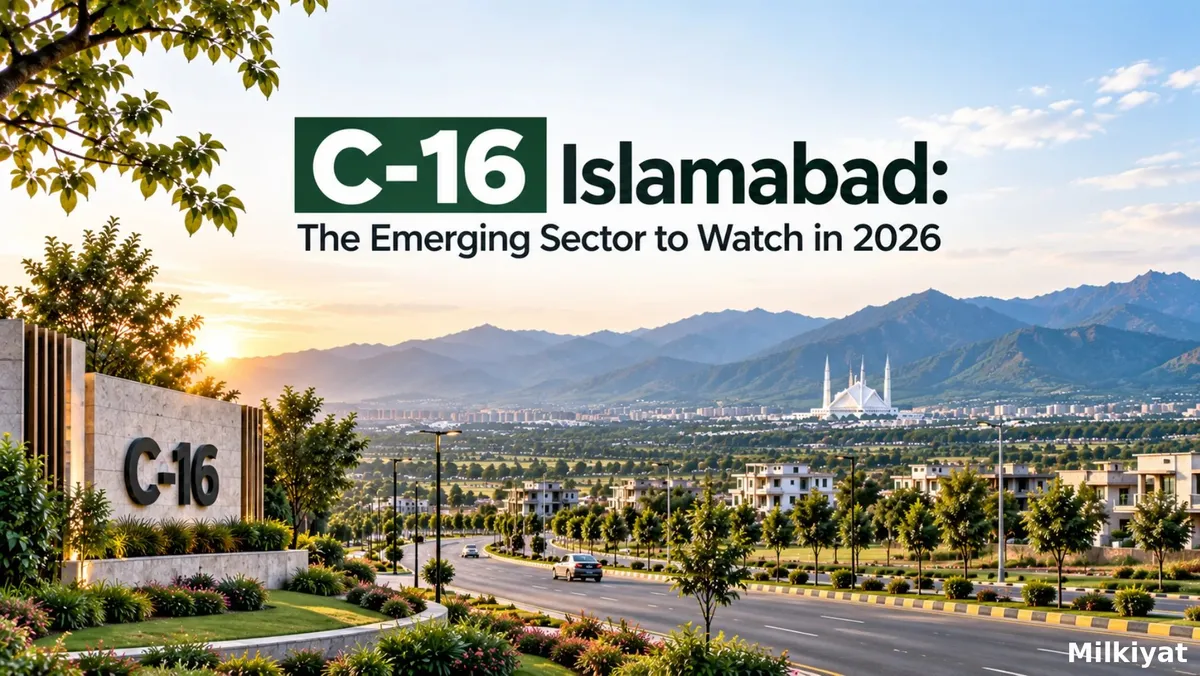
C-16 Islamabad: The Emerging Sector to Watch in 2026

By Bibi Masooma
Real Estate AnalystVerified author
13 min read
Short Answer
Is C-16 Islamabad worth watching for investment? Yes, C-16 has several documented factors that make it worth monitoring, including a Rs 5 billion CDA infrastructure development tender issued in November 2025, a master plan covering approximately 2,500 residential plots, and stronger recent development activity compared with some other emerging Islamabad sectors.
However, C-16 is not yet a confirmed near-term investment play. The sector experienced a multi-year gap between earlier development announcements and the 2025 infrastructure tender, and it remained classified as “partially or fully stalled” in the mid-2026 assessment. There is also no confirmed possession date.
For buyers and investors, the most accurate conclusion is simple: C-16 Islamabad has genuine development momentum and long-term potential, but investors should remain patient and verify CDA's latest progress before committing capital. Documented development activity is encouraging, but it should not be treated as a guarantee of rapid completion, possession or price appreciation.
Why C-16 Islamabad Is Being Watched in 2026
Every year, a handful of Islamabad sectors get labelled “the one to watch,” usually by whoever currently holds a file in them. C-16 is unusual because the label has real, documented evidence behind it, including major infrastructure development activity. That does not mean the evidence guarantees a particular outcome. The more useful approach is to weigh C-16's genuine development momentum against the uncertainty that remains around completion and possession.
C-16 Investment Case: Positive Signals vs Uncertainty
| Positive Signal | What It Supports | Remaining Uncertainty |
|---|---|---|
| Rs 5 billion CDA infrastructure tender | Shows that significant development activity has moved into a formal implementation stage. | A tender does not by itself guarantee rapid completion or possession. |
| Approximately 2,500 residential plots | Indicates a sizeable planned residential sector with room for future community growth. | Planned capacity does not mean the sector is already fully developed. |
| Margalla Avenue location | Provides a strategic position within Islamabad's northern development corridor. | Actual connectivity depends on completed infrastructure and road access. |
| Recent development momentum | Makes C-16 more credible as an emerging-sector investment story. | Earlier development delays show that progress can take longer than expected. |
| Comparative research | Places C-16 favourably against some similar emerging sectors. | Comparative rankings are not guarantees of future returns. |
| Long-term development potential | Creates a possible opportunity for patient investors. | No confirmed near-term possession outcome means investors need to accept timeline risk. |
The key point: C-16 deserves attention because its investment story is supported by documented development evidence, not simply promotional language. At the same time, investors should treat it as a development-stage opportunity with execution and timing risk, rather than a guaranteed short-term winner.
Why C-16 Actually Earns the "Watch" Label
Start with what makes C-16 different from most sectors that get this kind of hype. In November 2025, CDA issued tenders worth an estimated Rs 5 billion for development works in Sub-Sectors C-16/1 and C-16/2. That's not a vague promise or a chairman's soundbite, it's a formal, dated procurement commitment, dramatically larger than the roughly Rs 67 million CDA committed to neighbouring C-15 around the same time. When an authority puts that much money behind a specific, named piece of infrastructure work, it's a genuinely meaningful signal, distinct in kind from the marketing language that surrounds most "emerging sector" pitches.
Layer onto that a master plan with real specificity behind it: CDA officials confirmed back in 2023 that C-16 was designed around roughly 2,500 residential plots, a markaz, and class-III shopping centres, a considerably larger and more self-contained planned community than many comparably sized sectors. And separately, Milkiyat's own cheapest-sectors research ranks C-16 ahead of neighbouring C-15 specifically on development activity, a considered, comparative judgment rather than a generic claim about the area.
The Part the Hype Usually Leaves Out
Here's what a simple "next hotspot" pitch tends to skip: as of a mid-2026 Dawn report, C-16 remained grouped with sectors CDA itself classified as "partially or fully stalled," needing further review at a subsequent meeting. This came after the Rs 5 billion tender had already been issued, which is a genuinely important sequencing detail. A large funding commitment, on its own, did not move C-16 out of this classification. Whatever threshold CDA is actually using to decide a sector has "turned the corner" appears to require completed, on-the-ground infrastructure progress, not simply a budget allocation, however large.
There's also C-16's own specific history to reckon with. The sector's story doesn't start in 2025, it starts in 2023, when CDA announced an approved layout plan and a stated intention to begin inviting development tenders, alongside an anti-encroachment operation to clear the site. A meaningful gap, roughly two years, separated that announcement from the next major, verifiable funding milestone. That's not a hypothetical caution, it's C-16's own documented pattern, and it's worth weighing directly against any current optimism about how quickly the newly funded work will actually translate into possession.
What This Pattern Actually Tells You
The useful lesson here isn't "ignore C-16" or "C-16 is definitely about to boom," it's something more specific: this sector has demonstrated, in its own recent history, that announcements and even substantial funding commitments have not reliably predicted a fast timeline to completion. CDA's own broader track record on sector development backs this up, officials have separately acknowledged what one source described as a historically "poor" record on completing sector development on the timelines originally announced, citing decades-long delays in sectors like E-12 as an example of just how far a projected timeline can slip.
None of this means C-16 won't eventually complete its current round of development and reach possession. It means that the honest, evidence-based expectation should be shaped by C-16's own documented pattern of extended gaps between milestones, not by the size of the most recent funding announcement alone.
If someone is pitching C-16 to you specifically because of the Rs 5 billion tender, ask them directly what's actually been completed with that money so far, not just how much was allocated. The gap between "funded" and "finished" is exactly where this sector's own history suggests caution is warranted.
How C-16 Compares to Sectors That Genuinely Did Turn Around
It's worth being specific about what a genuine turnaround looks like elsewhere in Islamabad's sector-development pipeline, since C-14 provides a real, recent example within the same broader corridor as C-16. Our C-14 Islamabad guide covers how that sector moved from a similarly uncertain status through to an actual possession-handover process, driven by a sustained, specifically tracked push from CDA's current leadership, publicly reported milestones like electricity completion and street signage installation, not just a single funding announcement.
C-16 hasn't yet reached the point where CDA is describing its infrastructure in that same "final stages" language, the specific phrase that has consistently preceded possession handovers in sectors like C-14 and I-12. Until that language appears in an official CDA statement about C-16 specifically, the sector remains, by CDA's own most recent classification, in an earlier phase of the same broader process that eventually got C-14 to possession.
Who Should Actually Be Watching, and How Closely
This is genuinely a case where "watch it" is good advice, more so than for many sectors that get the same label without the evidence to back it up. But watching closely means tracking specific, checkable markers, not just remembering that a large number was once announced. The markers worth tracking are: a CDA statement describing C-16's infrastructure as having entered its "final stages"; confirmation that the Rs 5 billion tendered work has substantially progressed, ideally with specific completion percentages or milestones, the way CDA has periodically reported for C-14 and C-15; and any formal reclassification of C-16 out of the "partially or fully stalled" category in a future CDA leadership review.
For an investor or buyer who's specifically drawn to C-16 because of its comparative advantages over sectors like C-15, more funding, a larger and more established master plan, it's worth pairing that genuine interest with the same patience the sector's own history suggests is warranted. Our C-16 investment guide goes into considerably more depth on exactly who this kind of position suits and who it doesn't.
A Fair Final Word
C-16 deserves more genuine attention than most sectors carrying the "emerging" or "one to watch" label, because unlike most of them, it has real, dated, verifiable evidence behind the claim: a Rs 5 billion infrastructure commitment, a specific and sizeable master plan, and a favourable comparative ranking in independent research. But the same body of evidence that makes the optimistic case also contains the sector's own cautionary history, a multi-year gap between its initial 2023 announcement and its next major milestone, and an official "partially stalled" classification that persisted even after the large 2025 funding news. Both of these things are true at once, and a genuinely useful assessment of C-16 in 2026 has to hold both, rather than picking whichever one makes for a better headline.
Why This Kind of Careful Reading Matters Beyond C-16
The broader lesson from C-16's story extends well beyond this one sector. Islamabad's property market regularly produces genuinely exciting, evidence-backed developments real tenders, real funding and real institutional attention alongside marketing narratives that borrow the excitement of those developments without carrying forward the same nuance. Learning to separate the two isn't about becoming cynical toward every positive announcement. C-16's Rs 5 billion infrastructure tender is a genuinely meaningful positive development; the important question is what that evidence actually confirms about the sector's timeline and investment prospects.
For buyers who want to assess C-16 property prices, market conditions and buyer considerations, Milkiyat's C-16 Islamabad property market guide provides a broader market-focused perspective.
Applied to C-16 specifically, this approach produces a clear-eyed conclusion: the sector has real momentum, but that momentum should be balanced against its documented development history and the absence of confirmed possession. That is a more useful takeaway for a prospective buyer or investor than either the breathless “next big thing” framing or the dismissive “it's just another stalled sector” reaction. Both positions miss part of what the available evidence tells us about C-16 in 2026.
The Practical Investment Lesson
| What to Check | Why It Matters |
|---|---|
| Official CDA announcements | Establish whether a development claim is formally documented. |
| Tender and funding details | Show whether proposed development has moved into an actual implementation stage. |
| Physical development | Confirms whether announced plans are translating into work on the ground. |
| Possession status | Provides a much stronger indicator of how close a sector is to becoming a functioning property market. |
| Confirmed timelines | Help investors distinguish realistic holding periods from speculative expectations. |
| Current market prices | Should be assessed separately from future development potential and should not be treated as guaranteed future values. |
Bottom line: C-16's investment case is strongest when its positive development signals and remaining risks are considered together. The goal is not to promote or dismiss the sector, but to give buyers enough evidence to make an informed decision.
The Simplest Test for Any “Emerging Sector” Claim
If you take away one practical habit from this whole discussion, let it be this: whenever you hear a sector described as “emerging” or “the one to watch,” ask specifically what dated, official evidence backs that claim, and then ask what that same evidence does not confirm. For C-16, the evidence is genuinely more favourable than for many sectors that receive this kind of attention: there is a real Rs 5 billion infrastructure development tender for C-16/1 and C-16/2, documented through the official CDA tender record, along with a sizeable master plan and comparative evidence of stronger recent development activity.
But the same test also surfaces what isn't confirmed: there is no confirmed possession date, no clear evidence that the sector has been formally removed from its stalled classification, and a documented history of multi-year gaps between planning announcements and completed development. These limitations matter just as much as the positive signals when assessing C-16's investment potential.
Running this same test against any other sector you come across one you're pitched by a broker, one you see praised in a marketing video, or one that appears as a suggestion in a property app can tell you far more about its actual current status than the excitement of the pitch itself. C-16 currently passes this evidence-based test better than many comparable emerging sectors, but passing the test is not the same as having already reached completion or possession.
Frequently Asked Questions
1. Is C-16 actually worth watching in 2026?
Yes, more so than most sectors that get this label, given the scale of its documented 2025 funding commitment and its specific, sizeable master plan. But "worth watching" isn't the same as "ready to buy with confidence."
2. What's the single biggest reason for optimism about C-16?
The Rs 5 billion tender CDA issued in November 2025 for its two sub-sectors, a genuinely large, dated, and verifiable infrastructure commitment.
3. What's the single biggest reason for caution?
Despite that funding, C-16 remained officially classified as "partially or fully stalled" as of a mid-2026 review, and the sector's own history includes a roughly two-year gap between its 2023 launch announcement and the 2025 funding milestone.
4. Is C-16 further along than C-15?
On funding scale, yes, considerably. On official classification, both remained grouped together as "partially or fully stalled" in the most recent available CDA review.
5. Should I buy in now because of the hype?
Weigh the genuine evidence, the funding commitment and the master plan, against the sector's own documented pattern of slow follow-through, rather than acting purely on the "emerging sector" framing alone.
6. What would confirm C-16 has genuinely turned the corner?
A CDA statement describing its infrastructure as having entered "final stages," confirmed substantial progress on the Rs 5 billion tendered work, and a formal reclassification out of "stalled" status.
7. How does C-16 compare to C-14 as a point of reference?
C-14 has already progressed to possession-handover following a sustained, tracked push from CDA leadership. C-16 hasn't yet reached that same "final stages" language in official CDA statements, suggesting it's earlier in a broadly similar process.