Guide
Guide
A buyer's guide to the LDA Land Use Rules 2020: the ten land use classes, permitted, permissible and prohibited uses, mixed use and peri-urban land, commercialisation and conversion fees, and how to check a plot's land use in Lahore.
What an apartment for sale in E-11 Islamabad costs in 2026: prices by building, sub-sector and size, price per sq ft, 2 bed and 3 bed budgets, maintenance and parking, rental yield, how to verify a flat and the society transfer process.
Buying or selling in Faisal Hills means paying more than the plot price. This guide explains FBR valuation and DC rates, 236K and 236C advance tax, capital gains tax, stamp duty, transfer charges and annual property tax, with worked examples for 5, 8 and 14 marla plots.
West-open plots are the most demanded in DHA Karachi, but direction is only one part of a plot's value. This guide compares west, east, south and north-open plots on breeze, sunlight, design and price, and shows how to check a plot's direction.

Real Estate Analyst
10 min read
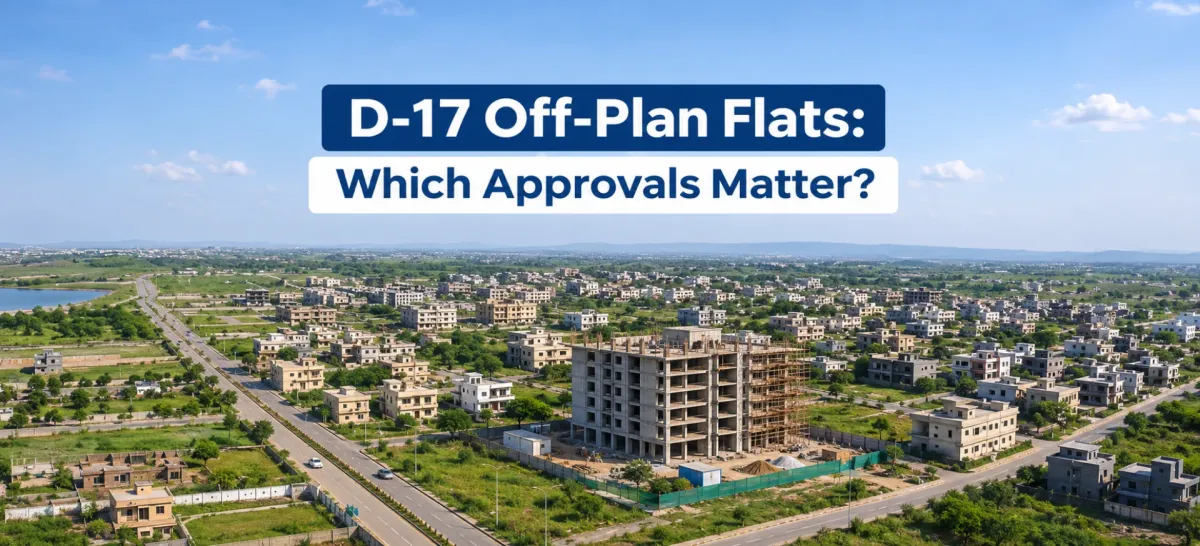
An off plan apartment D-17 offer can look affordable when a developer advertises a small booking amount, monthly installments and future possession. However, buying before completion introduces risks that do not apply in the same way to a legally transferable, ready-to-occupy flat.
Buyers researching the D-17 property market should first establish the exact project location, developer identity, land ownership and approval status. The sector includes Margalla View Housing Society (MVHS), but society-level records cannot automatically prove that an individual apartment project has permission to be built.
This guide explains the main approval, NOC, installment and developer checks before investing in a proposed apartment.
An off-plan apartment is purchased before the completed unit is available for occupation. Depending on the project, buyers may reserve a unit using architectural plans, marketing material and a payment schedule.
There are three important stages:
| Project stage | Buyer should establish |
|---|---|
| Off-plan or proposed | Land title, approvals and developer authority |
| Under construction | Approved design, construction progress and finances |
| Completed |
| Completion documents, utilities and lawful possession |
A project described as "launched" or "booking open" is not necessarily approved for construction.
Likewise, a building with a completed concrete structure may still lack the finishing work, clearances or utility connections needed for occupation.
Margalla View Housing Scheme is a private development associated with M/s Twin City Housing (Pvt) Ltd. in D-17/2, Islamabad.
Its original layout plan was approved in January 1995. The official record also identifies a revised layout approval from around the end of 2020.
The important complication concerns the development NOC.
CDA's current online scheme record labels the NOC status "Not Issued." However, the December 2025 regulatory documentation discussed in Milkiyat's published research refers to an NOC issued on June 14, 2002.
These records are inconsistent and must be clarified through the responsible authority before a financial commitment.
For the scheme's detailed approval history, see the Margalla View Housing Scheme guide.
No.
A housing scheme's layout approval concerns the wider land arrangement. Approval for a particular multistorey building involves additional questions about land use, building design and applicable construction requirements.
An apartment developer must demonstrate that the relevant site is authorised for the proposed development.
Even if an entire society has approved residential plots, a developer cannot assume that every plot may legally accommodate an apartment tower.
When a seller advertises a "D-17 apartment NOC," ask which approval the document actually represents.
The term may be used loosely to describe different stages of authorisation.
| Document | What it helps establish |
|---|---|
| Housing-scheme layout approval | Approved overall land arrangement |
| Development NOC record | Relevant society-level development permission |
| Approved building plan | Permitted design and building configuration |
| Land-use confirmation | Whether the proposed building use is allowed |
| Completion or occupancy documents | Whether the finished building may be occupied |
Documents should identify the relevant project, plot, approving authority and approval conditions.
A developer's statement that the "society is approved" does not answer whether the apartment project itself is authorised.
Likewise, an application receipt or an NOC for another building is not proof of approval for the advertised unit.
Before paying a booking amount, request the project's complete address and plot identification.
Ask to see the approved layout showing where the development site sits.
This matters particularly in MVHS because the published regulatory history includes disputes concerning amenity land and changes to the original layout.
An apartment project should not be assumed lawful merely because neighbouring houses and commercial buildings are occupied.
The proposed use must match the relevant approved plans and permissions.
A site described informally as "commercial" may still require specific building approvals. A residential plot cannot automatically be converted into apartments.
Also check whether the developer is offering ownership of a defined unit or another contractual interest.
The purchase agreement should clearly describe what the buyer will legally receive.
A developer's marketing reputation is not a substitute for documentary verification.
Start with the company's registered name, ownership structure and contact details.
Request evidence connecting the developer to the actual project land.
Ask for written answers supported by documents.
If a marketing company is collecting payments, confirm its authority to act for the developer.
Do not send funds to an unrelated personal account merely because a salesperson provides payment instructions.
A common attraction of D-17 flats on installments is the ability to spread payments over time.
However, a low booking amount does not establish that the entire purchase is affordable.
Compare the full price, payment schedule and additional obligations.
| Payment component | What to verify |
|---|---|
| Booking amount | Refund conditions and receipt |
| Down payment | When and to whom it is payable |
| Monthly installments | Amount, frequency and due dates |
| Construction-linked payments | Milestones and independent evidence |
| Possession payment | Amount and triggering conditions |
| Additional charges | Utilities, parking, transfer and other dues |
No standard D-17 apartment installment rate is established in the workbook.
Buyers should not assume that a payment plan from another Islamabad project applies to MVHS.
Suppose a hypothetical flat costs PKR 1 crore, with 30% payable upfront and the remaining amount spread equally over 36 months.
The down payment would be PKR 30 lakh.
The remaining PKR 70 lakh divided by 36 would be approximately PKR 194,444 per month.
This is an arithmetic illustration, not an advertised D-17 project offer.
Any additional charges would increase the buyer's total obligation.
Before booking, establish what kind of document the developer will issue.
A booking receipt, allotment letter and registered ownership document may represent different stages and rights.
Ask when the buyer can transfer or sell the interest, whether developer approval is needed and what charges apply.
For a resale of an unfinished apartment, confirm that the original buyer has paid all required installments.
Also establish whether the developer recognises the proposed transfer.
An agreement between private individuals may not be sufficient to complete a project-administered transfer.
An advertised possession date should be supported by the contract and realistic construction progress.
Ask for the planned completion schedule, current construction status and conditions for extending the deadline.
The agreement should address consequences if the developer does not deliver on time.
A verbal assurance about completion is less useful than a clearly written contractual provision.
Buyers planning to move in immediately or earn rental income should be particularly cautious about uncertain delivery dates.
Apartment advertisements commonly quote area in square feet, but the measurement may include more than the space usable inside the home.
Ask whether the stated area is carpet area, covered area or a larger saleable measurement including shared spaces.
For example, two flats advertised as 1,000 square feet may have different internal room dimensions.
Request a dimensioned floor plan identifying bedrooms, bathrooms, kitchen, balconies and circulation areas.
Check the number of units per floor, lift arrangements and access to emergency exits.
The D-17 workbook does not contain verified off-plan apartment price medians, so an accurate price-per-square-foot comparison requires actual comparable offers.
Apartment ownership involves expenses beyond the purchase price.
Confirm whether parking is included, separately charged or allocated through another arrangement.
Ask how electricity, water, gas, lifts, backup power and common-area maintenance will be managed.
Planned facilities should be separated from completed facilities.
A brochure showing landscaped spaces, a gym or a backup generator does not prove those amenities will be delivered or included without additional charges.
Obtain the developer's written specifications and maintenance arrangements before booking.
D-17 includes established residential and commercial activity, but buyers should not assume that all projects share the same ownership or legal permissions.
For example, the published J7-One Mall project page describes a completed commercial development in D-17 Markaz.
That is a useful illustration of why project type and completion status matter. A commercial mall is not equivalent to a residential apartment development, and its status does not validate another building's approvals.
For wider neighbourhood context, the D-17 Islamabad area guide discusses local housing, amenities and property-market conditions.
Certain warning signs justify delaying a purchase until the missing information is resolved.
Be cautious when a seller refuses to identify the project plot or developer entity.
Other concerns include approvals described only verbally, inconsistent apartment numbers, undocumented price changes and payments requested without official receipts.
A promised "guaranteed rental return" should not replace independent analysis of demand, possession and operating expenses.
Likewise, aggressive claims that a buyer must book immediately should not override document checks.
A credible offer should withstand careful review.
Buyers can begin with the D-17 property hub linked earlier and check whether any apartment inventory is currently available.
The workbook's proposed D-17 apartment-sale destination could not be independently verified during the November 20, 2026 review. It has therefore not been inserted as a functioning category link.
For a broader comparison of apartment types and published offers, explore apartments for sale in Islamabad.
That page covers multiple Islamabad locations and should not be treated as D-17-specific inventory.
Before contacting a seller, verify the actual project name, location, construction stage and financial terms.
Approval must be checked for each building. A society-level layout approval does not automatically authorise an individual apartment project.
Its layout plan has an approval record. Official records contain inconsistent information about the development NOC, so the current position requires clarification.
Installment offers may be marketed, but each payment plan must be verified individually. The workbook does not establish a standard installment schedule.
There is no single document that replaces all checks. Buyers need to establish lawful land rights, applicable building approvals and enforceable purchase terms.
That depends on the buyer's contractual rights, developer procedures and any applicable transfer restrictions.
Refund rights depend on the signed agreement and applicable law. Check cancellation and deduction clauses before paying.
Buying an off-plan flat in D-17 requires careful verification of the developer, the project land, building approvals and contractual obligations.
The conflicting MVHS NOC records make independent confirmation especially important.
A buyer should not proceed solely because a project is advertised inside an established housing society. The safer decision is based on verifiable documents, realistic delivery conditions and complete financial information.
Last Updated: November 20, 2026