News
Fauji Cement to Install Battery Storage, Solar Power at Two Plants

By Bibi Masooma
Real Estate AnalystVerified author
5 min read
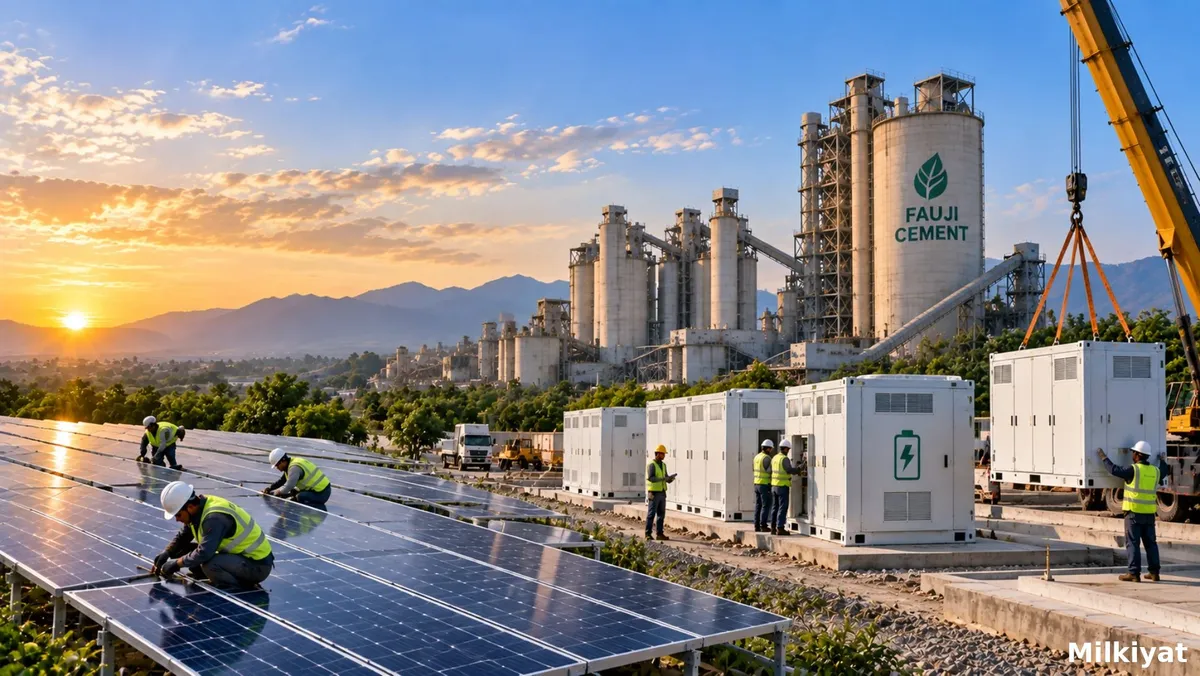
Fauji Cement Company Limited (FCCL) is set to install battery energy storage systems and solar power facilities at two of its cement plants to improve energy efficiency and increase the use of renewable power.
The project is expected to be completed within 10 months from its start date, supporting the company’s efforts to optimize energy consumption and strengthen its power infrastructure.
Board Approves Major Renewable Energy Investment
Fauji Cement Company Limited (FCCL) said its Board of Directors has approved a significant renewable energy project involving the installation of battery energy storage systems (BESS) with a combined capacity of 50 MWh, along with dedicated solar power capacity of 10 MW, at two of its production plants.
The listed cement manufacturer informed the Pakistan Stock Exchange (PSX) of the decision in a notice filed on Tuesday, as required under stock exchange disclosure rules for material corporate developments.
According to the notice, "The Board of Directors of Fauji Cement Company Limited has approved, through resolution by circulation, the installation of Battery Energy Storage Systems (BESS) of 25 MWh along with dedicated solar power setups of 5 MW each at the company's Nizampur and Jhang Bahtar plants."
This means each of the two plants will receive an identical setup: 25 MWh of battery storage paired with 5 MW of dedicated solar generation capacity, bringing the combined total across both sites to 50 MWh of storage and 10 MW of solar power.
Ten-Month Completion Timeline
The company said the project is expected to be completed within 10 months from its start date, though FCCL did not specify in the notice exactly when construction or installation would begin. The relatively short timeline suggests the company is treating this as a priority initiative rather than a long-term, multi-year rollout.
How the System Will Work
Explaining the rationale behind the project, the company said: "The project is intended to store daytime solar energy in the BESS for discharge during evening peak hours, thereby reducing reliance on peak grid electricity, optimising the company's energy costs and enhancing the company's renewable energy capacity."
In practical terms, this means the solar panels installed at the two plants will generate electricity during daylight hours, when solar output is at its peak. Rather than consuming all of that power immediately or exporting surplus back to the grid, a portion will be stored in the battery systems. That stored energy can then be discharged during the evening, when electricity demand and grid tariffs typically peak. This load-shifting approach is a common strategy among industrial energy users looking to reduce their dependence on the national grid during the most expensive and often least reliable hours of the day.
For a cement manufacturer, which runs energy-intensive operations around the clock, this kind of hybrid solar-plus-storage system can meaningfully cut electricity costs while also providing a buffer against grid instability or load-shedding.
Building on Existing Solar Investments
This is not FCCL's first foray into renewable energy. The company noted that in FY25, it had already expanded its solar capacity to 67.5 MW, a figure that now meets roughly 90% of its packaging needs and has contributed meaningfully to overall energy efficiency across its operations.
The new BESS and solar project therefore represents an incremental but substantial expansion of an existing renewable energy strategy, rather than an entirely new direction for the company. By adding battery storage to the mix, FCCL is moving beyond simply generating renewable power during the day and toward actually managing when that power is used, which is widely seen as the next logical step for industrial solar adopters.
Company Background
Fauji Cement Company Limited was incorporated in Pakistan as a public company in 1992 and commenced commercial operations in 1993. Since then, it has grown into one of the country's established cement manufacturers, producing and selling various types of cement for the domestic construction and infrastructure sectors. FCCL is part of the wider Fauji Group, one of Pakistan's largest business conglomerates with interests spanning fertiliser, cement, food, energy, and financial services.
Part of a Broader Shift Toward Alternative Energy
FCCL’s solar and battery storage project comes as Pakistan increasingly turns toward alternative energy sources. Rising electricity costs, grid reliability concerns, and falling solar technology costs have encouraged businesses to invest in renewable power.
For energy-intensive industries such as cement, solar generation and battery storage can help reduce reliance on conventional electricity and improve energy security.
What Comes Next
FCCL has not yet disclosed the total cost of the project or named the contractors or technology partners involved. As with most PSX-listed company disclosures of this kind, further details including the project's start date, funding structure, and any updates on implementation progress are likely to be shared through subsequent stock exchange filings as the project moves forward.
Source
Fauji Cement to Install Battery Storage, Solar Power at Two Plants — Business Recorder, September 22, 2026.