Guide
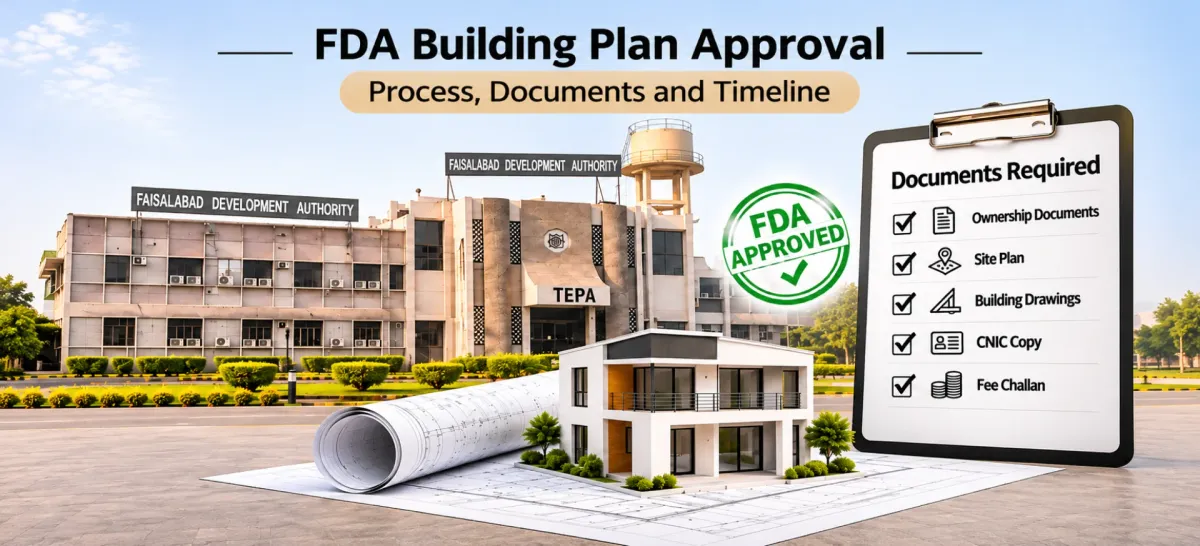
FDA Building Plan Approval: Process, Documents and Timeline
Guide
Explore apartments for sale in Park View City Islamabad, including 1, 2 and 3-bed units, project details, price comparisons, payment plans and buyer guidance.
A tenant guide to renting an office in F-10 Islamabad covering Markaz plazas, sizes, floors, rent benchmarks, approved use, agreements and a checklist.
A tenant guide to renting a shop in F-10 Islamabad covering Markaz plazas, sizes, floors, rent benchmarks, approved use, agreements and a checklist.
Explore Harmony Park in Capital Smart City, including 3.5 marla residential plots, villa apartments, location, development and property considerations.

By Maham Imtiaz
Real Estate AnalystVerified author
11 min read
Before you build a house or shop in an FDA-controlled area of Faisalabad, you need an approved building plan, often called a "naqsha". The Faisalabad Development Authority (FDA) checks your drawings against its Building and Zoning Regulations 2020, sanctions the plan, inspects the work and finally issues a completion certificate. Skipping any step can lead to fines, sealing or demolition.
Many buyers plan construction before they even choose a plot. If you are still at that stage, compare plots and houses among current property listings in Faisalabad, and check that the plot's size and road width suit the house you want to build.
This guide explains who approves plans in Faisalabad, which documents FDA asks for, what the rules allow on 5 marla, 10 marla and 1 kanal plots, how long approval takes and what it costs. For a wider look at FDA's directorates and services, read our complete guide to the Faisalabad Development Authority.
FDA's Town Planning-I Directorate handles building control in FDA's developed schemes, such as FDA City and FDA colonies. It processes every proposed plan under the FDA Building and Zoning Regulations 2020 and sends violation cases to the court of the Senior Special (Judicial) Magistrate FDA.
A later change in law also gave FDA the power to approve maps in private housing schemes under its control. Before that, FDA approved the schemes while the Faisalabad Municipal Corporation approved the building plans inside them.
| Where your plot is | Who usually approves the plan |
|---|
| FDA scheme (e.g. FDA City, FDA colonies) | FDA Town Planning-I |
| Private housing scheme in FDA's controlled area | FDA (confirm with the scheme office and FDA) |
| Older built-up city areas | Check with FDA or the Metropolitan Corporation Faisalabad |
| Outside FDA limits | The relevant local government |
Always confirm the approving body before your architect starts the drawings, because each body uses its own forms and fees.
FDA accepts plans only from qualified professionals:
| Professional | Requirement under the 2020 Regulations |
|---|---|
| Architect | Registered with the Pakistan Council of Architects and Town Planners and on FDA's approved list |
| Structural engineer | Registered with the Pakistan Engineering Council (PEC), with at least five years of structural experience |
| Buildings above 38 ft | Structural drawings vetted by a structural engineer on FDA's panel |
The architect, structural engineer and resident engineer each sign an undertaking on FDA's prescribed forms (BR-10, BR-11 and BR-12).
The regulations list the following documents for a standard application:
| Document | Detail |
|---|---|
| Application form | Forms BR-1 and BR-2 |
| Building plans | Five copies, two of them on linen, at 1:100 scale (1:200 for large buildings) |
| Title documents | Proof of ownership and allotment or transfer orders |
| Site plan and block plan | Site plan at 1:1250 and block plan at 1:400 |
| Drainage and landscape plans | At 1:400, showing tree planting |
| Undertaking | Form BR-5 on Rs500 stamp paper |
| Scrutiny fee receipt | Paid challan for the plan fee |
Larger and special buildings need extra papers. Multi-storey buildings need a stability certificate (BR-6), three sets of structural drawings, a soil report and material details. Some buildings also need an environmental (EPA) NOC or a traffic impact NOC. Religious buildings need an NOC from the district administration, and multi-storey buildings need an evacuation plan vetted by Rescue 1122 and Civil Defence.
FDA publishes its current service checklists on the Town Planning-I directorate page. Check it before you file, since FDA updates requirements from time to time.
The 2020 Regulations set these limits for residential plots in approved schemes:
Each storey needs a clear height of at least 9 ft 6 in. Violations in mandatory open spaces, such as setbacks, are non-compoundable, so FDA will not let you pay a fine to keep them.
| Step | What happens |
|---|---|
| 1. Confirm the approving body | Check whether FDA or another body controls your plot |
| 2. Hire an architect | Choose one registered with PCATP and on FDA's list |
| 3. Prepare drawings | Site, block, floor, drainage and landscape plans |
| 4. Submit the file | Lodge forms and drawings at FDA's One Window Counter or Khidmat Markaz |
| 5. Pay the scrutiny fee | FDA starts the clock once it receives the fee |
| 6. Scrutiny and site check | FDA checks the plans against the regulations |
| 7. Sanction letter | FDA approves, refuses with reasons, or asks for changes |
| 8. Construction and inspections | FDA staff may inspect without notice |
| 9. Completion notice | Notify FDA within one month of finishing |
| 10. Completion certificate | FDA inspects and issues the certificate if the building matches the plan |
FDA sanctions taller buildings in stages: foundation, ground floor, up to 38 ft, and above 38 ft. Multi-storey work cannot start until FDA approves the structural drawings.
| Service | Official timeline |
|---|---|
| Building plan approval | 30 working days (Khidmat Markaz commitment) |
| Completion certificate | 30 working days |
| Decision limit in the 2020 Regulations | 45 days for residential plans after a complete file and fee |
| Land use conversion | 45 days |
The two figures differ because they come from different instruments. The 2020 Regulations set an outer limit of 45 days, while FDA's Khidmat Markaz committed to 30 working days. For commercial and public buildings, the 45-day period starts only after you submit the required NOCs.
You can track your application through the E-Khidmat portal and mobile app, or call the E-Khidmat helpline on 080009100.
The fee schedule in the regulations dates from 2018, so confirm current rates with FDA before you pay.
| Fee | Residential | Commercial |
|---|---|---|
| Plan scrutiny (first or revised plan) | Rs5 per sq ft of covered area | Rs10 per sq ft |
| Completion processing, up to 5 marla | Rs5,000 | Rs10,000 |
| Completion processing, above 5 marla | Rs10,000 | Rs20,000 |
| Completion processing, above 10 marla | Rs20,000 | Rs30,000 |
| Clearance report | Rs500 per marla | Rs3,000 lump sum |
| Possession | Rs500 per marla | Rs300 per marla |
Milkiyat.com finding: Take a 5 marla plot of about 1,125 sq ft (25 × 45 ft). At the maximum 75% ground coverage, each floor covers about 844 sq ft. A two-storey house therefore has about 1,688 sq ft of covered area (844 × 2). At Rs5 per sq ft, the scrutiny fee comes to about Rs8,440, and the completion fee adds Rs5,000. Approval costs roughly Rs13,440 in FDA fees, before stamp paper and architect charges.
Compare that with the penalty route. Building just 200 sq ft on the first floor without approval attracts Rs350 per sq ft, or Rs70,000 (200 × 350). That single violation costs about five times the full approval fees (70,000 ÷ 13,440).
In approved schemes, a sanctioned plan lapses at the end of the plot's building period or three years from sanction, whichever comes first. In other areas, it stays valid for three years. After it lapses, you need a fresh sanction and a fresh scrutiny fee.
The building period itself runs three years for plots up to 2 kanal and up to five years for larger plots. The regulations also set daily fines for finishing late, starting at Rs5,000, so plan your construction schedule carefully.
FDA can order alterations, halt construction, demolish non-compliant work at the owner's cost and file a police report. It can also revoke a sanction for defective title or false statements after a seven-day show-cause notice.
| Violation (residential) | Penalty per sq ft |
|---|---|
| Excess ground coverage | Rs150 |
| Excess floor area ratio | Rs200 |
| Unauthorised construction, ground floor | Rs250 |
| Unauthorised construction, upper floors | Rs350 |
| Excess storeys | Rs350 |
| Excess height | Rs180 |
If work continues after FDA serves a notice, a daily fine of Rs1,000 applies for residential buildings and Rs5,000 for others. Work started before approval also attracts these penalty rates.
A completion certificate proves your building matches the approved plan. Buyers, banks and utility companies often ask for it, and a house without one can sell at a discount. FDA issues the certificate only if the work follows the sanctioned plan, or if any deviations are compoundable and you have settled them in writing.
If you are buying a built house rather than building one, ask the seller for both the approved plan and the completion certificate before you agree a price.
FDA City plots carry a fixed construction period. If you miss it, you must apply to FDA's Estate Management-II for an extension, which may carry a surcharge. Check the remaining construction period before you buy a vacant plot.
Choosing the right area matters as much as the plot itself. Our Faisalabad area guide compares the city's main neighbourhoods, roads and infrastructure, so you can pick a location that suits your build.
Yes, if your plot falls in an FDA scheme or FDA-controlled area. Confirm the approving body for your exact plot before you start.
FDA's Khidmat Markaz committed to 30 working days. The 2020 Regulations set an outer limit of 45 days for residential plans after a complete file.
FDA needs forms BR-1 and BR-2, five sets of plans, title documents, a site plan, block plan, drainage and landscape plans, a BR-5 undertaking and the fee receipt.
The regulations set Rs5 per sq ft of covered area for residential plans, plus a completion fee from Rs5,000. Confirm current rates with FDA.
The 2020 Regulations allow three storeys on a 5 marla plot in an approved scheme, up to 38 ft, with 75% maximum ground coverage.
In approved schemes, it lapses at the end of the building period or after three years, whichever comes first. Elsewhere, it stays valid for three years.
FDA can halt the work, demolish it, impose per-square-foot penalties and file a police report.
A PCATP-registered architect on FDA's approved list, and for structural work, a PEC-registered structural engineer.
This guide is for general information only. Fees, timelines and building rules can change, and parts of the regulations cited are marked as draft. Readers must confirm current requirements, fees and approvals with FDA and qualified professionals before submitting plans or starting construction. Milkiyat.com does not guarantee the accuracy of third-party information, and this guide is not legal or professional advice.