Guide
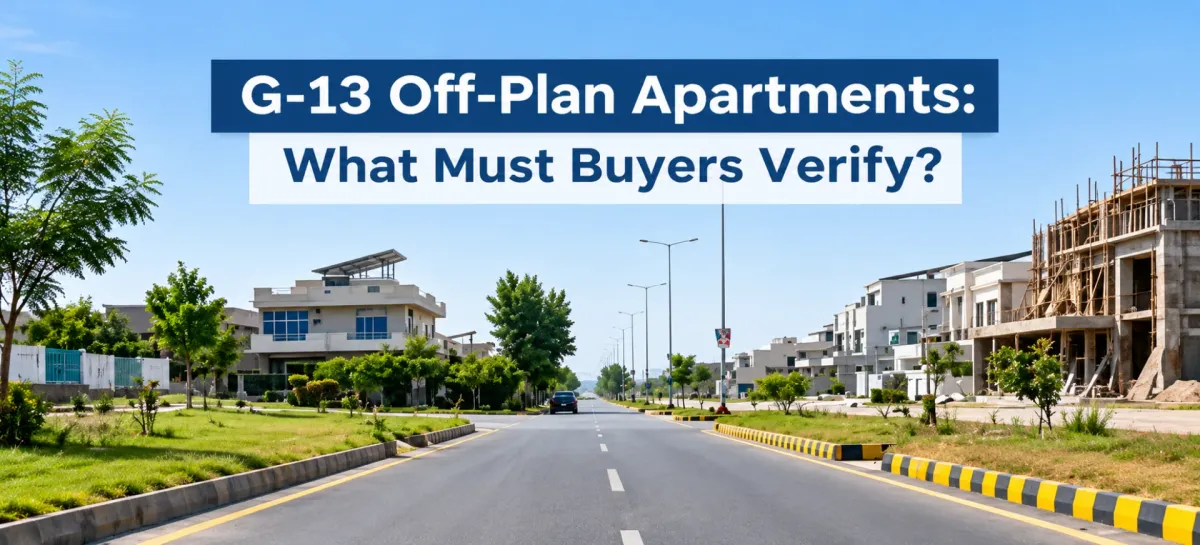
G-13 Off-Plan Apartments: What Must Buyers Verify?

Real Estate Analyst
10 min read
Buying Off-Plan Apartments in G-13 Islamabad
Buying an off plan apartment G-13 Islamabad can appeal to buyers seeking a modern home with payments spread over the construction period. However, off-plan purchases involve additional risks because the apartment may not yet be completed, inspected or ready for occupation. Buyers exploring G-13 property listings should distinguish completed flats from under-construction units and check the legal status of the exact project.
For a project-based comparison, Lifestyle Residency Islamabad is a relevant FGEHA-associated high-rise development in G-13/1 and G-13/4. Buyers can also examine the wider G-13 apartment market, but a listing alone does not confirm project approval, unit ownership or guaranteed possession. The safest purchase begins with documentary verification rather than an attractive installment advertisement.
What Is an Off-Plan Apartment?
An off-plan apartment is purchased before construction and final handover are complete.
Buyers typically make payments according to a booking and installment schedule rather than paying the entire purchase price immediately.
This arrangement can reduce the initial cash requirement, but it introduces uncertainty about construction progress, completion dates and the final delivered unit.
Off-Plan vs Ready Apartments
| Feature | Off-plan apartment | Ready apartment |
|---|---|---|
| Construction | In progress or not started | Completed |
| Initial payment | Often booking plus installments | Usually larger upfront payment |
| Inspection | Limited to plans and construction | Actual unit can be inspected |
| Possession | Future contractual date | Subject to completed transfer and handover |
| Main risk | Delay or non-completion | Building condition and documentation |
Neither option is automatically better. Buyers should choose according to their financial capacity, intended use and tolerance for delays.
G-13 High-Rise Development and FGEHA
G-13 is an established Islamabad residential sector administered through the Federal Government Employees Housing Authority (FGEHA).
High-rise apartment developments have introduced a different property category alongside traditional houses and residential plots.
FGEHA has described apartment schemes within G-13, including Lifestyle Residency and Kashmir Avenue Apartments.
However, each project has its own development arrangements, approval records and possession conditions.
Who Approves High-Rise Apartments in G-13?
Buyers should establish the applicable approval framework for the specific development.
For FGEHA-associated projects, start by examining FGEHA's project records, approved layouts, development agreements and relevant building-control documentation.
Depending on the project and applicable legal requirements, other statutory approvals may also be necessary.
An FGEHA association does not automatically prove that every required high-rise approval has been issued.
Ask the developer to provide documentary confirmation of the approvals applicable to the particular project and building.
Check 1: Verify the Project's Land Ownership
Land ownership is one of the most important checks before purchasing an apartment under construction.
A developer may advertise an apartment project without personally owning the land.
Development can instead proceed through a joint venture, lease, land-development agreement or another authorized arrangement.
Buyers should request:
- Land ownership or lawful development-right documents.
- Applicable land allotment or lease records.
- The approved project layout.
- Identification of the contracting developer.
- Relevant development and joint-venture agreements.
- Evidence of authority to sell individual units.
A marketing brochure should not replace these records.
For properties in G-13/1 Islamabad, check the development's exact site rather than assuming every apartment belongs to the same approved project.
Check 2: Confirm Building Plans and Approvals
A project's advertised tower height, number of floors and proposed facilities should match its applicable approved plans.
Request documentary confirmation of the building plans and any necessary amendments.
What Should Buyers Examine?
| Document | Purpose |
|---|---|
| Approved layout | Establishes the permitted site arrangement |
| Building-plan approval | Identifies the authorized construction |
| Environmental clearance, where required | Addresses applicable environmental obligations |
| Fire and building-safety documentation | Supports assessment of safety compliance |
| Development agreement | Explains the developer's rights and obligations |
| Completion or occupancy documents | Relevant before final occupation |
Approval of a residential sector does not automatically mean that every apartment tower within it is approved.
Similarly, booking acceptance does not prove that the developer has completed all required formalities.
Check 3: Investigate the Developer
Off-plan apartment buyers depend heavily on the developer's ability to complete construction.
Before booking, investigate the company responsible for the project.
Check its registration, previous developments, financial arrangements and construction record.
Questions to Ask
- Who is legally responsible for completing the project?
- Has the developer delivered comparable buildings?
- Are contractors formally appointed?
- What construction milestones have been achieved?
- Are project funds handled through documented arrangements?
- Is there a mechanism for resolving buyer complaints?
A well-designed sales office or promotional campaign does not establish financial capacity.
Request written evidence supporting important construction and delivery claims.
Lifestyle Residency: A G-13 Project Example
Lifestyle Residency is an FGEHA-associated high-rise apartment development involving a public-private joint-venture arrangement.
FGEHA's published project description identifies development sites in G-13/1 and G-13/4.
The project includes different apartment categories and proposed shared facilities.
However, buyers should distinguish published project specifications from confirmed conditions of individual units.
What to Verify at Lifestyle Residency
Before choosing a unit, ask for:
- The precise tower and apartment number.
- Approved covered area.
- Current construction status.
- The applicable payment schedule.
- Parking entitlement.
- Expected handover conditions.
- Outstanding charges and contractual obligations.
Do not assume that completion of one tower establishes the readiness of another.
Likewise, an advertised project price is not necessarily the final acquisition cost.
For nearby location information, explore G-13/4 property listings.
Check 4: Understand the Installment Plan
G-13 apartments on installments may appear affordable because buyers can spread payments across several months or years.
However, the booking amount does not represent the complete purchase obligation.
Before signing, obtain the full payment schedule.
| Payment component | What to verify |
|---|---|
| Booking amount | Initial non-refundable or refundable conditions |
| Confirmation payment | Deadline and contractual requirements |
| Monthly installments | Amount, frequency and due dates |
| Construction-linked payments | Milestones triggering payment |
| Possession payment | Amount payable before handover |
| Additional charges | Parking, utilities, maintenance or documentation |
Never assume that additional charges are included unless the agreement clearly states so.
Example of Total Payment Calculation
Consider a hypothetical apartment priced at PKR 1 crore with a 20% booking payment.
The initial amount would be PKR 20 lakh, leaving PKR 80 lakh under the agreed payment arrangement.
If the remaining amount were divided into 40 equal monthly installments, each installment would be PKR 2 lakh.
This is an arithmetic illustration, not an actual G-13 project payment plan.
The buyer must also account for additional contractual expenses.
Check 5: Review Possession and Delay Clauses
Possession is one of the most important issues in off-plan property transactions.
A developer may advertise an anticipated handover date, but the binding agreement determines the buyer's contractual rights.
Review the relevant clauses carefully.
Essential Contractual Questions
- What is the agreed completion deadline?
- Does the agreement allow extensions?
- What happens if construction is delayed?
- Can the apartment specifications change?
- What cancellation or refund rights apply?
- When does ownership transfer occur?
- What conditions must be satisfied before possession?
A verbal promise about early possession should not replace written contractual terms.
If the agreement provides broad extensions without meaningful buyer protections, obtain independent legal advice before proceeding.
Check 6: Verify Apartment Size and Facilities
Apartment advertisements often describe a unit using a total covered-area figure.
However, the usable internal space may differ from the area used for pricing.
Ask whether the quoted size includes shared areas, balconies or other components.
Compare These Features
- Net usable floor area.
- Total advertised covered area.
- Bedroom and bathroom dimensions.
- Balcony and ventilation.
- Lift access and backup power.
- Parking allocation.
- Building maintenance services.
- Fire and emergency arrangements.
A larger advertised apartment is not necessarily more practical if much of the area is allocated differently than expected.
For a fair comparison, calculate the price per square foot using consistently defined areas.
Check 7: Calculate the Complete Buying Cost
The advertised apartment price may exclude several expenses.
Additional costs can include applicable taxes, transfer fees, documentation, parking, utility connections and maintenance deposits.
Buyers should request a written breakdown from the developer.
Also consider the ongoing cost of living in a high-rise building.
Lifts, generators, security, cleaning and shared amenities require regular maintenance.
A comparatively inexpensive apartment may carry high monthly service charges.
Off-Plan Apartment Investment Risks
Off-plan apartment investments involve several uncertainties.
Construction Delays
Unexpected financial or construction problems can affect handover.
Changes in Specifications
Final materials, layouts or facilities may differ from earlier promotional descriptions, subject to contractual terms.
Resale Restrictions
Some projects restrict transfers before certain payments or completion milestones.
Rental Income Uncertainty
An apartment cannot generate ordinary residential rent until it is suitable and legally available for occupation.
Projected future rental yields should not be presented as guaranteed returns.
Browse G-13 Listings on Milkiyat
Buyers should compare apartments by project, location, floor area, construction progress and payment obligations.
For broader neighbourhood context, consult the G-13 Islamabad area guide.
Milkiyat also provides a G-13 real estate agents directory, where buyers can examine available agent profiles and independently verify credentials.
Before booking, obtain written project documentation and consider review by an appropriately qualified property lawyer.
Frequently Asked Questions
Are off-plan apartments available in G-13 Islamabad?
G-13 contains high-rise apartment developments, including FGEHA-associated projects. Current booking and resale availability must be verified individually.
Does FGEHA association guarantee project approval?
No. Buyers should examine the specific project's applicable land, development and building approvals rather than relying only on the authority's involvement.
Can I buy G-13 apartments on installments?
Some projects use installment-based payment arrangements. Buyers should request the current contractual schedule because terms vary by development and unit.
Is Lifestyle Residency located in G-13?
Yes. FGEHA identifies Lifestyle Residency development sites in G-13/1 and G-13/4.
What happens if an off-plan apartment is delayed?
The buyer's rights depend on the signed agreement and applicable law. Review completion, extension, cancellation and refund provisions before booking.
Are off-plan apartments good investments?
They may suit buyers comfortable with construction and delivery uncertainty. Returns depend on acquisition cost, completion, market demand and eventual resale or rental value.
Final Thoughts
Buying an off-plan apartment in G-13 requires careful investigation of the project, developer, approvals and contractual obligations.
A manageable installment plan does not eliminate construction or possession risks.
The strongest purchasing decision combines verified documents, realistic payment planning and a clear understanding of the final apartment being purchased.
Last Updated: November 18, 2026