Guide
Guide
Explore apartments for sale in Park View City Islamabad, including 1, 2 and 3-bed units, project details, price comparisons, payment plans and buyer guidance.
A tenant guide to renting an office in F-10 Islamabad covering Markaz plazas, sizes, floors, rent benchmarks, approved use, agreements and a checklist.
A tenant guide to renting a shop in F-10 Islamabad covering Markaz plazas, sizes, floors, rent benchmarks, approved use, agreements and a checklist.
Explore Harmony Park in Capital Smart City, including 3.5 marla residential plots, villa apartments, location, development and property considerations.

Real Estate Analyst
11 min read
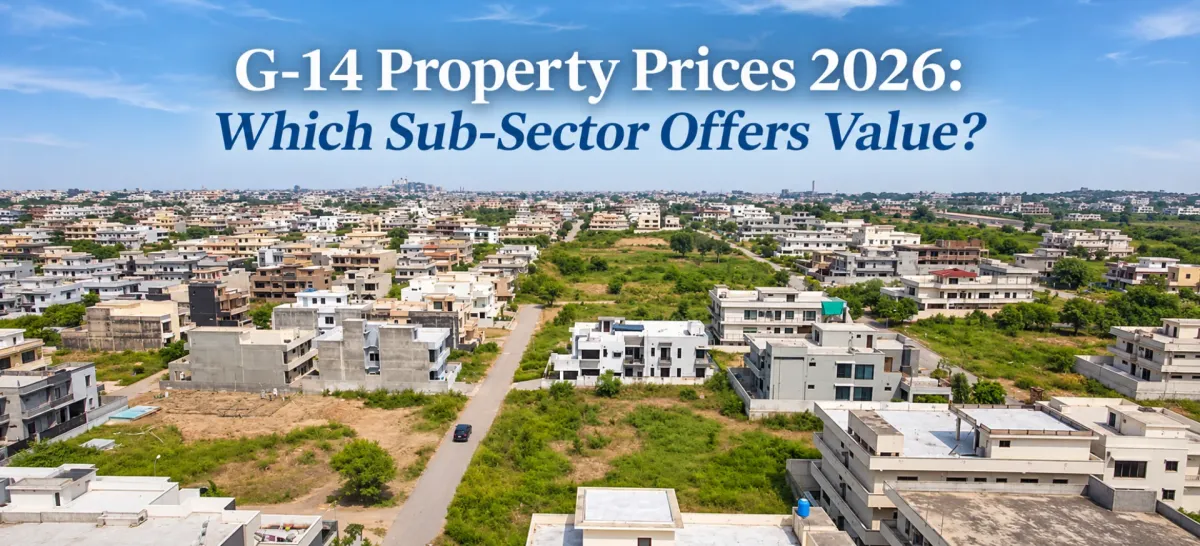
G-14 Islamabad property prices depend on sub-sector, plot dimensions, possession status and the condition of surrounding streets. Buyers exploring property in G-14 Islamabad should distinguish established residential streets from areas where possession or development remains incomplete. A comparatively low asking price may reflect additional waiting time, unresolved documentation or extra costs rather than a genuine bargain.
The market contains plots as well as completed homes, including houses for sale in G-14. A buyer planning construction has different priorities from someone seeking a ready house or rental investment. Compare ownership, street access, covered area and outstanding dues before judging value. The purpose of this guide is to explain price drivers, not to substitute one sector-wide figure for four different sub-sectors.
G-14 is administered by the Federal Government Employees Housing Authority (FGEHA). Its four sub-sectors have not followed identical development timelines. According to the G-14 editorial plan, G-14/4 is established, G-14/2 and G-14/3 reached the completion-certificate stage in July 2026, and G-14/1 continues to face possession issues. A completion certificate for an area does not prove that every plot has been handed over.
| Sub-sector |
|---|
| Development position |
|---|
| Main buyer consideration |
|---|
| G-14/1 | Significant possession uncertainty | Verify allotment and handover status |
| G-14/2 | Completion-certificate stage reached | Check plot-specific possession and road access |
| G-14/3 | Completion-certificate stage reached | Confirm street conditions and documentation |
| G-14/4 | Established residential area | Assess house condition and asking-price premium |
G-14/1 and G-14/3 are deliberately unlinked because their proposed sub-sector URLs redirect to the general G-14 landing page.
G-14/1 remains different from developed residential streets. A buyer considering a plot here should check whether the plot is allotted, transferable and formally available for possession. Advertisements describing expected development cannot guarantee a handover date. If construction is the immediate objective, the uncertain timeline may matter more than a lower upfront price.
G-14/2 has advanced through development and completion processes, but possession must be confirmed for the exact plot. Compare accessible streets with properties that still require further checks. A similarly sized plot may command a different asking price because of road width, corner position or nearby housing activity.
For G-14/3, examine the plot's approved dimensions, road access, ground level and documentary possession. A seller's claim that the whole sub-sector is ready is not sufficient. Buyers weighing G-14/1 vs G-14/3 prices must compare similar properties and account for their different possession exposure.
G-14/4 has a more established residential environment. Prices for completed houses reflect both land and construction, unlike vacant-plot prices. Inspect building age, covered area, layout, parking and maintenance requirements. A newly finished house can carry a premium, but finishing quality and structural condition should be checked independently.
For the wider sector history and neighbourhood context, read the G-14 Islamabad area guide. The separate G-13 versus G-14 analysis provides a deeper comparison of possession and development status.
Plot dimensions offer a more dependable comparison than advertised marla labels. The workbook uses 25 square yards per marla for its price calculations. Confirm the recorded dimensions before comparing seller quotations.
| Plot dimensions | Area (sq yd) | Approximate marla |
|---|---|---|
| 25×40 ft | 111.1 | 4.44 |
| 25×50 ft | 138.9 | 5.56 |
| 30×60 ft | 200 | 8 |
| 35×70 ft | 272.2 | 10.89 |
| 40×80 ft | 355.6 | 14.22 |
| 50×90 ft | 500 | 20 |
| 60×100 ft | 666.7 | 26.67 |
These are geometric conversions, not a claim that every advertisement uses the same marla convention.
Smaller plots can suit buyers who need a lower total purchase budget. Yet the price per square yard may be high when a property offers a desirable street or confirmed possession. Verify whether the quoted figure includes outstanding development charges. A low asking price is not necessarily a low final acquisition cost.
The 30×60-foot category contains 200 square yards; the 35×70 category contains approximately 272 square yards. Both can serve family-house plans, subject to applicable building requirements. Compare matching dimensions, nearby construction, corner status and actual access rather than assuming a uniform G-14 plot rate.
Larger sites may allow more extensive house layouts, but they also involve higher total land and construction budgets. The 40×80 plot is approximately 14.2 marla under the workbook convention, while a 50×90 plot is 20 marla. An advertisement's label should never override the official area recorded for the property.
The workbook's G-14 Price Index is designed to record asking prices by sub-sector, property type, size and possession status. It requires a minimum of five comparable listings before publishing a median. The relevant median fields are currently blank, so this guide does not state unsupported November 2026 averages, sub-sector rankings or guaranteed price ranges.
| Comparison needed | Evidence required before a median can be quoted |
|---|---|
| G-14/2 plot rates | Five comparable listings in one size category |
| G-14/3 plot rates | Five comparable listings with possession recorded |
| G-14/4 house prices | Five similar houses, accounting for build and size |
| G-14 rent | Five comparable rental advertisements by property type |
This distinction protects readers from confusing an individual asking price with an area-wide valuation. Asking prices may also differ from final negotiated transaction amounts. Where no suitable sample exists, buyers should request several current comparable listings and record their checking dates.
The G-14/1 vs G-14/3 prices question cannot be answered solely by placing two advertisements side by side. G-14/1 has greater possession uncertainty, while G-14/3 has reached a later development stage. For a meaningful comparison, use the same plot dimensions, confirm transfer eligibility, identify possession status and account for dues.
A possession-ready plot may be more practical for near-term construction. A less-developed property might suit someone with a longer holding period, but that decision adds risk. Neither outcome guarantees price appreciation. Avoid concluding that one whole sub-sector is cheaper without sufficient comparable data.
An advertised price is the seller's request, not proof of a completed sale at that rate. Before drawing conclusions about G-14 plot prices, note the listing date and ask whether the property is still on the market. Record its sub-sector, plot number, approved dimensions and possession category. Compare it with several similar properties rather than a single unusually high or low advertisement.
For a house, ask whether the quoted price includes fixtures and whether any major repairs are needed. For a plot, check whether corner status, additional land or a wide-road position explains the difference. Keep a simple comparison sheet with the asking price, calculated price per square yard and verified dues. This makes it easier to separate a genuine price difference from mismatched property types. Any future market median should follow the workbook's five-listing minimum and remain clearly dated.
G-14 house prices depend on land dimensions and the building itself. Age, workmanship, covered area, number of floors, layout and utility arrangements can all change the asking price. Comparisons are most useful within similar sub-sectors and house sizes.
For a 25×40 or 25×50 house, inspect usable room sizes, ventilation, parking and any recent extensions. A renovated older home may suit one family better than a newly finished house with limited functional space. Ask for construction documents and assess the cost of repairs before negotiating.
For houses on 30×60 or 40×80 plots, compare the number of independent units, stair access, kitchens and meters. Double-unit layouts may appeal to extended families, but a separate floor is not automatically a legally or practically independent rental unit. Evaluate the quality of construction instead of valuing a house solely by bedroom count.
To standardize plot quotations, first convert the approved dimensions into square yards. Then calculate:
Price per square yard = Asking price ÷ Area in square yards
Price per marla = Price per square yard × 25
As a hypothetical example, a 200-square-yard plot advertised for PKR 3 crore has a calculated rate of PKR 150,000 per square yard, or PKR 37.5 lakh per marla. This illustrates the formula only; it is not a verified G-14 market price.
For houses, land-only rates are insufficient because the purchase price also covers construction. Buyers should compare similar houses using both plot area and covered area.
G-14 rent varies by property size, condition, location and whether a tenant is renting an entire house or a portion. Established residential streets may offer a more immediate rental proposition than places without completed construction. Verify active rental advertisements before estimating returns.
Gross rental yield = Annual rent ÷ Total purchase price × 100
For illustration, a house purchased for PKR 5 crore and rented at PKR 100,000 per month would generate PKR 12 lakh annually, or a 2.4% gross yield. These are hypothetical numbers, not current G-14 rent findings. Maintenance, vacancy, taxes and repairs would reduce the net return.
Before purchasing a plot, request the allotment record, ownership and transfer history, possession evidence and a current statement of dues. A completion milestone for a sub-sector does not replace plot-specific verification. Confirm the exact approved layout and physically locate the plot.
For completed houses, inspect the building and ask about unpaid utility bills, alterations and structural problems. Buyers should factor in registration and transfer expenses, applicable taxes, legal review and required repairs. The quoted purchase price should not be treated as the entire budget.
| Check | Why it matters |
|---|---|
| Ownership and transfer | Establishes who can legally sell |
| Possession | Determines documented handover status |
| Approved dimensions | Enables accurate size comparisons |
| Dues | Reveals liabilities beyond asking price |
| Site access | Affects construction and occupation |
| House inspection | Identifies repair and safety expenses |
If any issue remains unresolved, seek documentary clarification and appropriate professional advice before paying an advance.
| Buyer objective | Area to investigate | Main caution |
|---|---|---|
| Ready residential home | G-14/4 | Condition and total purchase cost |
| Plot for future construction | G-14/2 or G-14/3 | Verify individual possession |
| Longer-term plot holding | G-14/1 | Handover and legal uncertainty |
| Rental investment | Established residential streets | Confirm rents and maintenance |
These are starting points, not endorsements of every property in those areas. Choose based on verified records and the actual site rather than on an assumed sector-wide price trend.
To compare current residential land, explore plots for sale in G-14. Review the plot number, size and seller's possession claims, then request supporting documentation. The page is a source of inventory, not a substitute for independent legal verification.
Milkiyat also maintains a G-14 agents directory. Check whether any relevant agent profiles are currently available and verify an agent's credentials before relying on advice. Do not assume that a directory page guarantees a particular agent is active or verified.
They vary by sub-sector, plot size, possession and house condition. The workbook does not yet provide enough completed Price Index observations for reliable medians.
Individual G-14/1 plots may be advertised differently because of possession uncertainty. A general ranking requires size-matched, date-stamped listings and verified status.
G-14/4 is the established residential sub-sector identified in the workbook. Buyers should still inspect the specific property and its documentation.
Both reached the completion-certificate stage, but that does not establish possession of every plot. Verify the exact plot before paying.
Divide the asking price by the area in square yards, then multiply by 25 using the workbook's conversion convention.
Completed houses and portions may generate rent. Use comparable current rental listings and allow for vacancy and ongoing expenses before estimating yield.
G-14 Islamabad property prices cannot be reduced to one sector-wide figure. Development stages, possession, dimensions and construction quality produce very different buying situations. Compare matching properties, verify official records and calculate the complete acquisition cost before choosing between G-14/1, G-14/2, G-14/3 and G-14/4.
Last Updated: November 17, 2026