Guide
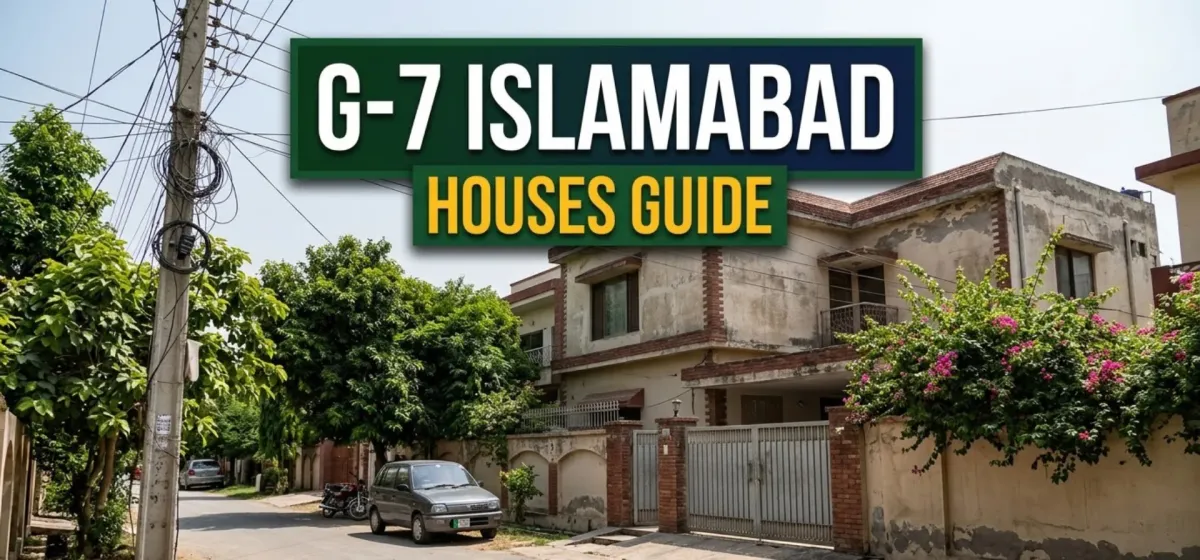
G-7 House Prices 2026 by Sub-Sector and Sub-Block: G-7/2-1 to G-7/4

Real Estate Analyst
12 min read
This guide covers house prices in G-7 Islamabad by sub-sector, from G-7/1 to G-7/4. It is not the sector overview and it does not cover flats or government quarters.
Overview
If you are looking for a house in G-7, the first thing to understand is that there is no single price. The same 5 marla plot can be worth very different amounts depending on the sub-sector, the street, the age of the building and the papers behind it. This guide explains how G-7 is divided, how to work out a fair figure for the houses for sale in G-7 you are considering, and what to do between shortlisting a house and paying for it.
If you want the wider picture of the sector first, including its markets, schools and location, start with our G-7 Islamabad area guide, and come back here when you are ready to compare houses.
Who Owns What in G-7
A large share of G-7 was planned as housing for government employees. Those quarters are allotted to officers and are not sold on the open market, so they cannot be priced or bought. The properties that can change hands are private houses on private plots and flats in buildings sold to private owners. These are different markets, and a flat priced by the square foot cannot be compared with a house priced by its plot.
Private houses in G-7 are mostly small. The plot most often described is 25x50 feet, and a house of that size normally has two or three floors, sometimes with a basement. Buyers who want a flat should look at the apartments in G-7 separately. The rest of this guide is about houses.
How G-7 Is Divided: Sub-Sectors and Sub-Blocks
CDA names each sector with a letter and a number, and divides it into sub-sectors written after a slash. G-7 has four, G-7/1, G-7/2, G-7/3 and G-7/4. A further number after a hyphen, such as G-7/2-4 or G-7/3-2, points to a sub-block inside a sub-sector. We did not find a published sub-block map, so treat a sub-block name in an advertisement as a pointer and not as proof. Always ask for the CDA plot number and the street name.
The sub-sector matters because it changes the character of the street. Areas around G-7/2 sit close to a market and a park, which brings convenience and also noise, parking pressure and traffic, and buyers who want that kind of position can start with the houses for sale in G-7/2.
G-7/3 has many older houses, so a buyer there may be paying mostly for land with a view to rebuilding, and the houses for sale in G-7/3 are worth reading with that in mind.
G-7/4 is where plots up to 1 kanal are found, which suit families who want space and a different price from 5 marla streets, and its houses for sale in G-7/4 show how much the bigger plots change the picture. Visit at different times of day before you decide, because a quiet street at noon may look different in the evening.
What Moves the Price of a G-7 House
Two houses on identical plots rarely ask the same, because the building and the position change the number. The table lists what buyers usually weigh and how each factor tends to push the price.
| Factor | Usually raises the price | Usually lowers the price |
|---|---|---|
| Position | Corner plot, wide road, near a market or park | Narrow inner street, next to a busy commercial strip |
| Building | Newer construction, extra floor, basement, good finish | Old structure that needs rebuilding |
| Plot | Regular shape, full legal dimensions | Odd shape, plot smaller than its label |
| Papers | Clean allotment, transfer papers and no dues | Missing papers, unpaid charges, unclear ownership |
| Use | Ready to live in, or let in portions | Needs repairs before anyone can move in |
Buyers who plan to demolish look at the land value, and buyers who plan to move in look at the building. A seller's asking price is an opening position, so a fair final figure is usually reached by comparison and not by the first number.
Marla, Square Feet and Square Yards in G-7
In CDA sectors one marla is 25 square yards, or 225 square feet. Listings quote size in marla, in square feet or as plot dimensions, and the three do not always agree, so convert everything to square yards before you compare. The table gives the sizes you are most likely to meet, and the 25x50, 10 marla and 1 kanal rows open the matching house listings.
| Plot | Square feet | Square yards | Marla |
|---|---|---|---|
| 25x50 feet | 1,250 | 138.9 | About 5.6 |
| 5 marla | 1,300 | 144.4 | About 5.8 |
| 10 marla | 2,250 | 250 | 10 |
| 1 kanal | 4,500 | 500 | 20 |
These are our arithmetic from 25 square yards to a marla and 9 square feet to a square yard. A plot called 5 marla is exactly 125 square yards, while a 25x50 plot is about 14 square yards larger, and both are often advertised as 5 marla. Ask for the dimensions, and check them in the plot papers.
How to Estimate a Fair Price in Four Steps
The most useful number for comparing houses is the price per square yard of the plot, because it works for every size.
- Convert the plot to square yards using the table above.
- Take a land value. Our G-7 guide puts land at Rs240,000 to Rs335,000 per square yard, and the range is not split by sub-sector or size, so use it as a rough guide.
- Multiply the plot area by the range to get a land only value.
- Add something for the building, the position and the papers, using the factors above, and compare the total with what you are being asked.
Here is what step three gives for common plots, by our arithmetic.
| Plot | Square yards | Land only, low | Land only, high |
|---|---|---|---|
| 5 marla | 125 | Rs3.0 crore | Rs4.2 crore |
| 25x50 feet | 138.9 | Rs3.3 crore | Rs4.7 crore |
| 10 marla | 250 | Rs6.0 crore | Rs8.4 crore |
| 1 kanal | 500 | Rs12.0 crore | Rs16.8 crore |
An ask well above the high column is paying for a building, a position or both, and the question to put to the seller is what exactly justifies the difference. An ask inside the range deserves a careful look at the papers and at the structure, because the building will usually be worth less than its land only share if it is old.
Because small plots cost more per square yard than large ones, do not compare a 5 marla rate with a 1 kanal rate. Compare houses of the same size on similar streets, and ask a registered dealer for recent sales and not only for asks. You can speak to one of the verified property dealers in G-7 and ask for sales in your own sub-sector.
From Shortlist to Possession: How a Purchase Works
Buying in an established CDA sector follows a fixed order, and the order protects you.
| Stage | What to do | What to keep |
|---|---|---|
| Shortlist | Compare three houses of the same size and sub-sector | Notes on plot area, rate and age |
| Verify | Check allotment, transfer history, dues and plot dimensions | Copies of every paper |
| Agree | Settle the price and what is included | A written agreement |
| Pay | Pay by bank transfer to the account named in the transfer papers | Every receipt |
| Transfer | Complete the transfer with CDA and pay the fee | Stamped documents |
| Possession | Take possession and update utility accounts | Handover note and meter readings |
Transfer cost is worth knowing in advance. Dawn reported that the CDA board reduced its property transfer fee from 3 percent to 1 percent of the property's value. The Express Tribune reported the reduction without stating the new rate, and neither report says which value the fee is charged on. On a Rs5 crore house, 1 percent would be Rs5 lakh, our arithmetic. Other taxes and charges are separate, so confirm the current schedule with CDA before you agree a price.
Buying to Live In or to Rebuild
The right price depends on what you plan to do with the house. A buyer who will move in pays for the building, so its condition matters as much as the plot. Check the roof, the damp in the walls, the wiring, the water tank and the drainage, and ask how the house has been used, since a house let out in portions may have had walls added or moved. Remember that the floors you see should match the floors approved.
A buyer who will rebuild is really buying land, and the building is worth little or nothing to them. For that buyer the land only table above is the better guide, and the real cost is construction, the time it takes and the rent paid elsewhere meanwhile. Ask a builder for a written estimate before you agree a price, so that the two numbers can be added up together.
A buyer who is investing should also think about who would rent the house and how it would be let, as a whole house or in portions, and should not assume that a high asking price will be matched by rent.
Mistakes Buyers Make in G-7
The most common mistake is comparing asks without comparing plots. A buyer sees two 5 marla houses at different prices and assumes one is cheaper, when one plot is 125 square yards and the other is 139. The second is the confusion between a government quarter and a private house, which is why ownership comes first in every check. The third is paying before the transfer papers have been read, and the fourth is trusting a bedroom or bathroom count that the seller gave, when the approved plan says otherwise.
A fifth, and costly, mistake is to ignore the building. A buyer who plans to rebuild should price in the cost of construction and the months in which nobody lives there, and a buyer who plans to move in should have the structure inspected by someone who is not selling the house.
Questions to Ask Before You Pay
Ask for the plot number, the sub-sector and sub-block, and the plot area in square feet and square yards. Ask who the registered owner is and whether any dues are pending. Ask how many floors were approved and how many were built, and whether there is a basement. Ask for the year of construction and for work done since. Ask what is included in the price, such as fittings, and ask for the rate the seller has in mind per square yard, so that you can compare it yourself.
Browse G-7 Listings
When you are ready to compare real houses, start from the G-7 listings hub and work through one sub-sector at a time, converting each plot to square yards as you go.
FAQs
How much does a house cost in G-7 Islamabad?
It depends on the sub-sector, the plot size, the age of the building and the papers. Work out the price per square yard of the plot and compare houses of the same size. Our G-7 guide puts land at Rs240,000 to Rs335,000 per square yard, and a house costs more than its land because of the building.
Which G-7 sub-sector is cheapest?
There is no fixed answer, because older streets, plot sizes and distance from the market all change the rate. Compare asks per square yard for the same plot size in each sub-sector before you decide.
How many marla is a 25x50 house?
A 25x50 plot is 1,250 square feet, or 138.9 square yards, which is about 5.6 marla at 25 square yards a marla. Many advertisements call it 5 marla.
Can I buy a government quarter in G-7?
Government quarters are allotted and are not sold on the open market, so the houses and flats that can be bought are privately owned. Confirm the status of any property with the relevant authority.
What is the CDA transfer fee?
Dawn reported that the board cut it from 3 percent to 1 percent of the property's value. Confirm the current rate and the value used with CDA.
What do G-7/2-1 and G-7/3-2 mean?
The first number is the sub-sector and the second is a sub-block inside it. We did not find a published sub-block map, so confirm the plot number and street with CDA.
Disclaimer: This guide by Milkiyat.com is for general information only. Prices, fees and sub-sector details can change without notice. Before any transaction, readers should independently verify ownership, documents, CDA allotment and transfer, dues and the plot size with the relevant authorities and qualified professionals. No guarantee is given about any property, and this guide is not legal or financial advice.