Milkiyat.com
BuyRentNew ProjectsAgentsAgenciesCommercialCompare
HOMEEXPLOREADDPROJECTSFAVORITES

Contents

  1. (Top)
  2. Short Answer
  3. Introduction
  4. The Underlying Problem: A Falling Water Table
  5. Groundwater Trends in the Twin Cities
  6. The Tanker Economy: A Sign of the Gap, Not a Solution
  7. Twin Cities Water Demand vs. Supply (Reported Estimates)
  8. CDA's 2026 Response: Mandatory Rainwater Harvesting
  9. CDA's Rainwater Harvesting Requirement (2026)
  10. What to Actually Ask Before Buying Into a Society
  11. Water Supply Verification Checklist
  12. Water Source Comparison for Buyers
  13. Official Information vs. Marketing Claims vs. Resident Experience
  14. Bottom Line
  15. FAQs
  16. Internal Links Used
  17. Official Sources Used

Guide

Groundwater and Water Supply in Twin-City Housing Societies
Groundwater and Water Supply in Twin-City Housing Societies
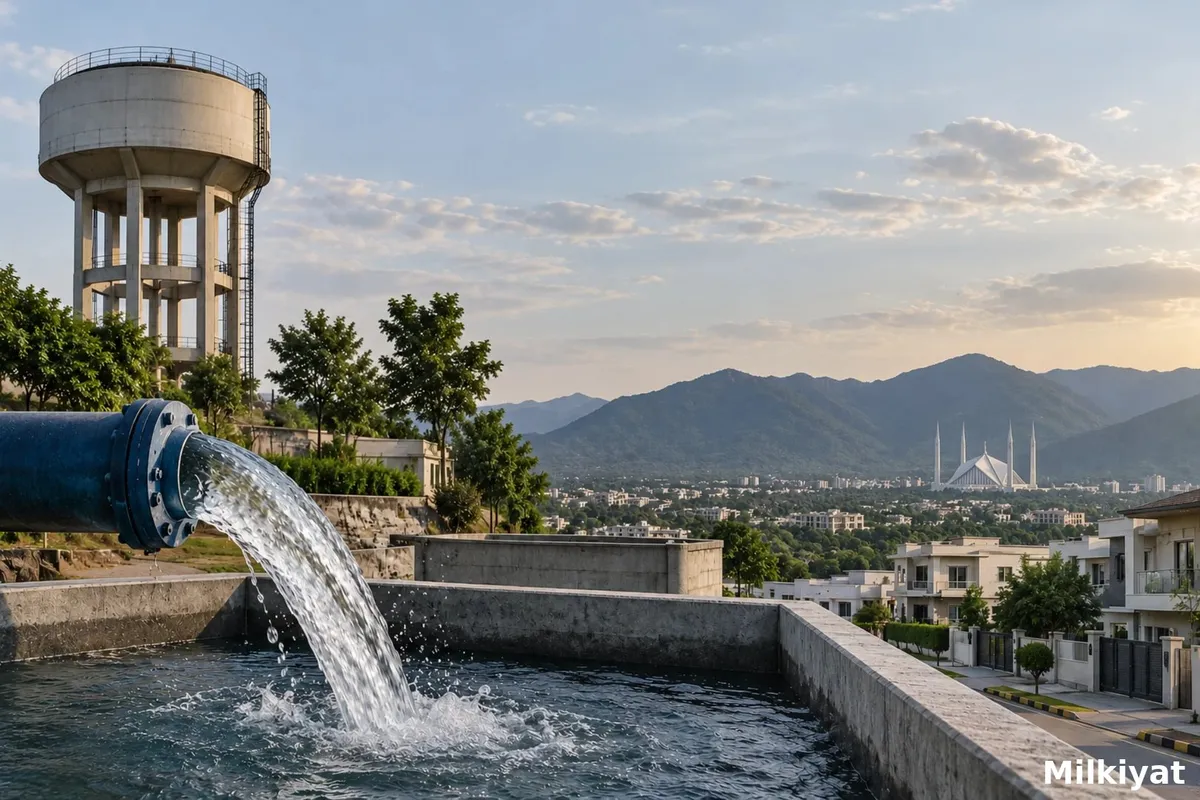
Reliable groundwater and water supply are key factors in the long-term livability and value of housing societies across Islamabad and Rawalpindi.
Property photo

By Bibi Masooma

Real Estate AnalystVerified author

4 September 202613 min read

ShareWhatsApp

At a Glance: Water availability can vary significantly between housing societies and even between blocks. Buyers should verify the actual water source, supply reliability, groundwater conditions, backup arrangements, and official approvals rather than relying only on marketing claims. Resident experience can also help confirm whether the stated water facilities work consistently in daily life.

Short Answer

Do housing societies in Islamabad and Rawalpindi have a reliable water supply? Not always. Many societies depend on groundwater from private tube wells instead of a fully piped municipal network. As groundwater levels continue to decline, water availability can vary between societies and even between different blocks. Before buying, check the actual water source, daily supply, tube-well dependence, shortage history, and backup arrangements. CDA's rainwater harvesting and groundwater recharge requirements also make water infrastructure an important part of property due diligence.

Introduction

Water availability is one of the most important things to check before buying a property, yet it is often one of the least discussed parts of Pakistani real estate marketing. A housing society may highlight wide roads, parks, security, schools, commercial areas, and development status, but buyers may still have a basic question: Where will the water for this house actually come from?

In Islamabad and Rawalpindi, the answer is not always a simple municipal pipeline connection. Depending on the location and housing society, water may come from public supply networks, private tube wells, groundwater, tankers, or a combination of these sources. This means that two societies that both describe themselves as “fully developed” can have very different water-supply conditions.

The issue becomes more important when groundwater is the main source. If a society depends heavily on tube wells, its long-term water security can be affected by how much groundwater is being extracted, how quickly the aquifer is naturally recharged, and how many households are drawing from the same underground water source. For a buyer, this can translate into practical problems such as low water pressure, supply interruptions, dependence on storage tanks, or additional spending on tanker water during shortages.

Islamabad's authorities are also placing greater emphasis on rainwater harvesting and groundwater recharge. In March 2026, the Capital Development Authority (CDA) published notices regarding rooftop rainwater harvesting, while CDA also reported plans for around 100 recharge wells and 20 rainwater storage tanks in the capital.

CDA Public Notices – Rooftop Rainwater Harvesting

This is important for property buyers because rainwater harvesting is not simply an environmental feature. Properly designed systems can help capture rainwater instead of allowing it to run off, while recharge infrastructure can support groundwater replenishment. CDA's existing regulations also contain rainwater-harvesting and groundwater-recharge requirements for certain residential and other buildings.

However, a rainwater-harvesting requirement does not automatically mean that every housing society has a reliable water supply. Buyers still need to understand the actual source of water reaching their home.

The easiest way to think about it is to separate three things:

  • Official information: What CDA, WASA, RDA, or another relevant authority officially says about water infrastructure, approvals, requirements, and supply.
  • Marketing claims: What a developer or housing society says about its utilities, such as “all facilities available” or “fully developed.”
  • Resident experience: What people actually living in that specific block or street experience every day including water pressure, timings, shortages, tanker use, and interruptions.

These three can sometimes tell very different stories.

For example, a society may have water infrastructure in place, but that does not necessarily mean every block receives the same level of service. A newly occupied area may also have different conditions from an older, fully populated block. Similarly, a society may have tube wells and underground tanks but still experience shortages during periods of high demand or reduced groundwater availability. Buyers should also verify a society's approval and development status before making a decision. For more guidance, see our CDA Approved, Under Process, & Illegal Housing Societies List: Ultimate Investment Guide.

That is why “water available” should not be treated as the same thing as “reliable water supply.”

Before purchasing a plot, house, or apartment in a Twin-City housing society, buyers should therefore ask specific questions: What is the primary water source? Is the supply municipal or privately managed? Does the society operate its own tube wells? Is tanker water used during shortages? How often does the supply stop? Is water pressure adequate on upper floors? And does the specific block have the same supply as the rest of the society?

The answers can affect not only your daily living experience but also the property's long-term practicality and resale appeal.

This guide explains how groundwater and water supply work across housing societies in Islamabad and Rawalpindi, what buyers should verify, and which warning signs should not be ignored before making a property decision.

The Underlying Problem: A Falling Water Table

Groundwater levels across Islamabad and Rawalpindi have been declining for years, largely because of increasing groundwater extraction and reduced natural recharge as urban areas expand. A recent study found that groundwater depth increased from about 22.8 metres to 56 metres in Islamabad, while Rawalpindi saw a change from around 37.8 metres to 59 metres over the period studied. The decline was linked with tube wells, boreholes, population growth and urban expansion.

Other research has estimated groundwater depletion at roughly 1 metre per year in Islamabad and around 2.5 metres per year in Rawalpindi, although the rate varies by location and study period.

The main issue is simple: more groundwater is being extracted while less rainwater is naturally reaching the aquifer. As roads, buildings and other paved surfaces expand, less rainfall can soak into the ground and recharge groundwater. At the same time, the growing number of tube wells and boreholes increases pressure on the same underground water resources.

This is important for housing-society buyers because a private tube well may provide sufficient water today, but that does not automatically mean the supply will remain reliable in the future. Buyers should therefore check the society's water source, tube-well dependence, recharge measures and backup arrangements before purchasing.

Relevant research: Groundwater and water-supply study of Islamabad–Rawalpindi · PCRWR Hydrological Assessment of Islamabad's Water Resources

Groundwater Trends in the Twin Cities

CityReported Depletion RateNotable Driver
IslamabadRoughly 1 metre per year in several areasThousands of private boreholes across sectors and housing societies
RawalpindiRoughly 2.5 metres per yearHeavy reliance on private tube wells amid limited public supply

The Tanker Economy: A Sign of the Gap, Not a Solution

Where piped and groundwater supply falls short, private water tankers have filled the gap, and reporting on Rawalpindi in particular describes this tanker market as having grown substantially, sometimes drawing from unregulated or illegally operated hydrants. Rawalpindi's daily water requirement has been estimated at around 71 million gallons, against an actual supply closer to 54 million gallons a meaningful shortfall that tanker deliveries are left to fill, often at a real cost to residents and with limited quality assurance on the water being delivered. A thriving tanker market in a given area is a signal worth noticing, not a neutral convenience it usually means the area's formal supply, whether piped or groundwater-based, isn't meeting actual demand.

Twin Cities Water Demand vs. Supply (Reported Estimates)

CityReported Daily DemandReported Daily SupplyApproximate Shortfall
Rawalpindi~71 MGD~54 MGD~17 MGD
IslamabadHigher reported deficit in some assessmentsVaries by source and yearConfirm current figures with CDA/WASA

Note: These are reported estimates from different sources and periods, not a single live government dataset. Current water-demand and supply figures should be verified with CDA and WASA Rawalpindi before using them as current statistics.

Many households across Islamabad and Rawalpindi rely on tanker-delivered water, supplementing or replacing an inconsistent piped or groundwater supply.

CDA's 2026 Response: Mandatory Rainwater Harvesting

Regulators have started responding to this directly. Following a directive issued on 18 March 2026, CDA made rooftop rainwater harvesting compulsory for all new construction in Islamabad, requiring architectural drawings to include a rooftop catchment and filtration system feeding into a dedicated recharge well typically reported at a depth of 80 to 150 feet depending on the sector designed to replenish groundwater rather than simply relying on further extraction. Submissions missing these elements are reportedly rejected outright at the map approval stage, making this a genuine, checkable requirement rather than a voluntary suggestion for any new construction going forward.

This is a meaningful shift in approach: rather than only restricting extraction, CDA's policy tries to actively rebuild what's being taken out, at least for new construction. It doesn't retroactively fix supply in older, already-built sectors and societies, which remain dependent on whatever mix of piped, groundwater, and tanker supply they've historically relied on.

CDA's Rainwater Harvesting Requirement (2026)

RequirementDetail
Effective fromDirective issued 18 March 2026
Applies toNew construction submissions in Islamabad
Required elementsRooftop catchment and filtration system, recharge well
Recharge well depthReportedly 80–150 feet, depending on sector
Non-compliance consequenceReported rejection of the building plan submission
CDA's 2026 requirement mandates a rooftop catchment and recharge well for new construction, aimed at replenishing groundwater rather than only extracting it.

What to Actually Ask Before Buying Into a Society

Given how much this varies by specific location, a buyer should treat water supply as its own distinct due-diligence category, not an assumption:

  • Ask directly whether the society's water supply is piped (and from where WASA, CDA-managed wells, or the society's own tube wells), tanker-dependent, or a mix.
  • If the society relies on tube wells, ask about typical yield reliability, especially during summer months when demand and depletion both peak.
  • For newer construction, confirm whether the society's own infrastructure, or your specific house if self-built, includes rainwater harvesting and a recharge well as required under CDA's 2026 policy.
  • Ask current residents, where possible, about their actual day to day experience how often water is unavailable, and how often they rely on tanker top-ups.
  • Factor tanker costs into your realistic monthly budget if you're moving into an area known to depend heavily on them.

Water Supply Verification Checklist

StepWhat to Ask
1Is supply piped, tube-well based, tanker dependent, or a mix?
2If tube-well based, how reliable is yield during peak summer demand?
3Does new construction here comply with CDA's rainwater harvesting requirement?
4What do current residents actually experience day to day?
5What would realistic monthly tanker costs add to your budget, if relevant?
Talking to current residents about their actual day-to-day water routine often reveals more than a society's marketing claims.

Water Source Comparison for Buyers

Water SourceReliabilityWhat to Watch For
Piped municipal/WASA supplyGenerally more consistent where availableConfirm actual coverage for your specific block, not just the general area
Society/CDA-managed tube wellsVariable, tends to weaken in peak summerAsk about historical reliability, not just current status
Private/individual tube wellsDepends entirely on local aquifer conditionsFalling water tables can reduce yield over time
Tanker-dependent supplyAvailable but costly and inconsistent in qualityBudget for ongoing cost; ask about water quality assurance

Official Information vs. Marketing Claims vs. Resident Experience

Comparing official records, society claims, and resident feedback helps buyers understand the actual water-supply situation.
  • Official information: CDA's published rainwater harvesting requirement and any available WASA/CDA supply data for the specific area.
  • Marketing claims: A society's general description of itself as "fully developed" or having "all utilities," which often doesn't specify water source or reliability in detail.
  • Resident experience: What people currently living in the specific block report about actual day-to-day water availability.
SourceWhat It Tells YouWhat to CheckReliability
Official InformationWhat authorities officially require or report about water supply and managementCDA rainwater harvesting requirements, WASA/CDA supply data, approved water sources, and relevant notices for the specific areaHigh
Marketing ClaimsHow a housing society presents its infrastructure and utilitiesClaims such as “fully developed,” “all utilities available,” or “24/7 water supply” — and whether they provide specific evidenceMedium to Low
Resident ExperienceWhat is actually happening on the groundCurrent residents’ reports about daily water availability, pressure, outages, tanker dependence, and block-level differencesUseful for Reality Check

Bottom Line

Water supply in Islamabad and Rawalpindi's housing societies can be more fragile and vary significantly by location than property marketing often suggests. Falling groundwater levels, reliance on private tube wells, and the use of tanker water are important factors buyers should consider before assuming a property has a reliable water supply.

Before buying, ask about the actual water source and supply reliability, check relevant CDA rainwater harvesting requirements for new construction, and speak to residents about their day-to-day experience. Water is easy to overlook during property due diligence, but it can directly affect daily living, household costs, and long-term property practicality.


FAQs

Q1: Is water supply generally reliable in Islamabad and Rawalpindi's housing societies?

It varies significantly by specific society and block. Some areas have reasonably consistent piped or tube-well supply, while others depend heavily on tanker delivery, particularly newer or peripheral developments.

Q2: Why is the groundwater table falling so quickly?

Largely due to widespread, historically unregulated private tube well drilling by housing societies, commercial buildings, and individual property owners, combined with inadequate natural recharge.

Q3: What is CDA's new rainwater harvesting requirement?

Following a March 2026 directive, new construction in Islamabad must include a rooftop rainwater catchment and filtration system feeding into a recharge well, typically 80–150 feet deep depending on the sector, or the building plan submission is rejected.

Q4: Does this new requirement apply to older, already-built houses?

No, it applies to new construction submissions going forward. Older sectors and societies remain dependent on whatever water infrastructure they already have.

Q5: How can I check a specific society's actual water situation before buying?

Ask the society directly about its water source, speak with current residents about day-to-day experience, and factor in the possibility of tanker dependency when budgeting.

Q6: Is tanker-delivered water safe to drink?

Water quality from private tankers has been reported as inconsistent in some areas, particularly where sourced from unregulated hydrants. Treat tanker water for drinking with appropriate caution and consider filtration or treatment.


Internal Links Used

  • CDA Approved, Under Process, & Illegal Housing Societies List: Ultimate Investment Guide

Official Sources Used

  • Capital Development Authority (CDA) Official Website

Note: Current, area-specific water supply data should be confirmed directly with CDA's Water and Sanitation Directorate or WASA Rawalpindi, as the demand-supply figures and groundwater depletion rates referenced in this article are based on research studies and reporting rather than a single live, continuously updated government dataset.

Contents

  1. (Top)
  2. Short Answer
  3. Introduction
  4. The Underlying Problem: A Falling Water Table
  5. Groundwater Trends in the Twin Cities
  6. The Tanker Economy: A Sign of the Gap, Not a Solution
  7. Twin Cities Water Demand vs. Supply (Reported Estimates)
  8. CDA's 2026 Response: Mandatory Rainwater Harvesting
  9. CDA's Rainwater Harvesting Requirement (2026)
  10. What to Actually Ask Before Buying Into a Society
  11. Water Supply Verification Checklist
  12. Water Source Comparison for Buyers
  13. Official Information vs. Marketing Claims vs. Resident Experience
  14. Bottom Line
  15. FAQs
  16. Internal Links Used
  17. Official Sources Used

Guide

Groundwater and Water Supply in Twin-City Housing Societies

Groundwater and Water Supply in Twin-City Housing Societies
Reliable groundwater and water supply are key factors in the long-term livability and value of housing societies across Islamabad and Rawalpindi.
Property photo

By Bibi Masooma

Real Estate AnalystVerified author

4 September 202613 min read

ShareWhatsApp

At a Glance: Water availability can vary significantly between housing societies and even between blocks. Buyers should verify the actual water source, supply reliability, groundwater conditions, backup arrangements, and official approvals rather than relying only on marketing claims. Resident experience can also help confirm whether the stated water facilities work consistently in daily life.

Short Answer

Do housing societies in Islamabad and Rawalpindi have a reliable water supply? Not always. Many societies depend on groundwater from private tube wells instead of a fully piped municipal network. As groundwater levels continue to decline, water availability can vary between societies and even between different blocks. Before buying, check the actual water source, daily supply, tube-well dependence, shortage history, and backup arrangements. CDA's rainwater harvesting and groundwater recharge requirements also make water infrastructure an important part of property due diligence.

Introduction

Water availability is one of the most important things to check before buying a property, yet it is often one of the least discussed parts of Pakistani real estate marketing. A housing society may highlight wide roads, parks, security, schools, commercial areas, and development status, but buyers may still have a basic question: Where will the water for this house actually come from?

In Islamabad and Rawalpindi, the answer is not always a simple municipal pipeline connection. Depending on the location and housing society, water may come from public supply networks, private tube wells, groundwater, tankers, or a combination of these sources. This means that two societies that both describe themselves as “fully developed” can have very different water-supply conditions.

The issue becomes more important when groundwater is the main source. If a society depends heavily on tube wells, its long-term water security can be affected by how much groundwater is being extracted, how quickly the aquifer is naturally recharged, and how many households are drawing from the same underground water source. For a buyer, this can translate into practical problems such as low water pressure, supply interruptions, dependence on storage tanks, or additional spending on tanker water during shortages.

Islamabad's authorities are also placing greater emphasis on rainwater harvesting and groundwater recharge. In March 2026, the Capital Development Authority (CDA) published notices regarding rooftop rainwater harvesting, while CDA also reported plans for around 100 recharge wells and 20 rainwater storage tanks in the capital.

CDA Public Notices – Rooftop Rainwater Harvesting

This is important for property buyers because rainwater harvesting is not simply an environmental feature. Properly designed systems can help capture rainwater instead of allowing it to run off, while recharge infrastructure can support groundwater replenishment. CDA's existing regulations also contain rainwater-harvesting and groundwater-recharge requirements for certain residential and other buildings.

However, a rainwater-harvesting requirement does not automatically mean that every housing society has a reliable water supply. Buyers still need to understand the actual source of water reaching their home.

The easiest way to think about it is to separate three things:

  • Official information: What CDA, WASA, RDA, or another relevant authority officially says about water infrastructure, approvals, requirements, and supply.
  • Marketing claims: What a developer or housing society says about its utilities, such as “all facilities available” or “fully developed.”
  • Resident experience: What people actually living in that specific block or street experience every day including water pressure, timings, shortages, tanker use, and interruptions.

These three can sometimes tell very different stories.

For example, a society may have water infrastructure in place, but that does not necessarily mean every block receives the same level of service. A newly occupied area may also have different conditions from an older, fully populated block. Similarly, a society may have tube wells and underground tanks but still experience shortages during periods of high demand or reduced groundwater availability. Buyers should also verify a society's approval and development status before making a decision. For more guidance, see our CDA Approved, Under Process, & Illegal Housing Societies List: Ultimate Investment Guide.

That is why “water available” should not be treated as the same thing as “reliable water supply.”

Before purchasing a plot, house, or apartment in a Twin-City housing society, buyers should therefore ask specific questions: What is the primary water source? Is the supply municipal or privately managed? Does the society operate its own tube wells? Is tanker water used during shortages? How often does the supply stop? Is water pressure adequate on upper floors? And does the specific block have the same supply as the rest of the society?

The answers can affect not only your daily living experience but also the property's long-term practicality and resale appeal.

This guide explains how groundwater and water supply work across housing societies in Islamabad and Rawalpindi, what buyers should verify, and which warning signs should not be ignored before making a property decision.

The Underlying Problem: A Falling Water Table

Groundwater levels across Islamabad and Rawalpindi have been declining for years, largely because of increasing groundwater extraction and reduced natural recharge as urban areas expand. A recent study found that groundwater depth increased from about 22.8 metres to 56 metres in Islamabad, while Rawalpindi saw a change from around 37.8 metres to 59 metres over the period studied. The decline was linked with tube wells, boreholes, population growth and urban expansion.

Other research has estimated groundwater depletion at roughly 1 metre per year in Islamabad and around 2.5 metres per year in Rawalpindi, although the rate varies by location and study period.

The main issue is simple: more groundwater is being extracted while less rainwater is naturally reaching the aquifer. As roads, buildings and other paved surfaces expand, less rainfall can soak into the ground and recharge groundwater. At the same time, the growing number of tube wells and boreholes increases pressure on the same underground water resources.

This is important for housing-society buyers because a private tube well may provide sufficient water today, but that does not automatically mean the supply will remain reliable in the future. Buyers should therefore check the society's water source, tube-well dependence, recharge measures and backup arrangements before purchasing.

Relevant research: Groundwater and water-supply study of Islamabad–Rawalpindi · PCRWR Hydrological Assessment of Islamabad's Water Resources

Groundwater Trends in the Twin Cities

CityReported Depletion RateNotable Driver
IslamabadRoughly 1 metre per year in several areasThousands of private boreholes across sectors and housing societies
RawalpindiRoughly 2.5 metres per yearHeavy reliance on private tube wells amid limited public supply

The Tanker Economy: A Sign of the Gap, Not a Solution

Where piped and groundwater supply falls short, private water tankers have filled the gap, and reporting on Rawalpindi in particular describes this tanker market as having grown substantially, sometimes drawing from unregulated or illegally operated hydrants. Rawalpindi's daily water requirement has been estimated at around 71 million gallons, against an actual supply closer to 54 million gallons a meaningful shortfall that tanker deliveries are left to fill, often at a real cost to residents and with limited quality assurance on the water being delivered. A thriving tanker market in a given area is a signal worth noticing, not a neutral convenience it usually means the area's formal supply, whether piped or groundwater-based, isn't meeting actual demand.

Twin Cities Water Demand vs. Supply (Reported Estimates)

CityReported Daily DemandReported Daily SupplyApproximate Shortfall
Rawalpindi~71 MGD~54 MGD~17 MGD
IslamabadHigher reported deficit in some assessmentsVaries by source and yearConfirm current figures with CDA/WASA

Note: These are reported estimates from different sources and periods, not a single live government dataset. Current water-demand and supply figures should be verified with CDA and WASA Rawalpindi before using them as current statistics.

Many households across Islamabad and Rawalpindi rely on tanker-delivered water, supplementing or replacing an inconsistent piped or groundwater supply.

CDA's 2026 Response: Mandatory Rainwater Harvesting

Regulators have started responding to this directly. Following a directive issued on 18 March 2026, CDA made rooftop rainwater harvesting compulsory for all new construction in Islamabad, requiring architectural drawings to include a rooftop catchment and filtration system feeding into a dedicated recharge well typically reported at a depth of 80 to 150 feet depending on the sector designed to replenish groundwater rather than simply relying on further extraction. Submissions missing these elements are reportedly rejected outright at the map approval stage, making this a genuine, checkable requirement rather than a voluntary suggestion for any new construction going forward.

This is a meaningful shift in approach: rather than only restricting extraction, CDA's policy tries to actively rebuild what's being taken out, at least for new construction. It doesn't retroactively fix supply in older, already-built sectors and societies, which remain dependent on whatever mix of piped, groundwater, and tanker supply they've historically relied on.

CDA's Rainwater Harvesting Requirement (2026)

RequirementDetail
Effective fromDirective issued 18 March 2026
Applies toNew construction submissions in Islamabad
Required elementsRooftop catchment and filtration system, recharge well
Recharge well depthReportedly 80–150 feet, depending on sector
Non-compliance consequenceReported rejection of the building plan submission
CDA's 2026 requirement mandates a rooftop catchment and recharge well for new construction, aimed at replenishing groundwater rather than only extracting it.

What to Actually Ask Before Buying Into a Society

Given how much this varies by specific location, a buyer should treat water supply as its own distinct due-diligence category, not an assumption:

  • Ask directly whether the society's water supply is piped (and from where WASA, CDA-managed wells, or the society's own tube wells), tanker-dependent, or a mix.
  • If the society relies on tube wells, ask about typical yield reliability, especially during summer months when demand and depletion both peak.
  • For newer construction, confirm whether the society's own infrastructure, or your specific house if self-built, includes rainwater harvesting and a recharge well as required under CDA's 2026 policy.
  • Ask current residents, where possible, about their actual day to day experience how often water is unavailable, and how often they rely on tanker top-ups.
  • Factor tanker costs into your realistic monthly budget if you're moving into an area known to depend heavily on them.

Water Supply Verification Checklist

StepWhat to Ask
1Is supply piped, tube-well based, tanker dependent, or a mix?
2If tube-well based, how reliable is yield during peak summer demand?
3Does new construction here comply with CDA's rainwater harvesting requirement?
4What do current residents actually experience day to day?
5What would realistic monthly tanker costs add to your budget, if relevant?
Talking to current residents about their actual day-to-day water routine often reveals more than a society's marketing claims.

Water Source Comparison for Buyers

Water SourceReliabilityWhat to Watch For
Piped municipal/WASA supplyGenerally more consistent where availableConfirm actual coverage for your specific block, not just the general area
Society/CDA-managed tube wellsVariable, tends to weaken in peak summerAsk about historical reliability, not just current status
Private/individual tube wellsDepends entirely on local aquifer conditionsFalling water tables can reduce yield over time
Tanker-dependent supplyAvailable but costly and inconsistent in qualityBudget for ongoing cost; ask about water quality assurance

Official Information vs. Marketing Claims vs. Resident Experience

Comparing official records, society claims, and resident feedback helps buyers understand the actual water-supply situation.
  • Official information: CDA's published rainwater harvesting requirement and any available WASA/CDA supply data for the specific area.
  • Marketing claims: A society's general description of itself as "fully developed" or having "all utilities," which often doesn't specify water source or reliability in detail.
  • Resident experience: What people currently living in the specific block report about actual day-to-day water availability.
SourceWhat It Tells YouWhat to CheckReliability
Official InformationWhat authorities officially require or report about water supply and managementCDA rainwater harvesting requirements, WASA/CDA supply data, approved water sources, and relevant notices for the specific areaHigh
Marketing ClaimsHow a housing society presents its infrastructure and utilitiesClaims such as “fully developed,” “all utilities available,” or “24/7 water supply” — and whether they provide specific evidenceMedium to Low
Resident ExperienceWhat is actually happening on the groundCurrent residents’ reports about daily water availability, pressure, outages, tanker dependence, and block-level differencesUseful for Reality Check

Bottom Line

Water supply in Islamabad and Rawalpindi's housing societies can be more fragile and vary significantly by location than property marketing often suggests. Falling groundwater levels, reliance on private tube wells, and the use of tanker water are important factors buyers should consider before assuming a property has a reliable water supply.

Before buying, ask about the actual water source and supply reliability, check relevant CDA rainwater harvesting requirements for new construction, and speak to residents about their day-to-day experience. Water is easy to overlook during property due diligence, but it can directly affect daily living, household costs, and long-term property practicality.


FAQs

Q1: Is water supply generally reliable in Islamabad and Rawalpindi's housing societies?

It varies significantly by specific society and block. Some areas have reasonably consistent piped or tube-well supply, while others depend heavily on tanker delivery, particularly newer or peripheral developments.

Q2: Why is the groundwater table falling so quickly?

Largely due to widespread, historically unregulated private tube well drilling by housing societies, commercial buildings, and individual property owners, combined with inadequate natural recharge.

Q3: What is CDA's new rainwater harvesting requirement?

Following a March 2026 directive, new construction in Islamabad must include a rooftop rainwater catchment and filtration system feeding into a recharge well, typically 80–150 feet deep depending on the sector, or the building plan submission is rejected.

Q4: Does this new requirement apply to older, already-built houses?

No, it applies to new construction submissions going forward. Older sectors and societies remain dependent on whatever water infrastructure they already have.

Q5: How can I check a specific society's actual water situation before buying?

Ask the society directly about its water source, speak with current residents about day-to-day experience, and factor in the possibility of tanker dependency when budgeting.

Q6: Is tanker-delivered water safe to drink?

Water quality from private tankers has been reported as inconsistent in some areas, particularly where sourced from unregulated hydrants. Treat tanker water for drinking with appropriate caution and consider filtration or treatment.


Internal Links Used

  • CDA Approved, Under Process, & Illegal Housing Societies List: Ultimate Investment Guide

Official Sources Used

  • Capital Development Authority (CDA) Official Website

Note: Current, area-specific water supply data should be confirmed directly with CDA's Water and Sanitation Directorate or WASA Rawalpindi, as the demand-supply figures and groundwater depletion rates referenced in this article are based on research studies and reporting rather than a single live, continuously updated government dataset.

Explore Pakistan real estate

Real Estate
  • House for Sale in Islamabad
  • Apartment for Sale in Islamabad
  • Plots for Sale in Islamabad
  • Commercial for Sale in Islamabad
  • Buy in E 11, Islamabad
  • Buy in F 7, Islamabad
  • Buy in G 11, Islamabad
  • House for Sale in Rawalpindi
  • Commercial for Sale in Rawalpindi
Rentals
  • House for Rent in Islamabad
  • Apartment for Rent in Islamabad
  • Commercial for Rent in Islamabad
  • Rent in G 11, Islamabad
Popular Cities
  • Islamabad city guide
  • Real estate in Islamabad
  • House for Sale in Islamabad
  • Apartment for Sale in Islamabad
  • Plots for Sale in Islamabad
  • Commercial for Sale in Islamabad
  • Lahore city guide
  • Real estate in Lahore
  • Karachi city guide
  • Real estate in Karachi
  • Rawalpindi city guide
  • Real estate in Rawalpindi
  • House for Sale in Rawalpindi
  • Commercial for Sale in Rawalpindi
  • Multan city guide
  • Peshawar city guide
  • Faisalabad city guide
  • Abbottabad city guide
  • Attock city guide
  • Badin city guide
  • Bahawalnagar city guide
  • Bahawalpur city guide
  • Bajaur city guide
  • Bannu city guide
  • Battagram city guide
  • Chakwal city guide
  • Charsadda city guide
  • Chiniot city guide
  • Gujranwala city guide
  • Gwadar city guide
  • Hafizabad city guide
  • Hangu city guide
  • Haripur city guide
  • Hyderabad city guide
  • Jhelum city guide
  • Mardan city guide
Societies & Areas
  • Browse all areas
  • Cities
  • Al Hamra Avenue — Islamabad
  • Al Makkah City — Islamabad
  • Anza Zephyr Dale Agro Farms — Islamabad
  • Bahria Enclave — Islamabad
  • Bani Gala — Islamabad
  • Blue Area — Islamabad
  • Blue World City Islamabad — Islamabad
  • Cabinet Division Employees Chs — Islamabad
  • Cbr Town Phase I And Ii — Islamabad
  • Chak Shahzad — Islamabad
  • D 12 — Islamabad
  • D 17 — Islamabad
  • Dha Gandhara — Islamabad
  • Dha Islamabad Phase 6 — Islamabad
  • Dha Phase 1 — Islamabad
  • Dha Phase 2 — Islamabad
  • Dha Phase 3 — Islamabad
  • Dha Phase 4 — Islamabad
Tools & Guides
  • Construction Cost Calculator
  • Area Unit Converter
  • Home Loan Calculator
  • All Tools
  • Market Trends
  • Area Guides
  • Browse by City
  • Investment Tips
  • Latest News
  • Property Tax Info
  • New Projects

Real Estate

  • House for Sale in Islamabad
  • Apartment for Sale in Islamabad
  • Plots for Sale in Islamabad
  • Commercial for Sale in Islamabad
  • Buy in E 11, Islamabad
  • Buy in F 7, Islamabad
  • Buy in G 11, Islamabad
  • House for Sale in Rawalpindi
  • Commercial for Sale in Rawalpindi

Rentals

  • House for Rent in Islamabad
  • Apartment for Rent in Islamabad
  • Commercial for Rent in Islamabad
  • Rent in G 11, Islamabad

Popular Cities

  • Islamabad city guide
  • Real estate in Islamabad
  • House for Sale in Islamabad
  • Apartment for Sale in Islamabad
  • Plots for Sale in Islamabad
  • Commercial for Sale in Islamabad
  • Lahore city guide
  • Real estate in Lahore
  • Karachi city guide
  • Real estate in Karachi
  • Rawalpindi city guide
  • Real estate in Rawalpindi
  • House for Sale in Rawalpindi
  • Commercial for Sale in Rawalpindi
  • Multan city guide
  • Peshawar city guide
  • Faisalabad city guide
  • Abbottabad city guide
  • Attock city guide
  • Badin city guide
  • Bahawalnagar city guide
  • Bahawalpur city guide
  • Bajaur city guide
  • Bannu city guide
  • Battagram city guide
  • Chakwal city guide
  • Charsadda city guide
  • Chiniot city guide
  • Gujranwala city guide
  • Gwadar city guide
  • Hafizabad city guide
  • Hangu city guide
  • Haripur city guide
  • Hyderabad city guide
  • Jhelum city guide
  • Mardan city guide

Societies & Areas

  • Browse all areas
  • Cities
  • Al Hamra Avenue — Islamabad
  • Al Makkah City — Islamabad
  • Anza Zephyr Dale Agro Farms — Islamabad
  • Bahria Enclave — Islamabad
  • Bani Gala — Islamabad
  • Blue Area — Islamabad
  • Blue World City Islamabad — Islamabad
  • Cabinet Division Employees Chs — Islamabad
  • Cbr Town Phase I And Ii — Islamabad
  • Chak Shahzad — Islamabad
  • D 12 — Islamabad
  • D 17 — Islamabad
  • Dha Gandhara — Islamabad
  • Dha Islamabad Phase 6 — Islamabad
  • Dha Phase 1 — Islamabad
  • Dha Phase 2 — Islamabad
  • Dha Phase 3 — Islamabad
  • Dha Phase 4 — Islamabad

Tools & Guides

  • Construction Cost Calculator
  • Area Unit Converter
  • Home Loan Calculator
  • All Tools
  • Market Trends
  • Area Guides
  • Browse by City
  • Investment Tips
  • Latest News
  • Property Tax Info
  • New Projects
Milkiyat.com

Pakistan's buyer-first real estate marketplace. Buy, rent, sell with confidence.

Operating office: Office 101, First Floor, Rizwan Center, Jinnah Ave, Blue Area, Islamabad

+92 307 5360488

[email protected]

Milkiyat.com is operated by MILKIYAT.COM ONLINE PORTAL (PRIVATE) LIMITED.

Corporate Unique Identification No. (CUI): 0337118

Incorporated under the Companies Act, 2017, Pakistan.

Verify company registration with SECP

Company▾
  • About Us
  • Contact
  • Jobs
  • Help & Support
  • Advertise
Platform▾
  • Insights
  • News
  • Blogs
  • Agents
  • Agencies
  • Add Property
Tools▾
  • Construction Cost Calculator
  • Area Unit Converter
  • Home Loan Calculator
  • Property Tax Info
  • All Tools

Company

  • About Us
  • Contact
  • Jobs
  • Help & Support
  • Advertise

Platform

  • Insights
  • News
  • Blogs
  • Agents
  • Agencies
  • Add Property

Tools

  • Construction Cost Calculator
  • Area Unit Converter
  • Home Loan Calculator
  • Property Tax Info
  • All Tools

Contact Milkiyat.com

Milkiyat.com is Pakistan's buyer-first real estate marketplace. We connect buyers directly with verified listings and KYC-approved agents — built for local and Overseas Pakistanis.

Terms of Use·Privacy Policy·Marketplace Disclaimer·Sitemap·
GET IT ONGoogle Play
Milkiyat.comFollow us:
© 2026 Milkiyat.com

More guides

  • Lahore Development Authority (LDA): The Complete 2026 Guide

    Everything Lahore buyers need to know about the Lahore Development Authority in one guide: its jurisdiction, approved and illegal housing societies, NOC stages, building plan rules, commercialisation and enforcement. We explain the July 2026 switch from file trading to PLRA Property Certificates, break down LDA's Rs88.6 billion budget, and give a nine-point checklist to run before you pay any token.

  • Real Estate Scams in Pakistan 2026: What the Regulator Data Reveals

    In 2026, Pakistani regulators flagged 449 housing schemes as illegal, and NAB returned Rs43 billion to more than 24,000 fraud victims. Milkiyat.com's data report breaks down where property scams showed up this year, what victims actually recovered, and what must change to stop them.

  • Everything You Need to Know About Elanza Creeks Park View City islamabad – Location, Payment Plan & Amenities Explained

    A complete buyer's guide to Elanza Creeks Park View City Islamabad the mixed-use high-rise by Elanza Holdings in The Walk Commercial. Covers unit prices, the instalment structure, booking documents, amenities, NOC position and the investment case, with the checks to run before you book.

  • G-7 Markaz Islamabad: Commercial Property & Business Guide 2026

    Explore the G-7 Markaz Islamabad commercial property market in 2026, including location, business activity, shops, offices, rental considerations and key factors for buyers.

More guides

  • Lahore Development Authority (LDA): The Complete 2026 Guide

    Everything Lahore buyers need to know about the Lahore Development Authority in one guide: its jurisdiction, approved and illegal housing societies, NOC stages, building plan rules, commercialisation and enforcement. We explain the July 2026 switch from file trading to PLRA Property Certificates, break down LDA's Rs88.6 billion budget, and give a nine-point checklist to run before you pay any token.

  • Real Estate Scams in Pakistan 2026: What the Regulator Data Reveals

    In 2026, Pakistani regulators flagged 449 housing schemes as illegal, and NAB returned Rs43 billion to more than 24,000 fraud victims. Milkiyat.com's data report breaks down where property scams showed up this year, what victims actually recovered, and what must change to stop them.

  • Everything You Need to Know About Elanza Creeks Park View City islamabad – Location, Payment Plan & Amenities Explained

    A complete buyer's guide to Elanza Creeks Park View City Islamabad the mixed-use high-rise by Elanza Holdings in The Walk Commercial. Covers unit prices, the instalment structure, booking documents, amenities, NOC position and the investment case, with the checks to run before you book.

  • G-7 Markaz Islamabad: Commercial Property & Business Guide 2026

    Explore the G-7 Markaz Islamabad commercial property market in 2026, including location, business activity, shops, offices, rental considerations and key factors for buyers.