News
Housing Ministry: New Policy to Tackle Pakistan's Urban Development Challenges

By Mariam Khan
Real Estate Analyst
3 min read
ShareWhatsApp
News
By Mariam Khan
Real Estate Analyst
3 min read
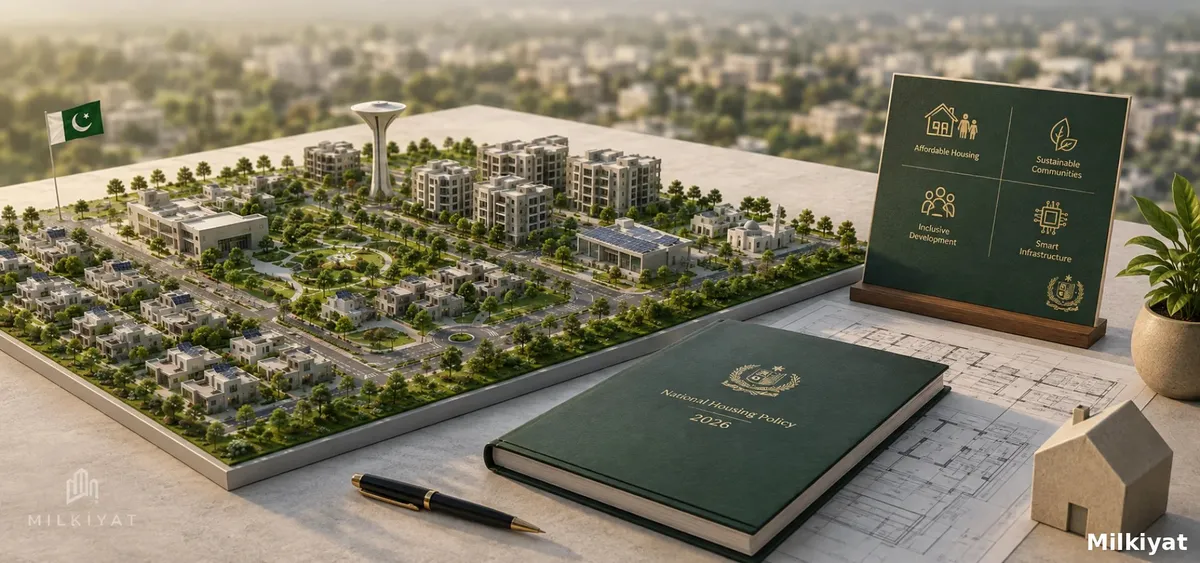
The Ministry of Housing and Works says the newly approved National Housing Policy 2026 will help address Pakistan's diverse and evolving housing and urban development challenges through a coordinated, inclusive, and sustainable framework, according to Dawn, published 12 August 2026. The statement, issued via press release, follows the federal cabinet's approval of the policy — Pakistan's first update to national housing policy since 2001, as milkiyat.com reported when the cabinet approval was announced.
The ministry described the approval as fulfilling a longstanding need for a comprehensive national framework capable of providing clear strategic direction for housing and urban planning. Its stated overarching vision is to promote adequate, affordable, and sustainable housing for all citizens, while improving access to housing opportunities, basic amenities, and supporting infrastructure — language that frames the policy as addressing access and equity, not just construction volume.
The ministry's own release sets out the same nine strategic themes previously reported via APP: Land for Housing, Housing Finance, Construction Services, Technology and Building Materials, Development of Intermediate and Secondary Towns, Slums/Kutchi Abadis and Squatter Settlements, Affordable Housing, Low-Income/Low-Cost and Rural Housing, and Capacity Building and Knowledge Sharing. Taken together, the ministry frames this as a comprehensive framework covering land availability, housing finance, construction and technology, balanced urban development, institutional and legal reform, and climate-resilient, environmentally sustainable housing.
Federal Minister for Housing and Works Mian Riaz Hussain Pirzada and the ministry's secretary credited the Policy & Planning Wing for preparing the document, and said efforts were made to bring all major stakeholders on board during formulation. Pirzada called the approval a significant achievement and a historic milestone for the ministry, given that Pakistan had gone without an updated national housing policy for nearly a quarter century. He said the policy would provide clear strategic direction for addressing the country's housing deficit and emerging urban development challenges going forward.
It's worth noting what this release does and doesn't add. The ministry's statement restates and reinforces the policy's themes and vision rather than introducing new implementation detail — no new regulations, zoning maps, energy-code standards, or enforcement mechanisms are disclosed here beyond what the cabinet approval already outlined. For the practical detail on what was actually decided — including the cabinet's specific direction on vertical housing, mandatory energy-efficiency codes, and zoning compliance — see milkiyat.com's earlier coverage of the cabinet's approval of the National Housing Policy 2026.
The ministry's emphasis on "balanced urban development" and institutional reform lines up with parallel developments already under way in the twin cities — including Islamabad's own review of a new real estate regulatory framework (RERA) and CDA's recent approval of nearly 2,000 new apartment units across the capital. Developers and buyers should watch for how this national framework's themes — particularly housing finance and construction technology — eventually filter down into CDA and RDA-specific rules, since that translation from national policy to city-level enforcement is where actual compliance requirements will take shape.
FBR notifies faceless income tax appeal rules, introducing anonymous commissioners, digital hearings and automated case allocation for tax disputes.
FBR replaces sales tax return STR-7 and revises purchase and sales invoice annexes, introducing expanded transaction and tax reporting requirements.
FBR seals a Karachi superstore outlet after finding Rs3.27 billion in off-system sales, POS violations and alleged sales tax irregularities.
Pakistan plans to split SNGPL and SSGCL into six to eight entities, restructure gas operations and shift over Rs3 trillion in circular debt.