Blog
I-8 vs G-9 Islamabad: Which Sector Delivers the Highest Rental Yield?
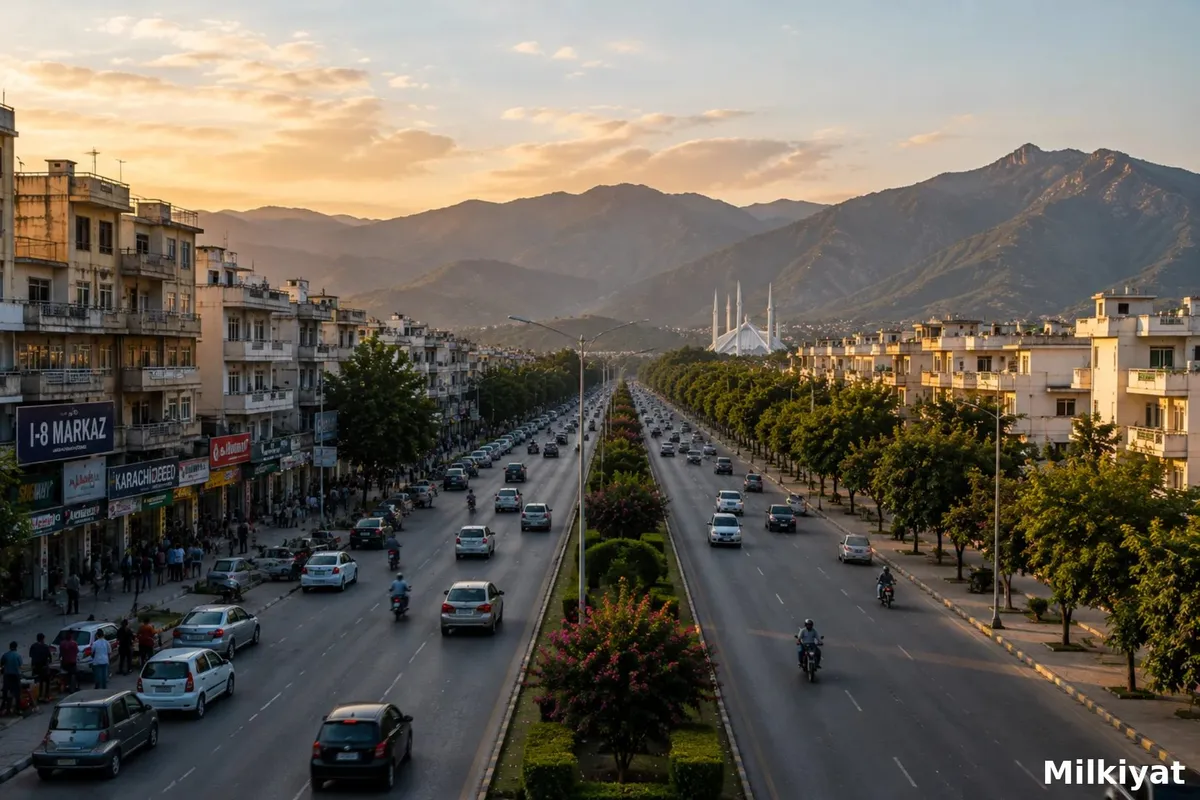

By Bibi Masooma
Real Estate AnalystVerified author
8 min read
Two investors can look at the same Islamabad property market and arrive at very different conclusions.
One may prioritise G-9 for its established location, mature residential market, and proximity to the city's institutional core. The other may look past the prestige and ask a more practical question: how much rental income can the property generate relative to the capital invested?
That is where I-8 becomes particularly interesting.
The difference is best understood through gross rental yield the annual rental income a property generates as a percentage of its purchase price. A higher monthly rent does not automatically mean a better investment. If a property costs substantially more to buy, its rental income may represent a smaller return on the capital invested. Conversely, a lower priced property with steady rental demand can produce a stronger rent to price ratio, even when its absolute monthly rent is lower.
This distinction matters in the I-8 versus G-9 comparison. I-8 has an unusual planning history: it was originally designated for a central railway and transportation centre before being converted into a residential sector, with the proposed railway site eventually becoming I-8 Markaz. Dawn's reporting on Islamabad's master-plan changes provides the historical context.
G-9, meanwhile, sits within Islamabad's established central-sector market, where rental demand also includes government employees whose housing allowances are subject to federal rent ceilings. The government has revised those ceilings over time, including a major revision notified in 2025. Dawn's reporting on the latest federal rental-ceiling revision provides the current context.
The investment question, then, is not simply which sector commands the higher rent. It is which sector generates the stronger rental return relative to the price paid to own it.
G-9 may have the edge on prestige, while I-8 may have the edge on yield. For investors focused on rental income, that distinction matters: the more prestigious address is not necessarily the more efficient investment.
What Gross Yield Actually Measures
Gross rental yield is the annual rent a property generates divided by its purchase price, expressed as a percentage. In simple terms, it measures how much rental income an investor earns relative to the amount paid for the property.
That distinction is important because a property with a higher monthly rent does not necessarily offer the better return. If its purchase price is also significantly higher, the rental income may represent a smaller percentage of the capital invested. A lower priced property, meanwhile, can produce a stronger yield even with a lower monthly rent, provided rental demand remains steady.
This is where the difference between property value and investment efficiency becomes clear. Premium sectors can command higher rents and stronger sale prices, but their higher purchase costs can compress gross yield. Lower entry cost sectors can have the opposite advantage: moderate rents, combined with a lower purchase price, can create a more favourable rent-to-price ratio.
For investors comparing I-8 and G-9, that is the key calculation. The question is not simply which sector earns more rent, but which one generates more rent relative to the capital required to buy it.
Illustrative example only not sourced market data: a PKR 3 crore property renting for PKR 40,000 a month generates approximately 1.6% gross yield. A PKR 1.8 crore property renting for PKR 35,000 a month generates approximately 2.3% gross yield. The second property earns less rent in absolute terms, yet produces the stronger yield because its purchase price is substantially lower.
That is the mechanism behind the I-8 versus G-9 comparison: the question is not simply which property generates more rent, but how much rental income it produces relative to the capital required to buy it.
| Yield factor | I-8 | G-9 |
|---|---|---|
| Purchase-price position | Generally lower entry point | Generally higher entry point |
| Rental-demand profile | Residential and commercial demand around I-8 Markaz | Established central-sector demand, including government-linked tenants |
| Main yield pressure | Unit quality, location and block-level rent variation | Higher purchase prices and grade-based rent ceilings for some tenants |
| Structural investment profile | More yield-focused | More focused on capital value, established demand and prestige |
Why I-8 Can Favour Yield Focused Buyers
I-8 has an unusual history in Islamabad's master plan. It was originally reserved for a major transportation centre, including a proposed railway station and bus facilities, before the sector was converted to residential use. By the time that change took shape, I-8 had developed a very different identity from the transport hub originally envisioned. Dawn's reporting on Islamabad's master-plan revisions documents how the sector was ultimately reshaped into a residential area.
That history helps explain why I-8 occupies an interesting position in today's property market. It sits at the southern edge of Islamabad, directly adjoining Rawalpindi, with access to major routes including the Islamabad Expressway and Murree Road. Its location gives residents and tenants practical access to both cities, while the sector itself has developed into an established residential community with I-8 Markaz as its commercial focal point.
The commercial story matters just as much as the location. I-8 Markaz has grown into a substantial retail and office cluster, creating a broader pool of residential and commercial tenants. Current market activity also points to steady demand for shops and offices in the Markaz, alongside continued residential rental activity across the sector.
That creates the basic structure a yield focused investor looks for: a relatively accessible purchase price paired with recurring rental demand. The important point is not that I-8 automatically delivers a higher yield on every property. Unit size, condition, exact block, purchase price, and achievable rent can change the calculation significantly. But structurally, I-8 gives investors a stronger opportunity to make the rent-to-price ratio work in their favour.
In simple terms: I-8 does not need G-9's prestige to compete on returns. If you pay less to buy the property and can still earn steady rent from it, the investment can deliver a stronger yield and that is where I-8's appeal lies.
Why G-9 Structurally Favours Capital Value Over Yield
G-9 tells a different investment story. Positioned close to Islamabad's institutional core and adjacent to G-8's dense government-office cluster, the sector has spent decades building the reputation of an established, centrally located residential market. That maturity comes with a price: buyers are paying not only for the property itself, but also for location, established infrastructure, accessibility and long-standing market recognition.
The rental equation is different. A portion of G-9's tenant base includes government employees whose housing allowances are influenced by the federal government's grade-based rent ceilings. As discussed in Milkiyat's companion analysis of G-9 vs G-10 tenant profiles, these ceilings can limit the rent that some tenants are able or willing to pay, even when an area's open-market rental potential is higher. The framework is based on government notifications rather than purely on landlord-tenant negotiation. Dawn's reporting provides additional context on the federal rent ceiling system.
That creates an important yield dynamic. When purchase prices rise faster than achievable rents, gross rental yield falls. G-9 can therefore command higher absolute property values and retain strong prestige and demand while still producing a weaker rent-to-price ratio than a lower-entry-cost sector such as I-8.
For investors focused primarily on capital preservation, established location and long-term property value, that trade-off may be acceptable. For an investor whose priority is rental efficiency, however, a prestigious address is not automatically the more efficient investment.
What This Means for Investors
-
If your goal is rental-income efficiency, I-8's lower entry price and steady rental demand make it the structurally stronger candidate for gross yield. Still, verify current purchase and rental figures for the specific property, because yields can vary significantly by block, property type and unit condition.
-
If your goal is capital preservation and prestige, G-9's central positioning, established market and proximity to Islamabad's institutional core support its appeal for long-term ownership, even if the yield calculation favours I-8.
-
Run the numbers on the actual property before committing. The structural pattern explains why I-8 can favour yield-focused investors, but individual properties can produce very different results depending on purchase price, achievable rent, vacancy, condition and location.
I-8 vs G-9 Investment Snapshot
| Comparison point | I-8 | G-9 |
|---|---|---|
| Best suited to | Investors focused on rental-income efficiency | Investors focused on central location, prestige and capital preservation |
| Core advantage | Lower entry cost with established residential and commercial demand | Established reputation, central positioning and institutional proximity |
| Key risk to check | Actual rent can vary by block, unit type, condition and tenant demand | Higher purchase price can compress gross yield; tenant affordability and applicable rent ceilings also matter |
| Before deciding | Compare current purchase price, achievable rent and vacancy risk | Compare current purchase price, achievable rent, applicable rent ceiling and long-term value |
Read Next on Milkiyat.com
- G-9 vs G-10 Islamabad: Government vs Private-Sector Tenant Profile
- G-10 vs G-11 Islamabad: Markaz Commercial Performance and Shop Rates
- House vs Plot Investment in Islamabad 2026
- Browse Apartments for Rent in Islamabad