Guide
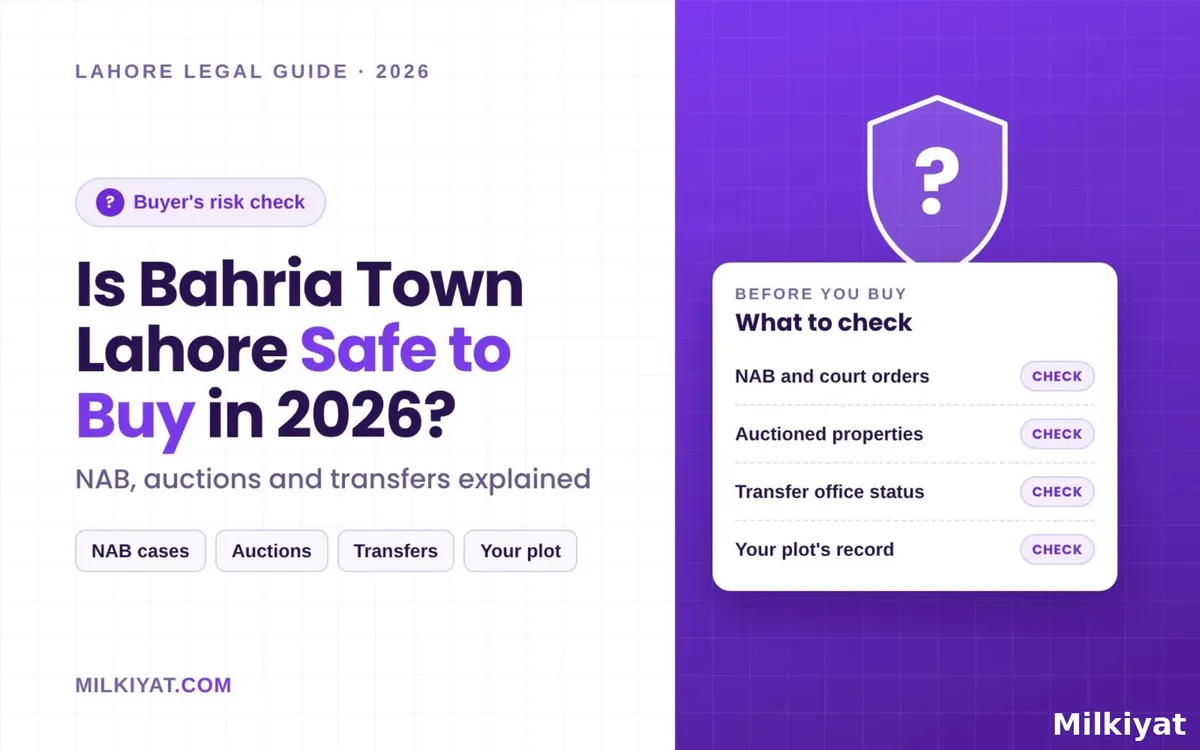
Is Bahria Town Lahore Safe to Buy in 2026? NAB, Auctions and Transfers

By Anza Gulzar
Real Estate Agent
15 min read
This guide examines the practical implications of NAB proceedings and property auctions for Bahria Town Lahore buyers and owners. It does not determine the legal status of any individual plot.
Is Bahria Town Lahore Safe to Buy in 2026?
Whether Bahria Town Lahore is safe to buy in 2026 depends on the specific property, its ownership documents, applicable approvals and the current legal position. NAB proceedings and court-authorised property auctions involving Bahria Town assets have raised important questions for buyers, but a legal action involving a particular property does not automatically establish that every plot in Lahore is frozen, cancelled or ineligible for transfer.
Anyone considering a purchase should assess the exact plot rather than relying solely on the developer's name, an agent's assurance or a general news headline. Begin by exploring the Lahore real estate market and comparing available houses for sale in Lahore, but complete independent legal and record verification before committing money.
This guide explains what the reported NAB proceedings and auctions may mean for Lahore buyers, how to check whether a transaction can proceed, what to ask about transfer-office operations and how to manage the risks of purchasing a plot or house in the current environment.
The key principle is simple: do not treat a brand-wide headline as proof of a particular plot's legal status. Obtain current, property-specific evidence before paying an advance or completing a transfer.
1. What Is Happening With Bahria Town and NAB?
The National Accountability Bureau (NAB) has pursued proceedings involving Malik Riaz, Bahria Town-related assets and other individuals in multiple matters. These proceedings concern different properties, transactions and legal questions. Buyers must distinguish between the allegations or claims in a case, the orders issued by a court and the practical effect of those orders on a particular property.
In its public statement dated 17 March 2025, NAB described investigations and references involving Bahria Town and its owner, and referred to actions concerning properties in several locations, including Lahore. Such a statement is relevant to due diligence, but the status of an individual property must still be established through the applicable official record and any relevant court order.
In August 2025, the Islamabad High Court dismissed petitions challenging the auction of specified Bahria Town properties, allowing NAB to proceed with the auction process. Subsequent reporting described the auction of certain commercial properties associated with proceedings involving a plea bargain and outstanding liabilities.
A separate development was reported in July 2026, when an Islamabad High Court bench referred a petition challenging auction notices for five Bahria Town properties to the Chief Justice's office for the constitution of an appropriate bench. The notices concerned properties associated with Rawalpindi and Islamabad.
These events should not be combined into a single claim that all Bahria Town projects face the same legal restriction. Nor should an earlier court order be presented as the final position of every later proceeding.
For a buyer in Lahore, the practical questions are:
- Does a court order or official attachment specifically identify the plot or property being purchased?
- Is the seller legally entitled to transfer it?
- Does an official record show a restriction, freeze, attachment or other encumbrance?
- Is the property eligible for transfer under the current applicable procedure?
- Can the relevant authority and society confirm the position in writing?
Until these questions are answered, neither a blanket assurance of safety nor a blanket assertion that every property is affected is justified.
2. Does NAB's Action Mean Bahria Town Lahore Is Unsafe?
There is no responsible way to give every plot in Bahria Town Lahore a single legal-risk rating without checking the relevant records.
A property transaction can involve several different layers: the seller's ownership, the society's internal records, any applicable government property record, development or approval status, and legal restrictions imposed by a competent authority or court.
A problem at one layer may affect the transaction even if the other documents appear complete.
For example, a seller may possess an allotment letter, but the property could have an ownership discrepancy or an outstanding restriction. Conversely, a news report about the auction of a particular commercial asset in another city does not, by itself, establish that an unrelated residential plot in Lahore is subject to the same order.
Buyers should therefore distinguish between three questions:
Is the development legally approved? Check the applicable regulatory record for the exact project, phase or scheme.
Is the particular property transferable? Verify the seller's recorded ownership, any restrictions and the society's current transfer requirements.
Is the transaction commercially sensible? Assess price, possession, development status, resale demand and the possibility of delays.
These questions overlap, but they are not interchangeable. A property may have market demand while still requiring legal clarification. Likewise, the ability to submit a transfer application does not necessarily resolve every issue relating to title or regulatory approval.
A purchase should proceed only when the relevant checks support the transaction and any material uncertainty has been addressed.
3. What Do the Property Auctions Mean for Existing Owners?
An auction is a legal process involving the particular assets identified in the relevant notice or order. Its implications depend on the property's identity, ownership, the legal basis for the action and the scope of any court directions.
The 2025 proceedings reported by the press concerned specified commercial properties associated with a recovery process. They should not be confused with a blanket auction of every residential plot held by individual buyers in Bahria Town Lahore.
For an existing owner, the first task is to determine whether the property is actually mentioned in an applicable notice, attachment order or judgment.
Check the following:
- The exact name and location of the property described in the notice.
- The plot number, title details and ownership information, where supplied.
- Whether the order concerns the developer's asset, a third-party asset pledged as security or an individually owned property.
- Whether the order restricts sale, transfer, registration, possession or another specific activity.
- Whether a later order has varied, stayed or otherwise affected the original direction.
Do not assume that a property is affected simply because its name contains Bahria Town. Equally, do not ignore a notice because the property is residential or because the seller says the matter concerns the developer alone.
If an official notice appears to identify your property, obtain the complete document and seek advice from a property lawyer familiar with the relevant proceedings before attempting a sale or transfer.
4. Is Bahria Town Lahore's Transfer Office Still Working?
Transfer-office status must be verified directly before a transaction. The existence of legal proceedings does not, on its own, prove that all transfer services have stopped. Similarly, a functioning customer-support office does not establish that every property is eligible for transfer.
Bahria Town's official contact directory lists its Lahore Customer Support Center at Bahria Orchard on Raiwind Road. The published contact numbers are 042-35451574–79. These are useful starting points for asking about the current transfer process, but they should not be treated as confirmation that a particular transfer application will be accepted.
Before visiting, contact the official office and ask:
- Is the transfer department currently accepting applications for my exact property category and phase?
- Is an appointment required?
- Are any additional documents or verification steps currently applicable?
- Does the property record show a hold, restriction or outstanding liability?
- Can the office confirm the current status of my specific application?
- Is there any official notice affecting the transfer of this property?
Where possible, request written confirmation or an application reference number. Keep a record of the date, the department contacted and the information provided.
If a transfer is delayed or rejected, ask for the reason in writing. A delay might arise from missing documents, dues, a record discrepancy or a property-specific restriction. These possibilities have different consequences and should not be treated as equivalent.
Do not rely solely on an agent's statement that transfers are open or closed throughout the entire development. The relevant question is whether the exact transaction can lawfully proceed under the current procedure.
5. How to Verify Your Plot Before Buying
A buyer should carry out property-specific checks before paying a substantial advance or signing an agreement that creates a binding obligation.
Step 1: Confirm the exact property
Record the society name, phase, sector, block, plot number, size and property category. Make sure the documents and proposed agreement identify the same property.
Step 2: Verify the seller's ownership
Ask for the original ownership or allotment documentation and compare the seller's identity with the relevant record. Where ownership has changed through inheritance, a previous transfer or a legal representative, obtain the supporting documents.
Step 3: Check the society record
Ask the authorised office to confirm the current recorded owner, transfer eligibility, outstanding dues and any recorded hold or restriction. Obtain written confirmation wherever available.
Step 4: Check the relevant regulatory record
Verify the approval and development status of the exact project or phase through the competent authority. Do not assume that a general approval statement about a development automatically establishes the legal status of every sector, extension or plot.
Step 5: Investigate court orders and official notices
If the property or its ownership appears connected to a reported proceeding, obtain the actual order or notice. Confirm whether it identifies the property directly and whether a subsequent order changes its effect.
Step 6: Confirm the Property Certificate requirement
For relevant Lahore housing-scheme transactions, verify the applicable PLRA Property Certificate requirements and the current process for the specific property. Check that the certificate details correspond to the plot and owner.
Step 7: Confirm that transfer can proceed
Ask the transfer office to confirm the current document checklist, application procedure and any outstanding requirement. A seller's assurance that the plot has been transferred previously is not a substitute for a current check.
Step 8: Document the transaction
Use a properly prepared agreement that identifies the property, sets out payment terms and responsibilities, and addresses what happens if a material legal restriction prevents completion. Obtain independent legal advice before agreeing to terms that expose you to substantial loss.
6. What If You Have Already Paid an Advance?
If you have paid token money or an advance and then discover a potential legal issue, do not make assumptions about whether the payment is automatically refundable.
Start by collecting the agreement, payment receipts, seller details, property documents and any messages or written representations concerning transfer eligibility. Then identify the precise issue: a missing document, an office delay, a recorded restriction or a court order may require a different response.
Ask the seller and the relevant office for written clarification. If the issue may prevent a lawful transfer, obtain advice from an independent property lawyer before paying more money or signing an amendment.
Review the agreement's provisions on completion, deadlines, representations, default and refund. The outcome will depend on the wording of the contract, the facts and applicable law.
Avoid informal arrangements in which a seller promises to resolve an unresolved legal matter after receiving the full payment. If additional time is needed, any extension or revised condition should be documented properly and reviewed independently.
7. Buying a New Plot Versus Buying an Existing Property
The risks and verification requirements may differ depending on whether you are buying a newly allotted plot, a resale plot, a house or a property file.
| Property type | Main checks |
|---|---|
| Newly allotted plot | Allotment terms, payment status, development status, transfer restrictions and applicable approvals |
| Resale plot | Seller's ownership, previous transfer history, dues, current record and transfer eligibility |
| Constructed house | Underlying plot title, building-related documents, possession, outstanding liabilities and any relevant restrictions |
| Property file | Whether it represents a transferable entitlement, the identity of the recorded holder, the applicable terms and whether it corresponds to an identifiable plot |
| Commercial property | Ownership, permitted use, relevant approvals, liabilities and any asset-specific legal restrictions |
A file should not automatically be treated as equivalent to a possession plot with a verified ownership record. Similarly, a constructed house requires checks beyond the seller's possession of the building.
If you are comparing property types, Milkiyat provides pages for apartments for sale in Lahore, plots and property files for sale, commercial properties for rent and houses for rent.
8. What Documents Should Buyers Keep?
Keep a complete record of the transaction from initial verification through final transfer.
Depending on the property and transaction, the file may include:
- Seller's ownership or allotment documents.
- Buyer and seller identity documents.
- The signed sale agreement and payment evidence.
- The latest society ownership or property-record confirmation.
- Relevant dues-clearance documentation.
- The applicable PLRA Property Certificate and verification details.
- Written responses from the transfer office.
- Copies of any relevant official notices or court orders.
- The submitted transfer application and acknowledgement.
- Final transfer documentation and any updated ownership record.
This is a preparation list rather than a claim that every item is mandatory in every transaction. The current official requirements should determine the final checklist.
Keep the documents securely and ensure that the final record reflects the agreed property details and the correct buyer.
9. Warning Signs That Require Further Investigation
Pause the transaction if any of the following issues arise:
- The seller refuses to show original ownership documents.
- The plot number or ownership details differ between records.
- The seller says that verification is unnecessary because the development is well known.
- A reported court order or official notice may apply to the property, but no one will provide the document.
- The transfer office identifies a restriction that the seller cannot explain.
- The Property Certificate or relevant record cannot be verified where required.
- The seller demands full payment before outstanding documentation is resolved.
- The proposed transaction depends on an informal promise to bypass a transfer restriction.
- The agreement does not adequately address a failure to complete the transfer.
These warning signs do not all establish fraud or illegality. They indicate that further verification is necessary before the buyer accepts the risk.
10. Frequently Asked Questions
Is Bahria Town Lahore safe to buy in 2026?
There is no single answer for every property. Buyers should verify the exact plot, seller's ownership, applicable approvals, transfer eligibility and any property-specific legal restrictions. NAB-related news should be considered carefully, without assuming that every plot is affected in the same way.
Has NAB auctioned all Bahria Town Lahore plots?
The reported auctions discussed in the cited 2025 coverage involved specified assets. Those reports do not establish that all residential plots in Bahria Town Lahore have been auctioned or are automatically subject to auction. Check the actual notice or order relevant to the property.
Are Bahria Town Lahore transfers banned?
A blanket ban cannot be established merely from the existence of NAB proceedings or auctions involving specified assets. Buyers should confirm the current operational status of the transfer office and the eligibility of their particular property.
Can an existing owner sell a plot?
The owner should first confirm that the plot is transferable, that the ownership record is accurate and that no applicable order or restriction prevents the proposed transaction. A lawyer should review any material uncertainty.
Does a transfer letter guarantee clear legal title?
A transfer letter is an important document, but it should be considered alongside the relevant ownership record, approvals, certificate requirements and any legal restrictions. Buyers should not rely on one document alone.
Should I wait before investing?
The decision depends on the property, the buyer's financial circumstances and the outcome of independent checks. If a material ownership or legal question remains unresolved, postponing payment until it is clarified is generally more prudent than relying on an informal assurance.
Where can I check transfer-office status?
Contact Bahria Town's official Lahore Customer Support Center and ask about the specific phase, plot and application. Request written clarification wherever possible, particularly if the transaction has been delayed or a restriction has been reported.
11. Final Verdict: Verify the Property, Not Just the Brand
The question of whether Bahria Town Lahore is safe to buy in 2026 should be answered through evidence about the specific property rather than a generalised conclusion based on headlines.
NAB proceedings and court-authorised auctions are relevant developments that buyers and existing owners should monitor. However, the legal effect of a proceeding depends on the property and parties involved, the terms of the order and any subsequent judicial developments.
Before buying, confirm the seller's ownership, the exact plot details, the relevant regulatory status, the current transfer procedure and any applicable Property Certificate requirement. If a notice or court order may affect the property, obtain the actual document and seek independent legal advice.
For existing owners, keep ownership records current and monitor official communications. For prospective buyers, avoid making a substantial payment until the important checks are complete and the transaction can proceed under the applicable rules.
A well-informed purchase depends on verified records, a clear transfer path and documented answers to outstanding legal questions—not on a blanket assurance that a development is either entirely safe or entirely unsafe.
Recommended
| Page | URL |
|---|---|
| Lahore real estate hub | https://milkiyat.com/cities/lahore |
| Houses for sale in Lahore | https://milkiyat.com/lahore/buy/house |
| Apartments for sale in Lahore | https://milkiyat.com/lahore/buy/apartment |
| Plots and property files for sale | https://milkiyat.com/lahore/buy/plot_file |
| Commercial properties for rent | https://milkiyat.com/lahore/rent/commercial |
| Houses for rent in Lahore | https://milkiyat.com/lahore/rent/house |