News
Karachi Completes Rs360m Jahangir Road Rehabilitation From Gurumandir to Teen Hatti
Real Estate Analyst
4 min read
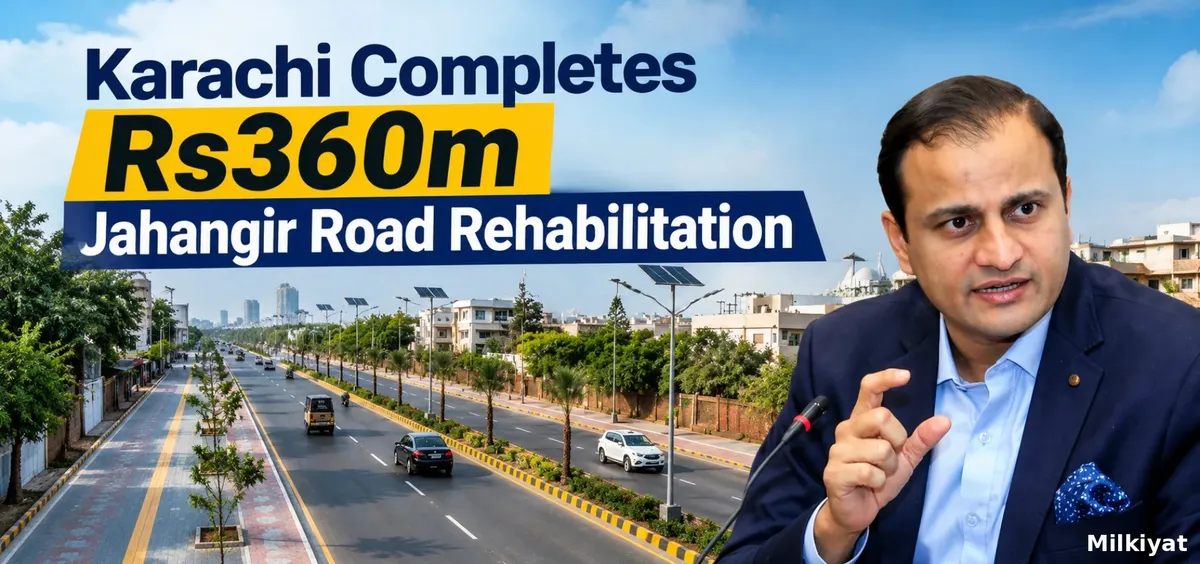
Karachi Mayor Murtaza Wahab inaugurated the Rs360 million rehabilitation and improvement of Jahangir Road from Gurumandir to Teen Hatti, a 1.4 kilometre stretch that now includes road widening from 26 to 32 feet, drainage improvements, footpaths, lane markings, and street lighting.
Jahangir Road functions as one of the key roads converging at Gurumandir Chowrangi, the roundabout where M.A. Jinnah Road terminates alongside Business Recorder Road, Jamshed Road, Jigar Muradabadi Road, and Clayton Road, placing it at the heart of one of central Karachi's busiest converging junctions. At the opposite end, the road connects toward Teen Hatti, a historic bridge crossing the Lyari River whose name traces back to three roadside shops or houses that once stood near the crossing. This corridor runs through genuinely dense, heavily urbanised central Karachi, connecting Liaquatabad and Teen Hatti through to Gurumandir.
This is not the first time Jahangir Road has been rebuilt, and understanding that history is essential to judging how significant this latest project actually is. The road was originally constructed under international engineering standards and lasted roughly 15 years before requiring major reconstruction. A subsequent rebuild, costing roughly Rs220 million and completed to recognised highway engineering standards, deteriorated rapidly within a comparatively short period, with numerous potholes, dozens of missing or open manhole covers along the Teen Hatti to Gurumandir stretch specifically, and broken, obstructed footpaths creating genuine safety hazards for pedestrians. Local area representatives have described the road as having been in a state of disrepair for years despite repeated reconstructions, attributing the recurring failures to substandard materials used in earlier rebuilds. The road was fully closed for a week in early 2026 specifically to allow repair work, forcing traffic onto alternate routes through Jail Chowrangi, Nishtar Road, and PIB Chowrangi before this current, more comprehensive Rs360 million project was undertaken.
Federal Minister Ahsan Iqbal has directed CDA to either immediately allot the required land to PIDE or refund approximately Rs4 billion after the institute waited six years despite completing payments by 2020.
Authorities in Topi, Swabi have launched demolitions against illegal buildings and structures along the Badri Nullah. Officials say the encroachments were blocking the natural water channel and contributing to flooding, with the enforcement operation expected to continue.
Authorities in Peshawar have declared 27 housing and plotting schemes in Shah Alam tehsil illegal, warning citizens against bookings, investments, and land transactions. Buyers and existing file holders are advised to verify NOC status directly with the relevant authorities before making any property-related decision.
Punjab has completed two new flood protection dykes at Jalalpur Pirwala to safeguard urban areas and nearby rural settlements from flooding, following the severe 2025 crisis that placed the city and surrounding farmland under significant threat.
Real Estate Analyst
4 min read
Karachi Mayor Murtaza Wahab inaugurated the Rs360 million rehabilitation and improvement of Jahangir Road from Gurumandir to Teen Hatti, a 1.4 kilometre stretch that now includes road widening from 26 to 32 feet, drainage improvements, footpaths, lane markings, and street lighting.
Jahangir Road functions as one of the key roads converging at Gurumandir Chowrangi, the roundabout where M.A. Jinnah Road terminates alongside Business Recorder Road, Jamshed Road, Jigar Muradabadi Road, and Clayton Road, placing it at the heart of one of central Karachi's busiest converging junctions. At the opposite end, the road connects toward Teen Hatti, a historic bridge crossing the Lyari River whose name traces back to three roadside shops or houses that once stood near the crossing. This corridor runs through genuinely dense, heavily urbanised central Karachi, connecting Liaquatabad and Teen Hatti through to Gurumandir.
This is not the first time Jahangir Road has been rebuilt, and understanding that history is essential to judging how significant this latest project actually is. The road was originally constructed under international engineering standards and lasted roughly 15 years before requiring major reconstruction. A subsequent rebuild, costing roughly Rs220 million and completed to recognised highway engineering standards, deteriorated rapidly within a comparatively short period, with numerous potholes, dozens of missing or open manhole covers along the Teen Hatti to Gurumandir stretch specifically, and broken, obstructed footpaths creating genuine safety hazards for pedestrians. Local area representatives have described the road as having been in a state of disrepair for years despite repeated reconstructions, attributing the recurring failures to substandard materials used in earlier rebuilds. The road was fully closed for a week in early 2026 specifically to allow repair work, forcing traffic onto alternate routes through Jail Chowrangi, Nishtar Road, and PIB Chowrangi before this current, more comprehensive Rs360 million project was undertaken.
Federal Minister Ahsan Iqbal has directed CDA to either immediately allot the required land to PIDE or refund approximately Rs4 billion after the institute waited six years despite completing payments by 2020.
Authorities in Topi, Swabi have launched demolitions against illegal buildings and structures along the Badri Nullah. Officials say the encroachments were blocking the natural water channel and contributing to flooding, with the enforcement operation expected to continue.
Authorities in Peshawar have declared 27 housing and plotting schemes in Shah Alam tehsil illegal, warning citizens against bookings, investments, and land transactions. Buyers and existing file holders are advised to verify NOC status directly with the relevant authorities before making any property-related decision.
Punjab has completed two new flood protection dykes at Jalalpur Pirwala to safeguard urban areas and nearby rural settlements from flooding, following the severe 2025 crisis that placed the city and surrounding farmland under significant threat.
Unlike the road's prior rebuild, which focused primarily on resurfacing, this project explicitly includes physical widening from 26 to 32 feet, a genuine capacity increase rather than a like for like resurfacing, alongside dedicated drainage improvements, a component the road's documented history of manhole and surface failures suggests was a genuine underlying gap in previous reconstructions.
Given this corridor's specific, repeated history of surface failure and open manhole hazards following past reconstructions, and the broader pattern of urban flooding concerns affecting Karachi more generally, the drainage improvements included in this latest project are arguably its most consequential element for the road's long term durability, not merely an added amenity. A road rebuilt without addressing underlying drainage capacity has, on this corridor's own documented history, tended to fail again within a relatively short period regardless of the surface work's initial quality.
Given Jahangir Road's specific, multi cycle history of deterioration following previous reconstructions, the genuine test of this project will be whether it holds up over the coming years rather than repeating the pattern of rapid decline seen after the road's last major rebuild. Readers and area residents should treat sustained durability, not the initial completion itself, as the real measure of this project's success.
Gurumandir to Teen Hatti is a heavily urbanised, commercially active corridor, and genuine improvements to road capacity, drainage, and pedestrian infrastructure here carry real relevance for commercial movement and property attractiveness along the route, provided the improvements actually hold up over time given the corridor's troubled maintenance history. Property owners, tenants, and businesses along Jahangir Road should treat this rehabilitation as a positive development while remaining realistic about the corridor's documented pattern of past deterioration, and should watch for consistent municipal maintenance in the months following completion as a more meaningful indicator of lasting improvement than the inauguration itself.
Unlike the road's prior rebuild, which focused primarily on resurfacing, this project explicitly includes physical widening from 26 to 32 feet, a genuine capacity increase rather than a like for like resurfacing, alongside dedicated drainage improvements, a component the road's documented history of manhole and surface failures suggests was a genuine underlying gap in previous reconstructions.
Given this corridor's specific, repeated history of surface failure and open manhole hazards following past reconstructions, and the broader pattern of urban flooding concerns affecting Karachi more generally, the drainage improvements included in this latest project are arguably its most consequential element for the road's long term durability, not merely an added amenity. A road rebuilt without addressing underlying drainage capacity has, on this corridor's own documented history, tended to fail again within a relatively short period regardless of the surface work's initial quality.
Given Jahangir Road's specific, multi cycle history of deterioration following previous reconstructions, the genuine test of this project will be whether it holds up over the coming years rather than repeating the pattern of rapid decline seen after the road's last major rebuild. Readers and area residents should treat sustained durability, not the initial completion itself, as the real measure of this project's success.
Gurumandir to Teen Hatti is a heavily urbanised, commercially active corridor, and genuine improvements to road capacity, drainage, and pedestrian infrastructure here carry real relevance for commercial movement and property attractiveness along the route, provided the improvements actually hold up over time given the corridor's troubled maintenance history. Property owners, tenants, and businesses along Jahangir Road should treat this rehabilitation as a positive development while remaining realistic about the corridor's documented pattern of past deterioration, and should watch for consistent municipal maintenance in the months following completion as a more meaningful indicator of lasting improvement than the inauguration itself.
