News
Karachi Red Line Contract Cancellation Declared Invalid

By Mariam Khan
Real Estate Analyst
4 min read
ShareWhatsApp
News
By Mariam Khan
Real Estate Analyst
4 min read
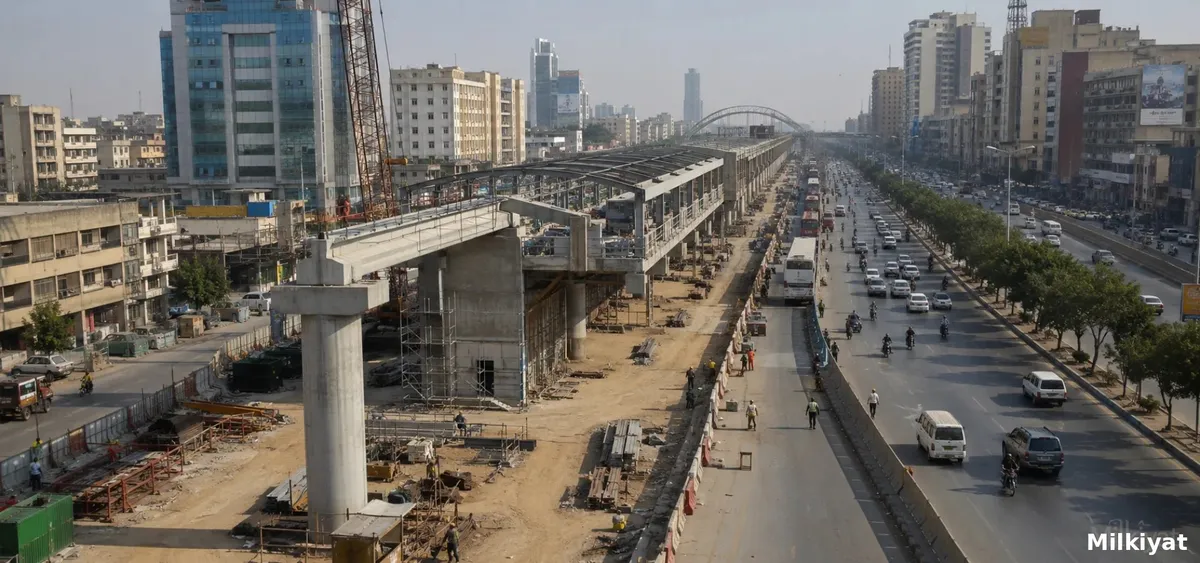
A Dispute Resolution Board has declared the Sindh government's cancellation of the Bus Rapid Transit (BRT) Red Line's Mosamiyat-to-Numaish construction contract "unlawful, invalid, null and void," according to Dawn, published 9 August 2026. TechJuice and Momentum Pakistan corroborated the ruling, which followed more than two months of hearings after the Sindh High Court directed both parties to the board.
The Sindh government had terminated the Lot-2 contract — covering the Mosamiyat-to-Numaish corridor — citing lack of progress. The contractor, AM Associate, challenged the termination in the Sindh High Court, arguing the provincial government itself had caused the delays. The court ordered both sides to resolve the matter through the project's pre-agreed Dispute Resolution Board rather than through litigation, as required under the signed contract terms.
After reviewing the case, the board ruled the government's cancellation had been taken in haste, without adequately considering the project's complexity, and issued an extraordinary indictment of TransKarachi, the Sindh government-owned agency responsible for executing the project. The board found TransKarachi lacked the institutional capacity and experienced project management needed for a scheme of this scale, and had failed to meet several of its own contractual obligations before terminating the agreement — including finalising the project design, handing over a site free of obstacles, and making outstanding payments to the contractor on time.
The roughly 27-kilometre Red Line, running from Malir Halt to Numaish, was announced in 2017 with an initial cost estimate of Rs79 billion; that figure has since risen to Rs103 billion. Construction began in early 2022 with an original 2023 completion target, later pushed to 2024, and then extended again to the end of 2026. According to Dawn's April 2026 reporting, the contract was first cancelled in April, with Sindh Senior Minister Sharjeel Memon citing contractor delays, while the Asian Development Bank — which funds the project — had reportedly expressed its own frustration with the pace of work. The Frontier Works Organisation (FWO) was subsequently brought in to resume construction on part of the corridor, according to a Profit by Pakistan Today report, while the Sindh High Court was separately told no new contract had formally been awarded for the disputed Lot-2 section, per Pakistan Construction & Quarry's coverage.
With the cancellation now invalidated, the ruling effectively restores AM Associate's contractual claim to the Mosamiyat-to-Numaish section, though it remains to be seen whether the Sindh government will accept the board's decision, appeal it, or attempt to renegotiate terms with the original contractor. Given TransKarachi's institutional shortcomings flagged directly by the board, further delay and legal wrangling before construction meaningfully resumes on this stretch appears likely.
The prolonged uncertainty on University Road has already disrupted businesses and residents along the corridor, and this latest legal turn suggests that disruption will continue rather than resolve soon. Commercial and residential property along and near the affected stretch has faced reduced accessibility, inconsistent business activity, and pressure on rents throughout the project's construction period — a pattern seen elsewhere in Pakistan when major transit infrastructure drags on for years rather than months. As milkiyat.com has noted in its coverage of the Rawalpindi Ring Road's impact on nearby property values, infrastructure projects tend to depress surrounding commercial activity during construction before any post-completion value uplift materialises — meaning property owners and tenants along University Road should plan for continued disruption rather than an imminent resolution. Buyers or investors considering property near the corridor should also independently verify current zoning, accessibility, and any pending acquisition or right-of-way issues before committing funds, following the same due-diligence approach outlined in milkiyat.com's guide to verifying property and housing schemes elsewhere in Pakistan.
FBR notifies faceless income tax appeal rules, introducing anonymous commissioners, digital hearings and automated case allocation for tax disputes.
FBR replaces sales tax return STR-7 and revises purchase and sales invoice annexes, introducing expanded transaction and tax reporting requirements.
FBR seals a Karachi superstore outlet after finding Rs3.27 billion in off-system sales, POS violations and alleged sales tax irregularities.
Pakistan plans to split SNGPL and SSGCL into six to eight entities, restructure gas operations and shift over Rs3 trillion in circular debt.