News
Pakistan, EU Sign €65m Agreements to Boost Investment, Tax Reforms and Energy Resilience

By Mariam Khan
Real Estate Analyst
4 min read
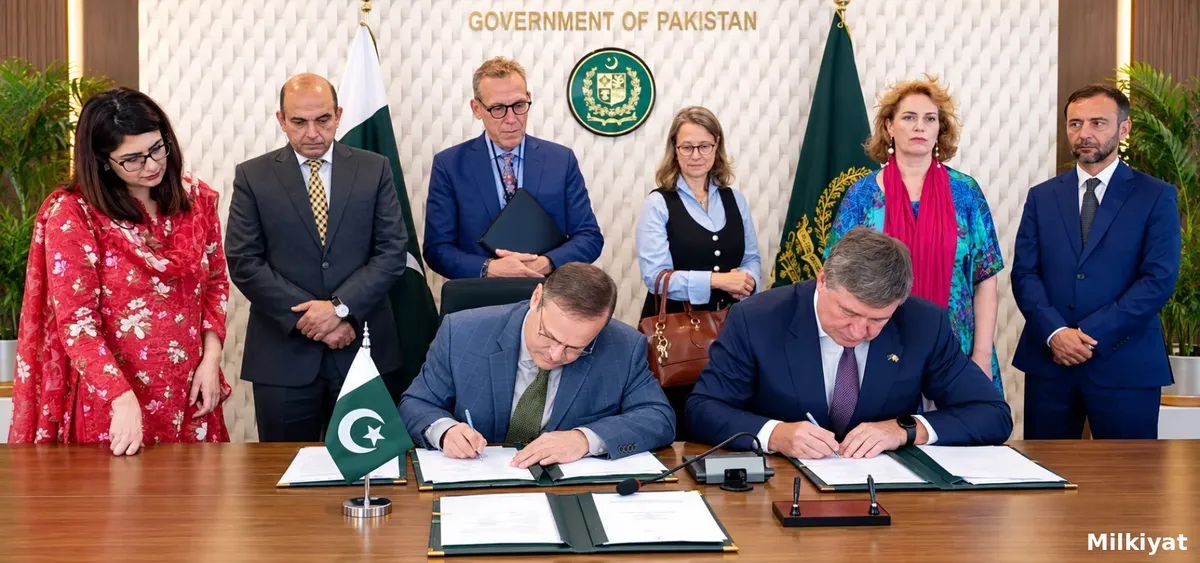
Pakistan and the European Union have signed three grant agreements worth €65 million, approximately Rs20.64 billion, covering investment facilitation and financial reforms, energy and environmental resilience in Khyber Pakhtunkhwa, and improvements to Pakistan's rule of law and business environment. The agreements were signed by EU Ambassador to Pakistan Raimundas Karoblis and Economic Affairs Division Secretary Muhammad Humair Karim, and fall under the EU's Global Gateway initiative.
What Each of the Three Programmes Actually Covers
The first programme, described as Global Gateway development facilitation for Pakistan covering investment management and the financial enabling environment, is aimed specifically at improving Pakistan's tax systems and strengthening long term government financial planning in order to attract foreign investment. The second, the Energy and Natural Environment Resilience programme in Khyber Pakhtunkhwa, is focused on expanding renewable energy access in off grid rural communities and providing training designed to attract private investment into KP's energy sector specifically. The third, EU support to the rule of law and business environment in Pakistan, is intended to enhance access to police, prosecution, courts, and legal aid in Khyber Pakhtunkhwa and Balochistan, while expanding alternative and commercial dispute resolution mechanisms in Punjab and Sindh.
Why the Tax and Investment Reform Programme Matters Most for Property
Of the three, the investment management and financial enabling environment programme carries the most direct, if indirect, relevance for real estate and development. Improvements to Pakistan's tax system and stronger long term government financial planning are precisely the kind of structural changes that shape how attractive Pakistan looks to foreign investors more broadly, and a more predictable, better managed fiscal environment tends to support greater foreign capital inflows into infrastructure and development projects over time, even though this specific grant is not earmarked for property or construction directly.
Why the Rule of Law Component Also Matters for Development
The rule of law and business environment programme's focus on expanding commercial dispute resolution mechanisms in Punjab and Sindh specifically is also worth noting for anyone involved in property and development transactions in those provinces. Faster, more reliable commercial dispute resolution reduces one of the practical risks that can deter both domestic and foreign investment in large development projects, where contract and land related disputes can otherwise take years to resolve through the ordinary court system.
Why the KP Energy Programme Is a Narrower, More Specific Bet
The energy and environmental resilience programme's focus on off grid rural communities in Khyber Pakhtunkhwa makes it a narrower intervention than the other two, targeted specifically at expanding renewable energy access outside the main grid rather than broader infrastructure. Ambassador Karoblis described the agreements as demonstrating the EU's commitment to supporting Pakistan's economic development and investment ambitions under the Global Gateway initiative, while Secretary Karim highlighted the relevance of the partnership to both Pakistan's foreign investment goals and its renewable energy access objectives.
What This Means for Pakistan's Investment Climate
None of these three programmes is a direct housing or property announcement, and readers should not expect any immediate change in construction activity or property demand from this signing alone. What this package does represent is a continued, incremental push toward the kind of structural reforms, better tax administration, stronger financial planning, and faster commercial dispute resolution, that tend to shape investor confidence in Pakistan over a longer horizon, including confidence relevant to future property, infrastructure, and development investment. Developers and investors tracking Pakistan's broader investment climate should treat this as one incremental data point in that longer running story rather than a standalone catalyst.