Blog
Pakistan’s Real Estate Shift: Tax Cuts, Urban Sprawl, and the Mortgage Gap

Real Estate Analyst
3 min read
The Big Picture
The government has rolled back its aggressive property taxes to kickstart Pakistan’s struggling real estate sector [1] [2]. While buyers and developers are celebrating cheaper transaction costs, urban planners are worried. These changes make it easier for investors to hoard empty land, fueling unchecked horizontal urban sprawl instead of building up into dense, vertical, and climate-resilient cities [1] [3].
1. What Changed in the Taxes?
The newly enacted federal budget introduced two massive tax reliefs for active tax filers:
- Goodbye Section 7E: The controversial 1% annual tax on unutilized empty plots worth over PKR 25 million has been completely removed [4].
- Land transfers no longer require a clean certificate from the FBR to proceed [4].
- Slashed Transaction Fees: For active tax filers on the Active Taxpayers List (ATL), property taxes have dropped significantly [4].
- Sellers now pay a flat 2.75% (down from up to 5.5%) [1].
- Buyers now pay a flat 1.25% (down from up to 2.5%) [1].
Punitive tax penalties remain exceptionally high (up to 18.5%) for non-filers to push them into the tax net [4].
2. The Elite Plot Distortion
The Federal Board of Revenue (FBR) slashed official valuation rates by roughly 30% in high-end, military-managed enclaves like DHA Lahore [1]. The Lahore Chamber of Commerce and Industry (LCCI) warns that this selective relief creates an uneven playing field [1]. Because tax values are artificially low in these premium enclaves, investment capital is naturally flowing away from standard, private middle-class housing projects and into luxury sectors where transaction taxes are cheaper.
3. Why Lahore is Growing Sideways
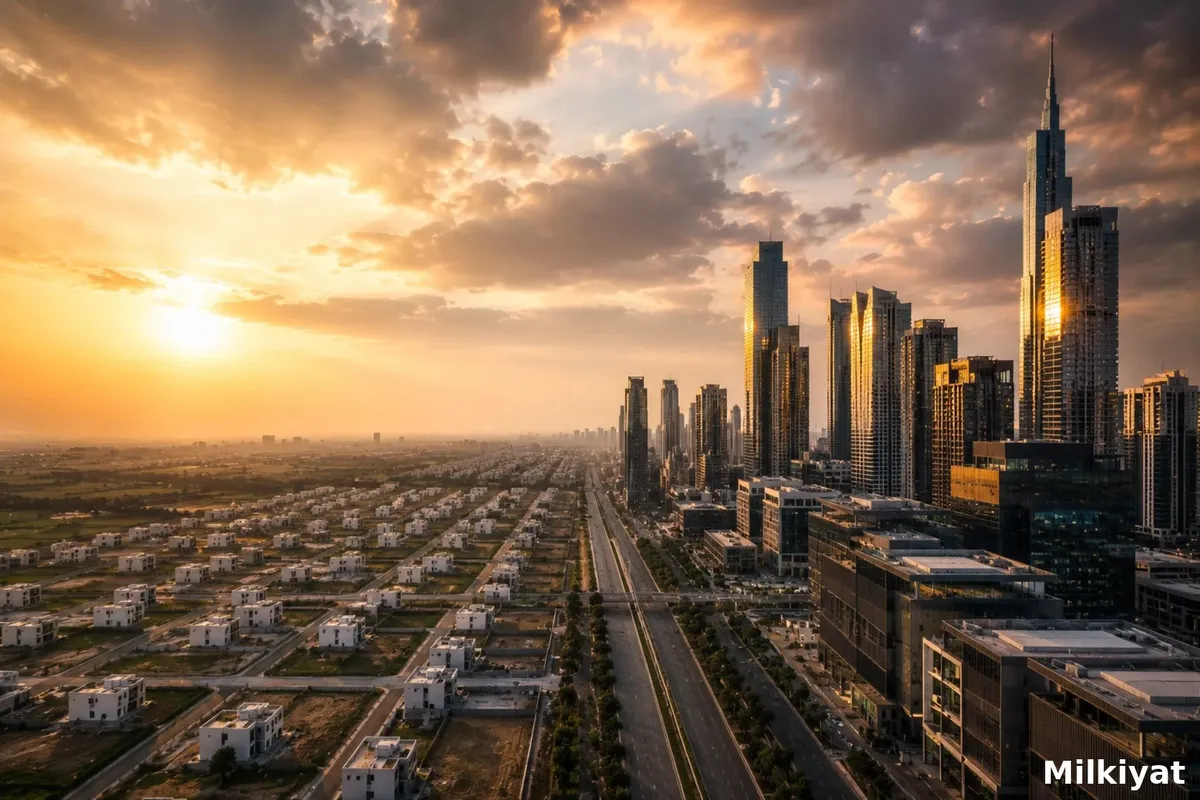
Because holding empty land no longer carries a tax penalty, speculative land hoarding is back. Private developers are rapidly destroying fertile agricultural fields on the edges of Lahore to build new horizontal housing societies [3].
- The Sprawl: Over forty years, more than 114,630 hectares of green arable land have turned into concrete roads and plots [3].
- The Vacancy Crisis: There are currently between 150,000 to 200,000 fully developed residential plots sitting completely empty and vacant inside Lahore [1].
Without a single, unified municipal authority to enforce vertical building laws (like high-rise apartments), Lahore continues to spread outward, destroying the environment and worsening the urban heat crisis [1] [3].
4. The Unaffordable Mortgage Problem
Even if developers build vertical apartments, ordinary citizens cannot afford to buy them due to a massive housing finance deficit [1]. To control inflation, the State Bank of Pakistan (SBP) has kept its benchmark interest rate high at 11.5% [5]. As a result, commercial bank home loans come with massive interest rates:
Effective Mortgage Rate = 1-Year KIBOR (11.56%) + Bank Spread = 14.50% to 16.00% Total Interest
At these interest rates, monthly payments are impossible for middle-income families, leaving the housing market dependent almost entirely on elite cash buyers [1].
5. The Path Forward
To create sustainable urban growth, Pakistan needs to move away from quick tax fixes and implement structural reforms:
- Tax Empty Land: Introduce a local municipal infrastructure fee on serviced plots that remain unbuilt for years to stop speculative hoarding.
- Unify City Planning: Merge competing local bodies (LDA, DHA, cantonments) into a single Metropolitan Planning Authority to mandate vertical high-rises.
- Unlock Better Home Loans: Partner with international institutions to create risk-sharing facilities, protecting banks and allowing them to offer viable 20-year fixed mortgages to salaried workers [1].
References
- Proceedings of the Seminar on Real Estate Tax Reforms and Urban Development — Lahore Chamber of Commerce and Industry (LCCI) https://www.lcci.com.pk/resources/seminar-real-estate-tax-reforms-2026 (accessed June 2026)↑↑↑↑↑↑↑↑↑↑↑
- Pakistan: Seventh and Eighth Reviews Under the Extended Fund Facility and Request for Structural Tax Policy Alignments — International Monetary Fund (IMF) https://www.imf.org/en/Publications/CR/Issues/2026/pakistan-seventh-eighth-reviews-eff (accessed May 2026)↑
- Satellite Imagery Analysis and Spatial Expansion Patterns of Lahore Metropolitan Area (1994–2024) — Urban Planning & GIS Research Consortium https://urbanplanning-gis.org/publications/lahore-spatial-expansion-analysis-1994-2024 (accessed March 2024)↑↑↑↑
- The Income Tax Ordinance, 2001 (As amended up to Finance Act, 2026) — Federal Board of Revenue (FBR), Government of Pakistan https://www.fbr.gov.pk/downloads/income-tax-ordinance-2001-finance-act-2026 (accessed June 2026)↑↑↑↑
- Monetary Policy Statement and KIBOR Market Reports (June 2026) — State Bank of Pakistan (SBP) https://www.sbp.org.pk/m_policy/2026/mps-june-2026 (accessed June 2026)↑