News
Property Enforcement Expands in KP After Flood Damage: Badri Nullah Demolitions in Topi
Real Estate Analyst
3 min read
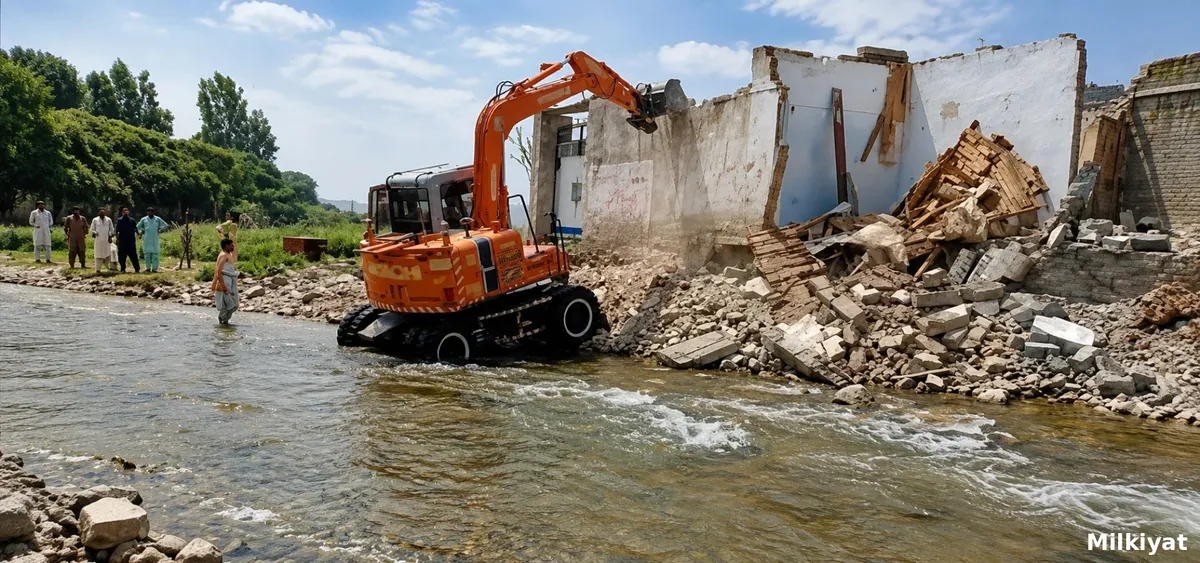
Authorities in Topi, Swabi have begun demolishing buildings and structures constructed illegally along the banks of the Badri Nullah, with officials saying the encroachments were obstructing the natural water channel and contributing to flooding in Topi and surrounding areas. The operation against structures on government land is expected to continue.
This enforcement action lands in a district with a documented, severe recent flooding history. Swabi experienced catastrophic flash flooding in August 2025, when a sudden cloudburst triggered flash floods, landslides, lightning strikes, and falling boulders from surrounding hills, resulting in significant loss of life and flattening a number of houses completely while damaging others. Separately, in earlier flooding, heavy rain across the Badri Nullah and other seasonal streams in the district caused rainwater to enter homes and shops directly, with drowning deaths recorded in the same general area. This history is directly relevant to why officials are now treating encroachment removal along Badri Nullah specifically as an urgent priority rather than routine enforcement.
Officials have specifically identified the demolished structures as obstructing the Badri Nullah's natural water channel, the same watercourse implicated in the area's prior flooding episodes. Removing construction that narrows or blocks a nullah's natural flow is intended to restore the channel's capacity to carry stormwater safely away from populated areas during heavy rainfall, precisely the kind of failure that has already caused serious damage and loss of life in this district.
Officials have indicated the operation against structures on government land along the nullah will continue, though the full scope has not been detailed. Given the severity of Swabi's documented flooding history, sustained follow through on this enforcement, rather than a single, limited operation, will be the genuine test of whether this action meaningfully reduces future flood risk in Topi.
This action fits within a pattern already documented in Islamabad, where authorities have similarly linked illegal construction along nullah rights of way to worsening urban flooding, including in Sector E-11, where fatal flooding was later traced to formal, approved narrowing of a drainage channel that was only reversed after tragedy occurred. The recurrence of this same underlying pattern, construction encroaching on natural drainage capacity followed later by demolition once flooding forces the issue, across multiple Pakistani cities and provinces suggests this is a structural, nationwide regulatory gap rather than an isolated local failure specific to Topi or Swabi.
Federal Minister Ahsan Iqbal has directed CDA to either immediately allot the required land to PIDE or refund approximately Rs4 billion after the institute waited six years despite completing payments by 2020.
Authorities in Peshawar have declared 27 housing and plotting schemes in Shah Alam tehsil illegal, warning citizens against bookings, investments, and land transactions. Buyers and existing file holders are advised to verify NOC status directly with the relevant authorities before making any property-related decision.
Karachi has completed the Rs360 million rehabilitation of Jahangir Road from Gurumandir to Teen Hatti. The 1.4-kilometre project includes road widening, drainage improvements, footpaths, lane markings and new street lighting.
Punjab has completed two new flood protection dykes at Jalalpur Pirwala to safeguard urban areas and nearby rural settlements from flooding, following the severe 2025 crisis that placed the city and surrounding farmland under significant threat.
Real Estate Analyst
3 min read
Authorities in Topi, Swabi have begun demolishing buildings and structures constructed illegally along the banks of the Badri Nullah, with officials saying the encroachments were obstructing the natural water channel and contributing to flooding in Topi and surrounding areas. The operation against structures on government land is expected to continue.
This enforcement action lands in a district with a documented, severe recent flooding history. Swabi experienced catastrophic flash flooding in August 2025, when a sudden cloudburst triggered flash floods, landslides, lightning strikes, and falling boulders from surrounding hills, resulting in significant loss of life and flattening a number of houses completely while damaging others. Separately, in earlier flooding, heavy rain across the Badri Nullah and other seasonal streams in the district caused rainwater to enter homes and shops directly, with drowning deaths recorded in the same general area. This history is directly relevant to why officials are now treating encroachment removal along Badri Nullah specifically as an urgent priority rather than routine enforcement.
Officials have specifically identified the demolished structures as obstructing the Badri Nullah's natural water channel, the same watercourse implicated in the area's prior flooding episodes. Removing construction that narrows or blocks a nullah's natural flow is intended to restore the channel's capacity to carry stormwater safely away from populated areas during heavy rainfall, precisely the kind of failure that has already caused serious damage and loss of life in this district.
Officials have indicated the operation against structures on government land along the nullah will continue, though the full scope has not been detailed. Given the severity of Swabi's documented flooding history, sustained follow through on this enforcement, rather than a single, limited operation, will be the genuine test of whether this action meaningfully reduces future flood risk in Topi.
This action fits within a pattern already documented in Islamabad, where authorities have similarly linked illegal construction along nullah rights of way to worsening urban flooding, including in Sector E-11, where fatal flooding was later traced to formal, approved narrowing of a drainage channel that was only reversed after tragedy occurred. The recurrence of this same underlying pattern, construction encroaching on natural drainage capacity followed later by demolition once flooding forces the issue, across multiple Pakistani cities and provinces suggests this is a structural, nationwide regulatory gap rather than an isolated local failure specific to Topi or Swabi.
Federal Minister Ahsan Iqbal has directed CDA to either immediately allot the required land to PIDE or refund approximately Rs4 billion after the institute waited six years despite completing payments by 2020.
Authorities in Peshawar have declared 27 housing and plotting schemes in Shah Alam tehsil illegal, warning citizens against bookings, investments, and land transactions. Buyers and existing file holders are advised to verify NOC status directly with the relevant authorities before making any property-related decision.
Karachi has completed the Rs360 million rehabilitation of Jahangir Road from Gurumandir to Teen Hatti. The 1.4-kilometre project includes road widening, drainage improvements, footpaths, lane markings and new street lighting.
Punjab has completed two new flood protection dykes at Jalalpur Pirwala to safeguard urban areas and nearby rural settlements from flooding, following the severe 2025 crisis that placed the city and surrounding farmland under significant threat.
For anyone owning or considering property near the Badri Nullah or any comparable natural watercourse in Khyber Pakhtunkhwa, this demolition action is a direct, serious signal that construction within a nullah's right of way carries genuine demolition risk, not merely regulatory inconvenience, particularly in districts with Swabi's documented flood history. Buyers should independently verify a property's specific distance from any natural drainage channel and its formal right of way boundary directly with the Peshawar Development Authority or the relevant local Tehsil Municipal Administration before purchasing, and should treat any structure built on or encroaching into a nullah's course as carrying both physical flood risk and legal demolition exposure simultaneously.
For anyone owning or considering property near the Badri Nullah or any comparable natural watercourse in Khyber Pakhtunkhwa, this demolition action is a direct, serious signal that construction within a nullah's right of way carries genuine demolition risk, not merely regulatory inconvenience, particularly in districts with Swabi's documented flood history. Buyers should independently verify a property's specific distance from any natural drainage channel and its formal right of way boundary directly with the Peshawar Development Authority or the relevant local Tehsil Municipal Administration before purchasing, and should treat any structure built on or encroaching into a nullah's course as carrying both physical flood risk and legal demolition exposure simultaneously.
