News
Rs4.25bn Serena Underpass Road Subsides Again After Heavy Rains in Islamabad
Real Estate Analyst
4 min read
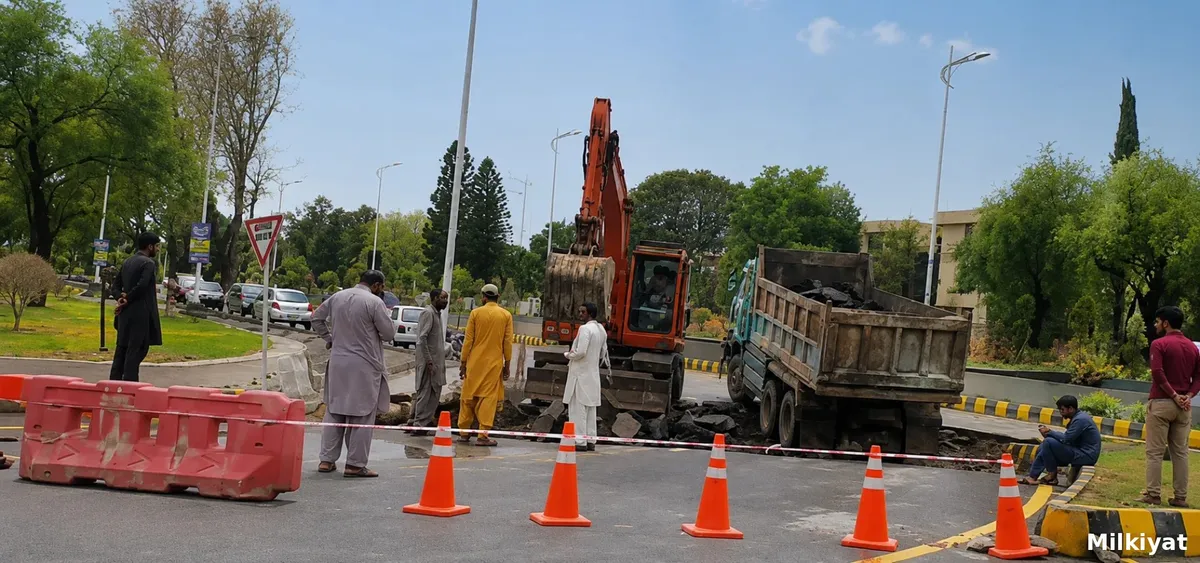
Part of the road around Islamabad's Serena Chowk Interchange, officially named Jinnah Square, has reportedly subsided again following this week's heavy monsoon rainfall, according to reports dated 3 September 2026. The Rs4.2 billion project was inaugurated by Prime Minister Shehbaz Sharif in February 2025 after being completed in a widely publicised 72 days.
This is a genuine repeat failure, not an isolated incident. The same newly built section of the Serena Underpass caved in previously in June 2025, just months after its high profile inauguration, during that year's first heavy monsoon rain. That earlier collapse produced a widely circulated video showing a large crater on the turning road leading toward Srinagar Highway, with a CDA digger working to clear debris, and drew immediate public criticism over the quality of the capital's rushed infrastructure delivery. A road subsiding twice within roughly 18 months of a brand new, heavily promoted project's completion is a materially different, more serious story than a single weather related incident.
The interchange comprises three underpasses, a two lane underpass at Khayaban-i-Suhrawardi and an eight lane underpass at Srinagar Highway, along with connecting roads and a half kilometre culvert, delivered across a 14 kilometre road network. According to CDA's own chairman at the time, construction was ordered to continue round the clock, with engineers from the project's consultant required to maintain a constant on site presence to meet the accelerated deadline. The project was originally targeted for completion within 60 days from its 5 November 2024 foundation, but officials cited a running nullah beneath the site and hard rock conditions as factors that extended the timeline. Despite these documented underground complications, the project was ultimately completed in 72 days, worked round the clock under direct pressure to finish ahead of schedule, a pace CDA and government officials repeatedly and publicly celebrated as a record achievement at the time.
The same running nullah and hard rock conditions that slowed original construction are directly relevant to understanding why this location may be structurally predisposed to drainage related subsidence. A nullah running beneath or near a road structure represents an active water channel that construction must properly account for and divert, and any inadequacy in how that diversion was engineered, particularly under a compressed 72 day construction timeline, would be expected to manifest exactly as recurring subsidence during periods of heavy rainfall, which is what has now happened on two separate occasions.
Authorities in Peshawar have declared 27 housing and plotting schemes in Shah Alam tehsil illegal, warning citizens against bookings, investments, and land transactions. Buyers and existing file holders are advised to verify NOC status directly with the relevant authorities before making any property-related decision.
Karachi has completed the Rs360 million rehabilitation of Jahangir Road from Gurumandir to Teen Hatti. The 1.4-kilometre project includes road widening, drainage improvements, footpaths, lane markings and new street lighting.
Punjab has completed two new flood protection dykes at Jalalpur Pirwala to safeguard urban areas and nearby rural settlements from flooding, following the severe 2025 crisis that placed the city and surrounding farmland under significant threat.
Master plan violations, narrowed drainage channels and encroachments on natural nullahs are contributing to worsening flooding in Islamabad. CDA now plans four check dams, a new E-11 nullah and removal of constructions obstructing waterways in vulnerable areas.
Real Estate Analyst
4 min read
Part of the road around Islamabad's Serena Chowk Interchange, officially named Jinnah Square, has reportedly subsided again following this week's heavy monsoon rainfall, according to reports dated 3 September 2026. The Rs4.2 billion project was inaugurated by Prime Minister Shehbaz Sharif in February 2025 after being completed in a widely publicised 72 days.
This is a genuine repeat failure, not an isolated incident. The same newly built section of the Serena Underpass caved in previously in June 2025, just months after its high profile inauguration, during that year's first heavy monsoon rain. That earlier collapse produced a widely circulated video showing a large crater on the turning road leading toward Srinagar Highway, with a CDA digger working to clear debris, and drew immediate public criticism over the quality of the capital's rushed infrastructure delivery. A road subsiding twice within roughly 18 months of a brand new, heavily promoted project's completion is a materially different, more serious story than a single weather related incident.
The interchange comprises three underpasses, a two lane underpass at Khayaban-i-Suhrawardi and an eight lane underpass at Srinagar Highway, along with connecting roads and a half kilometre culvert, delivered across a 14 kilometre road network. According to CDA's own chairman at the time, construction was ordered to continue round the clock, with engineers from the project's consultant required to maintain a constant on site presence to meet the accelerated deadline. The project was originally targeted for completion within 60 days from its 5 November 2024 foundation, but officials cited a running nullah beneath the site and hard rock conditions as factors that extended the timeline. Despite these documented underground complications, the project was ultimately completed in 72 days, worked round the clock under direct pressure to finish ahead of schedule, a pace CDA and government officials repeatedly and publicly celebrated as a record achievement at the time.
The same running nullah and hard rock conditions that slowed original construction are directly relevant to understanding why this location may be structurally predisposed to drainage related subsidence. A nullah running beneath or near a road structure represents an active water channel that construction must properly account for and divert, and any inadequacy in how that diversion was engineered, particularly under a compressed 72 day construction timeline, would be expected to manifest exactly as recurring subsidence during periods of heavy rainfall, which is what has now happened on two separate occasions.
Authorities in Peshawar have declared 27 housing and plotting schemes in Shah Alam tehsil illegal, warning citizens against bookings, investments, and land transactions. Buyers and existing file holders are advised to verify NOC status directly with the relevant authorities before making any property-related decision.
Karachi has completed the Rs360 million rehabilitation of Jahangir Road from Gurumandir to Teen Hatti. The 1.4-kilometre project includes road widening, drainage improvements, footpaths, lane markings and new street lighting.
Punjab has completed two new flood protection dykes at Jalalpur Pirwala to safeguard urban areas and nearby rural settlements from flooding, following the severe 2025 crisis that placed the city and surrounding farmland under significant threat.
Master plan violations, narrowed drainage channels and encroachments on natural nullahs are contributing to worsening flooding in Islamabad. CDA now plans four check dams, a new E-11 nullah and removal of constructions obstructing waterways in vulnerable areas.
The Serena Interchange sits at the planned starting point of Jinnah Square Downtown, a proposed 5,400 kanal residential and commercial district CDA has planned to extend from the interchange toward the Bhara Kahu bypass along Srinagar Highway and Murree Road, envisioned to include hotel, apartment, hospital, and commercial plots alongside significant green space. The underpass's structural reliability carries added weight given CDA's own stated ambition to position this exact corridor as one of the capital's next major investment and development zones.
No official CDA statement detailing the specific cause of this latest subsidence, the extent of the damage, or a repair timeline had been confirmed at the time of this report. Given that the same underlying issue reportedly caused the 2025 collapse, readers should watch for whether CDA's response this time addresses the underlying drainage and nullah diversion engineering, rather than treating a repaved surface alone as a genuine fix.
The Serena Interchange sits at a strategically important junction serving the Jinnah Convention Centre, Serena Hotel, Constitution Avenue, and the Diplomatic Enclave, meaning repeated closures or repair work at this specific site carry genuine, recurring disruption for traffic and accessibility across one of Islamabad's most consequential commercial and institutional corridors. Property owners, businesses, and commuters relying on this interchange should treat this second subsidence event as a signal that further, unplanned closures at this location remain a real possibility during future heavy rainfall until the underlying drainage issue is genuinely resolved, rather than assuming the current repair will be the last one required.
The Serena Interchange sits at the planned starting point of Jinnah Square Downtown, a proposed 5,400 kanal residential and commercial district CDA has planned to extend from the interchange toward the Bhara Kahu bypass along Srinagar Highway and Murree Road, envisioned to include hotel, apartment, hospital, and commercial plots alongside significant green space. The underpass's structural reliability carries added weight given CDA's own stated ambition to position this exact corridor as one of the capital's next major investment and development zones.
No official CDA statement detailing the specific cause of this latest subsidence, the extent of the damage, or a repair timeline had been confirmed at the time of this report. Given that the same underlying issue reportedly caused the 2025 collapse, readers should watch for whether CDA's response this time addresses the underlying drainage and nullah diversion engineering, rather than treating a repaved surface alone as a genuine fix.
The Serena Interchange sits at a strategically important junction serving the Jinnah Convention Centre, Serena Hotel, Constitution Avenue, and the Diplomatic Enclave, meaning repeated closures or repair work at this specific site carry genuine, recurring disruption for traffic and accessibility across one of Islamabad's most consequential commercial and institutional corridors. Property owners, businesses, and commuters relying on this interchange should treat this second subsidence event as a signal that further, unplanned closures at this location remain a real possibility during future heavy rainfall until the underlying drainage issue is genuinely resolved, rather than assuming the current repair will be the last one required.
