News
SBP Overhauls Housing Finance Rules, Allows Up to 30 Year Home Loans in Pakistan

By Mariam Khan
Real Estate Analyst
6 min read
ShareWhatsApp
News
By Mariam Khan
Real Estate Analyst
6 min read
News
By Mariam Khan
Real Estate Analyst
6 min read
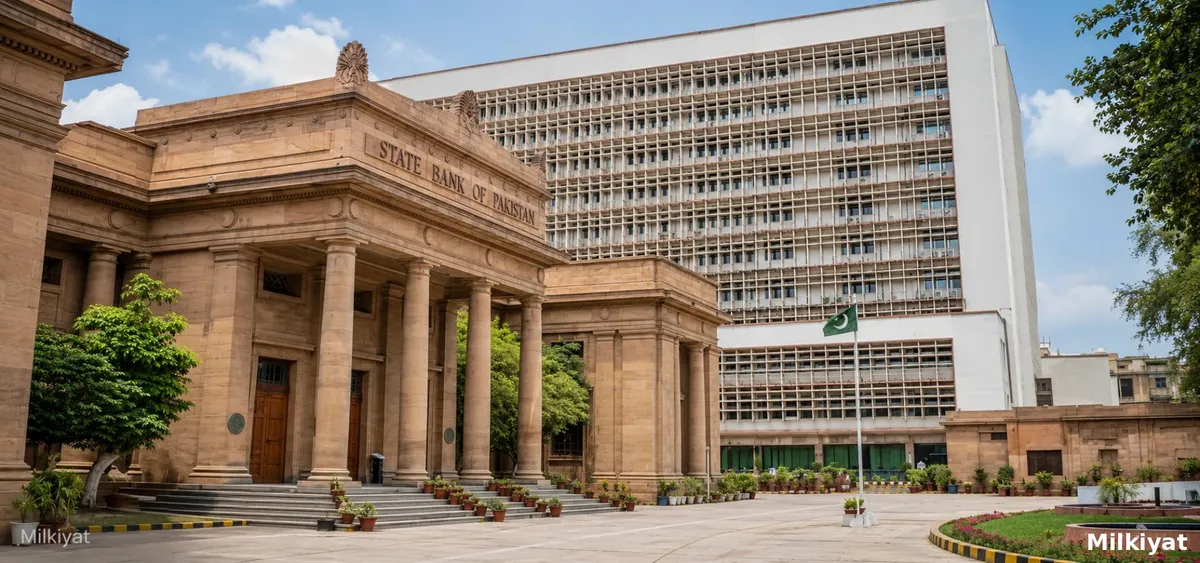
The State Bank of Pakistan has issued a comprehensive overhaul of the Prudential Regulations for Housing Finance, with the revised rules taking effect immediately, according to SH&SFD Circular No. 04 of 2026, dated 18 August 2026. The revised regulations supersede four earlier circulars issued between 2019 and 2021, and apply to all banks and Development Finance Institutions operating in Pakistan.
Under the new framework, the maximum tenor for housing finance has been extended to thirty years, up from the shorter terms that applied previously, while renewable energy financing carries a separate maximum tenor of ten years. The maximum Loan to Value ratio has been set at 90:10, meaning eligible borrowers can finance up to 90 percent of a property's value. On affordability, total monthly amortisation payments across a borrower's housing finance and all other outstanding consumer financing obligations may not exceed 65 percent of net disposable income.
The revised regulations set out six specific eligible purposes for housing finance: purchase of a house or apartment, construction of a house on a plot the borrower already owns, purchase of a plot combined with construction of a house on it, extension or expansion of an existing house, renovation of a housing unit, and installation of renewable energy solutions within housing units. This last category, covering solar panels, inverters, batteries and related equipment, can be secured either through hypothecation of the installed assets themselves or through any other security arrangement acceptable to the lending bank or DFI.
SBP has mandated a simplified, standardised loan application process across three distinct borrower categories, formal salaried persons, formal business owners, and informal income earners, with dedicated application forms for each published in both English and Urdu as part of the regulation itself. For borrowers with informal income sources, banks and DFIs are now required to assess eligibility using proxy income documents such as rent agreements, utility bills, telecom bills or school fee challans, rather than requiring the formal salary slips or business documentation that would exclude much of Pakistan's informally employed population from housing finance altogether. Banks and DFIs are also required to deploy informal income estimation models circulated by the Pakistan Banks Association specifically for assessing repayment capacity in these cases.
For housing finance up to Rs5 million, banks and DFIs may now extend financing by placing a lien on the property directly in the records of the relevant land record authority, rather than requiring a full registered mortgage. In such cases, financing may be extended against a Green Property Certificate issued by the Punjab Land Records Authority, or an equivalent certificate issued by the competent authority in other provinces, a change that directly links this national banking regulation to the provincial digital verification systems already covered in milkiyat.com's reporting on PLRA's housing society legal status checker.
On valuation, housing finance exceeding Rs10 million must now be assessed by at least one valuator listed on the Pakistan Banks Association's approved panel, while financing up to Rs10 million may continue to be assessed through a bank's own internal resources. For housing units of the same category, layout and size within a single society or colony, banks and DFIs are permitted to rely on a single unit's valuation across all comparable units rather than conducting separate valuations for each one, a provision likely to meaningfully speed up processing for large scale housing schemes with standardised unit types.
The revised regulations set out a detailed asset classification framework for housing finance that falls into arrears. Financing overdue by 90 days or more is classified as OAEM, with 180 days triggering Substandard classification, one year triggering Doubtful classification, and two years triggering Loss classification, each carrying escalating provisioning requirements. Notably, the Forced Sale Value benefit banks can apply against non performing loans for provisioning purposes now ceases entirely after five years from the date of classification, with a defined declining schedule of benefit percentages in the years before that cutoff.
Banks and DFIs must maintain a board approved policy governing rescheduling and restructuring of housing finance, and cannot reschedule or restructure a single borrower's housing finance more than once within any two year period. Where a rescheduling does occur, the tenure may be extended by a maximum of five years beyond the original agreed term, subject always to the overall thirty year ceiling. A non performing asset's classification cannot be upgraded solely because of rescheduling, unless the borrower has paid at least ten percent of the rescheduled amount or six instalments under the revised terms, whichever is higher.
This overhaul lands at a moment when Pakistan's government backed housing finance schemes, including Ghar Ho Tu Apna, have already been building momentum, as covered in milkiyat.com's earlier reporting on Meezan Bank's disbursements under that programme. A thirty year maximum tenor, a 90:10 Loan to Value ratio, and formal recognition of informal income documentation together represent a meaningfully more accessible framework than what preceded it, particularly for lower and middle income borrowers who previously struggled to qualify under stricter income documentation requirements. The explicit recognition of Green Property Certificates and equivalent provincial documents as valid security for smaller loans also signals that Pakistan's provincial land digitisation efforts are becoming directly integrated into national banking regulation, rather than existing as a separate, parallel verification layer.
Prospective borrowers should treat these revised regulations as the new baseline banks and DFIs are required to follow immediately, though individual institutions may still apply their own additional credit criteria within this framework. Anyone with informal income who was previously unable to qualify for housing finance should specifically ask lenders about the new proxy income assessment models now mandated under these regulations. Borrowers currently in financial difficulty on existing housing finance should also be aware of the tightened rescheduling limits, particularly the one restructuring per two year period rule and the conditions required before a non performing classification can be upgraded. For the wider property market, easier access to longer tenor, higher Loan to Value financing could support demand across the affordable and mid tier housing segments specifically, the categories most directly affected by the debt burden ratio and informal income provisions in this overhaul.
The State Bank of Pakistan has issued a comprehensive overhaul of the Prudential Regulations for Housing Finance, with the revised rules taking effect immediately, according to SH&SFD Circular No. 04 of 2026, dated 18 August 2026. The revised regulations supersede four earlier circulars issued between 2019 and 2021, and apply to all banks and Development Finance Institutions operating in Pakistan.
Under the new framework, the maximum tenor for housing finance has been extended to thirty years, up from the shorter terms that applied previously, while renewable energy financing carries a separate maximum tenor of ten years. The maximum Loan to Value ratio has been set at 90:10, meaning eligible borrowers can finance up to 90 percent of a property's value. On affordability, total monthly amortisation payments across a borrower's housing finance and all other outstanding consumer financing obligations may not exceed 65 percent of net disposable income.
The revised regulations set out six specific eligible purposes for housing finance: purchase of a house or apartment, construction of a house on a plot the borrower already owns, purchase of a plot combined with construction of a house on it, extension or expansion of an existing house, renovation of a housing unit, and installation of renewable energy solutions within housing units. This last category, covering solar panels, inverters, batteries and related equipment, can be secured either through hypothecation of the installed assets themselves or through any other security arrangement acceptable to the lending bank or DFI.
SBP has mandated a simplified, standardised loan application process across three distinct borrower categories, formal salaried persons, formal business owners, and informal income earners, with dedicated application forms for each published in both English and Urdu as part of the regulation itself. For borrowers with informal income sources, banks and DFIs are now required to assess eligibility using proxy income documents such as rent agreements, utility bills, telecom bills or school fee challans, rather than requiring the formal salary slips or business documentation that would exclude much of Pakistan's informally employed population from housing finance altogether. Banks and DFIs are also required to deploy informal income estimation models circulated by the Pakistan Banks Association specifically for assessing repayment capacity in these cases.
For housing finance up to Rs5 million, banks and DFIs may now extend financing by placing a lien on the property directly in the records of the relevant land record authority, rather than requiring a full registered mortgage. In such cases, financing may be extended against a Green Property Certificate issued by the Punjab Land Records Authority, or an equivalent certificate issued by the competent authority in other provinces, a change that directly links this national banking regulation to the provincial digital verification systems already covered in milkiyat.com's reporting on PLRA's housing society legal status checker.
On valuation, housing finance exceeding Rs10 million must now be assessed by at least one valuator listed on the Pakistan Banks Association's approved panel, while financing up to Rs10 million may continue to be assessed through a bank's own internal resources. For housing units of the same category, layout and size within a single society or colony, banks and DFIs are permitted to rely on a single unit's valuation across all comparable units rather than conducting separate valuations for each one, a provision likely to meaningfully speed up processing for large scale housing schemes with standardised unit types.
The revised regulations set out a detailed asset classification framework for housing finance that falls into arrears. Financing overdue by 90 days or more is classified as OAEM, with 180 days triggering Substandard classification, one year triggering Doubtful classification, and two years triggering Loss classification, each carrying escalating provisioning requirements. Notably, the Forced Sale Value benefit banks can apply against non performing loans for provisioning purposes now ceases entirely after five years from the date of classification, with a defined declining schedule of benefit percentages in the years before that cutoff.
Banks and DFIs must maintain a board approved policy governing rescheduling and restructuring of housing finance, and cannot reschedule or restructure a single borrower's housing finance more than once within any two year period. Where a rescheduling does occur, the tenure may be extended by a maximum of five years beyond the original agreed term, subject always to the overall thirty year ceiling. A non performing asset's classification cannot be upgraded solely because of rescheduling, unless the borrower has paid at least ten percent of the rescheduled amount or six instalments under the revised terms, whichever is higher.
This overhaul lands at a moment when Pakistan's government backed housing finance schemes, including Ghar Ho Tu Apna, have already been building momentum, as covered in milkiyat.com's earlier reporting on Meezan Bank's disbursements under that programme. A thirty year maximum tenor, a 90:10 Loan to Value ratio, and formal recognition of informal income documentation together represent a meaningfully more accessible framework than what preceded it, particularly for lower and middle income borrowers who previously struggled to qualify under stricter income documentation requirements. The explicit recognition of Green Property Certificates and equivalent provincial documents as valid security for smaller loans also signals that Pakistan's provincial land digitisation efforts are becoming directly integrated into national banking regulation, rather than existing as a separate, parallel verification layer.
Prospective borrowers should treat these revised regulations as the new baseline banks and DFIs are required to follow immediately, though individual institutions may still apply their own additional credit criteria within this framework. Anyone with informal income who was previously unable to qualify for housing finance should specifically ask lenders about the new proxy income assessment models now mandated under these regulations. Borrowers currently in financial difficulty on existing housing finance should also be aware of the tightened rescheduling limits, particularly the one restructuring per two year period rule and the conditions required before a non performing classification can be upgraded. For the wider property market, easier access to longer tenor, higher Loan to Value financing could support demand across the affordable and mid tier housing segments specifically, the categories most directly affected by the debt burden ratio and informal income provisions in this overhaul.
CDA is moving ahead with possession of developed plots in Sector C-14 Islamabad as basic infrastructure is completed and electricity work reaches its final stage. The update brings the sector closer to construction and practical residential use
The Islamabad High Court has overturned its 2022 ruling declaring Pakistan Naval Farms illegal. The decision removes a major legal concern, but CDA records still show separate Layout Plan and NOC issues that buyers should verify before investing
Pakistan cement stocks came under pressure as renewed US-Iran tensions raised concerns over global energy supplies. Rising fuel risks could affect cement production, construction costs, inflation, financing conditions and Pakistan’s broader property market.
Punjab has ordered completion of 82 additional road projects by September 7, 2026, including 33 roads in North Punjab, 23 in Central Punjab and 26 in South Punjab under the Local Road Program.
CDA is moving ahead with possession of developed plots in Sector C-14 Islamabad as basic infrastructure is completed and electricity work reaches its final stage. The update brings the sector closer to construction and practical residential use
The Islamabad High Court has overturned its 2022 ruling declaring Pakistan Naval Farms illegal. The decision removes a major legal concern, but CDA records still show separate Layout Plan and NOC issues that buyers should verify before investing
Pakistan cement stocks came under pressure as renewed US-Iran tensions raised concerns over global energy supplies. Rising fuel risks could affect cement production, construction costs, inflation, financing conditions and Pakistan’s broader property market.
Punjab has ordered completion of 82 additional road projects by September 7, 2026, including 33 roads in North Punjab, 23 in Central Punjab and 26 in South Punjab under the Local Road Program.