News
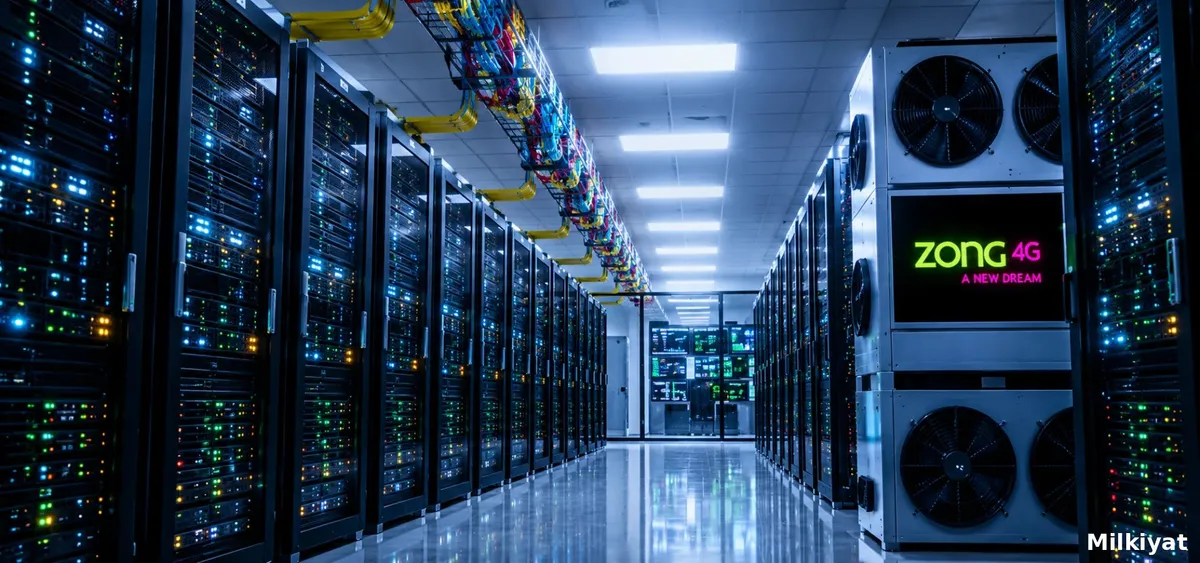
Sindh and Chinese Firm CMPak Agree to Build AI Ready Data Centre in Karachi

By Mariam Khan
Real Estate Analyst
4 min read
ShareWhatsApp
News
By Mariam Khan
Real Estate Analyst
4 min read
The Sindh government and CMPak, the parent company of Zong, have agreed to collaborate on establishing an AI ready Tier III data centre in Karachi under a public private partnership. The understanding was reached during a meeting at CM House between Chief Minister Syed Murad Ali Shah and CMPak Chairman and CEO Huo Junli, confirmed by the Sindh Chief Minister's House.
CMPak's delegation briefed the chief minister that a Tier III AI ready data centre requires uninterrupted and significantly higher electricity loads than conventional telecom facilities. To ensure reliability and scalability, the company sought provincial support on four specific fronts: conversion of the facility's electricity tariff from the commercial to the industrial category, enhancement of grid capacity serving the site, provision of dual power feeds for redundancy, and priority status or fast track facilitation for the project overall. The chief minister directed relevant provincial departments to examine each of these proposals.
The core technical challenge behind this request is straightforward: Tier III data centre standards require redundant power and cooling infrastructure capable of near continuous uptime, a considerably heavier and more consistent electricity draw than a standard telecom exchange or office building. Dual power feeds specifically provide a backup electrical supply path so operations continue uninterrupted if one feed fails, a standard requirement for facilities hosting always on cloud computing and AI workloads rather than conventional office or retail electricity demand.
CMPak Limited, operating under the brand name Zong, is a wholly owned subsidiary of China Mobile, the world's largest mobile network operator by subscriber base. CMPak began as Paktel in 1991, was acquired by China Mobile in 2007, and was rebranded Zong in 2008, marking China Mobile's first overseas venture. The company now serves more than 55 million subscribers in Pakistan, has invested over 3 billion dollars in the country, and has launched 5G services in more than 20 Pakistani cities. According to Zong's own description of its strategy, the company recently announced an AI Plus initiative aligned with both China Mobile Group's global AI strategy and Pakistan's National Artificial Intelligence Policy of 2025, positioning this Karachi data centre proposal as part of a broader, already articulated digital infrastructure push rather than a standalone announcement.
The chief minister assured CMPak of full provincial support and said Sindh was ready to work with the company in partnership to develop the facility, describing such projects as essential for building Pakistan's digital future and strengthening technological sovereignty. He said Karachi was emerging as a preferred destination for technology and data infrastructure investment given its strategic location, industrial base and connectivity, and that digital infrastructure represents a critical pillar of economic development and competitiveness going forward.
No specific site location, land size, investment figure, or construction timeline was disclosed alongside this agreement. What has been confirmed is an understanding to collaborate under a public private partnership structure and a provincial commitment to examine CMPak's specific power and facilitation requests, not a finalised site plan or signed development agreement.
While this is not residential property news, it carries real relevance for Karachi's commercial and industrial land market specifically. A Tier III data centre of this scale requires a site with access to significantly upgraded grid infrastructure and industrial tariff eligibility, criteria that typically narrow the realistic location options to Karachi's established industrial zones rather than general commercial or residential areas. If the enhanced grid capacity and dual power feed infrastructure CMPak has requested are actually built out to serve this facility, the surrounding industrial corridor could see a meaningful, lasting upgrade in available power infrastructure, a factor that tends to support demand for adjacent industrial and technology focused development once such upgrades are in place. Investors and businesses evaluating power intensive industrial sites in Karachi should watch for confirmation of the data centre's specific location as the clearest signal of where this kind of infrastructure upgrade will actually land.
FBR notifies faceless income tax appeal rules, introducing anonymous commissioners, digital hearings and automated case allocation for tax disputes.
FBR replaces sales tax return STR-7 and revises purchase and sales invoice annexes, introducing expanded transaction and tax reporting requirements.
FBR seals a Karachi superstore outlet after finding Rs3.27 billion in off-system sales, POS violations and alleged sales tax irregularities.
Pakistan plans to split SNGPL and SSGCL into six to eight entities, restructure gas operations and shift over Rs3 trillion in circular debt.