Blog
The F-5 Location Profile & Investment Appeal
Real Estate Analyst
12 min read
Short Answer:
F-5 is one of Islamabad's original Zone I sectors, wedged between Margalla Road, Ataturk Avenue, Jinnah Avenue and Constitution Avenue. It was planned as an institutional and commercial sector rather than a residential one, so it carries almost no private housing stock. Its value to investors comes from position rather than supply: F-5 puts you inside walking distance of the Red Zone, the Blue Area and Kohsar Market, and it houses one of the capital's densest clusters of IT and corporate offices. That combination is why F-5 Islamabad is considered a prime location, and why the practical way to invest in it is through commercial floors inside the sector or residential assets in the streets immediately around it.
Islamabad's F series runs from F-5 outward, and the numbering tells you something important: sector numbers rise from east to west, which makes F-5 the easternmost and oldest of the F sectors. It was laid out in the capital's first construction phase alongside F-6, F-7 and G-6, and it was never given the four-sub-sector residential grid that F-6 and F-7 received. Instead, F-5 was carved into two working sub-sectors, F-5/1 and F-5/2, split by Sir Agha Khan Road, and filled with institutional plots, government offices and corporate buildings. Anyone reading a sector map for the first time usually notices the same thing: F-5 has boulevards and office blocks where its neighbours have streets and houses.
That planning decision, made sixty years ago, is still the single most important fact about the sector's property market today. It is also why F-5 has to be read on two levels. As a place to live, the sector is understood through the amenities, schools, markets and daily conveniences it borrows from its neighbours, and that side of the picture is set out in the pillar guide, Living in F-5 Islamabad: A Complete Guide to Amenities, Lifestyle, and Neighborhood Perks. As a place to put money, it has to be read through land use, tenant quality and what the official valuation tables do and do not say — which is what this profile covers.
F-5 has no markaz of its own, so its parking demand lands on Blue Area, Super Market and Kohsar Market. A practical guide to where vehicles can legally sit, what the CDA parking standard now requires, and when the bays actually fill.
The F-5 Islamabad security level is among the highest in the capital, but it is borrowed from the Red Zone next door rather than built into the sector. Here is the full picture: police station jurisdiction, Safe City coverage, fire and medical response, the registrations owners must complete, and the closure risk nobody prices in.
F-5 has no CDA office of its own. Water is billed by CDA, electricity by IESCO and gas by SNGPL, each from a different counter. Here is which office owns which problem, what every connection and clearance costs, and what to check before you take over a property.
F-5 has no Markaz, so a residential plot cannot be commercialised for a fee. This guide covers what the ICT Residential Sectors Zoning (Building Control) Regulations 2020 actually permit on an F-5 plot, height, storeys, setbacks, basements, home occupation, and what a non-conforming use costs if CDA seals it.
Real Estate Analyst
12 min read
Short Answer:
F-5 is one of Islamabad's original Zone I sectors, wedged between Margalla Road, Ataturk Avenue, Jinnah Avenue and Constitution Avenue. It was planned as an institutional and commercial sector rather than a residential one, so it carries almost no private housing stock. Its value to investors comes from position rather than supply: F-5 puts you inside walking distance of the Red Zone, the Blue Area and Kohsar Market, and it houses one of the capital's densest clusters of IT and corporate offices. That combination is why F-5 Islamabad is considered a prime location, and why the practical way to invest in it is through commercial floors inside the sector or residential assets in the streets immediately around it.
Islamabad's F series runs from F-5 outward, and the numbering tells you something important: sector numbers rise from east to west, which makes F-5 the easternmost and oldest of the F sectors. It was laid out in the capital's first construction phase alongside F-6, F-7 and G-6, and it was never given the four-sub-sector residential grid that F-6 and F-7 received. Instead, F-5 was carved into two working sub-sectors, F-5/1 and F-5/2, split by Sir Agha Khan Road, and filled with institutional plots, government offices and corporate buildings. Anyone reading a sector map for the first time usually notices the same thing: F-5 has boulevards and office blocks where its neighbours have streets and houses.
That planning decision, made sixty years ago, is still the single most important fact about the sector's property market today. It is also why F-5 has to be read on two levels. As a place to live, the sector is understood through the amenities, schools, markets and daily conveniences it borrows from its neighbours, and that side of the picture is set out in the pillar guide, Living in F-5 Islamabad: A Complete Guide to Amenities, Lifestyle, and Neighborhood Perks. As a place to put money, it has to be read through land use, tenant quality and what the official valuation tables do and do not say — which is what this profile covers.
F-5 has no markaz of its own, so its parking demand lands on Blue Area, Super Market and Kohsar Market. A practical guide to where vehicles can legally sit, what the CDA parking standard now requires, and when the bays actually fill.
The F-5 Islamabad security level is among the highest in the capital, but it is borrowed from the Red Zone next door rather than built into the sector. Here is the full picture: police station jurisdiction, Safe City coverage, fire and medical response, the registrations owners must complete, and the closure risk nobody prices in.
F-5 has no CDA office of its own. Water is billed by CDA, electricity by IESCO and gas by SNGPL, each from a different counter. Here is which office owns which problem, what every connection and clearance costs, and what to check before you take over a property.
F-5 has no Markaz, so a residential plot cannot be commercialised for a fee. This guide covers what the ICT Residential Sectors Zoning (Building Control) Regulations 2020 actually permit on an F-5 plot, height, storeys, setbacks, basements, home occupation, and what a non-conforming use costs if CDA seals it.
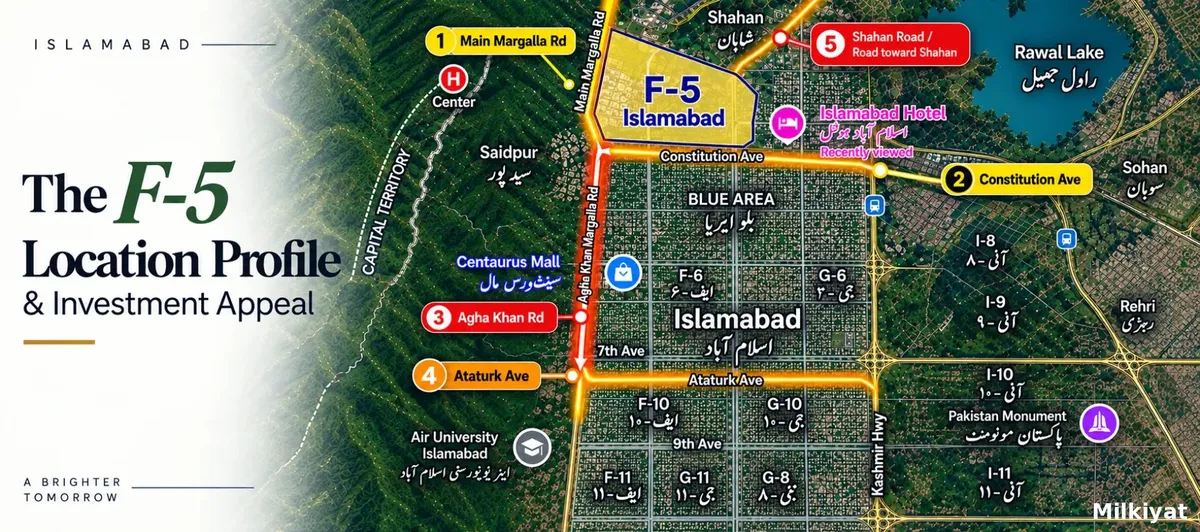
Four roads define the sector, and each one connects it to a different economy.
Margalla Road (north) runs along the foothills and gives the sector fast access to the hill trailheads and to the F-6 and F-7 stretch of Islamabad's most expensive housing.
Ataturk Avenue (west) separates F-5 from F-6. Cross it and you are in Kohsar Market and the F-6/3 café strip within minutes — which is why F-5 workers treat F-6 as their lunch and errand sector.
Jinnah Avenue (south) is the Blue Area corridor, Islamabad's central business district, and it also carries the Metrobus Red Line. F-5's southern edge is effectively a CBD frontage.
Constitution Avenue (east) is the Red Zone: Parliament House, the Prime Minister's Office, the Supreme Court, the federal ministries and the diplomatic enclave approach.
Very few addresses anywhere in Pakistan sit simultaneously against a hill park, a central business district and a seat of government. F-5 does, and it does so without being inside any of them, which spares it the permanent security cordons that constrain movement inside the Red Zone itself. The full route-by-route picture of how this connectivity works in practice is covered in The Complete F-5 Islamabad Commuter Guide.
Ask three different people what F-5 sector Islamabad is known for and you will get three answers, all correct.
Technology and outsourcing. F-5 is the historic anchor of Islamabad's software industry. The Evacuee Trust Complex on Sir Agha Khan Road in F-5/1 alone hosts a long list of software houses, engineering-software firms, cybersecurity consultancies and business-process outsourcing operations, and the Pakistan Software Export Board keeps an office in the same building. For twenty years, "an office in F-5" has been shorthand in the local tech sector for an established firm.
Federal institutions. The Federal Public Service Commission and the PTV News Centre both sit on Agha Khan Road, and a range of federal and semi-government bodies occupy plots across both sub-sectors. This is a sector where a large share of the daytime population arrives by government transport.
Proximity, not amenity. F-5 has no markaz of its own in the way F-6 has Kohsar Market or F-7 has Jinnah Super. Its residents and workers borrow the amenities of the sectors on either side. That is not a defect in the sector's design; it is the design, and it is the reason F-5's amenity profile has to be assessed across its boundaries rather than inside them.
Prestige in Islamabad is usually explained through house prices. In F-5 it has to be explained through something else, because the housing stock barely exists. Five factors do the work.
One: the commute is measured in minutes, not kilometres. A civil servant working in the Secretariat, a lawyer with a matter in the Islamabad High Court, a banker in the Blue Area and a software engineer in the Evacuee Trust Complex can all live within the same ten-minute radius. In a city where the outer sectors and private societies now impose forty-minute commutes each way, that radius is itself the scarce asset.
Two: the land is finished. F-5 was developed decades ago. Roads, sewerage, electricity, gas and telephone infrastructure are in place and have been for a generation. There is no development risk, no possession timeline, no balloting, no phase that may or may not be delivered, the categories of risk that dominate every conversation about Islamabad's private housing societies simply do not apply here.
Three: the tenant base is institutional. Office demand in F-5 comes from federal bodies, international firms, consultancies and export-oriented technology companies. These tenants sign longer leases, default less often and care more about address quality than a typical retail tenant does. Commercial floors in the sector therefore behave less like speculative plot files and more like income assets.
Four: supply cannot grow. No new sector can be created between the Margalla foothills and Constitution Avenue. The plot count in F-5 is what it was in 1970. Every marginal increase in demand for a central address lands on a fixed stock.
Five: the halo is real and it is priced. Because F-5 itself offers so little to buy, demand spills into the streets on the other side of Ataturk Avenue and into apartment stock along Jinnah Avenue. Part of what a buyer pays for in F-6 and lower Blue Area is F-5 adjacency.
The most instructive document for a serious investor is not a listing portal but the Federal Board of Revenue's notified valuation table for Islamabad, currently governed by S.R.O. 644(I)/2026 dated 16 April 2026 and further amended in August 2026. You can pull the current notification and its amendments from the FBR's Islamabad property valuation page.
Two things stand out.
First, the table sets a uniform valuation for built structure across the capital: Rs 2,500 per square foot for a superstructure up to five years old and Rs 1,200 per square foot for anything older. Land, not construction, is what the notified value is really pricing.
Second, and more revealing, F-5 does not carry its own residential open-plot line in the table the way its neighbours do. The nearest notified benchmarks are the combined F-6/F-7 entry at Rs 210,000 per square yard, F-8 at Rs 200,000, F-10 at Rs 175,000, F-11 at Rs 160,000, and G-6 in the range of Rs 140,000 to Rs 180,000 depending on sub-sector. Commercial frontage on Jinnah Avenue is notified at Rs 100,000 per square foot for a ground-floor shop.
The absence of a standalone F-5 residential rate is not an oversight. It is the tax authority documenting what the market already knows: there is effectively no private residential plot trade in the sector to value. For a buyer, the practical consequence is that any F-5 transaction will be assessed against whichever notified category the property actually falls into, commercial, apartment, or a neighbouring sector's rate where a conflict exists, in which case the notification specifies the higher of the two values applies. That should be confirmed with a tax adviser before an offer is made, not after.
There are three realistic routes for private capital.
Commercial floor space. Buying or long-leasing office floors in the sector's corporate buildings is the most direct exposure. The tenant pool is institutional, the address carries weight with clients, and vacancy tends to be structural rather than cyclical because the supply of comparable central office space is thin.
Adjacent residential. For buyers who want a house rather than an office, the honest recommendation is F-6 or the upper G-6 streets. You buy the same commute, the same access to Kohsar Market and the Margalla trails, and a functioning resale market. The trade-off between buying built property and holding land in Islamabad, and how the tax treatment differs between the two, is examined in detail in House vs Plot Investment in Islamabad 2026.
Apartments on the southern edge. Residential apartment stock along and behind the Jinnah Avenue corridor captures F-5's location advantage at a lower entry price than a house in F-6, and it is the segment most exposed to demand from professionals working in the sector.
Illiquidity. A sector with almost no residential turnover has no reliable comparable-sales record. Exit can take longer than in F-10 or F-11, and pricing depends on negotiation rather than an observable market.
Land-use and conversion exposure. Institutional, amenity and government-allotted plots carry restrictions that a casual buyer may not detect from a listing. Commercial use of a plot never zoned for it is the classic Islamabad due-diligence failure, and it is more likely in a sector planned around institutions.
Access disruption. Proximity to the Red Zone is an asset for most of the year and a liability during protests, state visits and security events, when road closures around Constitution Avenue can affect approaches to the sector.
Three checks should happen before money moves. Verify the property's status directly with the Capital Development Authority, its Initial Property Verification Service issues a report drawn from the Housing, Estate and Land directorates and is the appropriate first stop for confirming approved layout position, sanctioned area and building-completion status. Second, confirm the notified valuation category the property falls into, because that figure drives advance tax and capital gains exposure at transfer, not the price on the agreement. Third, obtain the No Demand Certificate and building control clearances through CDA's One Window operation in G-7/4, and treat any seller reluctance on this point as decisive.
F-5 is not a sector you buy into cheaply and hold for appreciation. It is a location asset with almost no retail supply attached to it, and its investment appeal works through two channels: direct ownership of commercial floor space with institutional tenants, and indirect exposure through the residential streets and apartment stock that borrow its position. Investors who understand that distinction find F-5 genuinely useful. Investors who go looking for a kanal plot to flip will spend six months discovering there isn't one.
Q1. Why is F-5 Islamabad considered a prime location if there are hardly any houses in it?
A. Because prime status in F-5 comes from position rather than housing stock. The sector sits against the Red Zone, the Blue Area, the Margalla foothills and F-6 simultaneously, and it holds a major concentration of technology and federal offices. Its scarcity value flows into the residential streets and apartments immediately around it.
Q2. What is F-5 sector Islamabad known for?
A. Three things: Islamabad's oldest software and outsourcing cluster, centred on the Evacuee Trust Complex in F-5/1; a set of federal and semi-government institutions along Sir Agha Khan Road; and a location that borrows amenities from F-6, the Blue Area and the Red Zone rather than providing its own markaz.
Q3. How many sub-sectors does F-5 have?
A. Two working sub-sectors, F-5/1 and F-5/2, divided by Sir Agha Khan Road. This is unusual for an F-series sector, F-6, F-7 and F-8 each carry four or more residential sub-sectors.
Q4. Can an overseas Pakistani buy property in F-5?
A. Yes, subject to the same CDA transfer process and FBR tax treatment as any Islamabad buyer. In practice, the available stock is commercial floors and apartments rather than houses, and remote buyers should insist on a CDA property verification report before paying any token.
Q5. Does F-5 have a notified FBR valuation rate?
A. F-5 does not appear with its own residential open-plot rate in the current Islamabad valuation notification. Commercial and apartment categories are assessed under the applicable notified entries, and where more than one rate could apply to an area, the notification directs that the higher value be used. Confirm the applicable category against the current SRO before transfer.
Q6. Is F-5 a better investment than F-6 or F-7?
A. For rental income from institutional office tenants, F-5 is the stronger proposition. For capital appreciation, liquidity and a functioning resale market in residential property, F-6 and F-7 are better. Most investors seeking exposure to this part of Islamabad end up owning in F-6 and treating F-5 adjacency as the reason.
Four roads define the sector, and each one connects it to a different economy.
Margalla Road (north) runs along the foothills and gives the sector fast access to the hill trailheads and to the F-6 and F-7 stretch of Islamabad's most expensive housing.
Ataturk Avenue (west) separates F-5 from F-6. Cross it and you are in Kohsar Market and the F-6/3 café strip within minutes — which is why F-5 workers treat F-6 as their lunch and errand sector.
Jinnah Avenue (south) is the Blue Area corridor, Islamabad's central business district, and it also carries the Metrobus Red Line. F-5's southern edge is effectively a CBD frontage.
Constitution Avenue (east) is the Red Zone: Parliament House, the Prime Minister's Office, the Supreme Court, the federal ministries and the diplomatic enclave approach.
Very few addresses anywhere in Pakistan sit simultaneously against a hill park, a central business district and a seat of government. F-5 does, and it does so without being inside any of them, which spares it the permanent security cordons that constrain movement inside the Red Zone itself. The full route-by-route picture of how this connectivity works in practice is covered in The Complete F-5 Islamabad Commuter Guide.
Ask three different people what F-5 sector Islamabad is known for and you will get three answers, all correct.
Technology and outsourcing. F-5 is the historic anchor of Islamabad's software industry. The Evacuee Trust Complex on Sir Agha Khan Road in F-5/1 alone hosts a long list of software houses, engineering-software firms, cybersecurity consultancies and business-process outsourcing operations, and the Pakistan Software Export Board keeps an office in the same building. For twenty years, "an office in F-5" has been shorthand in the local tech sector for an established firm.
Federal institutions. The Federal Public Service Commission and the PTV News Centre both sit on Agha Khan Road, and a range of federal and semi-government bodies occupy plots across both sub-sectors. This is a sector where a large share of the daytime population arrives by government transport.
Proximity, not amenity. F-5 has no markaz of its own in the way F-6 has Kohsar Market or F-7 has Jinnah Super. Its residents and workers borrow the amenities of the sectors on either side. That is not a defect in the sector's design; it is the design, and it is the reason F-5's amenity profile has to be assessed across its boundaries rather than inside them.
Prestige in Islamabad is usually explained through house prices. In F-5 it has to be explained through something else, because the housing stock barely exists. Five factors do the work.
One: the commute is measured in minutes, not kilometres. A civil servant working in the Secretariat, a lawyer with a matter in the Islamabad High Court, a banker in the Blue Area and a software engineer in the Evacuee Trust Complex can all live within the same ten-minute radius. In a city where the outer sectors and private societies now impose forty-minute commutes each way, that radius is itself the scarce asset.
Two: the land is finished. F-5 was developed decades ago. Roads, sewerage, electricity, gas and telephone infrastructure are in place and have been for a generation. There is no development risk, no possession timeline, no balloting, no phase that may or may not be delivered, the categories of risk that dominate every conversation about Islamabad's private housing societies simply do not apply here.
Three: the tenant base is institutional. Office demand in F-5 comes from federal bodies, international firms, consultancies and export-oriented technology companies. These tenants sign longer leases, default less often and care more about address quality than a typical retail tenant does. Commercial floors in the sector therefore behave less like speculative plot files and more like income assets.
Four: supply cannot grow. No new sector can be created between the Margalla foothills and Constitution Avenue. The plot count in F-5 is what it was in 1970. Every marginal increase in demand for a central address lands on a fixed stock.
Five: the halo is real and it is priced. Because F-5 itself offers so little to buy, demand spills into the streets on the other side of Ataturk Avenue and into apartment stock along Jinnah Avenue. Part of what a buyer pays for in F-6 and lower Blue Area is F-5 adjacency.
The most instructive document for a serious investor is not a listing portal but the Federal Board of Revenue's notified valuation table for Islamabad, currently governed by S.R.O. 644(I)/2026 dated 16 April 2026 and further amended in August 2026. You can pull the current notification and its amendments from the FBR's Islamabad property valuation page.
Two things stand out.
First, the table sets a uniform valuation for built structure across the capital: Rs 2,500 per square foot for a superstructure up to five years old and Rs 1,200 per square foot for anything older. Land, not construction, is what the notified value is really pricing.
Second, and more revealing, F-5 does not carry its own residential open-plot line in the table the way its neighbours do. The nearest notified benchmarks are the combined F-6/F-7 entry at Rs 210,000 per square yard, F-8 at Rs 200,000, F-10 at Rs 175,000, F-11 at Rs 160,000, and G-6 in the range of Rs 140,000 to Rs 180,000 depending on sub-sector. Commercial frontage on Jinnah Avenue is notified at Rs 100,000 per square foot for a ground-floor shop.
The absence of a standalone F-5 residential rate is not an oversight. It is the tax authority documenting what the market already knows: there is effectively no private residential plot trade in the sector to value. For a buyer, the practical consequence is that any F-5 transaction will be assessed against whichever notified category the property actually falls into, commercial, apartment, or a neighbouring sector's rate where a conflict exists, in which case the notification specifies the higher of the two values applies. That should be confirmed with a tax adviser before an offer is made, not after.
There are three realistic routes for private capital.
Commercial floor space. Buying or long-leasing office floors in the sector's corporate buildings is the most direct exposure. The tenant pool is institutional, the address carries weight with clients, and vacancy tends to be structural rather than cyclical because the supply of comparable central office space is thin.
Adjacent residential. For buyers who want a house rather than an office, the honest recommendation is F-6 or the upper G-6 streets. You buy the same commute, the same access to Kohsar Market and the Margalla trails, and a functioning resale market. The trade-off between buying built property and holding land in Islamabad, and how the tax treatment differs between the two, is examined in detail in House vs Plot Investment in Islamabad 2026.
Apartments on the southern edge. Residential apartment stock along and behind the Jinnah Avenue corridor captures F-5's location advantage at a lower entry price than a house in F-6, and it is the segment most exposed to demand from professionals working in the sector.
Illiquidity. A sector with almost no residential turnover has no reliable comparable-sales record. Exit can take longer than in F-10 or F-11, and pricing depends on negotiation rather than an observable market.
Land-use and conversion exposure. Institutional, amenity and government-allotted plots carry restrictions that a casual buyer may not detect from a listing. Commercial use of a plot never zoned for it is the classic Islamabad due-diligence failure, and it is more likely in a sector planned around institutions.
Access disruption. Proximity to the Red Zone is an asset for most of the year and a liability during protests, state visits and security events, when road closures around Constitution Avenue can affect approaches to the sector.
Three checks should happen before money moves. Verify the property's status directly with the Capital Development Authority, its Initial Property Verification Service issues a report drawn from the Housing, Estate and Land directorates and is the appropriate first stop for confirming approved layout position, sanctioned area and building-completion status. Second, confirm the notified valuation category the property falls into, because that figure drives advance tax and capital gains exposure at transfer, not the price on the agreement. Third, obtain the No Demand Certificate and building control clearances through CDA's One Window operation in G-7/4, and treat any seller reluctance on this point as decisive.
F-5 is not a sector you buy into cheaply and hold for appreciation. It is a location asset with almost no retail supply attached to it, and its investment appeal works through two channels: direct ownership of commercial floor space with institutional tenants, and indirect exposure through the residential streets and apartment stock that borrow its position. Investors who understand that distinction find F-5 genuinely useful. Investors who go looking for a kanal plot to flip will spend six months discovering there isn't one.
Q1. Why is F-5 Islamabad considered a prime location if there are hardly any houses in it?
A. Because prime status in F-5 comes from position rather than housing stock. The sector sits against the Red Zone, the Blue Area, the Margalla foothills and F-6 simultaneously, and it holds a major concentration of technology and federal offices. Its scarcity value flows into the residential streets and apartments immediately around it.
Q2. What is F-5 sector Islamabad known for?
A. Three things: Islamabad's oldest software and outsourcing cluster, centred on the Evacuee Trust Complex in F-5/1; a set of federal and semi-government institutions along Sir Agha Khan Road; and a location that borrows amenities from F-6, the Blue Area and the Red Zone rather than providing its own markaz.
Q3. How many sub-sectors does F-5 have?
A. Two working sub-sectors, F-5/1 and F-5/2, divided by Sir Agha Khan Road. This is unusual for an F-series sector, F-6, F-7 and F-8 each carry four or more residential sub-sectors.
Q4. Can an overseas Pakistani buy property in F-5?
A. Yes, subject to the same CDA transfer process and FBR tax treatment as any Islamabad buyer. In practice, the available stock is commercial floors and apartments rather than houses, and remote buyers should insist on a CDA property verification report before paying any token.
Q5. Does F-5 have a notified FBR valuation rate?
A. F-5 does not appear with its own residential open-plot rate in the current Islamabad valuation notification. Commercial and apartment categories are assessed under the applicable notified entries, and where more than one rate could apply to an area, the notification directs that the higher value be used. Confirm the applicable category against the current SRO before transfer.
Q6. Is F-5 a better investment than F-6 or F-7?
A. For rental income from institutional office tenants, F-5 is the stronger proposition. For capital appreciation, liquidity and a functioning resale market in residential property, F-6 and F-7 are better. Most investors seeking exposure to this part of Islamabad end up owning in F-6 and treating F-5 adjacency as the reason.
