News
Up to 50mm Rain Hits Islamabad as CDA Carries Out Dewatering at Waterlogging Points
Milkiyat.com is operated by MILKIYAT.COM ONLINE PORTAL (PRIVATE) LIMITED.
Corporate Unique Identification No. (CUI): 0337118
Incorporated under the Companies Act, 2017, Pakistan.
Real Estate Analyst
5 min read
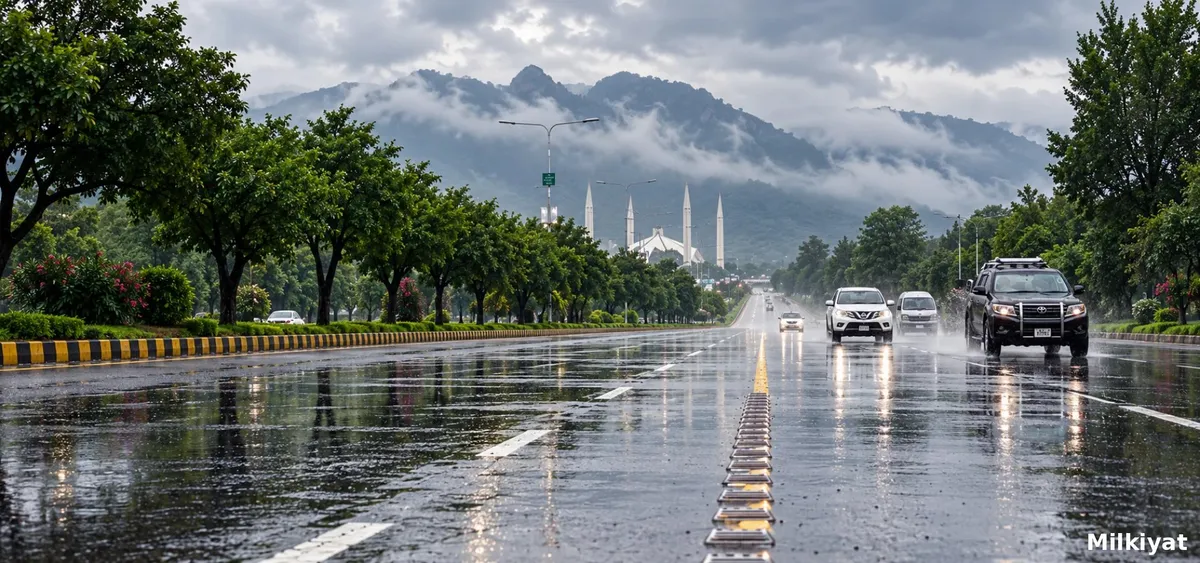
Up to 50 millimetres of rain was recorded in different parts of Islamabad, prompting the Capital Development Authority to deploy sanitation teams to clear drainage grates and remove accumulated rainwater from roads. Teams remained in the field during and after the downpour, clearing mud, leaves, garbage, and other debris from roadside grates to prevent blockages and allow rainwater to drain.
CDA officials said sanitation staff monitored major roads and other vulnerable locations, carrying out dewatering operations wherever water accumulated, while working to keep major routes accessible to commuters as the rain affected traffic movement at various points across the capital. Assistant commissioners and the additional deputy commissioner (general) also monitored the situation across different areas, coordinating directly with relevant departments. CDA Chairman Sohail Ashraf visited several parts of the city during the rain, including Babar Park, to review drainage and sanitation arrangements on the ground, separately reviewing ongoing development and landscaping work at the park itself. CDA said drainage and cleaning operations would continue after the rainfall, particularly at locations already known to be prone to water accumulation.
This rainfall event fits directly within an already established, recurring pattern this monsoon season. On 1 September, torrential rain inundated several low-lying areas of the capital, with nullahs overflowing in Sector E-11 and Ghouri Town specifically, recording as much as 150 millimetres in E-11 alone, entering roads and some building basements while Rawal Dam's spillways were opened the same afternoon. Comparable emergency drainage operations were again required in the weeks since. This 15 September event, while recording a comparatively lower 50 millimetres citywide, confirms that Islamabad's drainage vulnerability has remained an active, recurring issue throughout this monsoon season rather than resolving after any single earlier episode.
A separate but genuinely connected regulatory deadline is worth understanding alongside this specific rain event. CDA made rooftop rainwater harvesting legally mandatory for property owners across Islamabad from 18 March 2026, extending the requirement not just to new construction but to all existing houses across the capital, with residents given a six to eight month grace period to retrofit their homes with a functional recharge system before facing non-compliance fines. That compliance window falls due this same month, meaning this rain event arrives at almost exactly the point homeowners were expected to have completed the retrofit CDA itself mandated specifically to address rainwater management at the individual property level.
RDA inflows reached $14.906 billion in August, reflecting stronger overseas investment and growing confidence in Pakistan’s real estate and development sector.
Pakistan’s LNG supply shock is increasing pressure on gas, electricity and construction costs, adding another major risk for developers, businesses and property owners.
Pakistan’s FX reserves have climbed to a record $21.4 billion after the $3 billion Eurobond inflow, strengthening the outlook for currency and import-cost stability.
Rawalpindi Cantonment has reduced the planned residential property tax hike to 20%, with instalment relief and surcharge waivers for homeowners.
Real Estate Analyst
5 min read
Up to 50 millimetres of rain was recorded in different parts of Islamabad, prompting the Capital Development Authority to deploy sanitation teams to clear drainage grates and remove accumulated rainwater from roads. Teams remained in the field during and after the downpour, clearing mud, leaves, garbage, and other debris from roadside grates to prevent blockages and allow rainwater to drain.
CDA officials said sanitation staff monitored major roads and other vulnerable locations, carrying out dewatering operations wherever water accumulated, while working to keep major routes accessible to commuters as the rain affected traffic movement at various points across the capital. Assistant commissioners and the additional deputy commissioner (general) also monitored the situation across different areas, coordinating directly with relevant departments. CDA Chairman Sohail Ashraf visited several parts of the city during the rain, including Babar Park, to review drainage and sanitation arrangements on the ground, separately reviewing ongoing development and landscaping work at the park itself. CDA said drainage and cleaning operations would continue after the rainfall, particularly at locations already known to be prone to water accumulation.
This rainfall event fits directly within an already established, recurring pattern this monsoon season. On 1 September, torrential rain inundated several low-lying areas of the capital, with nullahs overflowing in Sector E-11 and Ghouri Town specifically, recording as much as 150 millimetres in E-11 alone, entering roads and some building basements while Rawal Dam's spillways were opened the same afternoon. Comparable emergency drainage operations were again required in the weeks since. This 15 September event, while recording a comparatively lower 50 millimetres citywide, confirms that Islamabad's drainage vulnerability has remained an active, recurring issue throughout this monsoon season rather than resolving after any single earlier episode.
A separate but genuinely connected regulatory deadline is worth understanding alongside this specific rain event. CDA made rooftop rainwater harvesting legally mandatory for property owners across Islamabad from 18 March 2026, extending the requirement not just to new construction but to all existing houses across the capital, with residents given a six to eight month grace period to retrofit their homes with a functional recharge system before facing non-compliance fines. That compliance window falls due this same month, meaning this rain event arrives at almost exactly the point homeowners were expected to have completed the retrofit CDA itself mandated specifically to address rainwater management at the individual property level.
RDA inflows reached $14.906 billion in August, reflecting stronger overseas investment and growing confidence in Pakistan’s real estate and development sector.
Pakistan’s LNG supply shock is increasing pressure on gas, electricity and construction costs, adding another major risk for developers, businesses and property owners.
Pakistan’s FX reserves have climbed to a record $21.4 billion after the $3 billion Eurobond inflow, strengthening the outlook for currency and import-cost stability.
Rawalpindi Cantonment has reduced the planned residential property tax hike to 20%, with instalment relief and surcharge waivers for homeowners.
This recurring pattern of citywide waterlogging is precisely the underlying problem the newly signed CDA-JICA Water Supply, Sewerage and Drainage Master Plan through 2050, covered separately by milkiyat.com, is designed to address at a structural, citywide level. That plan's drainage component specifically involves assessing natural streams, stormwater networks, and flood risk zones to propose concrete measures against urban flooding and extreme rainfall events, exactly the kind of event now recurring across Islamabad on close to a weekly basis this monsoon season. The gap between that plan's long term 2050 horizon and the immediate, repeated need for emergency dewatering operations like this one illustrates the practical distance between citywide structural planning and the drainage reality residents are experiencing right now.
No specific timeline for structural drainage improvements addressing the recurring waterlogging locations has been announced, and this event was managed through the same reactive dewatering and debris clearance approach used in comparable episodes earlier this season. Given how frequently this same response has now been required, whether any interim, faster acting drainage improvements will be implemented ahead of the JICA master plan's own multi-year timeline remains an open question.
With Islamabad experiencing repeated monsoon spells and recurring waterlogging at broadly the same vulnerable locations, storm water drainage capacity, plot elevation, and flood exposure history should be treated as core, ongoing due diligence factors for both residential and commercial property across the capital, not a one time seasonal consideration. Property owners still working through CDA's rainwater harvesting compliance requirement should treat this month's deadline as a genuine, active obligation given how directly it connects to the same drainage strain visible in this week's rainfall. Buyers and investors evaluating property in or near previously affected areas, including Sector E-11 and Ghouri Town specifically, should independently confirm a property's flood history and elevation before purchasing, given the now well documented, recurring nature of this risk throughout the current monsoon season.
This recurring pattern of citywide waterlogging is precisely the underlying problem the newly signed CDA-JICA Water Supply, Sewerage and Drainage Master Plan through 2050, covered separately by milkiyat.com, is designed to address at a structural, citywide level. That plan's drainage component specifically involves assessing natural streams, stormwater networks, and flood risk zones to propose concrete measures against urban flooding and extreme rainfall events, exactly the kind of event now recurring across Islamabad on close to a weekly basis this monsoon season. The gap between that plan's long term 2050 horizon and the immediate, repeated need for emergency dewatering operations like this one illustrates the practical distance between citywide structural planning and the drainage reality residents are experiencing right now.
No specific timeline for structural drainage improvements addressing the recurring waterlogging locations has been announced, and this event was managed through the same reactive dewatering and debris clearance approach used in comparable episodes earlier this season. Given how frequently this same response has now been required, whether any interim, faster acting drainage improvements will be implemented ahead of the JICA master plan's own multi-year timeline remains an open question.
With Islamabad experiencing repeated monsoon spells and recurring waterlogging at broadly the same vulnerable locations, storm water drainage capacity, plot elevation, and flood exposure history should be treated as core, ongoing due diligence factors for both residential and commercial property across the capital, not a one time seasonal consideration. Property owners still working through CDA's rainwater harvesting compliance requirement should treat this month's deadline as a genuine, active obligation given how directly it connects to the same drainage strain visible in this week's rainfall. Buyers and investors evaluating property in or near previously affected areas, including Sector E-11 and Ghouri Town specifically, should independently confirm a property's flood history and elevation before purchasing, given the now well documented, recurring nature of this risk throughout the current monsoon season.
