Guide
CDA vs RDA Jurisdiction: Which Is Better for Your Investment in 2026?

By wajahat Ali
Real Estate Analyst
Updated 14 min read
Guide
By wajahat Ali
Real Estate Analyst
Updated 14 min read
Facing property dealer fraud in Pakistan? Learn where to file a complaint, how to report fake files or token money scams, and what evidence you need.
KDA plots usually come developed but carry old-file and lease risks. MDA plots are newer but often lack possession and utilities. This guide compares both authorities risk by risk, with official values and costs.
MDA allots most of its plots by ballot, with odds as low as one in nine. This guide explains forms, deposits, results, instalments, cancellations and refunds, with figures from past ballots and the Auditor General’s audit.
MDA’s New Malir Housing Scheme was launched in 1997 on 4,000 acres, but reports say only 231 of 27,107 allottees have possession. This guide covers its real status, sectors, official values and verification checks.
This guide covers CDA vs RDA jurisdiction, which authority governs your plot, and how to verify it. For a comparison of their enforcement records and buyer-protection posture, see "CDA vs RDA Property Approval: Which Authority Offers Better Buyer Protection in 2026.
Quick Answer: CDA vs RDA
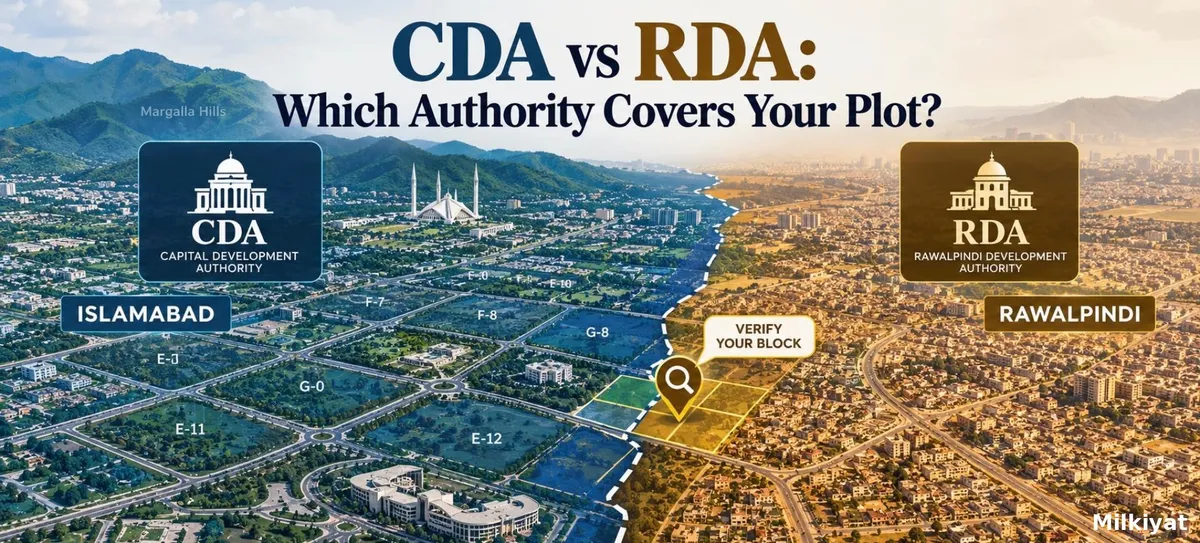
Islamabad and Rawalpindi are twin cities but they are not governed by the same authority, the same law, or the same approval process and confusing the two is the single most common jurisdictional mistake twin-cities buyers make.
The two questions worth separating here: which authority has jurisdiction, and how well each one protects you once you've bought. This guide answers the first, boundaries, the NOC/LOP process, and how to verify split-jurisdiction societies block by block, including the 2026 regulatory changes reshaping both authorities. For the second question,how CDA's and RDA's enforcement records actually compare, and why "government sector land vs. private housing society" matters more than the authority's name alone, see CDA vs RDA Property Approval: Which Authority Offers Better Buyer Protection in 2026.
The CDA was established under the CDA Ordinance, 1960, as the federal body responsible for planning, developing, and administering Islamabad a role it has held since before the city's first master plan was finalized by Doxiadis Associates. CDA's mandate covers town planning, land development, municipal services (though some municipal functions have shifted toward the Metropolitan Corporation Islamabad in recent local-government reforms), building control, and regulatory oversight for the entire Islamabad Capital Territory.
Any developer wishing to build, subdivide, or sell plots inside ICT must obtain CDA approval ,starting with a Layout Plan (LOP) and, for full legal sale authority, a No Objection Certificate (NOC). So before shortlisting any of the plots for sale in Islamabad, check which of these two stages the scheme has actually reached.
RDA was formally established in May 1989 under the Punjab Development of Cities Act, 1976, replacing the older Rawalpindi Improvement Trust (RIT), and began live operations in March 1992. It is a provincial body its chairman answers to the Government of Punjab, not to the federal government responsible for master planning, housing-scheme approval, infrastructure (roads, the Rawalpindi Ring Road, drainage), and enforcement across Rawalpindi district.
RDA runs a One Window Operations Centre (OWOC) a digitised single point for map approvals, completion certificates, and plot transfers and, like CDA, distinguishes between LOP and final NOC status for private schemes.
Rawalpindi predates Islamabad. When the federal capital was carved out of Rawalpindi district in the 1960s, CDA inherited the new capital's planning authority while RDA (and its predecessor, RIT) retained the older city. That shared origin is why jurisdiction confusion is so common today: much of Islamabad's revenue record is still administered through Rawalpindi's revenue department, and several sectors near the two cities' edge have, at different points, been approved by the wrong authority entirely (see the boundary section below).
The simple rule: Rawalpindi district plot → check RDA. Islamabad Capital Territory plot → check CDA. Punjab peri-urban land outside both → check PHATA.
In practice, the boundary is messier than a district line on a map:
Several of the twin cities' largest schemes are not under one authority. Buying "the society" without checking the specific block can put you in a legally different regime than you expect:
| Society | Split |
|---|---|
| Multi Gardens B-17 | Blocks A–B: CDA (NOC Jan 2018). Blocks C, C-1, D, E, F, G and Phase 2 (Sector H-17): RDA |
| Bahria Town | Phases I, II, III, VIII: RDA. Phases III-E, IV, V, VI, VII, VII-E: CDA Zone 5 (VII-E has held a CDA NOC since March 2015) |
| Eighteen Islamabad | Phase 1: RDA/PHATA. Phase 2: CDA |
| DHA Islamabad–Rawalpindi | Multiple phases span both authorities; DHA self-regulates NOC under the Ministry of Defence framework, which is a materially different assurance from the private CDA/RDA process |
Milkiyat.com finding: Across the four split-jurisdiction cases above, none has fewer than two blocks/phases under different regulators, and in three of the four cases the "junior" phase (the one launched later, e.g. B-17 Phase 2, Eighteen Phase 1's PHATA overlap) is the one most often marketed loosely. If you're buying a later phase or a block letter past the scheme's original launch blocks, budget extra time to verify, don't assume the whole society's original approval status carries over.
This is the section most competing guides on this topic are missing, and it changes practical answers for several corridors:
Long-running GT Road / Kotha Kalan / Sohan / Faizabad ambiguity. A 2018 Survey of Pakistan first exposed that RDA had approved roughly a dozen building plans that actually fell inside Islamabad's limits, because Rawalpindi's revenue department still manages the estate records for parts of Islamabad. A joint CDA–RDA committee (chaired by CDA's Member Planning) has been working these cases on a case-by-case basis, with December 31, 2022 set as the cutoff after which any construction in the disputed zone would not be considered for retroactive legalisation. Effect for buyers: a valid-looking building approval in this corridor does not guarantee the correct authority issued it, verify which authority's by-laws actually govern the fee and file, not just which authority stamped the paperwork.
CDA local-governance reform proposals. With no elected local government sitting in Islamabad since 2021, reform proposals now under discussion would expand accountable local governance for the capital in a way its 2015 Metropolitan Corporation attempt was denied. Track this if you're underwriting a long hold, a stronger local-government layer would be a structural change to how ICT sectors are administered day to day, separate from CDA's planning role.
RDA Green Property Certificate (GPC), effective 1 July 2026. For RDA-jurisdiction plots, a developer's allotment letter is no longer accepted as sole proof of ownership. The GPC is a QR-coded, PLRA-issued, NADRA-verified, GPS-surveyed document, and RDA has declared roughly 293 schemes illegal alongside CDA sealing 99 more properties, as part of the same 2026 enforcement push. See our Fard vs Intiqal vs Registry guide for how the GPC fits into the wider ownership-proof chain, and our RDA Green Property Certificates & CDA Crackdowns explainer for the full enforcement timeline.
Milkiyat.com finding: RDA's 293 schemes declared illegal against its roughly 82 RDA-approved private housing societies (per our RDA-approved societies list) means illegal/unrecognised schemes outnumber approved ones by more than 3.5 to 1 in the Rawalpindi market alone (293 ÷ 82 ≈ 3.57). That ratio is the single strongest argument for verifying NOC status before paying token money, regardless of which authority is involved.
Both authorities use a staged approval system, and the stage matters more than whether a scheme is "approved" or not in a binary sense:
Verification portals differ by authority:
For the full step-by-step walkthrough of checking a specific plot or society on each portal, see our companion piece: How to Verify a Housing Society's NOC Online in Pakistan — RDA/CDA/LDA Step-by-Step Guide. This guide focuses on which authority applies and why it matters; that one focuses on the mechanics of checking.
| Factor | CDA (Islamabad) | RDA (Rawalpindi) |
|---|---|---|
| Legal basis | Federal, CDA Ordinance, 1960 | Provincial , Punjab Development of Cities Act, 1976 |
| Established | 1960 (Islamabad's founding authority) | May 1989 (operations from March 1992), replacing RIT |
| Governs | Islamabad Capital Territory (ICT) | Rawalpindi district |
| Notable approved projects | Park View City, Bahria Town Phases III-E/IV/V/VI/VII, DHA Islamabad sectors | Bahria Town Phases I/II/III/VIII, Capital Smart City, Silver City, Rudn Enclave, Multi Gardens B-17 (Blocks C–G) |
| Verification portal | IPVS / CDA housing-societies list | rda.gop.pk + GPC/PLRA (from July 2026) |
| Typical entry price | Higher | Lower |
| Recent enforcement | ~99 properties sealed (2026 crackdown) | ~293 schemes declared illegal (2026 crackdown) |
| 2026 governance change | Local-government reform proposals under discussion | Green Property Certificate now mandatory for ownership proof |
For price and yield comparisons rather than jurisdiction, see our head-to-head DHA Islamabad vs Bahria Town Rawalpindi returns guide and [Islamabad Societies vs Rawalpindi Societies guide] this article stays focused on the regulatory question those pieces both assume you've already answered.
Work through these questions in order:
A pattern we see work well for twin-cities investors balancing legal security against affordability is a core-satellite allocation:
This isn't a recommendation to buy any specific project; it's a framework for sizing legal-risk exposure against entry cost across the two jurisdictions, which is the actual decision this guide exists to inform.
Is CDA or RDA better for investment? Neither is categorically better. CDA generally offers stronger federal-law backing and higher long-term price stability; RDA generally offers lower entry prices and faster development in growth corridors, with more exposure to boundary and under-process risk. The right choice depends on your risk tolerance and the specific phase/block you're buying. If you are renting rather than buying, the jurisdiction check still matters: before taking an apartment for rent in Islamabad, confirm the building sits in an approved sector or scheme.
How do I know if my plot is under CDA or RDA? Check the sector or scheme name against CDA's ICT sector list and RDA's district boundary first. For split-jurisdiction societies (Bahria Town, B-17, Eighteen, DHA), check the exact block or phase, then confirm on IPVS (CDA) or rda.gop.pk (RDA).
What's the difference between an NOC and a Layout Plan (LOP)? An LOP confirms the scheme's master plan is accepted and is often mistaken for full authorisation. A final NOC confirms legal land acquisition, infrastructure compliance, and utility provision, and is the only stage that actually authorises plot sales.
Does PHATA overlap with CDA or RDA? No, PHATA covers Punjab peri-urban districts (Attock, Gujar Khan, Fateh Jang) outside both CDA's ICT boundary and RDA's Rawalpindi district boundary, though some schemes marketed as "RDA" or "Islamabad" sit partly or wholly in PHATA territory. See our PHATA guide for the full breakdown.
What is the Green Property Certificate and does it apply to CDA plots too? The GPC, mandatory from 1 July 2026, is specifically an RDA/PLRA requirement for Rawalpindi-jurisdiction plots. CDA jurisdiction plots are verified through IPVS and CDA's own title/transfer process. Businesses taking commercial property for rent in Islamabad can ask the landlord for this verified ownership record before signing a lease.
Can a housing society be part-approved and part-illegal? Yes, this is the norm for several of the twin cities' largest schemes. See the split-jurisdiction table above; always verify at the block/phase level, never at the society-name level.