Blog
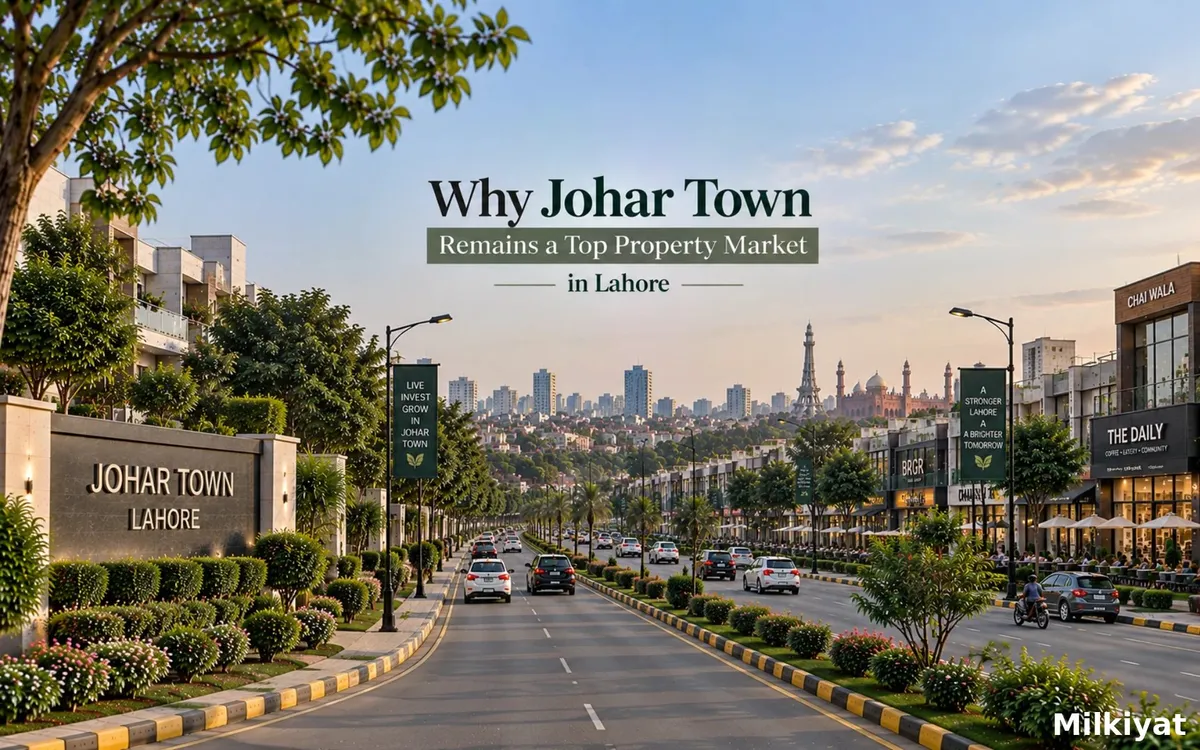
Why Johar Town Remains a Top Property Market in Lahore
Milkiyat.com is operated by MILKIYAT.COM ONLINE PORTAL (PRIVATE) LIMITED.
Corporate Unique Identification No. (CUI): 0337118
Incorporated under the Companies Act, 2017, Pakistan.
Real Estate Analyst
15 min read
Property demand in Lahore is closely linked to areas that combine everyday livability with convenient access to the city’s major roads, institutions and commercial centres. Johar Town stands out in this regard, having developed over the years into a large and active urban neighbourhood rather than a purely residential housing area.
The area offers a broad property mix, from residential plots and houses to apartments, shops and offices. Its location also places residents within reach of important parts of Lahore, while established infrastructure reduces the development-related uncertainty found in newer housing schemes. These characteristics have helped Johar Town maintain its relevance for homebuyers, tenants, landlords and property investors.
For readers looking to understand the financial side of buying property in the area, our Johar Town Property Prices 2026 guide provides a detailed breakdown of current asking prices across different property types and sizes. It covers residential plots, houses and commercial properties, along with the factors that can cause prices to vary between blocks and locations. Reviewing these price ranges alongside location, property condition and accessibility can help buyers set a realistic budget before shortlisting properties in Johar Town.
Lahore has seen dozens of new housing schemes emerge over the past decade, many promising modern infrastructure, larger plots and strong future returns. Yet Johar Town continues to attract buyers, tenants and investors because its value is based on facilities and connectivity that are already in place. In property markets, an established location can offer a different kind of advantage from a new development that still depends on future infrastructure and population growth.
Walk through Johar Town today and the difference is easy to notice. The area has mature trees, active markets, established residential streets, schools, healthcare facilities and families who have made the neighbourhood their long-term home. These existing advantages contribute to its everyday convenience and help sustain demand for different types of property.
Real Estate Analyst
15 min read
Property demand in Lahore is closely linked to areas that combine everyday livability with convenient access to the city’s major roads, institutions and commercial centres. Johar Town stands out in this regard, having developed over the years into a large and active urban neighbourhood rather than a purely residential housing area.
The area offers a broad property mix, from residential plots and houses to apartments, shops and offices. Its location also places residents within reach of important parts of Lahore, while established infrastructure reduces the development-related uncertainty found in newer housing schemes. These characteristics have helped Johar Town maintain its relevance for homebuyers, tenants, landlords and property investors.
For readers looking to understand the financial side of buying property in the area, our Johar Town Property Prices 2026 guide provides a detailed breakdown of current asking prices across different property types and sizes. It covers residential plots, houses and commercial properties, along with the factors that can cause prices to vary between blocks and locations. Reviewing these price ranges alongside location, property condition and accessibility can help buyers set a realistic budget before shortlisting properties in Johar Town.
Lahore has seen dozens of new housing schemes emerge over the past decade, many promising modern infrastructure, larger plots and strong future returns. Yet Johar Town continues to attract buyers, tenants and investors because its value is based on facilities and connectivity that are already in place. In property markets, an established location can offer a different kind of advantage from a new development that still depends on future infrastructure and population growth.
Walk through Johar Town today and the difference is easy to notice. The area has mature trees, active markets, established residential streets, schools, healthcare facilities and families who have made the neighbourhood their long-term home. These existing advantages contribute to its everyday convenience and help sustain demand for different types of property.
For buyers deciding between its two main sections, understanding the differences in location, development, accessibility and property demand is equally important. Our detailed Johar Town Phase 1 vs Phase 2 comparison looks at how the two phases differ and what those differences mean for buyers and investors.
One of Johar Town’s biggest strengths is its established infrastructure, which gives residents access to facilities that buyers in newer developments may have to wait years for. Both phases have developed road networks, electricity, gas, water and sewerage systems, while schools, hospitals, shopping areas, restaurants and other everyday services are already operating within and around the neighbourhood. This mature infrastructure also supports rental demand because tenants generally prefer areas where essential facilities are readily accessible. However, conditions can vary from one block or street to another, so buyers should inspect the exact property rather than judging the entire area by its overall reputation.
| Infrastructure Factor | Johar Town Advantage |
|---|---|
| Road Network | Established roads with access to major routes |
| Electricity | Existing electricity connections across developed areas |
| Gas | Gas availability in established residential sections |
| Water & Sewerage | Developed utility networks in settled neighbourhoods |
| Schools & Universities | Several educational institutions nearby |
| Healthcare | Access to major hospitals and medical facilities |
| Shopping | Local markets, commercial centres and major retail destinations |
| Public & Private Transport | Convenient access to major Lahore routes |
| Commercial Activity | Established shops, offices, restaurants and services |
| Rental Appeal | Existing amenities support demand from tenants |
| Buyer Advantage | Less infrastructure uncertainty than many developing schemes |
The single biggest reason Johar Town performs so well is that its infrastructure is not a future promise, it is already there. Roads are carpeted and have been for years. Sewerage, electricity and gas connections exist throughout almost the entire society. This might sound like a small thing, but for a buyer comparing options, it removes a huge amount of risk. In a newer scheme, you are betting that the developer will finish the promised roads, parks and utilities on schedule. In Johar Town, that bet has already been settled, and settled in the buyer's favour.
This is also why rental demand in Johar Town tends to be more reliable than in newer areas. Tenants, whether families, students or businesses, want a place that works today, not a place that will work in a few years once construction catches up.
| Factor | Johar Town (established area) | Typical new scheme |
|---|---|---|
| Roads and utilities | Already built and working | Often still under construction |
| Schools, hospital, mall | Already open and operating | Usually planned for later phases |
| Price movement | Steady, gradual growth | Can be volatile, tied to construction progress |
| Rental market | Active and reliable | Often limited until possession begins |
| Buyer profile | Mostly genuine end users | Often a larger share of investors and speculators |
This table sums up why so many buyers, even ones initially drawn to a flashy new project, eventually circle back to considering Johar Town seriously. Certainty has a real value, and Johar Town sells a lot of it.
Very few housing schemes in Lahore manage to combine all of these in one place: a major shopping mall, a large exhibition centre, top-tier hospitals, respected universities, and a full range of housing from modest 3 Marla plots to large 1 and 2 Kanal houses. Johar Town does. Emporium Mall alone draws shoppers from across the city, while the Lahore Expo Centre regularly brings in business visitors and exhibition crowds. Shaukat Khanum Memorial Cancer Hospital, one of the country's most respected hospitals, sits close by, and universities like UCP, UMT and Bahria University keep a steady stream of students and young professionals looking for nearby housing and flats.
This mix matters because it creates several separate sources of demand at once, families wanting to live near good schools and a hospital, students wanting affordable flats near their university, and investors wanting shops and offices near the mall and Expo Centre. When one type of demand slows down, the others tend to keep the overall market steady.
Johar Town’s location gives it an important advantage in Lahore’s property market. The area is connected to major roads such as Canal Road, College Road, Khayaban-e-Firdousi and Main Boulevard Johar Town, making it relatively easy for residents to reach different parts of the city. Access to major commercial, educational and healthcare destinations also adds to its everyday convenience. As surrounding road networks and urban activity continue to develop, properties located near major access points can benefit from stronger demand, better rental prospects and improved long-term appeal.
| Connectivity Point | Why It Matters |
|---|---|
| Canal Road | Provides access toward major areas of Lahore |
| College Road | Important route serving Johar Town and surrounding neighbourhoods |
| Main Boulevard Johar Town | Connects residents with major commercial and residential areas |
| Khayaban-e-Firdousi | Provides convenient movement within and around Johar Town |
| Emporium Mall | Major shopping and entertainment destination nearby |
| Expo Centre Lahore | Supports commercial and visitor activity in the surrounding area |
| Hospitals | Convenient access to important healthcare facilities |
| Educational Institutions | Several schools, colleges and universities are accessible from the area |
| Rental Demand | Good connectivity can make properties more attractive to tenants |
| Investment Appeal | Properties near major roads and active commercial areas can have stronger demand |
Johar Town already sits close to Canal Road, Multan Road and the M-2 Motorway interchange, giving it strong connections both within Lahore and toward other cities. On top of this, Lahore's Ring Road, especially its Southern Loop, has made it noticeably easier over the years for residents and visitors to reach areas like Johar Town without cutting through the most congested parts of central Lahore. Better connectivity generally supports property values over time, since it widens the pool of people for whom a daily commute to or from the area feels practical, not painful.
One quiet strength of Johar Town's property market is that a large share of its buyers are genuine end users, people who actually want to live there, not investors flipping files for a quick profit. Markets dominated by speculation tend to swing hard, prices shoot up on hype, then fall just as fast when sentiment changes. Markets with a strong base of real, long-term residents tend to be steadier, since people are not buying and selling purely based on short-term price movement. Johar Town leans heavily toward the second kind of market, and that is a large part of why its price growth over the years has looked more like a steady climb than a rollercoaster.
This also shows up in how long properties tend to stay in the same family. It is common in Johar Town to meet residents who bought their house decades ago and have simply never felt a strong enough reason to sell, unlike newer investment-heavy schemes where a large share of owners are actively looking to exit as soon as a decent profit appears. A lower natural turnover rate, combined with steady demand from new buyers wanting in, is a healthy combination for long-term price stability.
Rather than sudden jumps, Johar Town's property prices have generally moved upward in smaller, more consistent steps over recent years. Even in periods where Lahore's wider property market slowed down, Johar Town rarely saw the sharp price drops seen in some newer, still-developing schemes further from the city. This pattern is typical of mature, fully built areas everywhere, once the initial development risk is gone, prices tend to track general demand and inflation more closely than speculation.
No market stays exactly the same forever, and it is worth being honest about what could shift Johar Town's position over time. New competing schemes closer to the airport or along newer motorway extensions could eventually pull some investor attention away, especially buyers chasing the fastest possible capital gains rather than stability. Traffic congestion around the Main Boulevard and Emporium Mall, if it continues to grow without matching road improvements, could also make some of the busiest blocks less comfortable to live in day to day, even if it does not necessarily reduce their commercial value. Rising construction costs across Pakistan more generally could also slow down how quickly older houses in Johar Town get rebuilt or renovated, which would gradually shift more of the market toward resale of existing structures rather than fresh builds. None of these are reasons to avoid Johar Town today, but they are reasonable things for a long-term buyer to keep an eye on over the next several years.
It is also worth noting that Johar Town's fully developed status, while its biggest strength, does mean there is limited room for the kind of dramatic land value increase that can happen in a scheme where empty land slowly fills up with construction. Buyers should go in expecting steady appreciation in line with the city's general growth, rather than the kind of rapid, ground-floor gains sometimes seen in newly launched schemes during their early years.
| Buyer Type | Why Johar Town Fits |
|---|---|
| Family wanting to move in now | Fully working infrastructure, no waiting for construction |
| Long-term, steady investor | Consistent price growth, low volatility |
| Commercial investor or business owner | Built-in customer base near Emporium Mall and Expo Centre |
| Short-term flipper chasing fast gains | Better suited to newer, still-developing schemes instead |
Based on everything covered above, a few buyer types get the most out of Johar Town today. Families who want to move into a fully working neighbourhood immediately, without waiting years for infrastructure to catch up, are extremely well served here. Investors who prefer steady, dependable growth over high-risk, high-reward bets will likely appreciate Johar Town's track record of gradual, consistent price movement. Business owners and commercial investors benefit from the area's built-in customer base around Emporium Mall and Expo Centre, without needing to wait for a neighbourhood to grow into its commercial potential.
Buyers chasing the fastest possible short-term profit, on the other hand, may find newer, still-developing schemes more exciting, though also considerably more uncertain. Johar Town rewards patience and a long-term view far more than it rewards a quick flip.
Long-term market experience often shapes how buyers view Johar Town. Because the area has established infrastructure, active residential communities and functioning commercial zones, it is generally seen as a comparatively predictable market rather than one dependent on future development promises. This can make it appealing to cautious buyers who prioritise livability, resale options and established demand over speculative growth.
| Market Factor | What It Means for Buyers |
|---|---|
| Established Area | Less dependent on future infrastructure development |
| Buyer Confidence | Familiar market with a long trading history |
| Resale Potential | Wider pool of potential buyers and investors |
| Rental Demand | Supported by established residential and commercial activity |
| Infrastructure | Roads, utilities and everyday facilities are already available |
| Investment Profile | More suitable for steady, location-driven investment |
| Risk Level | Generally less development-related uncertainty than newer schemes |
| Best Suited For | End-users, rental investors and cautious property buyers |
Lahore's property market has expanded steadily beyond the traditional city centre, with newer housing developments emerging toward the city's outer areas. Johar Town occupies an important position within this wider market because it combines an established urban environment with access to major roads, commercial centres and essential services. The area's development and planning also falls within the broader urban-planning framework of the Lahore Development Authority (LDA), making official planning and development information an important reference point for property buyers.
For buyers moving from older central neighbourhoods, Johar Town can offer a more modern residential setting without moving too far from established parts of the city. At the same time, buyers considering newer developments on Lahore's outskirts may compare Johar Town based on infrastructure, accessibility, possession and the availability of everyday facilities.
Its established character means residents do not have to wait for basic amenities and commercial activity to develop from scratch. This balance between location, infrastructure, accessibility and property demand helps explain why Johar Town continues to hold an important position in Lahore's broader real estate market.
Johar Town keeps its place near the top of Lahore's property market because it does not ask buyers to bet on the future. Its roads, schools, hospital, mall and exhibition centre already exist and already work. That combination of full development, strong connectivity and a genuine, real-user driven demand base is hard to copy, and it is exactly why this area has stayed relevant even as dozens of newer schemes have launched around it. For anyone looking for a place that offers both a comfortable place to live and a reasonably steady long-term investment, Johar Town remains one of the safer, more dependable choices in Lahore's property market.
Q1. Why does Johar Town remain popular despite so many newer schemes in Lahore?
A. Because it is already fully developed, with working roads, utilities, a major mall, a hospital and universities all in place, giving buyers certainty that newer, still-developing schemes cannot yet offer.
Q2. Has Johar Town seen the same price swings as newer housing schemes?
A. No. Johar Town's price growth has generally been steadier and more gradual, since its market is driven more by genuine end users than by short-term speculation.
Q3. What could affect Johar Town's property market in the future?
A. New competing schemes closer to major infrastructure projects, and rising traffic congestion around its busiest commercial roads, are the two main factors worth watching over time.
Q4. Is Johar Town better for living or for investment?
A. It works well for both. Families benefit from its full infrastructure and amenities, while investors benefit from steady, dependable price growth and strong commercial rental demand near Emporium Mall and Expo Centre.
Q5. Should I buy in Johar Town now or wait?
A. If you want a fully developed area to live in immediately, or a steady long-term investment, there is little reason to wait. If you are chasing the fastest possible short-term profit, a newer, still-developing scheme may suit that goal better, though with more risk attached.
For buyers deciding between its two main sections, understanding the differences in location, development, accessibility and property demand is equally important. Our detailed Johar Town Phase 1 vs Phase 2 comparison looks at how the two phases differ and what those differences mean for buyers and investors.
One of Johar Town’s biggest strengths is its established infrastructure, which gives residents access to facilities that buyers in newer developments may have to wait years for. Both phases have developed road networks, electricity, gas, water and sewerage systems, while schools, hospitals, shopping areas, restaurants and other everyday services are already operating within and around the neighbourhood. This mature infrastructure also supports rental demand because tenants generally prefer areas where essential facilities are readily accessible. However, conditions can vary from one block or street to another, so buyers should inspect the exact property rather than judging the entire area by its overall reputation.
| Infrastructure Factor | Johar Town Advantage |
|---|---|
| Road Network | Established roads with access to major routes |
| Electricity | Existing electricity connections across developed areas |
| Gas | Gas availability in established residential sections |
| Water & Sewerage | Developed utility networks in settled neighbourhoods |
| Schools & Universities | Several educational institutions nearby |
| Healthcare | Access to major hospitals and medical facilities |
| Shopping | Local markets, commercial centres and major retail destinations |
| Public & Private Transport | Convenient access to major Lahore routes |
| Commercial Activity | Established shops, offices, restaurants and services |
| Rental Appeal | Existing amenities support demand from tenants |
| Buyer Advantage | Less infrastructure uncertainty than many developing schemes |
The single biggest reason Johar Town performs so well is that its infrastructure is not a future promise, it is already there. Roads are carpeted and have been for years. Sewerage, electricity and gas connections exist throughout almost the entire society. This might sound like a small thing, but for a buyer comparing options, it removes a huge amount of risk. In a newer scheme, you are betting that the developer will finish the promised roads, parks and utilities on schedule. In Johar Town, that bet has already been settled, and settled in the buyer's favour.
This is also why rental demand in Johar Town tends to be more reliable than in newer areas. Tenants, whether families, students or businesses, want a place that works today, not a place that will work in a few years once construction catches up.
| Factor | Johar Town (established area) | Typical new scheme |
|---|---|---|
| Roads and utilities | Already built and working | Often still under construction |
| Schools, hospital, mall | Already open and operating | Usually planned for later phases |
| Price movement | Steady, gradual growth | Can be volatile, tied to construction progress |
| Rental market | Active and reliable | Often limited until possession begins |
| Buyer profile | Mostly genuine end users | Often a larger share of investors and speculators |
This table sums up why so many buyers, even ones initially drawn to a flashy new project, eventually circle back to considering Johar Town seriously. Certainty has a real value, and Johar Town sells a lot of it.
Very few housing schemes in Lahore manage to combine all of these in one place: a major shopping mall, a large exhibition centre, top-tier hospitals, respected universities, and a full range of housing from modest 3 Marla plots to large 1 and 2 Kanal houses. Johar Town does. Emporium Mall alone draws shoppers from across the city, while the Lahore Expo Centre regularly brings in business visitors and exhibition crowds. Shaukat Khanum Memorial Cancer Hospital, one of the country's most respected hospitals, sits close by, and universities like UCP, UMT and Bahria University keep a steady stream of students and young professionals looking for nearby housing and flats.
This mix matters because it creates several separate sources of demand at once, families wanting to live near good schools and a hospital, students wanting affordable flats near their university, and investors wanting shops and offices near the mall and Expo Centre. When one type of demand slows down, the others tend to keep the overall market steady.
Johar Town’s location gives it an important advantage in Lahore’s property market. The area is connected to major roads such as Canal Road, College Road, Khayaban-e-Firdousi and Main Boulevard Johar Town, making it relatively easy for residents to reach different parts of the city. Access to major commercial, educational and healthcare destinations also adds to its everyday convenience. As surrounding road networks and urban activity continue to develop, properties located near major access points can benefit from stronger demand, better rental prospects and improved long-term appeal.
| Connectivity Point | Why It Matters |
|---|---|
| Canal Road | Provides access toward major areas of Lahore |
| College Road | Important route serving Johar Town and surrounding neighbourhoods |
| Main Boulevard Johar Town | Connects residents with major commercial and residential areas |
| Khayaban-e-Firdousi | Provides convenient movement within and around Johar Town |
| Emporium Mall | Major shopping and entertainment destination nearby |
| Expo Centre Lahore | Supports commercial and visitor activity in the surrounding area |
| Hospitals | Convenient access to important healthcare facilities |
| Educational Institutions | Several schools, colleges and universities are accessible from the area |
| Rental Demand | Good connectivity can make properties more attractive to tenants |
| Investment Appeal | Properties near major roads and active commercial areas can have stronger demand |
Johar Town already sits close to Canal Road, Multan Road and the M-2 Motorway interchange, giving it strong connections both within Lahore and toward other cities. On top of this, Lahore's Ring Road, especially its Southern Loop, has made it noticeably easier over the years for residents and visitors to reach areas like Johar Town without cutting through the most congested parts of central Lahore. Better connectivity generally supports property values over time, since it widens the pool of people for whom a daily commute to or from the area feels practical, not painful.
One quiet strength of Johar Town's property market is that a large share of its buyers are genuine end users, people who actually want to live there, not investors flipping files for a quick profit. Markets dominated by speculation tend to swing hard, prices shoot up on hype, then fall just as fast when sentiment changes. Markets with a strong base of real, long-term residents tend to be steadier, since people are not buying and selling purely based on short-term price movement. Johar Town leans heavily toward the second kind of market, and that is a large part of why its price growth over the years has looked more like a steady climb than a rollercoaster.
This also shows up in how long properties tend to stay in the same family. It is common in Johar Town to meet residents who bought their house decades ago and have simply never felt a strong enough reason to sell, unlike newer investment-heavy schemes where a large share of owners are actively looking to exit as soon as a decent profit appears. A lower natural turnover rate, combined with steady demand from new buyers wanting in, is a healthy combination for long-term price stability.
Rather than sudden jumps, Johar Town's property prices have generally moved upward in smaller, more consistent steps over recent years. Even in periods where Lahore's wider property market slowed down, Johar Town rarely saw the sharp price drops seen in some newer, still-developing schemes further from the city. This pattern is typical of mature, fully built areas everywhere, once the initial development risk is gone, prices tend to track general demand and inflation more closely than speculation.
No market stays exactly the same forever, and it is worth being honest about what could shift Johar Town's position over time. New competing schemes closer to the airport or along newer motorway extensions could eventually pull some investor attention away, especially buyers chasing the fastest possible capital gains rather than stability. Traffic congestion around the Main Boulevard and Emporium Mall, if it continues to grow without matching road improvements, could also make some of the busiest blocks less comfortable to live in day to day, even if it does not necessarily reduce their commercial value. Rising construction costs across Pakistan more generally could also slow down how quickly older houses in Johar Town get rebuilt or renovated, which would gradually shift more of the market toward resale of existing structures rather than fresh builds. None of these are reasons to avoid Johar Town today, but they are reasonable things for a long-term buyer to keep an eye on over the next several years.
It is also worth noting that Johar Town's fully developed status, while its biggest strength, does mean there is limited room for the kind of dramatic land value increase that can happen in a scheme where empty land slowly fills up with construction. Buyers should go in expecting steady appreciation in line with the city's general growth, rather than the kind of rapid, ground-floor gains sometimes seen in newly launched schemes during their early years.
| Buyer Type | Why Johar Town Fits |
|---|---|
| Family wanting to move in now | Fully working infrastructure, no waiting for construction |
| Long-term, steady investor | Consistent price growth, low volatility |
| Commercial investor or business owner | Built-in customer base near Emporium Mall and Expo Centre |
| Short-term flipper chasing fast gains | Better suited to newer, still-developing schemes instead |
Based on everything covered above, a few buyer types get the most out of Johar Town today. Families who want to move into a fully working neighbourhood immediately, without waiting years for infrastructure to catch up, are extremely well served here. Investors who prefer steady, dependable growth over high-risk, high-reward bets will likely appreciate Johar Town's track record of gradual, consistent price movement. Business owners and commercial investors benefit from the area's built-in customer base around Emporium Mall and Expo Centre, without needing to wait for a neighbourhood to grow into its commercial potential.
Buyers chasing the fastest possible short-term profit, on the other hand, may find newer, still-developing schemes more exciting, though also considerably more uncertain. Johar Town rewards patience and a long-term view far more than it rewards a quick flip.
Long-term market experience often shapes how buyers view Johar Town. Because the area has established infrastructure, active residential communities and functioning commercial zones, it is generally seen as a comparatively predictable market rather than one dependent on future development promises. This can make it appealing to cautious buyers who prioritise livability, resale options and established demand over speculative growth.
| Market Factor | What It Means for Buyers |
|---|---|
| Established Area | Less dependent on future infrastructure development |
| Buyer Confidence | Familiar market with a long trading history |
| Resale Potential | Wider pool of potential buyers and investors |
| Rental Demand | Supported by established residential and commercial activity |
| Infrastructure | Roads, utilities and everyday facilities are already available |
| Investment Profile | More suitable for steady, location-driven investment |
| Risk Level | Generally less development-related uncertainty than newer schemes |
| Best Suited For | End-users, rental investors and cautious property buyers |
Lahore's property market has expanded steadily beyond the traditional city centre, with newer housing developments emerging toward the city's outer areas. Johar Town occupies an important position within this wider market because it combines an established urban environment with access to major roads, commercial centres and essential services. The area's development and planning also falls within the broader urban-planning framework of the Lahore Development Authority (LDA), making official planning and development information an important reference point for property buyers.
For buyers moving from older central neighbourhoods, Johar Town can offer a more modern residential setting without moving too far from established parts of the city. At the same time, buyers considering newer developments on Lahore's outskirts may compare Johar Town based on infrastructure, accessibility, possession and the availability of everyday facilities.
Its established character means residents do not have to wait for basic amenities and commercial activity to develop from scratch. This balance between location, infrastructure, accessibility and property demand helps explain why Johar Town continues to hold an important position in Lahore's broader real estate market.
Johar Town keeps its place near the top of Lahore's property market because it does not ask buyers to bet on the future. Its roads, schools, hospital, mall and exhibition centre already exist and already work. That combination of full development, strong connectivity and a genuine, real-user driven demand base is hard to copy, and it is exactly why this area has stayed relevant even as dozens of newer schemes have launched around it. For anyone looking for a place that offers both a comfortable place to live and a reasonably steady long-term investment, Johar Town remains one of the safer, more dependable choices in Lahore's property market.
Q1. Why does Johar Town remain popular despite so many newer schemes in Lahore?
A. Because it is already fully developed, with working roads, utilities, a major mall, a hospital and universities all in place, giving buyers certainty that newer, still-developing schemes cannot yet offer.
Q2. Has Johar Town seen the same price swings as newer housing schemes?
A. No. Johar Town's price growth has generally been steadier and more gradual, since its market is driven more by genuine end users than by short-term speculation.
Q3. What could affect Johar Town's property market in the future?
A. New competing schemes closer to major infrastructure projects, and rising traffic congestion around its busiest commercial roads, are the two main factors worth watching over time.
Q4. Is Johar Town better for living or for investment?
A. It works well for both. Families benefit from its full infrastructure and amenities, while investors benefit from steady, dependable price growth and strong commercial rental demand near Emporium Mall and Expo Centre.
Q5. Should I buy in Johar Town now or wait?
A. If you want a fully developed area to live in immediately, or a steady long-term investment, there is little reason to wait. If you are chasing the fastest possible short-term profit, a newer, still-developing scheme may suit that goal better, though with more risk attached.
A step-by-step buyer's guide to booking an apartment in Lake Harbour 2, Downtown Park View City Islamabad the price band and per-square-foot maths, how the installment structure is built, what the down payment reserves, the documents and booking form required, how to pay safely, the taxes and charges on top of the sticker price, and what to confirm about the possession date.
A practical look at Lake Harbour 2 amenities in Downtown Park View City Islamabad — the three layers of security, the building core systems, clubhouse and fitness spaces, lake-facing units, green building features and the questions to ask before you book.
Lake Harbour 2 floor plans broken down unit by unit, the confirmed 538 sq ft one-bed apartment sizes, the price-per-square-foot maths behind the PKR 1.5–1.8 Crore band, the office and retail formats inside this G+6 mixed-use building on A-Com Plot 07, and a clear guide to which size actually fits your budget and plans.
Lake Harbour 2 sits on A-Com Plot 07 in Downtown Park View City, but who is actually building it? This guide profiles Foursquare Developers (Pvt) Ltd: its Islamabad head office inside Lake Harbour 1, its leadership team, its one completed project, its relationship with Milkiyat.com, and the six checks any buyer can run to test developer credibility before booking.
A step-by-step buyer's guide to booking an apartment in Lake Harbour 2, Downtown Park View City Islamabad the price band and per-square-foot maths, how the installment structure is built, what the down payment reserves, the documents and booking form required, how to pay safely, the taxes and charges on top of the sticker price, and what to confirm about the possession date.
A practical look at Lake Harbour 2 amenities in Downtown Park View City Islamabad — the three layers of security, the building core systems, clubhouse and fitness spaces, lake-facing units, green building features and the questions to ask before you book.
Lake Harbour 2 floor plans broken down unit by unit, the confirmed 538 sq ft one-bed apartment sizes, the price-per-square-foot maths behind the PKR 1.5–1.8 Crore band, the office and retail formats inside this G+6 mixed-use building on A-Com Plot 07, and a clear guide to which size actually fits your budget and plans.
Lake Harbour 2 sits on A-Com Plot 07 in Downtown Park View City, but who is actually building it? This guide profiles Foursquare Developers (Pvt) Ltd: its Islamabad head office inside Lake Harbour 1, its leadership team, its one completed project, its relationship with Milkiyat.com, and the six checks any buyer can run to test developer credibility before booking.
