News
Why Pakistan's Zoning Directive Could Redefine Urban Housing — If Provinces Enforce It

By Mariam Khan
Real Estate Analyst
4 min read
The federal cabinet's decision to link the newly approved National Housing Policy 2026 with mandatory zoning compliance and vertical construction could mark a genuine departure from Pakistan's land-intensive urban growth model — but only if provinces actually enforce it, according to a Dawn editorial, published 12 August 2026. The paper argues this is potentially "the most consequential decision in the redefinition of urban housing in Pakistan," provided implementation follows through at the provincial level.
The Pattern the Editorial Is Reacting To
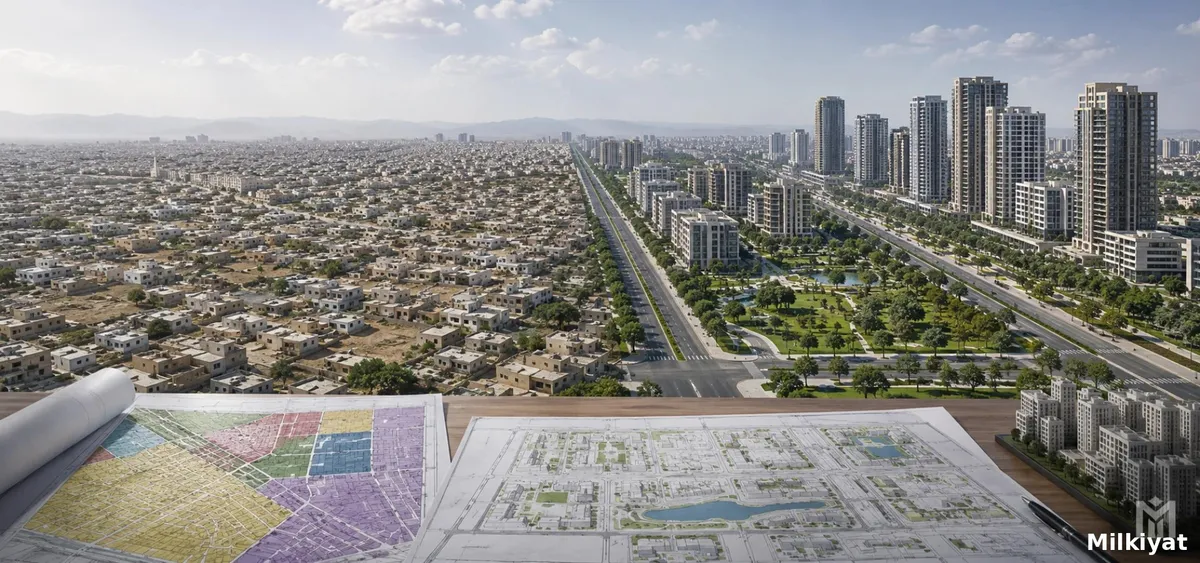
For decades, Dawn argues, Pakistan's housing societies have spread across farmland on the edges of cities more as investment vehicles than as genuine responses to housing demand — producing uncontrolled urban sprawl without a corresponding dent in the housing deficit. This model, the editorial says, has diverted capital into land banking while consuming farmland around major cities and contributing to food inflation, a concern the paper frames as especially costly for a country already facing food insecurity, water stress, and climate vulnerability.
The Scale of the Problem, in Numbers
The housing deficit Dawn references is substantial and well-documented across multiple sources this year. Arab News reported in May that Pakistan faces a housing shortage of around 10 million units, citing UN-Habitat data showing the country's urban population nearly doubled from 43 million to 75 million between 1998 and the present — a scale of urbanisation that has intensified pressure on farmland surrounding major cities. Separately, the World Bank and International Finance Corporation estimate the deficit at more than 10 million units, growing by roughly 400,000 units annually. A separate policy brief on urbanisation and the housing credit gap found that the top 20 districts by population density account for 42 percent of Pakistan's total annual housing demand despite occupying just 5 percent of the country's land area — meaning demand is heavily concentrated in exactly the urban cores where horizontal expansion is least sustainable.
Vertical Construction as the Proposed Fix
The editorial's core argument is straightforward: horizontal expansion consumes new farmland for every additional tranche of housing, while vertical development can accommodate several times as many families on the same footprint. But it stresses this only works with enforceable zoning, density standards, building and energy-efficiency codes, and adequate supporting infrastructure — without which, Dawn warns, the federal housing policy risks remaining "largely advisory" rather than a binding framework. That vertical-housing direction was formally set out in the cabinet's approval of the National Housing Policy 2026, covered in milkiyat.com's report on the policy's approval and its nine strategic themes, and reinforced separately by the Ministry of Housing and Works in its own statement, covered in milkiyat.com's piece on the ministry's framing of the policy's urban development goals.
Supply Isn't the Only Problem, Dawn Argues
The editorial is careful to note that solving supply alone won't fix the deficit — affordability has to move in lockstep with zoning and vertical construction. It calls on government to connect zoning policy, vertical construction, and mortgage affordability into a single coherent housing strategy, rather than treating supply-side reform and housing finance as separate tracks. That argument lines up with ongoing housing-finance activity milkiyat.com has covered separately, including Meezan Bank's Rs3 billion in disbursements under the government's Ghar Ho Tu Apna scheme — a reminder that expanding mortgage access and expanding buildable, affordable supply are two halves of the same problem.
What This Means for Islamabad and Rawalpindi Specifically
If provinces follow through on enforceable zoning and vertical-construction rules, cities like Islamabad and Rawalpindi — where CDA and RDA already control building approvals — would likely see this translate into stricter density and floor-area requirements for new housing schemes, rather than continued approval of horizontal, farmland-consuming developments on the urban periphery. Developers and investors should watch how this national direction filters into CDA and RDA-specific regulations over the coming months, since, as the editorial itself stresses, the policy's real-world impact depends entirely on provincial enforcement rather than the federal cabinet decision alone.
Sources
- Dawn — "Housing deficit" (Editorial), 12 Aug 2026: https://www.dawn.com/news/2022310/housing-deficit
- Arab News — "Pakistan weighs high-rise housing push to curb urban sprawl, protect farmland", 14 May 2026: https://www.arabnews.com/node/2643548/amp
- Profit by Pakistan Today — "Only 39% of Pakistan's rural households own homes, as urban ownership stands at 52%, housing deficit crosses 10 million", 9 Apr 2026: https://profit.pakistantoday.com.pk/2026/04/09/only-39-of-pakistans-rural-households-own-homes-as-urban-ownership-stands-at-52-housing-deficit-crosses-10-million/
- Dawn — "Affordable housing": https://www.dawn.com/news/1985115
- The News — "Pakistan's housing market struggles to keep up as demand for new units reaches one million per year", 27 May 2026: https://www.thenews.pk/print/1417674-pakistan-s-housing-market-struggles-to-keep-up-as-demand-for-new-units-reaches-one-million-per-year