News
World Bank Seeks 21-Month Extension for Punjab's $200 Million Affordable Housing Programme

By Mariam Khan
Real Estate Analyst
3 min read
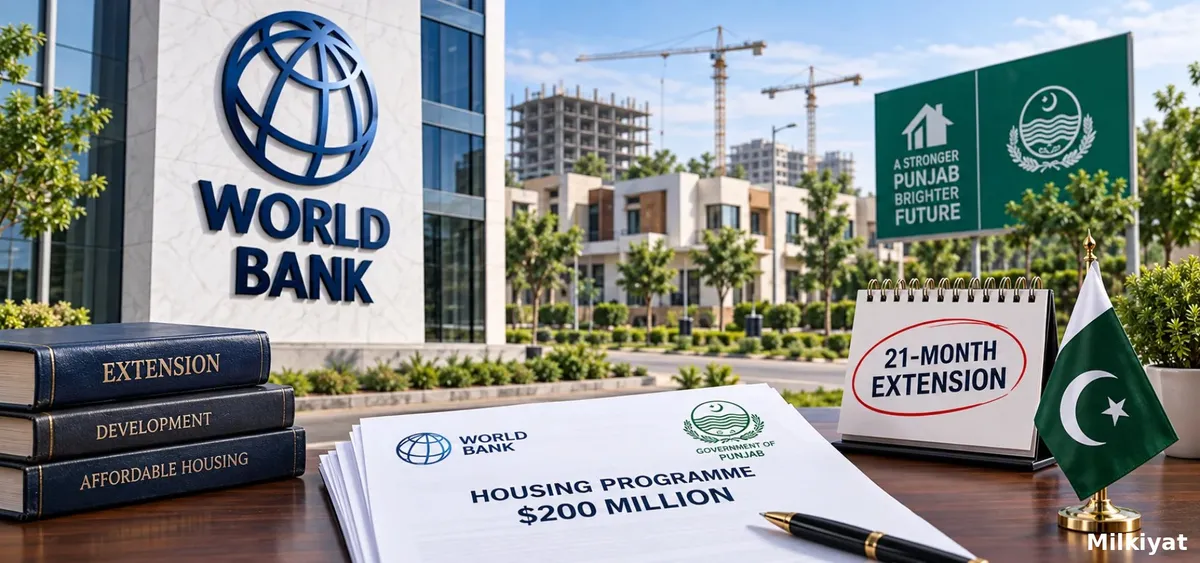
The World Bank has proposed extending Punjab's Affordable Housing Programme by 21 months to March 2029, after rating the project's implementation progress Moderately Unsatisfactory. The programme targets 77,000 housing units in total, including 37,000 affordable homes, but physical construction had not started as of May 2026, more than four years after the programme was originally approved.
A Rating That Has Moved in the Wrong Direction
The programme's trajectory is documented clearly through the World Bank's own successive assessments. Implementation Progress has deteriorated from an earlier Moderately Satisfactory rating to the current Moderately Unsatisfactory rating, even as the separate measure of progress toward the project's core development objective has been held at Moderately Satisfactory, a gap that itself signals the underlying goals remain sound while execution has fallen behind. Institutional capacity risk connected to the programme has escalated to Substantial, reflecting the World Bank's own assessment that the implementing institutions have struggled to execute at the pace originally planned.
How Little of the Money Has Actually Moved
Of the revised $203.82 million financing envelope, only $41.12 million has been disbursed, leaving $162.70 million undisbursed nearly halfway through the programme's originally planned timeline. Disbursements under this kind of World Bank financing are typically tied to specific implementation milestones rather than released upfront, meaning the low disbursement figure is itself a direct reflection of how little physical and institutional progress has actually been achieved so far, rather than simply a funding delay unrelated to delivery.
What the Proposed Restructuring Would Change
The proposed restructuring would introduce beneficiary led construction and demand side housing subsidies, a meaningful shift in approach from what appears to have been a more centrally delivered construction model originally envisioned. Beneficiary led construction and demand side subsidies generally place more of the actual building process in the hands of the eventual homeowners or private developers, supported by targeted financial assistance, rather than relying on a government implementing agency to deliver completed units directly, an approach that could address some of the institutional execution problems that have driven the current unsatisfactory rating if adopted.
Why the Housing Policy Freeze Matters Just as Much
Significantly, Punjab's own comprehensive housing policy has separately been put on hold pending notification and implementation of the federal government's national housing policy. This means the provincial policy framework meant to guide affordable housing development in Punjab more broadly is itself stalled waiting on a federal level decision, adding a second layer of delay sitting above the specific implementation problems already affecting this individual World Bank financed programme.
What This Means for Punjab's Affordable Housing Supply
For anyone tracking affordable housing supply in Punjab, this update is a clear signal that a substantial planned pipeline, 77,000 units including 37,000 specifically affordable homes, remains almost entirely on paper more than four years after approval, with zero physical delivery achieved despite the programme nearing its original halfway point. Private developers, housing finance providers, and prospective beneficiaries should treat the shift toward beneficiary led construction and demand side subsidies as the more concrete near term development to watch, since it could reshape how affordable housing gets built in Punjab going forward, while the broader provincial housing policy remains stalled pending federal action with no confirmed timeline of its own.