News
12 Illegal Housing Societies Demolished in Punjab as Authorities Intensify Crackdown

By Mariam Khan
Real Estate Analyst
4 min read
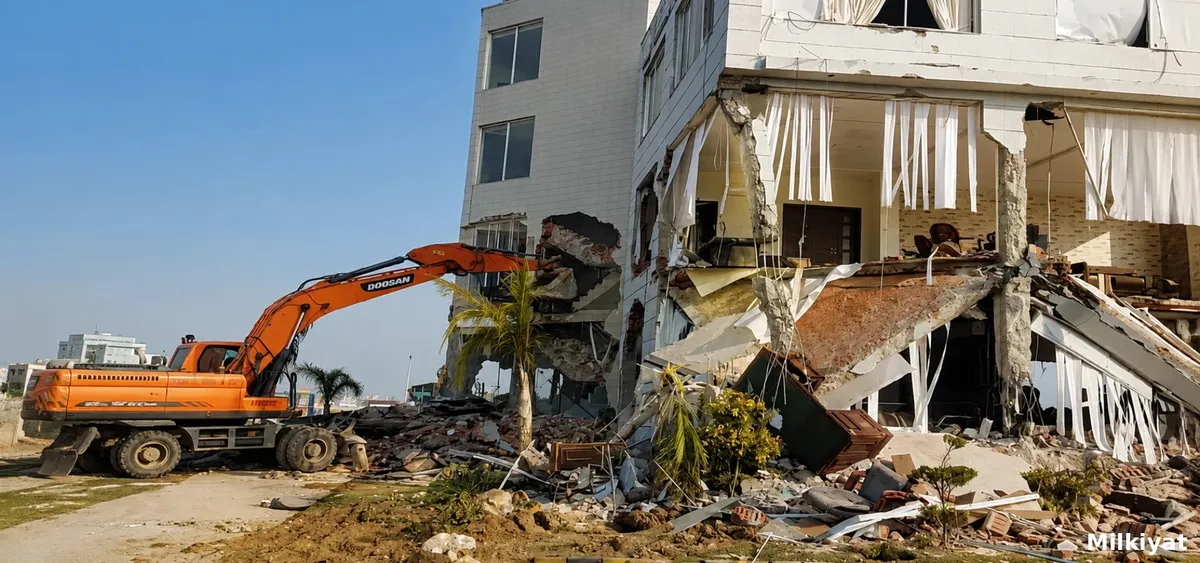
Twelve illegal housing societies were demolished, along with their concrete structures, in Pakpattan district, while cases were registered against the owners of four schemes under the Local Government Ordinances 2022 and 2025. The demolition operations continued for roughly two weeks and were jointly carried out by the Punjab Enforcement and Regulatory Authority, commonly known as PERA, local police, and revenue department officials.
Why These Schemes Were Declared Illegal
The illegal societies fall within the jurisdiction of the District Council, Pakpattan, and the operation was launched on the directives of Deputy Commissioner and District Council Administrator Asif Raza. The deputy commissioner had previously declared all 12 housing schemes illegal, through separate notifications and reminders, for failing to fulfil mandatory legal requirements. Most of the societies had reportedly not obtained approval for their layout plans from the Zila Council, the specific, foundational approval step their operators appear to have skipped entirely before selling plots.
About the Authority Leading the Enforcement
PERA was established under the Punjab Enforcement and Regulation Act, 2024, and formally launched by Chief Minister Maryam Nawaz Sharif, tasked specifically with enforcing laws related to price control, hoarding, encroachments, and other public welfare regulations across the province. The authority operates through more than 150 enforcement stations spread across Punjab's divisional, district, and tehsil headquarters, including a dedicated station in Arifwala within Pakpattan district itself, and employs more than 8,000 personnel provincewide, reflecting the genuinely significant institutional scale behind this kind of joint enforcement operation.
The Legal Action Against Developers
Cases against the owners of four housing societies specifically have been registered at police stations in Arifwala, filed under Sections 160 and 165 of the Local Government Ordinance 2025 and Sections 160(4) and 175(4) of the Local Government Ordinance 2022. Despite these registered cases, none of the owners had actually been arrested at the time of this report, since they had secured pre arrest bail from local tehsil and district courts, meaning the legal proceedings against them continue even as the physical structures themselves have already been removed.
What Remains Unresolved
Whether the four developers facing registered cases will ultimately face conviction, given they currently hold pre arrest bail, remains to be seen through the ongoing court process. It also remains unclear whether plot buyers who had already paid money toward any of the 12 demolished schemes have any realistic path to recovering their investment now that the underlying structures have been physically removed.
Why the Owners' Bail Status Matters for Buyers
The fact that none of the four developers facing charges have been arrested, having secured pre arrest bail before enforcement even reached the demolition stage, is a useful, sobering detail for prospective buyers to understand about how these situations typically unfold. Demolition of illegal structures does not necessarily mean swift or certain legal consequences for the developers responsible, a gap that matters directly for anyone hoping legal action against a scheme's operators might eventually lead to compensation or refunds.
What Plot Buyers Should Verify Before Investing in Any Private Housing Scheme
Before making any payment toward a plot in a private housing scheme anywhere in Punjab, buyers should directly verify that the scheme has secured layout plan approval from the relevant Zila Council or equivalent municipal authority, exactly the step most of the 12 demolished Pakpattan schemes appear to have skipped. Buyers should request documented proof of this approval directly from the scheme's developer and independently confirm it with the local district or tehsil administration, rather than accepting a developer's verbal assurance or an active sales office as evidence of legitimacy. Given how this Pakpattan case shows structures can be demolished well after money has already changed hands, and that developer prosecution does not guarantee buyer compensation, this kind of upfront verification remains the only genuinely reliable protection available before committing funds to any private housing scheme.