Blog
B-17 vs D-12 Islamabad: Margalla Access and Road Connectivity

By Bibi Masooma
Real Estate AnalystVerified author
Updated 7 min read
Two Islamabad sectors, two sets of marketing brochures, one shared claim: Margalla Hills proximity. B-17 and D-12 both lean hard on that view in how they sell themselves to buyers. But proximity to a mountain range is not the same as a working road into the city that sits beside it, and on that specific point, these two sectors are not in the same category at all.
D-12 sits in the foothills of the Margalla Hills on Islamabad's western side, close to E-11, F-10, and F-11, and has grown into a settled residential sector with built homes, a working Markaz, and strong demand from families who want quick access to the city's core. Its connection to Margalla Avenue has become one of its biggest practical advantages, turning hillside scenery into a genuinely short commute. For a full picture of the sector's layout, amenities, development, and market profile, see our D-12 sector guide.
This article compares D-12 with B-17 on the point both sectors market most heavily, Margalla Hills access, and separates the roads that are already working from the ones still being planned. Connectivity tends to show up in prices, so a sector with a finished road into central Islamabad usually commands more. Browsing current D-12 property listings gives you a sense of what that access is worth before comparing it with B-17.
B-17 vs D-12 at a Glance
| Factor | B-17 (Multi Gardens) | D-12 |
|---|---|---|
| Launched | 2004 | 1994 |
| Developed by | MPCHS, a private cooperative society | CDA, directly |
| Legal framework | Cooperative Societies Act, 1925 | Direct CDA development |
| General location | Northwest Islamabad, along GT Road and M-1 Motorway | Foothills of Margalla Hills, near E-11 and F-10/F-11 |
| Development status | Ongoing across multiple blocks and a newer Phase 2 | Largely complete since around 2011 |
| Primary current road access | GT Road, M-1 Motorway | Margalla Avenue, directly into central Islamabad |
| Margalla Avenue connection | Described as an upcoming extension | Operational since April 2024 (D-12 to E-11 stretch) |
| Commute orientation | Toward Rawalpindi, Peshawar, and the airport corridor | Toward central Islamabad's core sectors |
D-12: The Sector Margalla Avenue Was Actually Built To Serve
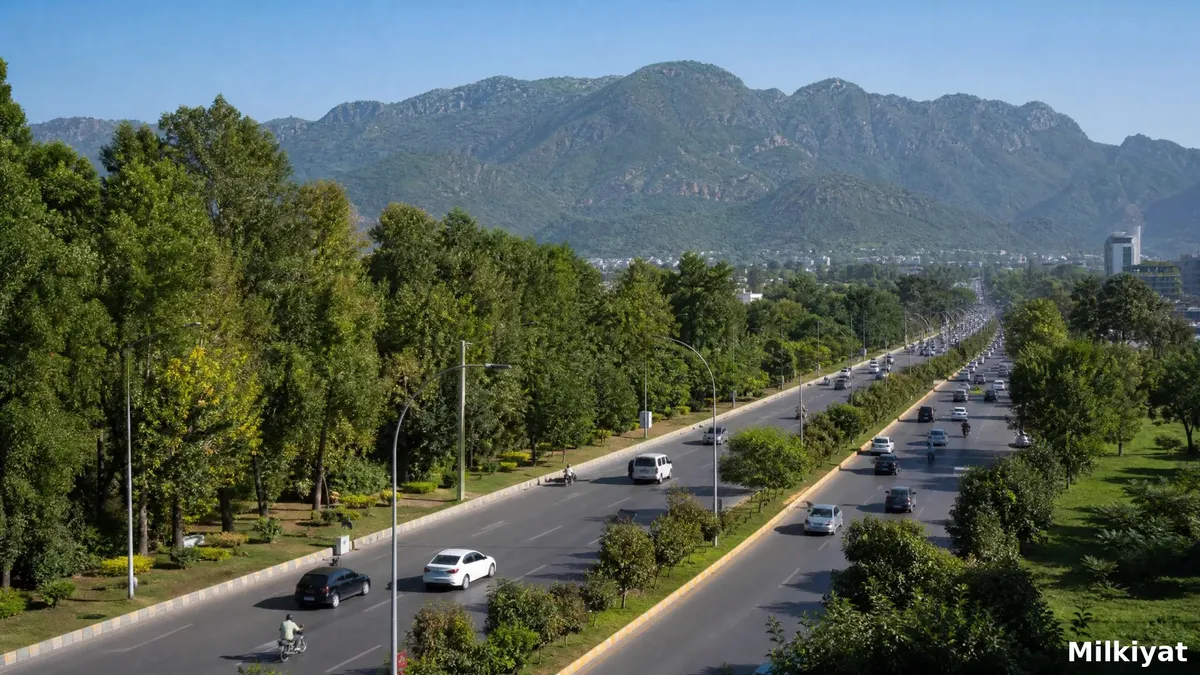
D-12 was launched by CDA in 1994 and was largely built out by around 2011, with most of its plots possessed, houses constructed, and its central Markaz fully functioning. Its real advantage today isn't just the hillside views. It's the road. Margalla Avenue, sometimes called the Margalla Expressway, runs roughly ten kilometres along the foothills of the Margalla Hills, and CDA has explicitly built it as a second high-speed corridor linking the city's west and east sides, easing pressure on the older Srinagar Highway. According to CDA's official Islamabad project information, the 5.5-kilometre stretch running from D-12 to E-11 was formally inaugurated on 22 April 2024, connecting the existing Khayaban-i-Iqbal to Murree Road. That is not a future promise. It is a finished, functioning road that D-12 residents use today to reach the F-10, F-11, and E-11 area directly.
B-17: Margalla Views, a Different Road Reality
B-17, widely known as Multi Gardens, tells a different connectivity story even though its own marketing leans just as hard on the Margalla Hills. The scheme was launched in 2004 by the Multi Professionals Cooperative Housing Society, commonly abbreviated MPCHS, a private cooperative society rather than CDA acting directly. Geographically, B-17 sits much further to the city's northwest, hugging GT Road and running alongside the M-1 Motorway, closer in practice to Tarnol, Sangjani, and the road toward Peshawar than to Islamabad's established core.
B-17's own promotional material consistently references a coming link to Margalla Avenue, describing it in various places as an extension that is planned, upcoming, or in creation, rather than something already carrying traffic. That distinction matters enormously in practice. Until that extension is actually finished, a B-17 resident's fastest routes into the city run through GT Road and the M-1 Motorway, which are genuinely useful roads but oriented toward Rawalpindi, the airport, and the Peshawar direction rather than a direct hill-front route into central Islamabad the way D-12 already has.
The Road Status, Side by Side
| Road link | Status for D-12 | Status for B-17 |
|---|---|---|
| Margalla Avenue (D-12 to E-11 stretch) | Completed, inaugurated April 2024 | Not applicable, sector sits well beyond this stretch |
| Margalla Avenue extension toward B-17 | Not applicable | Described as planned or upcoming in current sector marketing |
| Primary functioning access road today | Margalla Avenue directly | GT Road and M-1 Motorway |
| Commute direction served | Central Islamabad core | Rawalpindi, Peshawar, and airport corridor |
| Distance to central sectors (approximate, by road) | Short, direct route via Margalla Avenue | Longer route via GT Road or motorway |
Why This Distinction Gets Blurred in Marketing
Part of the confusion is understandable. Both sectors genuinely sit near the Margalla range, and both have legitimate reason to mention it. But a buyer comparing the two needs to separate scenery from infrastructure. D-12's version of "Margalla access" is a finished expressway carrying real commuter traffic today. B-17's version, at least for now, is a future extension that multiple independent sources describe as still being planned rather than delivered, even though the surrounding CDA push to develop new sectors along Margalla Avenue, covering C-13 through C-16, shows the broader corridor is a genuine, active priority for the authority. Read more about how this same pattern of shared corridor versus different price and access reality plays out elsewhere in Milkiyat's G-11 vs F-11 Kashmir Highway comparison.
It's also worth noting that B-17, as a cooperative-society development, carries the kind of governance and title considerations covered in Milkiyat's G-15 vs G-16 Islamabad: Cooperative Society Governance Risk, on top of the connectivity gap discussed here. D-12, as a direct CDA sector, doesn't carry that particular layer of risk.
What This Means for Buyers
If Margalla Avenue access into central Islamabad is the actual priority, D-12 delivers that today, not as a future promise. Its road is built, its sector is largely complete, and the commute into F-10, F-11, and the wider core is short and direct. If B-17 is the sector under consideration specifically for its Margalla Avenue connectivity, that connection should be treated as a planned upgrade rather than a current feature, and current commute patterns via GT Road and the M-1 Motorway should be the basis for any decision, not the marketing language around a future extension. B-17 still has real strengths, including its scale, its motorway access, and its proximity to the new airport, but those strengths run in a different direction than the one its Margalla branding implies.
Read Next on Milkiyat.com
- G-11 vs F-11 Islamabad: The Kashmir Highway Price Differential
- F-11 vs E-11 Islamabad: CDA Freehold vs Cooperative Society Title
- Browse Plots for Sale in Islamabad