Guide
Bahria Town Sectors G and H Lahore: Cheapest Entry, Longest Wait
Guide

By Anza Gulzar
Real Estate Agent
15 min read
This guide covers the reported Sector G and Sector H areas of Bahria Town Lahore, including Lalak Jan and Sarwar blocks. Verify each property's exact location and status before buying.
Bahria Town Sector G Lahore is a property-search area associated with blocks such as Lalak Jan and Sarwar, attracting buyers who want to explore residential opportunities within the wider Bahria Town Lahore community. However, a lower advertised price does not automatically mean better value, and a property with an uncertain development or possession timeline may carry risks that outweigh its initial affordability.
This guide examines Sector G Lahore, the available information about Lalak Jan and Sarwar blocks, the need to verify Sector H, and the factors that influence property prices, development timelines and buyer decisions. For the wider community context, read the Bahria Town Lahore guide. Buyers should distinguish verified records from marketing descriptions, compare dated property quotations and confirm the status of an individual property before making a financial commitment.
The phrase “Cheapest Entry, Longest Wait” is a question to investigate rather than a proven market fact. Establishing whether Sector G is the cheapest entry point requires comparable, dated prices across relevant sectors. Establishing whether buyers face a longer wait requires reliable information about development, possession and transfer conditions.
Sector G is a useful focus for buyers researching residential property options within Bahria Town Lahore, particularly when listings identify Lalak Jan Block or Sarwar Block. These block names can help narrow a property search, but they should not be treated as evidence that every listed property has the same development status, possession availability or documentation.
Before evaluating an advertised property, establish precisely what is being offered. A listing might refer to a residential plot, a file, a plot with possession, or a constructed house. These are different property categories and can involve different costs, documentation requirements and risks.
The distinction matters because an apparently inexpensive property may not be immediately usable. A buyer planning to construct a house needs to establish whether the plot is identifiable, transferable and eligible for construction under the applicable requirements. An investor planning to resell may instead prioritise demand, documentation, liquidity and the likely holding period.
Sector G should therefore be assessed through property-specific evidence rather than its sector label alone. Buyers should verify the location, plot number, dimensions, development conditions and applicable transfer process before comparing prices.
Lalak Jan Block appears in the available Sector G listing context and deserves individual consideration when narrowing a residential property search. Nevertheless, a block name in a listing does not establish the legal status, physical condition or possession availability of every property advertised there.
Start by confirming the exact location and the type of property being sold. Ask for the plot number, dimensions, relevant ownership or allotment records and any available documentation establishing transfer eligibility. The details should correspond with the property shown to the buyer and the records maintained by the relevant authority or management office.
A site visit is particularly important when development or possession conditions are unclear. Buyers should establish whether the plot can be physically identified, whether access roads are usable, whether surrounding development is visible and whether relevant services are available at the specific location.
The following factors deserve attention:
Lalak Jan Block may suit buyers whose budget and timeline align with the verified conditions of an available property. Without comparable transaction evidence, however, its affordability relative to other blocks cannot be assumed.
Sarwar Block is another block name associated with Sector G property listings. Buyers should apply the same verification process here rather than assuming that its prices, development or possession conditions are identical to those of Lalak Jan Block.
Two properties carrying the same block name may differ in location, access, dimensions, documentation and readiness for construction. These differences can materially affect the total amount a purchaser must spend and the time required before the property can be used.
For a plot advertised in Sarwar Block, ask the seller to identify the exact location and provide the available supporting documents. Check whether the advertised price includes all relevant amounts or whether additional charges remain payable. Confirm the status of any outstanding development requirements before agreeing to a transaction.
Buyers should also investigate the difference between a seller's claimed possession status and the actual position recorded in the relevant documentation. A verbal assurance that possession is available is not enough when the buyer's plans depend on immediate construction or use.
For investment buyers, the potential resale market deserves equal attention. A lower purchase price can be attractive, but resale may be difficult if buyers are uncertain about documentation, development or transfer eligibility. The realistic investment cost therefore includes the purchase amount, holding expenses and the potential delay before a sale becomes possible.
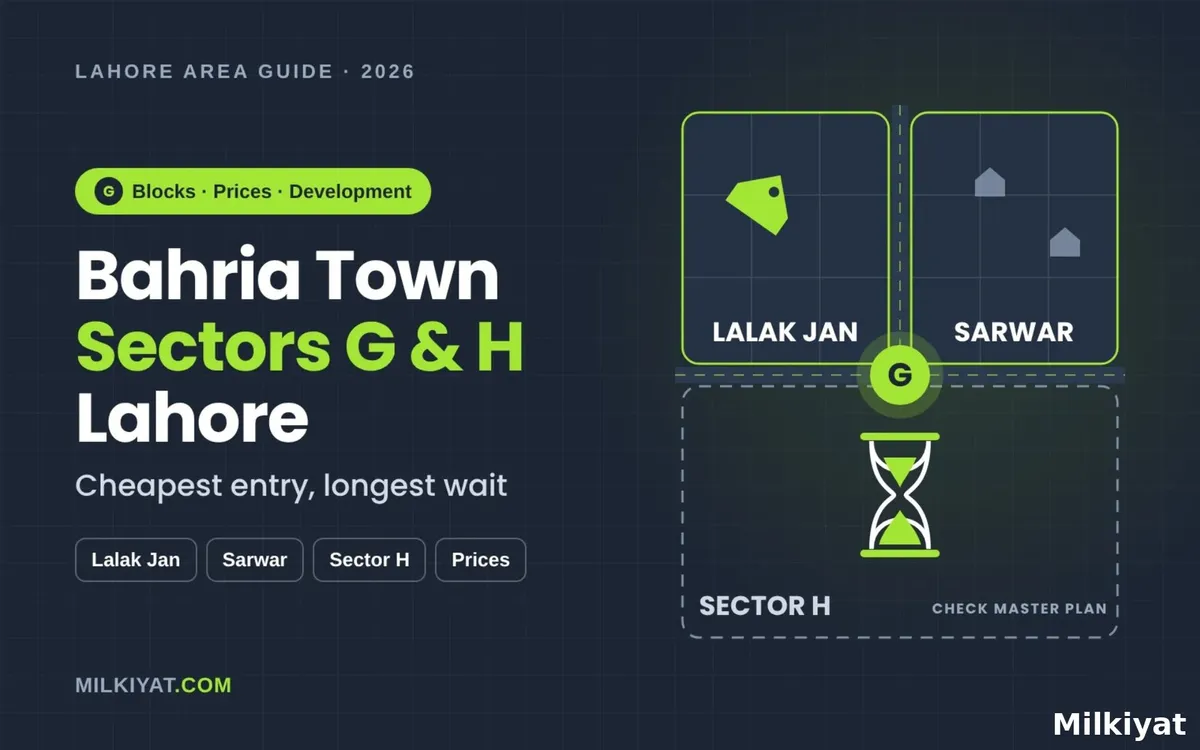
Sector H requires particular caution. The available planning context identifies the existence of Sector G blocks such as Lalak Jan and Sarwar, while confirmation of Sector H on the relevant master plan remains outstanding.
This guide does not treat Sector H as a confirmed, independently established sector. Its existence, boundaries, blocks and development status should be verified through an authoritative master plan or relevant official documentation before any property is marketed or purchased on that basis.
Buyers should not assume that a listing mentioning Sector H proves its official recognition. The name could reflect a seller's description, an informal label or information that needs further verification. None of those possibilities should be accepted without supporting evidence.
Before considering a property advertised under a Sector H label, ask for:
If the seller cannot establish these details, pause the transaction until the uncertainty is resolved. Buyers should avoid making payments based on assumptions about a sector's future development, promised recognition or expected appreciation.
The absence of sufficient confirmation in the available material does not, by itself, prove that Sector H does not exist. It means the claim should remain unconfirmed until reliable evidence is available.
The approval position must be distinguished from the marketing description of a sector or block. According to the Bahria Town Lahore pillar information checked on 6 October 2026, the relevant LDA record lists Sectors A, B, C and D, while Sectors G and H are not included in those identified entries.
This distinction is important, but it must be interpreted carefully. The absence of a sector from the specific entries referenced in the pillar is not sufficient on its own to establish every aspect of that sector's legal status. Buyers should check the applicable official records and obtain clarification about the exact property before drawing a conclusion.
The approval status of a broader development and the documentation for an individual plot are also different questions. Even where a broader area has an identified approval record, buyers still need to verify ownership, plot identity, transfer eligibility and other property-specific requirements.
For Sector G and any property advertised as Sector H, buyers should investigate:
Do not rely exclusively on a dealer's claim that approval is complete or that a particular block will receive approval in the future. Ask for documentary evidence and seek appropriate professional advice when the record is unclear.
The claim that Sector G offers the cheapest entry point needs evidence from comparable property prices. A low advertised figure in one listing cannot establish that the entire sector is cheaper than all other relevant sectors or blocks.
A meaningful comparison requires a consistent property category, similar plot sizes, comparable documentation and development status, and prices collected within a defined period. Comparing a file awaiting further steps with a developed plot ready for use can produce a misleading conclusion.
For example, a lower-priced property may require additional payments, have less convenient access or involve a longer period before possession or construction. Another property with a higher asking price may offer greater clarity about its location and transfer status. These differences need to be considered alongside the headline amount.
A useful comparison should include the following:
| Factor | What to record |
|---|---|
| Sector and block | Exact location stated in the listing |
| Property category | File, residential plot or completed house |
| Plot size | Verified area and dimensions |
| Asking price | Seller's quoted amount |
| Price date | Date the quotation was obtained |
| Development status | Verified physical conditions |
| Possession | Confirmed, pending or unclear |
| Documentation | Available records and transfer eligibility |
| Additional costs | Dues, charges and other expected payments |
Buyers can use the Bahria Town Lahore house listings when comparing advertised houses within the wider community. However, house prices should not be used as direct substitutes for residential plot prices. The property types must remain separate throughout the analysis.
To support a “cheapest” claim, collect dated quotations for comparable plots across relevant sectors and blocks. Record the source and date of each observation, then compare prices using the same area unit and property category. Until that comparison demonstrates a consistent difference, Sector G should be described as an area to investigate for potentially affordable options, not as definitively the cheapest sector.
A longer wait can affect a property's practical value, but it must be established through reliable development and possession information. The name of a sector, a low asking price or a seller's promise does not demonstrate how long a purchaser will need to wait.
Buyers should distinguish between several milestones. Physical development may involve roads and services; possession concerns the applicable ability to take control of the property; transfer eligibility concerns the ability to complete the relevant ownership process; and construction readiness depends on the applicable requirements for building.
These milestones are related but not interchangeable. A property may be advertised as developed while particular services remain incomplete, or its transfer position may require additional verification. Buyers should establish which milestone has actually been reached.
To assess a potential delay, ask for dated documentation and inspect the location. Confirm what work remains, who is responsible for completing it and whether any official timetable exists. If a completion date is merely an informal estimate, do not treat it as a guaranteed deadline.
The cost of waiting can include funds tied up in the property, additional visits, financing expenses and delayed rental or residential use. A buyer planning to build immediately should place greater weight on verified construction readiness than someone who has a longer investment horizon.
No reliable comparative development timeline has been established here to prove that Sector G has the longest wait in Bahria Town Lahore. That part of the title should therefore be treated as a question requiring evidence, not a confirmed fact.
The initial purchase amount may not reflect the full cost of acquiring and using a property. Buyers should calculate the expected total outlay before deciding that one option is cheaper than another.
Potential costs include applicable transfer charges, taxes, documentation fees, outstanding dues and professional advice. Depending on the property's status, additional expenses may arise from development requirements, utility connections, site preparation or construction.
Where possession or development remains uncertain, buyers should also consider the financial effect of delay. Funds committed to a property may remain unavailable for other purposes while the buyer waits for a required milestone. That opportunity cost can make a seemingly inexpensive property less attractive.
Ask the seller for a written breakdown of amounts already paid, outstanding liabilities and any further payments expected. Confirm current charges through the relevant authority or management office rather than relying on an old estimate.
A sensible comparison includes the advertised price, confirmed additional costs, expected holding expenses and the property's actual readiness for the intended use. This is more useful than ranking properties by their initial price alone.
A residential plot offers flexibility for a buyer who wants to construct a home, subject to the applicable requirements. However, the purchaser must account for the property's documentation, construction budget, development conditions and the time required before the house becomes usable.
A completed house can reduce the need to manage construction from the beginning, but it introduces other considerations. Buyers should assess structural condition, covered area, layout, maintenance requirements and the cost of any necessary repairs.
For buyers comparing houses across Lahore, houses for sale in Lahore can provide a broader starting point. If the aim is to compare different residential formats rather than only plots and houses, apartments for sale in Lahore may also help establish the alternatives available within the city.
The correct choice depends on the buyer's objectives, not simply the sector's advertised entry price. Someone seeking immediate residential use may prefer a verified, ready-to-occupy property. Someone planning to build later may accept a different timeline, provided the property details and risks are understood.
The biggest risks arise when buyers commit funds before resolving basic questions about the property. Unclear ownership, inconsistent plot details, uncertain transfer eligibility and unsupported development promises can all complicate a transaction.
Avoid treating an advertisement, brochure or informal map as conclusive evidence of a property's identity. Request the relevant records and confirm that the property being offered matches the details in those documents.
Be cautious if a seller refuses an inspection, pressures you to pay immediately, avoids explaining outstanding charges or offers a future approval as though it were already confirmed. These warning signs do not automatically establish wrongdoing, but they justify further investigation.
Do not assume that a low price compensates for missing documentation. Before payment, clarify the terms of the transaction, the responsibilities of each party and the conditions that must be satisfied before transfer or possession.
For files and other property interests, establish exactly what rights are being transferred. A file should not be described or valued as though it were automatically equivalent to a developed, identifiable plot with confirmed possession.
A structured approach can help buyers assess Sector G and investigate any property advertised under Sector H.
Step 1: Define the objective. Decide whether the property is intended for construction, residential use, rental income or resale.
Step 2: Confirm the location. Verify the sector, block, plot number and dimensions against available records.
Step 3: Establish the property category. Determine whether the offer concerns a file, plot or completed house.
Step 4: Review documentation. Check ownership, transfer eligibility, relevant approvals and outstanding obligations.
Step 5: Inspect the site. Observe access, development, surrounding construction and available services.
Step 6: Compare dated prices. Use comparable property types and record the source and date of every quotation.
Step 7: Calculate the total cost. Include confirmed charges, repairs, construction requirements and possible holding expenses.
Step 8: Confirm possession and timelines. Establish what is available now and what remains incomplete, using documentary evidence where possible.
Step 9: Obtain appropriate advice. Resolve material legal or documentation questions before committing funds.
Step 10: Complete the transaction carefully. Use a written agreement, proper payment records and the applicable transfer procedure.
Bahria Town Sector G Lahore may be worth investigating for buyers comparing residential property options, particularly listings associated with Lalak Jan and Sarwar blocks. However, affordability should be demonstrated through dated, comparable prices rather than assumed from the sector name.
The development and possession timeline is equally important. A lower asking price may come with additional costs, uncertainty or a longer period before the property can be used. Buyers should establish the actual status of the specific property and avoid relying on unsupported completion promises.
Sector H requires separate verification. Until its existence, boundaries and relevant status are established through reliable documentation, buyers should not treat it as a confirmed sector simply because a listing uses that name.
The available approval context identifies LDA entries for Sectors A through D, while the referenced information does not establish equivalent approval details for G and H. This should prompt further checks rather than an unsupported conclusion about the legal status of every property in those areas.
Ultimately, the best purchase is not necessarily the property with the lowest advertised price. It is the property whose identity, documentation, costs, development conditions and suitability for the buyer's objectives can be established with reasonable confidence.
Compare Bahria Town Lahore and Park View City Lahore in 2026, including prices, approval status, location, facilities and investment considerations.
Compare Bahria Town Lahore and LDA City in 2026, including plot prices, location, development, approval checks and factors to consider before buying property.
A 2026 comparison of Bahria Town Lahore and Lake City covering property prices, approval checks, location, amenities and key factors for buyers.
Explore PDA commercial plot auctions in Hayatabad and Regi Model Town, including reserve prices, bidding procedures, deposits and payment terms.