Guide
China Cutting Explained: How Karachi's Amenity Land Became Plots
Guide
A tenant guide to renting an office in D-12 Islamabad covering Markaz plazas, sizes, floors, rent benchmarks, approved use, agreements and a checklist.
Explore 1 bed apartment prices in Park View City Islamabad, including project comparisons, apartment sizes, price per sq ft, lake-facing views and buying options.
Explore apartments for sale in Park View City Islamabad, including 1, 2 and 3-bed units, project details, price comparisons, payment plans and buyer guidance.
A tenant guide to renting an office in F-10 Islamabad covering Markaz plazas, sizes, floors, rent benchmarks, approved use, agreements and a checklist.

By Maham Imtiaz
Real Estate AnalystVerified author
9 min read
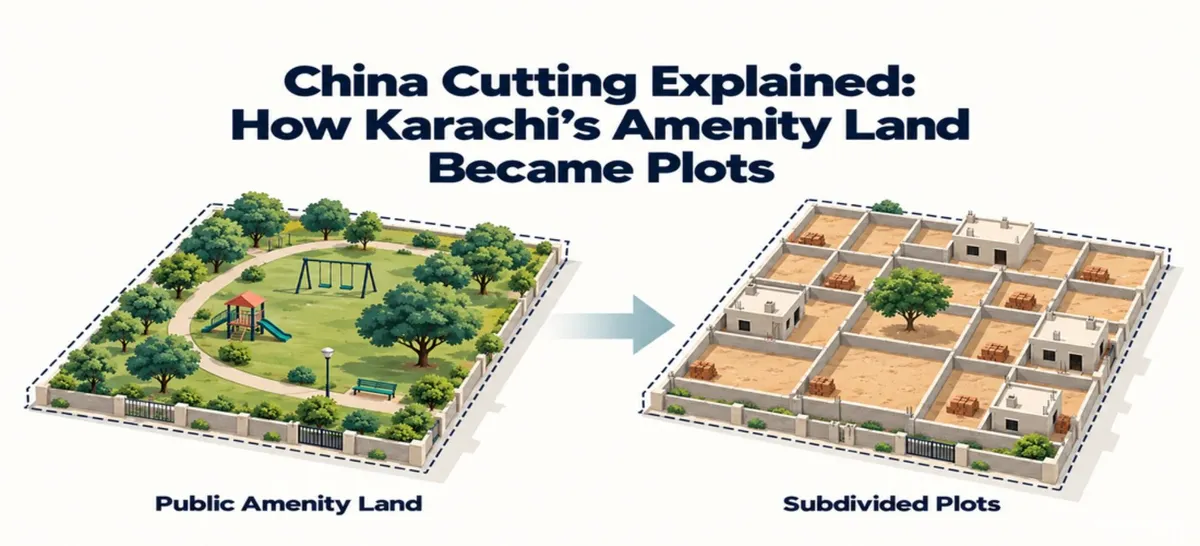
"China cutting" is Karachi shorthand for one of the city's most damaging land frauds: taking a park, playground, green belt or other public plot, cutting it into small residential or commercial lots, and selling them off. The buyers are usually ordinary families looking for an affordable plot in an established neighbourhood. What they get is land that was never lawfully available, and a house the law can order demolished.
China-cut plots fail at the very first check. Our guide on how to verify property in Karachi explains that the land layer of any purchase starts with confirming the plot's lawful allotment and designated use, and a china-cut plot has neither, whatever papers come with it.
This guide explains how china cutting works, where it has happened, how big the problem is, what the courts and authorities have done, why china-cut buildings are physically dangerous as well as legally void, and how to recognise a china plot before you pay.
The method has been described consistently since at least 2015.
| Step | What happens |
|---|---|
| 1. Target | A park, playground, green belt, community centre site, school plot or even a graveyard in a planned scheme |
| 2. Cut | The land is divided into small lots, typically 100 square yards or less; a 500-yard plot might become lots of 100, 80 or 60 yards |
| 3. Paper |
| Allotment letters, transfer orders or leases are produced, sometimes forged, sometimes issued with official collusion |
| 4. Sale | Agents sell the lots, often called "china plots", at prices below the surrounding market |
| 5. Build | Houses or shops go up without SBCA approval |
| 6. Utilities | Connections are obtained informally or through the neighbourhood |
In a 2017 bail order, the Sindh High Court described green belts and parks encroached through china cutting and government land illegally leased with official collusion, and directed the anti-corruption department to act against SBCA officials who allowed illegal buildings. In Criminal Bail Application No. 994 of 2017, the court also barred the accused from selling any units until a building plan was approved and a completion certificate issued, which shows how a buyer's purchase can be frozen even before any final ruling.
| Area | What was reported |
|---|---|
| Gulshan-e-Iqbal | Amenity plots cut into small residential lots |
| Gulistan-e-Jauhar | Amenity plots cut into small residential lots |
| North Nazimabad | Amenity plots cut into small residential lots |
| Korangi | Bagh-e-Korangi, a public park, converted into a residential colony; a 2020 building collapse on a china-cut plot |
Reporting in 2015 described hundreds of amenity plots in these areas reduced to small lots. The pattern appears in KDA schemes across the city, because those schemes have the most planned amenity land.
In November 2017, KDA's director general told the Supreme Court that at least 35,000 amenity plots across Karachi had been illegally occupied or china-cut over about 20 years. Authorities had demolished illegal buildings at 27 locations in the two days before the report. The Court gave KDA, KMC and the deputy commissioners two months to cancel illegal allotments and clear the land.
No public figure since then shows how many of those 35,000 plots have been recovered. In March 2024, the Sindh local government minister discussed with KDA a proposal to regularise houses and shops built on china-cut KDA land, each under 120 square yards and home to thousands of people. No approved policy has been reported.
| Year | Court | Order |
|---|---|---|
| 2017 | Supreme Court | Remove encroachments from 35,000 amenity plots within two months |
| 2017 | Sindh High Court | China cutting of green belts and parks noted; action directed against SBCA officials |
| January 2019 | Supreme Court | Karachi to be restored in line with its master plan; constructions outside it to be demolished; encroachments to be razed |
| 2024 | Supreme Court, 2024 SCMR 1215 | Amenity plots cannot be changed to commercial use |
The law treats a china-cut allotment as void from the start, so the passage of time does not cure it. A buyer three or four transfers down the chain holds nothing better than the first person who carved out the plot.
A china-cut plot cannot have a lawful building plan, so nobody checks the design. In September 2020, a residential building in Korangi collapsed, killing four people. SBCA said the building was illegal and stood on a plot carved out of an amenity plot. It was only four years old, and rainwater collecting in its basement was reported to have weakened its foundations.
Our review of Karachi building collapses and their approval records shows how unapproved construction recurs in the city's deadliest collapses.
| Risk | Consequence |
|---|---|
| Void allotment | No title to transfer; later sales pass on nothing |
| Demolition | Encroachment drives and court orders target amenity land |
| No SBCA approval | No completion plan, so no registry under section 18-G |
| No legal utilities | Section 18-G bars new connections without a completion plan |
| Criminal exposure | Sindh's anti-encroachment law punishes encroachers with up to 10 years' imprisonment |
| No compensation | The anti-encroachment law provides none for evicted encroachers |
| Uncertain regularisation | Proposals have been discussed, but none approved |
Time does not reduce these risks. A family that has lived in a china-cut house for a decade has no stronger claim than the person who first carved out the plot.
About five plots a day for twenty years. 35,000 amenity plots ÷ 20 years = 1,750 plots a year, or 1,750 ÷ 365 = about 4.8 plots every day.
The 2017 demolitions touched 0.08% of the problem. 27 locations ÷ 35,000 plots = about 0.08%.
One 500-yard amenity plot can become six china plots. 500 square yards ÷ 80 square yards = 6.25, so six 80-yard lots (480 square yards), with no land left for roads or open space.
Conversion on paper doubles the official value. The FBR values amenity plots at 50% of residential plots in the same area. In the Gulshan-e-Iqbal blocks valued at Rs5,000 per square foot for residential plots, a 120-square-yard plot (1,080 square feet) is worth Rs5.4 million as residential land but Rs2.7 million as amenity land. That gap is the incentive behind china cutting.
The Korangi building lasted four years. Built on a china-cut plot around 2016, it collapsed in September 2020.
| Check | Where |
|---|---|
| Plot appears on the approved layout plan with residential use | KDA master plan or land department |
| Allotment traceable in KDA's records | KDA land department |
| Plot not in or beside a park, playground, green belt or graveyard | Site visit and layout plan |
| SBCA building plan and completion plan | SBCA |
| Legal, separate utility connections | K-Electric, SSGC and water utility |
| No encroachment or demolition notice | KDA and district administration |
| Price consistent with nearby plots | Market comparison |
China cutting is the most extreme form of the amenity plot problem. Our guide to KDA amenity plots and buyer risk covers the wider legal framework, including Article 52-A of the KDA Order.
A. Carving parks, playgrounds, green belts and other amenity plots into small residential or commercial lots and selling them without a lawful allotment.
A. KDA told the Supreme Court in November 2017 that at least 35,000 amenity plots had been illegally occupied or china-cut over about 20 years.
A. Reported cases include Gulshan-e-Iqbal, Gulistan-e-Jauhar, North Nazimabad and Korangi, where the Bagh-e-Korangi park was converted into a residential colony.
A. No regularisation policy has been approved. In March 2024, the Sindh government discussed a proposal for houses on china-cut KDA land under 120 square yards, but it remained at the discussion stage.
A. No. A china-cut plot cannot have an SBCA completion plan, and section 18-G bars registration and new utility connections without one.
A. It can be. Such buildings have no approved design or inspections. A four-year-old building on a china-cut plot in Korangi collapsed in 2020, killing four people.
A. Check the plot against KDA's approved layout plan, confirm its allotment in KDA's records, and be wary of small, irregular plots in or near parks and other public spaces.
This guide is for general information. Plot status, court orders and regularisation policies change, and buyers should confirm every plot's allotment and designated use with KDA, SBCA and a qualified lawyer before paying.