Guide
Fard vs Intiqal vs Registry: What Proves Property Ownership in Pakistan (2026)

By wajahat Ali
Real Estate Analyst
Updated 6 min read
A buyer pays in full, signs the Registry, and drives home sure the plot is theirs. In the government's record, it still belongs to the seller. That gap causes a huge share of property disputes in Pakistan, and it comes down to three documents people wrongly treat as the same: the Registry, the Intiqal, and the Fard.
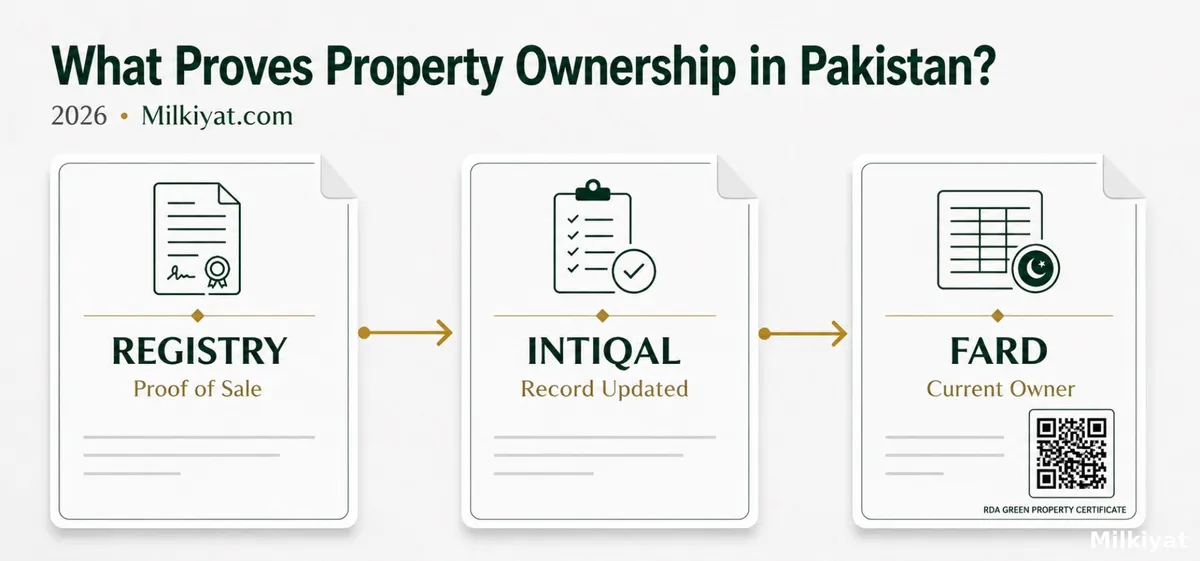
In one line: A Registry proves a sale happened. An Intiqal changes the government's ownership record. A Fard shows who owns the plot today. You need all three, not one.
Registry: proof a sale happened
The Registry, or registered sale deed, legalises the transfer of property from seller to buyer. It is drafted on stamp paper and registered, signed, and stamped by the sub-registrar. It records the buyer, seller, property details, and the transaction. This is also where government charges apply: stamp duty, registration fee, and withholding taxes (236C on the seller, 236K on the buyer).
Think of it as a sale receipt. The Registry proves you paid and a seller handed the plot over on a certain date. It does not update the master record of who owns the land.
Intiqal (mutation): the change in the government record
Intiqal, or mutation, is how ownership is actually changed in the revenue record. A revenue officer orders that your name replace the previous owner's in the ownership column held by the patwari or land record centre. Crucially, a sale is not the only trigger: Intiqal is required for gift and inheritance too. When an owner dies, heirs apply for an inheritance mutation (wirasat intiqal) with the death certificate and Family Registration Certificate, no Registry involved.
The double-sale trap. If A sells to B by Registry but B never completes the Intiqal, the record still shows A as owner. A dishonest A can then sell the same plot again to C. This is exactly what completing the Intiqal prevents so never skip it to save fees.
Fard: proof of who owns it right now
The Fard (also Fard Malkiat, Record of Rights, or Jamabandi) is an extract from the government land record showing who currently owns a specific property. It lists the mouza, tehsil, district, khewat and khatooni numbers, the owner, share in joint property, khasra number, and the mutation (Intiqal) number the ownership is based on. That reference ties the Fard back to the Intiqal that created it.
Key point: A Fard is only issued once the mutation is recorded. If a buyer has a Registry but the Intiqal was never entered, no Fard can be issued in their name. A missing Fard in the buyer's name means the chain is incomplete.
In computerised areas of Punjab, you get a Fard through an Arazi Record Centre, e-Khidmat Markaz, or the PLRA online portal; overseas Pakistanis can use it with a NICOP. Always pull a fresh Fard close to the transaction date.
Registry vs Intiqal vs Fard: quick comparison
| Document | What it proves | Issued by | Triggered by |
|---|---|---|---|
| Registry | A sale happened and was recorded | Sub-registrar | Sale only |
| Intiqal | Ownership changed in the government record | Revenue officer / PLRA | Sale, gift, inheritance |
| Fard | Who owns the plot today | Arazi Record Centre / PLRA | A recorded mutation |
Read it as a chain: the Registry feeds the Intiqal; the Intiqal produces the Fard. Break any link and ownership is incomplete, however good the paperwork looks.
Twin-cities twist: CDA, PLRA and the new Green Property Certificate
Jurisdiction decides which record you check. A Rawalpindi plot falls under RDA and Punjab's land record; an Islamabad plot under the CDA; Punjab peri-urban land under PHATA. Using the wrong portal is a common mistake, so start with our RDA vs CDA jurisdiction guide and the Rawalpindi Development Authority explainer.
For Rawalpindi housing schemes, the Fard now has a successor. From July 1, 2026, the RDA requires a Green Property Certificate (GPC) — a QR-coded, PLRA-issued document tying a plot to NADRA-verified identity and GPS-surveyed boundaries. A developer's allotment letter alone is no longer accepted as proof. Islamabad plots are verified through the CDA. Our full twin-cities plot verification guide covers both tracks.
Private housing societies: where these documents may not exist
In most private societies you get no government Registry or Fard at all. The society is custodian of records and issues an allotment or transfer letter; your rights sit under its bylaws until it does bulk mutations. So your due diligence shifts to the society and regulator: confirm the exact block on the official approved layout and verify the file with the society office. An "approved" society name does not mean every block or extension is legal. See our guide on verifying housing societies via the NAB property system.
Ownership verification checklist
- Establish jurisdiction first: Rawalpindi → RDA/PLRA; Islamabad → CDA; Punjab peri-urban → PHATA.
- Pull a fresh Fard or GPC yourself — never rely on the seller's old copy.
- Match the record to the seller's CNIC and trace the mutation number.
- Check for encumbrances: mortgages, court stays, disputed-ownership flags.
- Never pay in full before verification.
- Complete the Intiqal immediately after buying — you're not safe until your name is on a fresh Fard.
Bottom line
No single document proves ownership in Pakistan. The Registry legalises the sale, the Intiqal moves ownership in the state's record, and the Fard shows who holds title today — and they only protect you as a set. In the twin cities, add one habit: identify the right authority, insist on a current Fard or Green Property Certificate for the actual plot, and treat a society file as the start of verification, not the end.
FAQs
Does a Registry prove I own the property? No. It proves a sale happened and was recorded. Until the Intiqal is done and your name is on a fresh Fard, the record still shows the previous owner.
What is the difference between Fard and Registry? A Registry legalises one sale. A Fard shows who currently owns the property in the government record after mutation.
Is Intiqal needed for inherited or gifted property? Yes. Mutation is required for inheritance and gifts, not just sales — even though no Registry is involved.
- Sources: PLRA process notes; RDA Green Property Certificate framework (effective 1 July 2026); Land Revenue Act 1967; Registration Act 1908; Milkiyat.com research.*
Disclaimer: General information only, not legal advice. Property laws and authority procedures change and vary by jurisdiction. Always verify directly with the relevant authority (PLRA, RDA, CDA, or PHATA) and consult a qualified property lawyer before any transaction.