Blog
G-10 vs G-11 Islamabad: Markaz Commercial Performance and Shop Rates

By Bibi Masooma
Real Estate AnalystVerified author
Updated 7 min read
Every Islamabad sector is built around its Markaz the commercial square that handles the sector's everyday needs, from groceries and pharmacies to phone repairs, tailoring and dining. G-10 and G-11 may serve similar middle-income neighbourhoods along Islamabad's northern commercial belt, but they did not grow up at the same time or in quite the same way. That difference in development history has shaped everything from the scale and layout of their Markaz to the type of businesses they attract and, ultimately, what a commercial shop in each market can earn, cost and appreciate to over time.
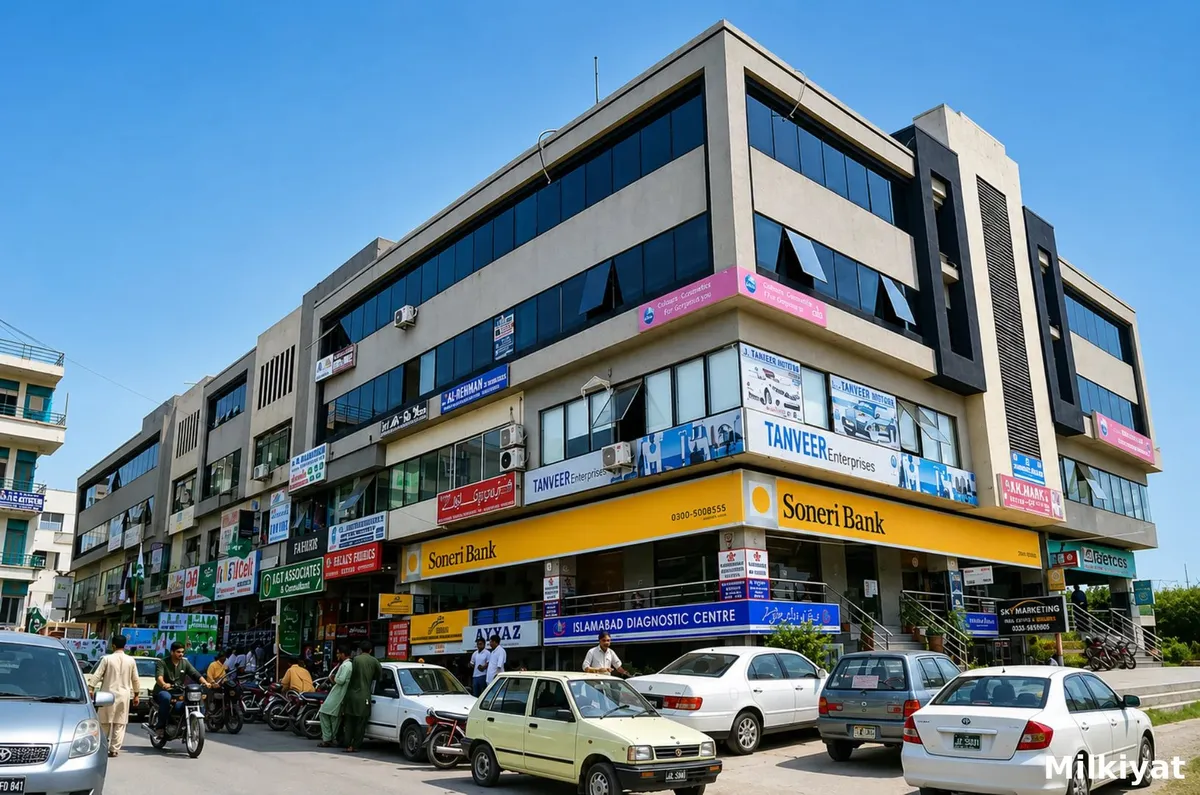
G-10 is one of Islamabad's more established middle-income sectors, sitting along the Kashmir Highway corridor with a mature Markaz that has served its surrounding neighbourhoods for decades. Banks, pharmacies, eateries, and long-running local shops give it a settled commercial rhythm built on repeat, everyday customers rather than destination shopping. For a broader look at the sector's layout, amenities, connectivity, and market character, see our G-10 sector guide.
This article compares the G-10 and G-11 Marakiz, looking at how their development history shapes tenant mix, unit positioning, rental performance, and long-term appreciation for commercial investors. Because a shop's value depends far more on frontage, floor, and footfall than on the sector label, asking prices vary widely within the same market. Browsing current G-10 shops and property listings helps you compare specific units before setting them against G-11.
For investors, that makes the comparison more interesting than a simple G-10 vs G-11 price check. One is a mature, established commercial ecosystem; the other offers a broader and comparatively newer retail environment. The result is two Markaz serving broadly similar customers, but operating with noticeably different commercial economics.
Two Marakiz, Two Different Launch Eras
G-10 and G-11 may sit close to each other on Islamabad's northern commercial belt, but their Markaz tell two very different stories of urban growth.
G-10 is the older commercial story. Developed during Islamabad's earlier sector expansion, the sector has had decades to build a settled customer base around its Markaz. Banks, pharmacies, fast-food outlets, general retailers and long-running local businesses have become part of the everyday rhythm of the surrounding neighbourhood. The sector's location along Kashmir Highway and its connections to neighbouring F-sector and G-sector areas have further strengthened its role as a practical, high-frequency shopping destination. CDA — Capital Development Authority
G-11 represents a later phase of Islamabad's expansion. Its Markaz developed with a broader commercial footprint and a more varied retail environment, creating space for restaurants, clothing outlets, electronics, furniture, services and larger format businesses. Its position between Kashmir Highway and Nazim-ud-Din Road also gives the sector a different movement pattern, with commercial activity drawing from several surrounding sectors. Islamabad Capital Territory Administration
The Commercial Difference Is More Than Age
The real distinction between the two Markaz is maturity versus variety.
G-10's established commercial stock has had years to develop its tenant base. That maturity can work in favour of landlords because businesses that depend heavily on repeat neighbourhood customers have less incentive to relocate once they have built a stable presence. At the same time, the older commercial fabric means that genuinely new, well positioned units are harder to find.
G-11 offers a different proposition. Its comparatively broader commercial environment gives investors more room to choose between different formats and locations from smaller retail units to offices, restaurants and larger commercial spaces. But that wider choice also creates a bigger gap between prime frontage and secondary positioning. A highly visible corner or main-road unit can perform very differently from a unit tucked away on a less active stretch.
That distinction matters when evaluating commercial property. The Markaz name alone does not determine investment quality; frontage, pedestrian movement, floor position, tenant profile and surrounding activity can be just as important. Islamabad's planned-sector structure, maintained through the city's broader development framework, makes these micro-location differences particularly relevant. CDA Islamabad Development & Planning
Two Markaz, Two Investment Personalities
Think of G-10 as the established operator: mature, familiar and deeply woven into the everyday shopping patterns of its surrounding neighbourhoods.
Think of G-11 as the broader-format market: more varied, more spacious and potentially more sensitive to the exact position of a commercial unit within the Markaz.
For an investor, the question therefore isn't simply “Which Markaz is better?” It's about what kind of commercial opportunity you are buying into.
Are you looking for the stability of a mature, established market or the variety and positioning opportunities of a broader commercial centre?
That distinction becomes far more important when the comparison moves beyond headline asking prices to actual shop economics: rental income, occupancy, tenant demand and long term appreciation.
Where the Two Marakiz Sit in Islamabad's Commercial Hierarchy
Dawn's own retrospective coverage of Islamabad's shopping areas has placed G-9 (Karachi Company), G-10, and G-11 Marakiz together in a distinct tier from the city's premium F-sector markets describing them as serving "the middle and working class" in a "less expensive and rather drab environment" compared to the branded, higher footfall commercial strips further north in sectors like F-6, F-7, and F-10. That framing still holds directionally: none of these three G-sector Marakiz compete with F-7's Jinnah Super or F-10 Markaz on rent per square foot or brand tenancy, and none are trying to. Their commercial value proposition is different daily needs convenience for a large, stable residential catchment rather than destination retail.
What Actually Drives Shop Performance Here
Within both Marakiz, sector label matters less to a shop's performance than its position inside the market itself. Ground-floor units facing the main commercial square, and especially corner units with dual road visibility, consistently draw stronger footfall and command firmer rents than interior units or upper-floor offices in the same building a pattern that holds in G-10 and G-11 alike, and in most Marakiz across Islamabad. Basement and ground-floor combinations in larger plazas tend to rent at a premium over standalone upper floors, reflecting easier customer access and better visibility from the street.
Neither Markaz has a published, government verified shop rate index, so any specific per square foot figure quoted by an agent or a listing should be treated as an asking price, not a confirmed market rate. What's consistent across both markets is the gap between a well positioned ground floor corner unit and a comparable interior or upper floor unit that positioning premium is typically far larger than any premium attached to choosing G-10 over G-11 or vice versa.
What This Means for Commercial Buyers and Investors
In G-10, expect a more settled, lower turnover tenant base and less new commercial inventory coming to market a fit for investors prioritising stability over upside. In G-11, the larger, newer Markaz footprint means more variation between top-performing and weaker units, and potentially more room for a well chosen unit to grow into stronger footfall as the sector's residential base matures further a fit for investors willing to do more homework on unit level positioning in exchange for more room to run. In either Markaz, prioritise ground-floor, corner, or main square facing units over interior or upper floor space; the positioning premium consistently outweighs whichever sector label the shop sits under. Treat any circulating rent per square foot figure as a starting point for negotiation, not a fixed benchmark verify recent, comparable, ground floor asking and closed rates directly before committing.
For related coverage of how Islamabad's older sectors are evolving, see Milkiyat's G-6 vs G-7 redevelopment economics piece and the G-9 vs G-10 tenant-profile comparison
Read Next on Milkiyat.com
- G-9 vs G-10 Islamabad: Government vs Private-Sector Tenant Profile
- G-6 vs G-7 Islamabad: Oldest Housing Stock and Redevelopment Economics
- F-10 vs F-11 Islamabad: The Price-Per-Marla Gap and What Explains It
- Browse Commercial for Sale in Islamabad
- Browse Commercial for Rent in Islamabad