Blog
G-6 vs G-7 Islamabad: Oldest Housing Stock and Redevelopment Economics

Blog
Blog
Real Estate Analyst
6 min read
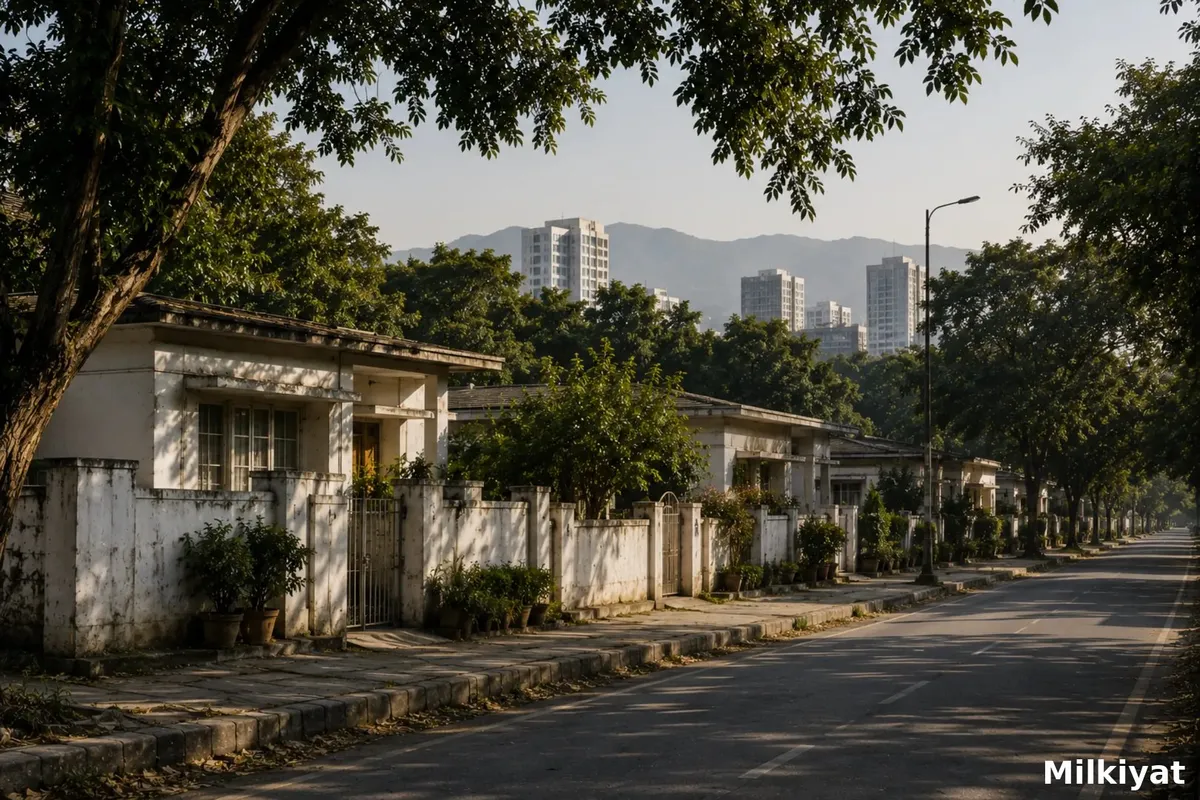
G-6 and G-7 are two of Islamabad's oldest planned sectors, home to some of the capital's earliest government housing — single-storey quarters built for federal secretaries, bureaucrats, and civil servants when the city itself was still young. Today, both sectors are at the center of very different redevelopment conversations. G-6's story is about land economics: how much value is sitting underused beneath low-rise government housing, and who actually controls it. G-7's story is about something harder to put a rupee figure on: what happens to the people living in the sector's margins when redevelopment becomes displacement.
In November 2024, Dawn reported on a Pakistan Institute of Development Economics (PIDE) study that quantified just how much value is locked up in Islamabad's old single-storey government housing. In sub-sector G-6/1 alone, government houses occupy 86 acres of land. The study found that converting this low-density housing into six high-rise buildings could accommodate the same number of residents on roughly 9 acres — freeing up 77 acres of land the study valued at more than PKR 52 billion, and estimated could add around 0.09 percentage points to national GDP if redeveloped and put to productive use.
Real Estate Analyst
6 min read
G-6 and G-7 are two of Islamabad's oldest planned sectors, home to some of the capital's earliest government housing — single-storey quarters built for federal secretaries, bureaucrats, and civil servants when the city itself was still young. Today, both sectors are at the center of very different redevelopment conversations. G-6's story is about land economics: how much value is sitting underused beneath low-rise government housing, and who actually controls it. G-7's story is about something harder to put a rupee figure on: what happens to the people living in the sector's margins when redevelopment becomes displacement.
In November 2024, Dawn reported on a Pakistan Institute of Development Economics (PIDE) study that quantified just how much value is locked up in Islamabad's old single-storey government housing. In sub-sector G-6/1 alone, government houses occupy 86 acres of land. The study found that converting this low-density housing into six high-rise buildings could accommodate the same number of residents on roughly 9 acres — freeing up 77 acres of land the study valued at more than PKR 52 billion, and estimated could add around 0.09 percentage points to national GDP if redeveloped and put to productive use.
That study fed directly into a push by the Special Investment Facilitation Council (SIFC) to replace single-storey government housing across F-6, G-6, and G-7 with high-rise construction — explicitly framed, per Dawn's reporting, as a way to save Islamabad's shrinking land bank rather than continuing to let senior officials occupy spacious single-storey plots, some with servant quarters, on prime urban land.
G-6 isn't a blank slate for this idea — it already tried something similar once, and the results are instructive. In 1998, the federal cabinet under then-Prime Minister Nawaz Sharif approved a redevelopment project intended to replace outdated single-storey government quarters with modern flats. CDA completed 200 residential flats in G-6 by 2003, explicitly meant to shift government employees out of low-rise housing and free up land — the same logic driving today's SIFC push, two decades earlier.
It didn't work as planned. According to Dawn's reporting, the flats fell into illegal occupation over the years, with a majority allegedly held by police personnel — some who moved in after the 2005 earthquake displaced residents elsewhere, more during the 2007 Lal Masjid operation, and many who simply never left. By June 2026, Dawn described the complex as "engulfed in neglect, broken promises and overflowing sewage." When CDA finally moved on the illegal occupants in July 2026, its first operation — backed by police assistance — recovered only 26 of the 200 flats.
A separate, smaller-scale version of the same pattern played out at G-6's Covered Market. In 2007, CDA controversially amended the site's lease terms to allow multi-storey construction; the leaseholder immediately demolished the historic single-storey market. Residents and the Supreme Court pushed back, and CDA was ultimately restrained from finalising the bylaw change — leaving the plot vacant ever since, with a public hearing on the matter only scheduled for June 2026, nearly two decades later.
G-7 shares G-6's basic profile — ageing single-storey government quarters occupying valuable, centrally located land, named in the same SIFC and PIDE discussions as a candidate for vertical redevelopment. But G-7 carries an additional, more difficult redevelopment story that G-6 does not: Allama Iqbal Colony, an informal settlement inside the sector that Dawn's May 2026 reporting described as home to more than 1,000 Christian families, many working in sanitation and municipal services for CDA itself. Around March 2026, red demolition markings appeared on walls throughout the colony with no prior warning or explanation — the same abrupt process residents have faced before.
This is redevelopment economics from the opposite direction. G-6's version is about unlocking underused, formally allotted government land for higher-value use. G-7's version, playing out in the same sector, is about what happens to informal, lower-income residents — many of whom have lived and worked in the area for decades — when a "posh" sector's underlying land becomes valuable enough to reclaim. Dawn's broader reporting on Islamabad's stalled master-plan revision notes that sectors like F-6, F-7, G-7, G-8, and F-8 all saw "mushroom growth" of both legal and illegal housing between 1990 and 2020, as the city's built-up area expanded more than sixfold — from 2,693 to 18,465 hectares — without a matching update to the master plan governing how that growth should be managed.
Neither G-6 nor G-7 functions as an open-market investment sector in the way F- or E-sectors do — most of the housing stock is government-allotted, not privately traded. But the redevelopment economics matter to the wider Islamabad property market in two concrete ways. First, if the SIFC's vertical-construction plan for G-6 and G-7 actually proceeds past the study stage, it would release a meaningful amount of prime, centrally located land — potentially tens of billions of rupees' worth by the PIDE study's own estimate — into some form of new use, which would ripple through demand and pricing in adjacent sectors. Second, G-6's own history with its 2003 flats and its Covered Market shows that Islamabad's redevelopment plans have a documented pattern of stalling badly between approval and delivery — a pattern worth remembering before treating any new redevelopment announcement as a near-term catalyst.
For related coverage of how Islamabad's sector-level legal and land-use structures affect property decisions, see Milkiyat's F-11 vs E-11 comparison of CDA and cooperative-society title
That study fed directly into a push by the Special Investment Facilitation Council (SIFC) to replace single-storey government housing across F-6, G-6, and G-7 with high-rise construction — explicitly framed, per Dawn's reporting, as a way to save Islamabad's shrinking land bank rather than continuing to let senior officials occupy spacious single-storey plots, some with servant quarters, on prime urban land.
G-6 isn't a blank slate for this idea — it already tried something similar once, and the results are instructive. In 1998, the federal cabinet under then-Prime Minister Nawaz Sharif approved a redevelopment project intended to replace outdated single-storey government quarters with modern flats. CDA completed 200 residential flats in G-6 by 2003, explicitly meant to shift government employees out of low-rise housing and free up land — the same logic driving today's SIFC push, two decades earlier.
It didn't work as planned. According to Dawn's reporting, the flats fell into illegal occupation over the years, with a majority allegedly held by police personnel — some who moved in after the 2005 earthquake displaced residents elsewhere, more during the 2007 Lal Masjid operation, and many who simply never left. By June 2026, Dawn described the complex as "engulfed in neglect, broken promises and overflowing sewage." When CDA finally moved on the illegal occupants in July 2026, its first operation — backed by police assistance — recovered only 26 of the 200 flats.
A separate, smaller-scale version of the same pattern played out at G-6's Covered Market. In 2007, CDA controversially amended the site's lease terms to allow multi-storey construction; the leaseholder immediately demolished the historic single-storey market. Residents and the Supreme Court pushed back, and CDA was ultimately restrained from finalising the bylaw change — leaving the plot vacant ever since, with a public hearing on the matter only scheduled for June 2026, nearly two decades later.
G-7 shares G-6's basic profile — ageing single-storey government quarters occupying valuable, centrally located land, named in the same SIFC and PIDE discussions as a candidate for vertical redevelopment. But G-7 carries an additional, more difficult redevelopment story that G-6 does not: Allama Iqbal Colony, an informal settlement inside the sector that Dawn's May 2026 reporting described as home to more than 1,000 Christian families, many working in sanitation and municipal services for CDA itself. Around March 2026, red demolition markings appeared on walls throughout the colony with no prior warning or explanation — the same abrupt process residents have faced before.
This is redevelopment economics from the opposite direction. G-6's version is about unlocking underused, formally allotted government land for higher-value use. G-7's version, playing out in the same sector, is about what happens to informal, lower-income residents — many of whom have lived and worked in the area for decades — when a "posh" sector's underlying land becomes valuable enough to reclaim. Dawn's broader reporting on Islamabad's stalled master-plan revision notes that sectors like F-6, F-7, G-7, G-8, and F-8 all saw "mushroom growth" of both legal and illegal housing between 1990 and 2020, as the city's built-up area expanded more than sixfold — from 2,693 to 18,465 hectares — without a matching update to the master plan governing how that growth should be managed.
Neither G-6 nor G-7 functions as an open-market investment sector in the way F- or E-sectors do — most of the housing stock is government-allotted, not privately traded. But the redevelopment economics matter to the wider Islamabad property market in two concrete ways. First, if the SIFC's vertical-construction plan for G-6 and G-7 actually proceeds past the study stage, it would release a meaningful amount of prime, centrally located land — potentially tens of billions of rupees' worth by the PIDE study's own estimate — into some form of new use, which would ripple through demand and pricing in adjacent sectors. Second, G-6's own history with its 2003 flats and its Covered Market shows that Islamabad's redevelopment plans have a documented pattern of stalling badly between approval and delivery — a pattern worth remembering before treating any new redevelopment announcement as a near-term catalyst.
For related coverage of how Islamabad's sector-level legal and land-use structures affect property decisions, see Milkiyat's F-11 vs E-11 comparison of CDA and cooperative-society title
F-5 is enclosed by four of Islamabad's most significant roads, and each edge sets a different part of its value. This guide maps all four boundaries, corrects the widely repeated claims about F-5 bordering F-7 and G-6, and covers the Margalla Hills access that sits on the sector's own northern boundary road.
F-5 has no metro station of its own, but the Red Line terminus at Pak Secretariat sits on its southern edge. Here is every station, feeder route, fare and timing that matters for commuting into and out of the sector.
Compare Bahria Town Phase 7 and Phase 8 Rawalpindi rental yields, tenant demand, mature sectors, expanding areas and the risks shaping landlord returns.
Airport Green Garden vs Airport Enclave: Compare approval records, NOC status, title checks and key risks before buying property near Islamabad Airport.
F-5 is enclosed by four of Islamabad's most significant roads, and each edge sets a different part of its value. This guide maps all four boundaries, corrects the widely repeated claims about F-5 bordering F-7 and G-6, and covers the Margalla Hills access that sits on the sector's own northern boundary road.
F-5 has no metro station of its own, but the Red Line terminus at Pak Secretariat sits on its southern edge. Here is every station, feeder route, fare and timing that matters for commuting into and out of the sector.
Compare Bahria Town Phase 7 and Phase 8 Rawalpindi rental yields, tenant demand, mature sectors, expanding areas and the risks shaping landlord returns.
Airport Green Garden vs Airport Enclave: Compare approval records, NOC status, title checks and key risks before buying property near Islamabad Airport.