Guide
Guide
A buyer's guide to the LDA Land Use Rules 2020: the ten land use classes, permitted, permissible and prohibited uses, mixed use and peri-urban land, commercialisation and conversion fees, and how to check a plot's land use in Lahore.
What an apartment for sale in E-11 Islamabad costs in 2026: prices by building, sub-sector and size, price per sq ft, 2 bed and 3 bed budgets, maintenance and parking, rental yield, how to verify a flat and the society transfer process.
Buying or selling in Faisal Hills means paying more than the plot price. This guide explains FBR valuation and DC rates, 236K and 236C advance tax, capital gains tax, stamp duty, transfer charges and annual property tax, with worked examples for 5, 8 and 14 marla plots.
West-open plots are the most demanded in DHA Karachi, but direction is only one part of a plot's value. This guide compares west, east, south and north-open plots on breeze, sunlight, design and price, and shows how to check a plot's direction.

Real Estate Analyst
11 min read
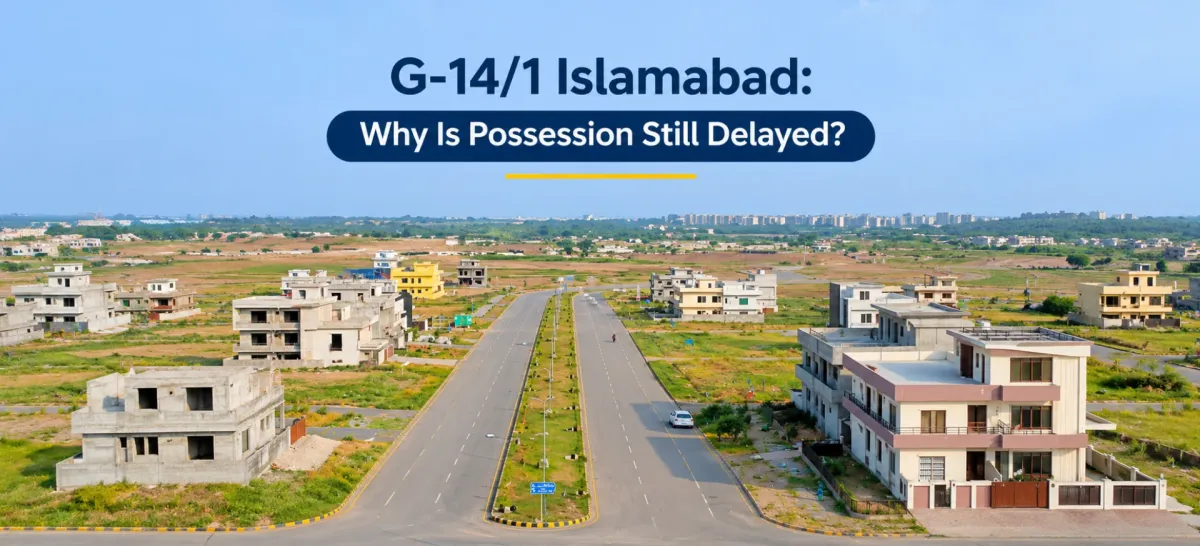
G-14/1 Islamabad is one of the most closely watched yet uncertain residential sub-sectors of G-14. Although plots were allotted years ago, general possession has not been handed over, and unresolved land issues continue to obstruct development. For anyone considering a purchase, this is the first risk to understand.
Buyers browsing plots for sale in G-14 Islamabad should check the exact sub-sector of every advertisement. A plot offered in G-14/4 cannot be compared directly with an allotment in G-14/1, where possession and infrastructure remain unresolved.
The broader G-14 property inventory includes advertisements from different sub-sectors. This guide explains why G-14/1 remains delayed, what the official developments mean and what buyers should verify before making a payment.
G-14/1 is part of Sector G-14, Islamabad, under the Federal Government Employees Housing Authority (FGEHA).
The sector contains four sub-sectors: G-14/1, G-14/2, G-14/3 and G-14/4. However, their development histories differ considerably.
G-14/4 forms part of an established residential area, while G-14/2 and G-14/3 have experienced separate land-clearance and possession processes.
G-14/1 remains affected by occupied land, built-up properties and unresolved development arrangements.
Its location within Islamabad does not guarantee that an individual allotted plot can be occupied or developed.
The main issue is that general plot possession in G-14/1 has not been confirmed as handed over.
In August 2026, the federal government informed the Senate that occupied land in G-14/1 would be vacated after issues involving affected persons and built-up properties were resolved.
The government also described negotiations and other lawful measures being pursued by FGEHA.
In September 2026, housing authorities were directed to accelerate the process for starting development work.
Neither development announced a confirmed general possession date for G-14/1.
An allotment or transfer record does not automatically provide physical possession.
A buyer may legally acquire an interest in a plot but remain unable to construct a house until the necessary land and development conditions are resolved.
Before buying, establish whether the exact plot has been cleared, whether possession has been officially offered and whether construction is permitted.
Do not rely on assurances that possession will arrive within a particular number of months.
Several connected issues explain the long delay.
Parts of the land contain existing structures and occupied properties.
Clearing these areas involves identifying affected persons, addressing compensation and legal claims, and obtaining lawful control of the land.
Development cannot simply proceed as though the site were vacant.
Claims involving original landowners and affected residents have complicated the land-clearance process.
Such issues may involve entitlement, compensation and the status of existing buildings.
Their resolution affects when infrastructure contractors can access particular areas.
A development tender for G-14/1 was floated on June 22, 2023, but was cancelled on November 16, 2023, because the land was not available for possession.
This illustrates an important difference between announcing development work and having land physically available for construction.
A new instruction to expedite tendering does not mean that roads, sewerage or utilities have been completed.
The prolonged delay has affected families who received plot allotments many years ago.
In August 2026, representatives of the G-14 Allottees Welfare Association raised concerns about the absence of development and possession.
The delegation highlighted the difficulties faced by families waiting to use or transfer their allocated property.
Milkiyat covered these concerns in its G-14/1 allottees' demand for possession and development rights.
The demands reflect the practical consequences of delay: uncertain construction plans, additional financial commitments and difficulties faced by heirs of original allottees.
However, a meeting or public demand does not itself establish that possession has been granted.
A buyer should never treat G-14 as one uniform housing market.
| Sub-sector | Development and possession context | Main buyer consideration |
|---|---|---|
| G-14/1 | General possession not handed over | Land clearance and legal risk |
| G-14/2 | Development and completion processes advanced | Verify plot-specific possession |
| G-14/3 | Land clearance and possession processes advanced | Verify current certificate and plot status |
| G-14/4 | Established residential sub-sector | House condition, access and transaction records |
Status reflects the workbook's 2026 development distinctions. No sub-sector-wide statement replaces verification of an individual plot.
G-14/2 and G-14/3 reached important completion-certificate stages in July 2026. Subsequent processes, including plot-specific possession arrangements, must still be checked individually.
G-14/4 offers a more established residential environment.
The existing G-14 sub-sector possession comparison discusses these differences in further detail.
A G-14/1 map helps identify the intended location of a plot, but it does not prove that the land is vacant or ready for construction.
Before purchasing, request the latest applicable layout and verify the plot's position within it.
Important details include the plot number, street, dimensions and proximity to proposed roads or other designated land uses.
An allotment document may identify a plot on a plan, but physical demarcation and site access can depend on land clearance.
If the seller cannot arrange a site inspection, ask for a clear explanation supported by the relevant records.
Avoid accepting an approximate map pin as proof of the plot's physical boundaries.
The buyer should establish whether the map reflects the latest approved layout rather than an outdated marketing illustration.
G-14 plot advertisements use dimensions such as 25×40, 25×50, 30×60 and 40×80 feet.
These measurements are useful for comparing land area, but availability of each size in G-14/1 must be verified.
| Plot category | Dimensions | Area (sq yd) |
|---|---|---|
| 4 marla | 25×40 ft | 111.1 |
| 5 marla | 25×50 ft | 138.9 |
| 8 marla | 30×60 ft | 200 |
| 10 marla | 35×70 ft | 272.2 |
| 14 marla | 40×80 ft | 355.6 |
| 1 kanal | 50×90 ft | 500 |
Calculations use 25 square yards per marla. These are dimensional references, not a claim that every category has active G-14/1 listings.
For example, a 30×60-foot plot contains 1,800 square feet, equivalent to 200 square yards.
The advertised marla label should always be checked against the actual approved dimensions.
The dedicated G-14/1 size-filtered listing destinations are not verified, so the table deliberately does not link to invented inventory pages.
Plots without possession may be advertised below comparable properties in developed sub-sectors.
However, a lower asking price does not necessarily mean better value.
The difference may reflect uncertainty over land clearance, infrastructure development and the time required before construction becomes possible.
The workbook's G-14 Price Index does not establish a verified G-14/1 median from five comparable current observations.
Accordingly, this guide does not invent a size-specific price table.
For sector-wide benchmarks and differences between sub-sectors, consult the G-14 property-price report.
A buyer should consider more than the seller's asking price.
The total commitment may include transfer costs, outstanding dues, taxes and future expenditure related to development or construction.
The amount and responsibility for each charge must be established from current documents.
Never assume that an apparently discounted plot offers an equivalent opportunity to a possession-ready property.
A buyer should identify exactly what the seller owns and what is legally transferable.
Important documents may include the original allotment record, subsequent transfer records, identification and evidence of outstanding payments.
Where an original allottee has died, inheritance documentation may also be relevant.
A private agreement or possession promise should not replace independent verification of official records.
If ownership or transfer eligibility is unclear, obtain appropriate legal advice before paying.
Infrastructure development may involve costs that are not obvious from an advertisement.
Ask whether the seller has paid all applicable amounts and whether additional liabilities remain.
A written agreement should specify who bears any outstanding charges at the time of transfer.
Buyers should also consider the consequences if development takes longer than expected.
Holding a plot for several years may involve an opportunity cost even if no immediate construction expenses arise.
The possibility of future appreciation should not be used to dismiss unresolved legal or possession risks.
G-14/1 should not currently be presented as a generally ready-to-build residential sub-sector.
The lack of confirmed general possession means buyers cannot assume they can begin constructing a house immediately.
Even if nearby areas are developed, an individual G-14/1 plot requires its own possession and construction-permission checks.
Schools, utilities, shops and healthcare access in surrounding sectors may improve the wider location's appeal.
However, nearby facilities do not establish that roads, sewerage, electricity and water connections are available for a particular G-14/1 plot.
A buyer planning a family home should prioritise a realistic construction timeline over general location claims.
G-14/1 may attract buyers interested in long-term property holding who understand the possibility of extended delays.
However, it is less suitable for someone requiring immediate construction, predictable possession or near-term rental income.
| Buyer objective | Suitability concern |
|---|---|
| Build a home immediately | General possession remains unresolved |
| Move within a fixed deadline | Handover timing is uncertain |
| Generate rental income soon | Construction readiness is not established |
| Hold land long-term | Requires tolerance for legal and development risk |
| Purchase an existing allotment | Transfer and title checks are essential |
These considerations are not a recommendation to purchase or avoid a particular plot.
The decision depends on verified documents, affordability and the buyer's ability to tolerate uncertainty.
Use the sector-wide plot inventory linked earlier to identify advertised properties, then verify their exact sub-sector.
The workbook's proposed G-14/1 listing hub and dedicated G-14/1 plot-sale page did not provide usable sub-sector-specific destinations during verification.
They have therefore not been added as functioning internal links.
A G-14 advertisement should not be interpreted as a G-14/1 listing unless its description and supporting documents establish that location.
For broader background, read the G-14 Islamabad area guide.
Milkiyat also has a G-14 real estate agents directory, although it currently displays no agents for the area. Buyers should not treat the existence of a directory as evidence that a particular dealer is verified.
General possession has not been confirmed as handed over. Buyers must verify any claim about an individual plot directly through the applicable authority records.
Built-up properties, occupied land, affected-person claims and related land-clearance issues have delayed development.
No dependable general handover date has been established. Official instructions to accelerate work are not equivalent to a confirmed possession schedule.
A purchase may be possible where the seller holds transferable rights, but ownership, allotment, plot status and outstanding obligations require verification.
Non-possession properties may be advertised at lower prices, but comparable current data is needed to quantify the difference. The legal and development risks are also different.
It should not be assumed ready for construction while general possession and development remain unresolved.
G-14/1 Islamabad remains a high-uncertainty property market because land clearance, development and general possession have not been completed.
Government attention to these issues is important, but it should not be mistaken for a confirmed handover date.
Buyers should verify allotment, transfer eligibility, outstanding charges and the exact plot's status before committing funds.
For anyone planning immediate construction, possession certainty matters more than an attractive asking price.
Last Updated: November 20, 2026