Guide
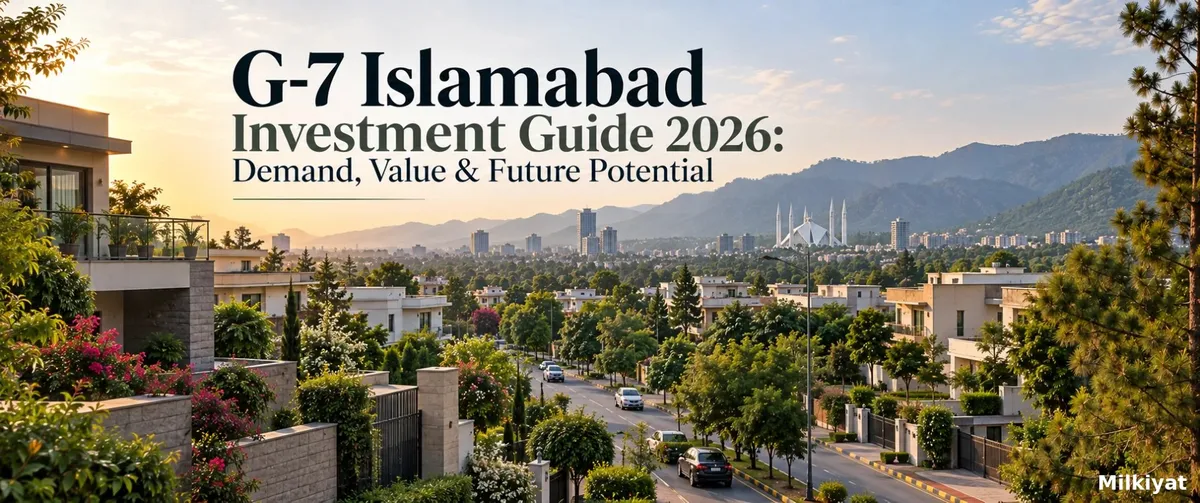
G-7 Islamabad Investment Guide 2026: Demand, Value & Future Potential

By Bibi Masooma
Real Estate AnalystVerified author
12 min read
G-7 occupies an unusual position in Islamabad's property investment landscape. Unlike newer housing societies on the city's expanding outskirts, where investors may benefit from fresh development and new plot releases, G-7 is a mature, built-out sector with very limited vacant land. Its investment profile is therefore shaped more by location, scarcity, established infrastructure and existing demand than by rapid new development.
This G-7 Islamabad Investment Guide 2026 explains what these factors mean for property investors, how G-7 compares with other Islamabad investment options, which factors influence property value and rental demand, and what investors should realistically consider when assessing potential returns.
| Investment Factor | G-7 Position |
|---|---|
| Market Type | Mature, established residential market |
| Land Supply | Very limited vacant residential inventory |
| Main Value Drivers | Location, scarcity and established infrastructure |
| Property Focus | Resale plots, houses and existing properties |
| Investor Consideration | Rental demand, property condition and long-term value |
The Core Investment Case for G-7
Three structural features are particularly important when evaluating G-7 as a property investment location. Unlike developing areas where future land releases and infrastructure can influence prices, G-7's investment profile is largely connected to its established location, limited supply and resale-driven market.
-
Fixed supply. G-7 is a fully established sector with very limited vacant residential land available. The existing stock of plots and houses is therefore relatively constrained, meaning future buyers largely compete for properties already in the market.
-
Central, hard-to-replicate location. G-7's proximity to Blue Area, PIMS Hospital, Jinnah Super Market and other central Islamabad destinations provides an established connectivity advantage. Unlike infrastructure that can be added to a developing society, a centrally positioned location cannot easily be recreated elsewhere.
-
Resale-dominated market. Property activity in G-7 is primarily based on existing properties being sold by private owners. As a result, asking prices and final transaction values can depend heavily on the property's exact location, condition, plot size, road access and negotiations between buyer and seller.
| Investment Feature | What It Means for Investors |
|---|---|
| Limited Supply | Buyers mainly compete for existing properties |
| Central Location | Access to major commercial and institutional areas |
| Resale Market | Property-specific pricing and negotiation are important |
| Established Area | Investment is less dependent on future basic development |
These factors help explain why G-7 should be evaluated differently from newer Islamabad investment locations. Rather than focusing only on future development, investors should examine the quality of the individual property, purchase price, rental potential, redevelopment requirements and surrounding demand.
Rental Demand and Yield Considerations
G-7's central location makes it consistently attractive to tenants working in Blue Area, diplomatic staff, and professionals who prioritize a short commute over larger living space in a peripheral society.
| Property Type | Typical Tenant Profile | Relative Rental Demand |
|---|---|---|
| Renovated 5–10 Marla house | Professionals, small families | High |
| Older, unrenovated house | Budget-conscious tenants, shared occupancy | Moderate |
| Flats/apartments (limited stock) | Single professionals, small households | High relative to limited supply |
| Commercial space (G-7 Markaz) | Retail, offices, clinics | High, see Commercial Guide |
Because rental supply in G-7 is also constrained by the same lack-of-new-construction dynamic that affects sale prices, well-maintained rental units in this sector tend to see comparatively low vacancy periods relative to newer societies still building out their tenant base.
Historical Price Behaviour
Islamabad's property market has moved through distinct phases over the past several years, and G-7's resale-only nature has generally made it less volatile than newer, supply-heavy societies during both up and down cycles.
| Period | Broader Islamabad Market | G-7 Specifically |
|---|---|---|
| 2022–2023 | Strong appreciation across most sectors | Held value well; premium sub-sectors saw solid gains |
| 2024 | Slower activity, higher financing costs | Comparatively resilient due to low supply |
| Early 2025 | Market stabilization | Selective demand for renovated properties continued |
| 2026 | FBR valuation cuts in several sectors; mixed sentiment | Central, walkable sub-sectors (G-7/1, G-7/2) held asking prices better than peripheral comparables |
The pattern that emerges is that G-7 tends to be a "defensive" holding within an Islamabad property portfolio, it may not deliver the sharpest short-term percentage gains seen in a newly launched society during its initial hype phase, but it also tends to lose less value during market slowdowns, precisely because there's no oversupply risk.
G-7 vs Alternative Investment Locations
G-7's investment profile becomes clearer when compared with other Islamabad property markets. The main differences are land supply, development stage, entry cost, liquidity and the source of potential value growth.
| Location | Supply Dynamic | Typical Appreciation Pattern | Liquidity |
|---|---|---|---|
| G-7 | Fixed, very limited new supply | Location and scarcity driven | Moderate, resale focused |
| Newer societies (outskirts) | Ongoing development and new inventory | Can rise quickly during early development phases | Often stronger during launch phases |
| F-6 / F-7 | Fixed, highly limited supply | Location and premium driven | Lower, high entry cost limits buyer pool |
| G-6 | Fixed, established housing stock | Similar central-location dynamics | Similar resale-focused market |
| G-7 Markaz | Very limited commercial supply | More closely linked to rental and business demand | Smaller buyer pool, higher ticket sizes |
Location is an important part of this comparison. Before assessing G-7 purely as an investment, buyers can review our G-7 Islamabad Area Guide 2026: Best Blocks, Location & Access to understand the sector's sub-sectors, surrounding areas, road connections and access to key amenities.
For investors comparing G-7 with newer peripheral societies, the trade-off is mainly between development-stage growth and established-location value. Newer societies may provide lower entry points through payment plans and can experience stronger price movement during early development phases, but they also have continuing inventory that can affect supply and resale conditions. G-7 generally requires a larger upfront purchase and has less dependence on future development, while its established central location provides an existing base of residential and commercial demand.
The comparison should therefore be made at the individual property level. Purchase price, plot size, rental potential, property condition, financing cost and expected holding period can materially change the investment calculation in any location.
Who G-7 Investment Suits Best
G-7's investment profile is more closely linked to established location, limited supply and existing property demand than to rapid development-led appreciation. This makes the sector more relevant for investors who are prepared to evaluate individual properties carefully and hold them over a longer period.
-
Long-term holders who are comfortable with a full-payment purchase may find G-7 relevant for strategies focused on rental income, land value and long-term capital preservation rather than a quick resale. Because many properties have older housing stock, investors should also consider renovation or reconstruction costs when calculating the total investment. Our G-6 vs G-7 Islamabad: Oldest Housing Stock and Redevelopment Economics explains why the plot, existing structure and redevelopment cost can materially change the economics of an older property.
-
Overseas Pakistanis looking for a centrally located property may consider G-7 because most transactions involve existing properties rather than newly launched developer inventory. However, remote buyers should still arrange proper verification of ownership, property records, construction condition and applicable CDA requirements before purchasing.
-
Investors seeking commercial exposure can also examine G-7 Markaz, where the investment calculation is more closely connected to commercial activity, rental demand, location and the property's use. Commercial property typically requires a different assessment from residential plots and houses because rental income and operating costs become more important.
G-7 may therefore be more relevant to investors focused on established-location property and longer holding periods than to buyers whose strategy depends primarily on short-term, developer-driven price movements. The actual suitability of any property still depends on its purchase price, condition, rental potential, financing cost and expected holding period.
Risk Factors to Weigh
| Risk | Why It Matters in G-7 |
|---|---|
| High entry cost | Full-payment, resale-only structure means no financing flexibility from a developer |
| Renovation/rebuild costs | Older structures may need significant capital investment before they command top rental or resale value |
| Limited new comparables | Price discovery can be harder given lower transaction volume than newer societies |
| Documentation verification | Older resale properties carry more history, chain of ownership and transfer records need careful verification |
| FBR valuation changes | Periodic revisions to official valuation tables affect transfer tax costs, which factor into total investment cost |
The Future Potential Angle
Because G-7 cannot expand physically in the same way as newer housing societies, its future property value is closely connected to how central Islamabad's commercial activity, connectivity and residential demand evolve. The sector's limited land supply means that changes in the surrounding urban environment can have a direct influence on its long-term investment profile.
Continued development of Blue Area and other central commercial zones could support demand for nearby established residential sectors such as G-7. Likewise, improvements to major transport corridors and public-transport connectivity can make centrally located neighbourhoods more accessible to residents, workers and businesses.
Another factor is overseas Pakistani investment. The State Bank of Pakistan's Roshan Digital Account (RDA) allows eligible non-resident Pakistanis to invest in residential and commercial real estate in Pakistan, including existing properties and land. This provides an established channel through which overseas buyers can participate in the country's property market. (State Bank of Pakistan)
| Future Factor | Potential Relevance to G-7 |
|---|---|
| Blue Area growth | May support demand for nearby residential property |
| Transport connectivity | Better access can strengthen the appeal of central locations |
| Limited land supply | Keeps the existing property stock relatively constrained |
| Overseas investment | RDA provides eligible NRPs a channel to invest in Pakistani real estate |
| Centralisation / decentralisation | Changes in commercial and government activity could affect locational demand |
However, G-7's location does not guarantee future price appreciation. If commercial activity, major offices or employment centres gradually shift away from the traditional central districts, some of the sector's location premium could face pressure. Investors should therefore monitor urban development, transport infrastructure, commercial activity, rental demand and regulatory changes rather than assuming that scarcity alone will determine future returns.
For overseas investors specifically, SBP's Roshan Apna Ghar also provides a framework for eligible NRPs to purchase, build or renovate property in Pakistan through digital channels. (SBP Roshan Apna Ghar)
The future investment case for G-7 is therefore primarily about maintaining the value of a scarce central location, rather than expecting the sector itself to expand. Its performance will depend on whether Islamabad's central areas continue to attract residents, businesses and investment over the long term.
Bottom Line for Investors
G-7 is best understood as a scarcity play rather than a growth play. It offers a defensible, centrally located asset with consistent rental demand and historically resilient pricing, at the cost of a higher entry ticket, full-cash transactions, and more limited liquidity than newer societies. Investors who value stability and location durability over rapid short-term appreciation are generally better matched to what G-7 offers than those chasing the fastest possible capital gain.
Frequently Asked Questions About G-7 Islamabad Investment 2026
1. Is G-7 Islamabad a developed area for property investment?
Yes. G-7 is an established CDA-developed sector with mature infrastructure, existing residential properties and access to central Islamabad's major commercial and administrative areas.
2. Why do investors consider G-7 Islamabad?
G-7's central location, limited vacant land, established infrastructure and proximity to areas such as Blue Area and Jinnah Super Market are important factors when evaluating its investment potential.
3. What types of property are available in G-7?
The market mainly consists of residential plots, houses and other existing properties. Investors should assess each property according to its location, size, construction condition and potential use.
4. Does G-7 have strong property demand?
Demand can vary by property type and exact location. Centrally positioned properties with good road access and established surroundings may attract both end-users and investors, but demand should be assessed at the individual-property level.
5. What factors affect G-7 property values?
Key factors include plot size, exact location, road width, corner position, accessibility, construction quality, surrounding development and proximity to commercial areas.
6. Is G-7 suitable for long-term property investment?
G-7's established location and limited supply of vacant residential land are relevant factors for long-term investors. However, future returns depend on the purchase price, property type, holding period and broader market conditions.
7. Can older houses in G-7 have redevelopment potential?
Some older properties may have redevelopment or reconstruction potential, depending on the plot, applicable regulations, building condition and permissible use. Investors should verify current CDA requirements before assuming that redevelopment will be possible.
8. How does G-7 compare with newer Islamabad sectors?
G-7 is a mature, centrally located sector where investors generally purchase existing properties. Newer sectors may offer more development-stage inventory, while G-7's investment case is more closely connected to established location, existing infrastructure and limited land supply.
9. What should investors verify before buying in G-7?
Investors should verify ownership, CDA records, plot dimensions, land use, building approvals, outstanding dues and other relevant documentation before completing a transaction.
10. What is the future potential of G-7 Islamabad?
G-7's future property performance will depend on factors such as central city demand, infrastructure, redevelopment activity, regulations and broader Islamabad market conditions. Its established location and limited land availability are important factors to monitor, but they do not guarantee a particular future return.
This guide is for general informational purposes and does not constitute financial or investment advice. Property markets carry risk, and past price behaviour does not guarantee future performance, readers should conduct independent due diligence or consult a qualified financial advisor before investing.