Blog
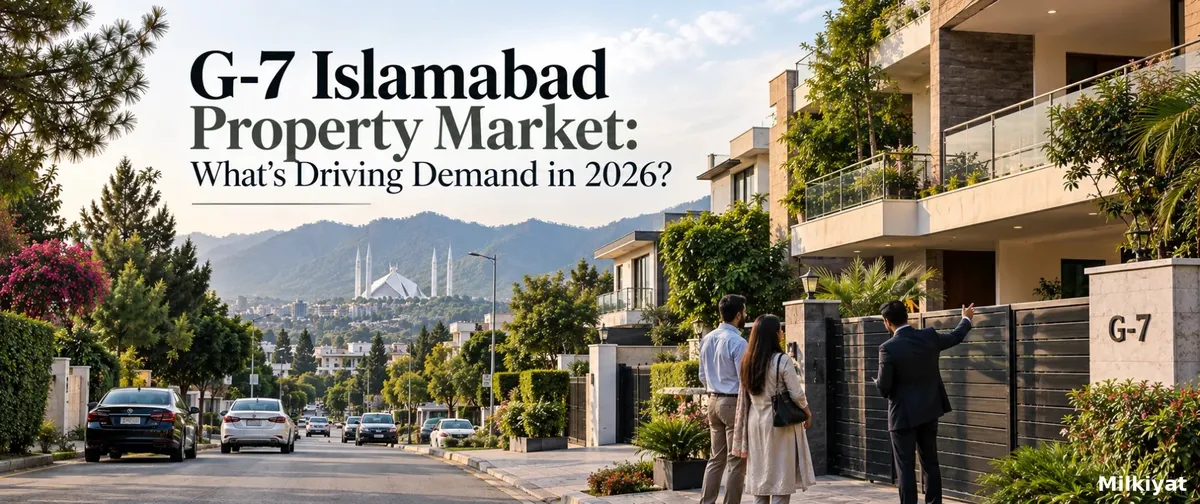
G-7 Islamabad Property Market: What’s Driving Demand in 2026?

By Bibi Masooma
Real Estate AnalystVerified author
Updated 12 min read
G-7 Islamabad property demand in 2026 is closely linked to its central location, established infrastructure, limited supply and access to major commercial and residential areas. Unlike newer housing societies that often rely on new launches and development activity to attract buyers, G-7 is a mature sector where demand is primarily connected to existing housing, accessibility and the appeal of living in central Islamabad.
This guide examines what is driving demand for G-7 property in 2026, who is buying residential and commercial properties, why the sector continues to attract end-users and investors, and which factors could influence its property market in the years ahead.
G-7 is one of Islamabad's original, centrally located sectors, close to Jinnah Avenue, Blue Area, and the city's main healthcare and diplomatic areas, with established streets, mature infrastructure, and a busy Markaz serving the neighbourhoods around it. Because it is fully built out, almost every property that changes hands is a resale, and limited supply shapes the market as much as demand does. For a broader look at the sector's layout, sub-sectors, amenities, and market character, see our G-7 sector guide.
This article looks at what is driving demand for G-7 property in 2026, from its central location and overseas investment interest to scarce resale inventory, rebuilt housing, and spillover from Blue Area. With so few listings available at any time, the condition and position of each property matter more than any sector-wide trend. Browsing current G-7 houses and plots for sale gives you a sense of what the market is actually offering before you weigh the factors below.
Demand Driver Why It Matters in G-7 Central Location Provides access to Blue Area and other key parts of Islamabad Established Infrastructure Residents can access existing roads, utilities and amenities Limited Supply Most properties are existing resale stock rather than new inventory Rental Demand Central location can support demand from different tenant groups Commercial Activity G-7 Markaz serves surrounding residential and business needs
The Short Version
Demand for G-7 Islamabad property in 2026 is being supported by several structural factors rather than a single market event. The sector's central location, established infrastructure and limited supply of existing properties give it a different market profile from newer areas where demand is often linked to fresh launches and ongoing development. For current pricing context, see our G-7 Islamabad Property Prices 2026: What Buyers Need to Know.
Five factors are particularly relevant: G-7's central location, overseas Pakistani investment in Islamabad property, limited comparable resale inventory, interest in renovated or rebuilt houses, and commercial activity linked to nearby Blue Area. Together, these factors help explain why G-7 continues to attract attention from both end-users and investors.
| Demand Driver | How It Supports G-7 Demand |
|---|---|
| Central Location | Keeps major commercial, administrative and residential areas within relatively easy reach |
| Overseas Investment | Eligible overseas Pakistanis can invest in Pakistani property through channels such as Roshan Digital Account |
| Limited Resale Supply | Buyers mainly compete for existing plots and houses rather than newly released inventory |
| Renovated & Rebuilt Homes | Older properties can attract buyers looking for upgraded housing in an established location |
| Blue Area Spillover | Nearby commercial activity supports demand for surrounding residential and commercial property |
These factors should not be interpreted as a guarantee of price growth. G-7 remains a property-by-property market, where exact location, plot size, construction quality, purchase price, rental potential and documentation can significantly influence the outcome. The combination of established demand and limited supply simply gives the sector a different set of market dynamics from developing areas of Islamabad.
Driver 1: Location That Can't Be Replicated
Location is one of the strongest structural drivers of G-7 Islamabad property demand in 2026. G-7 sits close to Jinnah Avenue, Blue Area, Kashmir Highway and PIMS Hospital, while the Diplomatic Enclave is also within a short drive. This central position gives residents convenient access to Islamabad's established commercial, healthcare and diplomatic areas.
Unlike newer housing societies on the city's outskirts, G-7 has a location advantage that cannot easily be recreated through new development. Buyers seeking central Islamabad therefore compete for existing G-7 properties rather than relying on a large supply of newly launched plots and houses. For a detailed look at the sector's location and connectivity, see our G-7 Islamabad Area Guide 2026: Best Blocks, Location & Access.
Driver 2: Diaspora Investment Inflows
Overseas Pakistani investment into domestic real estate has remained a meaningful demand source throughout 2026, supported in part by continued growth in formal investment channels like the State Bank of Pakistan's Roshan Digital Account (RDA) scheme, which has seen cumulative inflows climb past $13.9 billion by August 2026. While RDA funds flow into a mix of certificates, equities, and direct property-related spending, a portion of this diaspora capital consistently finds its way into established, centrally located residential sectors like G-7, properties that overseas buyers view as easier to rent out reliably and less exposed to the supply risk of a still-developing society.
| Demand Source | Relevance to G-7 |
|---|---|
| Diaspora/RDA-linked investment | Favors low-risk, centrally located, easily rentable property |
| Local upgrader buyers | Moving from smaller/peripheral homes to centrally located G-sectors |
| Business owners | Seeking G-7 Markaz proximity for commercial convenience |
| Long-term family holdings | Multi-generational ownership, low sale frequency |
Driver 3: A Persistent Shortage of Comparable Inventory
Because G-7 cannot expand and because turnover is inherently lower in a resale-only market, the number of listings available at any given time is small relative to demand. Active listing counts for G-7 on major property portals typically number in the single digits to low double digits at any point, a stark contrast to the hundreds of active listings routinely seen in newer, still-developing societies. This scarcity is arguably the single biggest reason G-7 pricing has proven resilient: there simply isn't enough supply coming to market to meaningfully soften prices, even during periods when broader buyer sentiment cools.
Driver 4: Renewed Interest in Renovated and Rebuilt Housing
A noticeable trend across 2025 and into 2026 has been growing buyer preference for G-7 properties that have been demolished and rebuilt, or substantially renovated, over original 1970s–80s-era construction. Buyers are increasingly willing to pay a significant premium for modern wiring, updated plumbing, contemporary layouts, and better insulation, while original, unrenovated structures on comparable plots have seen comparatively slower price growth. This has effectively created two distinct price tiers within the same sub-sector, and sellers holding older structures are increasingly weighing the cost of a pre-sale renovation against simply pricing in a discount.
| Housing Condition | Buyer Demand (2026) | Typical Price Position |
|---|---|---|
| Rebuilt / substantially renovated | High | Premium tier |
| Well-maintained original construction | Moderate | Mid tier |
| Original, unrenovated, older construction | Lower, price-sensitive buyers only | Discounted tier |
Driver 5: Spillover Commercial Demand from Blue Area
G-7 Markaz has benefited from businesses priced out of, or unable to find space in, Blue Area proper, particularly food and beverage outlets, professional services firms, and clinics that want proximity to the commercial core without paying Blue Area-level rents. This spillover effect has kept commercial occupancy in G-7 Markaz relatively strong through 2026, which in turn supports overall sector desirability for residential buyers who value having services nearby.
What's Different About 2026 Specifically
A few developments this year have added texture to the broader G-7 demand story:
- FBR's valuation revision. The Federal Board of Revenue's mid-2026 decision to cut official property valuations by 10 to 30 percent across several Islamabad sectors reduced the tax base for transactions, which has made recorded transfer costs somewhat more manageable, even though it doesn't necessarily reflect a fall in actual market asking prices.
- Continued monsoon-related infrastructure strain. Islamabad's recurring drainage and waterlogging issues this monsoon season have kept infrastructure resilience on buyers' minds citywide, and centrally located, well-established sectors like G-7, with mature drainage infrastructure relative to some newer, still-developing societies, have benefited somewhat from this comparison, even though G-7 has not been immune to city-wide rain events.
- The CDA-JICA Master Plan announcement. News of the long-term Water Supply, Sewerage and Drainage Master Plan through 2050 has drawn attention to infrastructure planning citywide, reinforcing the perception that established sectors with existing infrastructure carry less long-term uncertainty than newer developments still awaiting full build-out.
G-7 Against the Broader Islamabad Market
| Factor | Broader Islamabad Market (2026) | G-7 Specifically |
|---|---|---|
| New supply | Continuous, across multiple new societies | None, fully built out |
| Price volatility | Higher in newer/peripheral societies | Lower, more resilient |
| Buyer financing | Developer payment plans common | Full cash typical |
| Rental demand | Variable by location | Consistently strong given centrality |
| Commercial activity | Growing across multiple hubs | Steady, boosted by Blue Area spillover |
What Could Change the Picture
No demand story is permanent, and a few factors could shift G-7's trajectory over time. A significant decentralization of government or commercial activity away from Blue Area would reduce some of G-7's locational premium. Continued interest rate pressure or a broader economic slowdown could dampen the pool of buyers able to transact in cash, which is the norm in this resale-only market. And any acceleration in renovation costs (materials, labour) could widen the price gap between rebuilt and original-condition housing stock even further, potentially pricing some buyers out of the premium tier entirely.
Outlook
Barring a major structural shift in Islamabad's commercial geography, G-7's core demand drivers central location, limited supply and overseas Pakistani investment interest are likely to remain relevant through the rest of 2026. The State Bank of Pakistan's Roshan Apna Ghar programme allows eligible overseas Pakistanis to purchase, build or renovate property in Pakistan through digital channels, providing an established route for diaspora participation in the real estate market. State Bank of Pakistan Roshan Apna Ghar
G-7 is unlikely to follow the same development-driven cycle as newly launched societies because its available land and existing property stock are more constrained. For buyers and investors, this makes location, scarcity, property condition, rental demand and purchase price important factors when assessing the sector's long-term outlook.
Frequently Asked Questions About G-7 Islamabad Property Market 2026
1. What is driving demand for property in G-7 Islamabad in 2026?
Demand is influenced by G-7's central location, established infrastructure, limited property supply and proximity to major commercial and institutional areas. Its position within Islamabad's original planned grid also keeps it connected to surrounding sectors and major roads. CDA describes Islamabad as a planned grid-based city divided into sectoral neighbourhoods.
2. Why is G-7 considered a mature property market?
G-7 is an established CDA sector with existing residential properties and infrastructure rather than a newly launched development. Most transactions involve existing plots and houses, with CDA maintaining ownership and transfer records for residential properties.
3. Does limited land supply affect G-7 property demand?
Limited supply is an important market characteristic because buyers generally compete for existing properties rather than a continuous supply of newly released residential plots. This makes the exact location, plot size, property condition and asking price particularly important when evaluating a purchase.
4. Is G-7's location a major demand driver?
Yes. G-7's central position provides access to established commercial, healthcare, residential and administrative areas. Its surrounding road network and proximity to central Islamabad are important factors when assessing residential and commercial demand.
5. What types of properties are in demand in G-7?
The market includes residential plots, houses and commercial properties. Demand can differ according to property size, location, condition, rental potential and intended use, so market activity should not be treated as uniform across the entire sector.
6. Is G-7 suitable for rental property?
G-7's established location and access to central Islamabad can support rental demand, but rental performance depends on the property type, rent level, condition, parking, exact location and tenant profile. Investors should calculate rental yield using actual achievable rent and total ownership costs.
7. What role does G-7 Markaz play in the property market?
G-7 Markaz serves the commercial needs of the surrounding residential population. Commercial property values can depend on visibility, frontage, floor level, accessibility, business activity and rental demand, making commercial and residential investment calculations different.
8. Are there any current CDA developments relevant to G-7?
CDA has continued infrastructure and urban-management activity in G-7 during 2026. For example, CDA reported an operation in March 2026 to clear encroachments from land designated as a public park adjacent to Khadda Market in G-7. CDA also approved rental arrangements for a Business Facilitation Center in G-7/2, with a 10% annual rent increment specified in the decision.
9. What should buyers check before purchasing property in G-7?
Buyers should verify ownership, transfer status, outstanding dues, approved land use, building approvals, sanctioned area and other relevant records. CDA's Property Verification Service specifically highlights checks relating to ownership, mortgages, planning specifications and building completion requirements.
10. Can G-7 property prices rise in the future?
Future prices will depend on factors including demand, supply, rental conditions, infrastructure, economic conditions and broader Islamabad property-market trends. Limited supply can be relevant, but it does not guarantee a particular future return.
11. How does G-7 compare with newer Islamabad sectors?
G-7 is an established, resale-oriented market, while newer sectors may have ongoing development and new inventory. The two market types therefore have different supply structures, entry conditions and risk factors.
12. What is the biggest factor to consider when buying in G-7?
The individual property's location and condition are crucial. Buyers should look beyond the sector name and compare the exact street, plot dimensions, road width, construction quality, accessibility, documentation and purchase price before making a decision.
This piece reflects general market observation and publicly available data as of September 2026. It is intended for informational purposes and does not constitute investment advice.