Guide
G-7 Islamabad Property Prices 2026: What Buyers Need to Know

By Bibi Masooma
Real Estate AnalystVerified author
13 min read
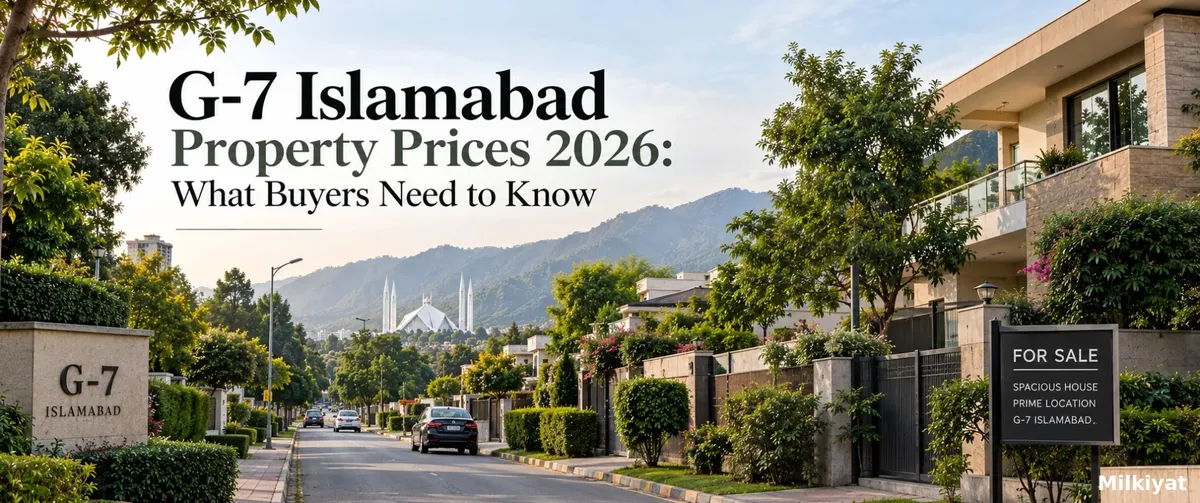
G-7 is one of Islamabad’s oldest and most centrally located residential sectors, positioned between Blue Area and the Margalla Hills, with Jinnah Super Market within easy reach and the Diplomatic Enclave just a short drive away. Developed decades before many of Islamabad’s newer G- and E-sectors, G-7 has very limited vacant land available today. As a result, most property transactions involve resale plots, constructed houses, or existing residential properties. This limited supply is one of the key factors shaping G-7 Islamabad property prices in 2026.
| G-7 Property Market Factor | What It Means for Buyers |
|---|---|
| Central Location | Easy access to Blue Area, Jinnah Super Market and key city areas |
| Limited Vacant Land | Most available properties are resale plots or built houses |
| Mature Development | Established roads, utilities and surrounding neighbourhood |
| Property Type | Prices vary by plot size, construction and exact location |
This guide explains G-7 property prices in 2026, how values differ across its four sub-sectors, why buyers may pay a premium compared with surrounding areas, and what to check before making an offer.
Why G-7 Is Priced the Way It Is
Unlike housing societies on Islamabad's expanding periphery, where developers release fresh inventory in phases and prices are partly set by payment plans, G-7 is a built-out sector. The Capital Development Authority (CDA) developed the sector decades ago, and today the market is largely made up of existing properties changing hands between private owners.
This makes G-7's property market different from newer areas where buyers can choose between fresh plots, early development-stage inventory and developer-backed payment plans. In G-7, buyers are generally purchasing an existing plot, house or established property, so factors such as exact location, street width, plot dimensions, construction quality, corner position and accessibility can significantly affect the asking price.
| Factor | Impact on G-7 Prices |
|---|---|
| Limited vacant land | Keeps the supply of available properties restricted |
| Central location | Adds value through easy access to key areas |
| Established infrastructure | Supports demand for ready-to-use properties |
| Property condition | Construction quality and age can change the price considerably |
Another important factor is limited supply. Because G-7 is an established sector, there is far less scope for a continuous release of new residential inventory compared with developing parts of Islamabad. When a well-located property comes onto the market, its price can therefore reflect not only the land itself but also the value of being in a mature and centrally located part of the capital.
For buyers, however, limited supply does not mean that every G-7 property has the same value. Prices can vary considerably between G-7/1, G-7/2, G-7/3 and G-7/4, depending on the property's exact position and characteristics. Buyers should therefore compare individual properties rather than relying only on an average sector-wide price. Before making an offer, it is also important to verify a property's location before paying a token and check ownership, property records and relevant CDA details.
The key point is simple: G-7 is priced as an established, limited-supply market rather than a newly launched housing development. This distinction helps explain why location, property condition and exact plot characteristics matter so much when comparing property prices in the sector.
This has three consequences for pricing:
- No installment plans. Because there's no developer selling on a payment schedule, the overwhelming majority of G-7 deals are full cash-on-transfer, which raises the effective entry ticket compared to a society where a buyer can spread payments over 2–3 years.
- Location premium dominates. Since the land itself isn't new, what buyers are really paying for is proximity, to Blue Area's commercial core, to Jinnah Super, to embassies and government offices, and to the Margalla foothills.
- Limited comparables. Because turnover is lower than in newer sectors, price discovery relies heavily on a handful of recent resale transactions and active listings rather than a large, liquid market.
Current Price Ranges by Plot Size
Prices in G-7 vary widely depending on plot size, sub-sector, street width, and whether the house is old construction, renovated, or rebuilt. The table below reflects the broad ranges currently being quoted and transacted across G-7 in 2026.
| Plot Size | Typical Price Range (PKR) | Notes |
|---|---|---|
| 5 Marla | 3.5 crore – 15 crore | Wide range depending on street/corner location and construction age |
| 7 Marla | 4 crore – 5.1 crore | Less common size in G-7; fewer comparables |
| 10 Marla | 5.6 crore – 38 crore | Highest variance; includes both old bungalows and rebuilt luxury homes |
| 1 Kanal | 11 crore – 25 crore | Premium end of the residential market |
| Commercial plots | Priced per square foot, see Commercial Guide | Concentrated around G-7 Markaz |
The spread within each size category is unusually wide for Islamabad, and that's a direct result of G-7 being an old, resale-only market: a 5 Marla house that has been demolished and rebuilt with modern finishes can sell for several times what a 40-year-old original structure on the same street size commands.
Price Comparison Across G-7 Sub-Sectors
G-7 is internally divided into four numbered sub-sectors G-7/1, G-7/2, G-7/3, and G-7/4 and each has a slightly different character and price position. Because G-7 is a mature sector with older housing stock and limited new land supply, property values are influenced heavily by the exact street, plot size, road width, construction condition and proximity to commercial areas.
This is also why buyers should not judge a property only by its asking price. In older sectors such as G-7, the value of the underlying plot and the cost of renovating or rebuilding an existing house can be just as important. For more context on how older housing stock affects land value and redevelopment costs, see our guide on G-6 vs G-7 Islamabad: Oldest Housing Stock and Redevelopment Economics.
| Sub-Sector | General Character | What Can Affect Price |
|---|---|---|
| G-7/1 | Established residential area | Street location, plot size and house condition |
| G-7/2 | Mature residential neighbourhood | Road access, construction and plot characteristics |
| G-7/3 | Residential area with stronger access to nearby amenities | Location, accessibility and surrounding activity |
| G-7/4 | Established residential sub-sector | Plot position, road width and existing construction |
These differences do not mean that one sub-sector always has higher prices than another. A well-located property in one part of G-7 can command a higher price than a larger but less strategically positioned property elsewhere. Buyers should therefore compare plot size, exact location, construction condition, access and redevelopment requirements before deciding whether an asking price is reasonable.
For older houses, the calculation should also include potential renovation, demolition and reconstruction costs. A property with a lower asking price may require significantly more work, while a well-maintained house in a better-positioned street may carry a higher upfront price but require less immediate investment.
How G-7 Compares to Neighbouring Sectors
Because G-7 sits between the F-sectors (F-6, F-7) and G-6, it's frequently cross-shopped against both. Here's roughly how it stacks up.
| Sector | Positioning vs G-7 | Typical Buyer Profile |
|---|---|---|
| F-6 / F-7 | Priced noticeably higher; considered Islamabad's most premium residential zone | High-net-worth buyers, diplomats, senior executives |
| G-6 | Broadly comparable, slightly more commercial character in places | Similar profile to G-7 buyers |
| G-8 / G-9 | Generally more affordable, further from the diplomatic core | Mid-market families, first-time buyers |
| E-7 | Premium plots, valued around Rs. 225,000 per square yard by FBR benchmarks | Ultra-high-end buyers |
G-7's position is essentially "premium but not the most premium", it trades at a discount to F-6/F-7 but at a meaningful premium to most G-sectors further from the city centre.
Recent Price Trend
Islamabad's residential property market has experienced a mixed trend in recent years, with periods of price appreciation alongside changes in taxation and official property valuations. The Federal Board of Revenue (FBR) periodically revises its valuation tables for Islamabad, which are used for determining the fair market value of immovable property for tax purposes and can affect the tax calculations associated with property transactions.
In February 2026, FBR issued S.R.O. 163(I)/2026, revising the fair market values of immovable properties in Islamabad. The notification also specified separate valuation treatment for residential and commercial properties and different rates for built-up structures based on their age.
These official valuations should not automatically be treated as a direct measure of current market asking prices. A property's actual market value can differ depending on its location, plot size, condition, road access and buyer demand. For G-7, this distinction is particularly important because properties are largely traded in an established resale market.
| Price Indicator | What It Shows |
|---|---|
| FBR Valuation | Official value used for tax purposes |
| Market Asking Price | Price requested by the property owner |
| Transaction Price | Price ultimately agreed between buyer and seller |
For the latest official figures and notifications, buyers can check the FBR Islamabad Immovable Property Valuation records before evaluating the tax implications of a property transaction.
| Period | General Market Direction | Key Driver |
|---|---|---|
| 2022–2023 | Gradual appreciation | Post-pandemic demand recovery, remittance inflows |
| 2024 | Slower growth, more cautious buyers | Interest rate environment, economic uncertainty |
| Early 2025 | Stabilization | Improved macroeconomic sentiment |
| 2026 (to date) | Selective appreciation in central sectors like G-7; FBR valuation cuts in several zones | Continued diaspora investment (including RDA-linked inflows), tax policy adjustments |
The practical takeaway: prices in a resale-only, centrally located sector like G-7 tend to be stickier than in newer, supply-heavy societies. Sellers with well-located, renovated properties have generally held their asking prices even through periods when the broader market cooled.
What Actually Moves the Price on a Specific Plot
Beyond the broad ranges above, four factors do most of the work in explaining why two similarly sized G-7 plots can differ in price by 50 percent or more:
- Street width and corner position. Corner plots and those on wider streets command a clear premium.
- Construction age and condition. A demolished-and-rebuilt structure with modern wiring, plumbing, and finishes sells for substantially more than an original 1970s–80s-era house of the same footprint.
- Facing and orientation. Park-facing or open-front plots are valued higher than interior, boxed-in plots.
- Documentation and transfer history. Clean CDA transfer records with no pending dues or disputes reduce buyer risk and support a stronger asking price.
Commercial Price Reference Point
While this guide focuses on residential pricing, it's worth noting that commercial superstructure valuations across Islamabad, relevant to G-7 Markaz, were set by FBR at Rs. 2,500 per square foot for buildings up to five years old, and Rs. 1,200 per square foot for older buildings, following the 2026 valuation revision. These are official benchmark rates used for tax purposes; actual market rental and sale rates in an active commercial hub like G-7 Markaz typically run well above these floors. A dedicated breakdown of G-7 Markaz commercial pricing is covered in the companion commercial guide.
Practical Due Diligence Before You Buy
- Verify CDA transfer file and NOC status directly, rather than relying solely on agent-provided documents.
- Cross-check the asking price against at least 3–4 recent comparable sales in the same sub-sector, not just active listings, since asking prices and closed prices can diverge significantly in a low-liquidity market.
- Confirm whether the structure requires demolition and rebuild, and price that cost into your total budget, it can materially change the economics of an otherwise attractive deal.
- Ask about outstanding utility dues, property tax, and any pending CDA notices before finalizing.
Bottom Line for Buyers
G-7 remains one of Islamabad's most centrally positioned and reliably in-demand residential sectors, but its resale-only, low-turnover nature means pricing is less standardized than in newer societies. Buyers who do the work of comparing recent actual transactions, not just listing prices, and who budget realistically for renovation or rebuild costs on older structures are in the best position to negotiate fairly and avoid overpaying for location alone.
Frequently Asked Questions
1. What is the property price trend in G-7 Islamabad in 2026?
G-7 remains an established residential market where prices vary according to plot size, exact location, construction condition, road access and property type. Buyers should compare individual properties rather than rely on a single sector-wide average.
2. Why is property expensive in G-7 Islamabad?
G-7 benefits from its central location, established infrastructure, limited vacant land and proximity to major commercial and administrative areas. Since it is a mature sector, most available properties are resale properties rather than newly released plots.
3. Which G-7 sub-sector is better for buying property?
G-7/1, G-7/2, G-7/3 and G-7/4 have different locations and property characteristics. Property prices can vary within each sub-sector, so buyers should compare the exact plot location, size, road width, construction and surrounding development.
4. Are G-7 property prices based on FBR valuations?
Not exactly. FBR valuation tables are official values used for tax purposes, while the actual market price is determined by the buyer and seller and can differ considerably. FBR has issued and amended Islamabad property valuation notifications during 2026.
5. Does an FBR valuation increase mean G-7 property prices have increased?
Not necessarily. FBR valuations and actual market prices serve different purposes. A change in the official valuation can affect the tax calculation for a transaction without meaning that every property in G-7 has increased by the same percentage.
6. Is G-7 suitable for buyers looking for an old house?
G-7 has a mature housing stock, so buyers can find older constructed properties. However, the purchase decision should account for the building's condition, renovation requirements, plot value and potential reconstruction costs.
7. What should I check before buying property in G-7?
Buyers should verify ownership, property records, plot dimensions, approved use, outstanding dues, mortgages and other relevant documentation. CDA's Initial Property Verification Service can help buyers check property records before proceeding with a transaction.
8. Why do two properties of the same size have different prices in G-7?
The price can change because of street location, road width, corner position, facing, construction quality, accessibility and proximity to commercial areas. Plot size alone is therefore not enough to determine the value of a G-7 property.
9. Is G-7 a developed sector?
Yes. G-7 is an established CDA-developed sector rather than a newly launched housing society. Buyers are generally dealing with existing properties and an established neighbourhood rather than early-stage development inventory.
10. Should buyers compare G-7 with G-6?
Yes. G-6 and G-7 are both mature central Islamabad sectors, and comparing their housing stock, location and redevelopment economics can provide useful context when evaluating property values.
This guide reflects prevailing market ranges and publicly available valuation data as of 2026. Actual transaction prices vary by property condition, negotiation, and timing, buyers should independently verify current asking and closed prices before making a purchase decision.