Guide
Islamabad Expressway Property Guide 2026: Best Areas to Buy, Invest or Earn Rental Income
Guide
Guide

By Bibi Masooma
Real Estate Analyst
11 min read
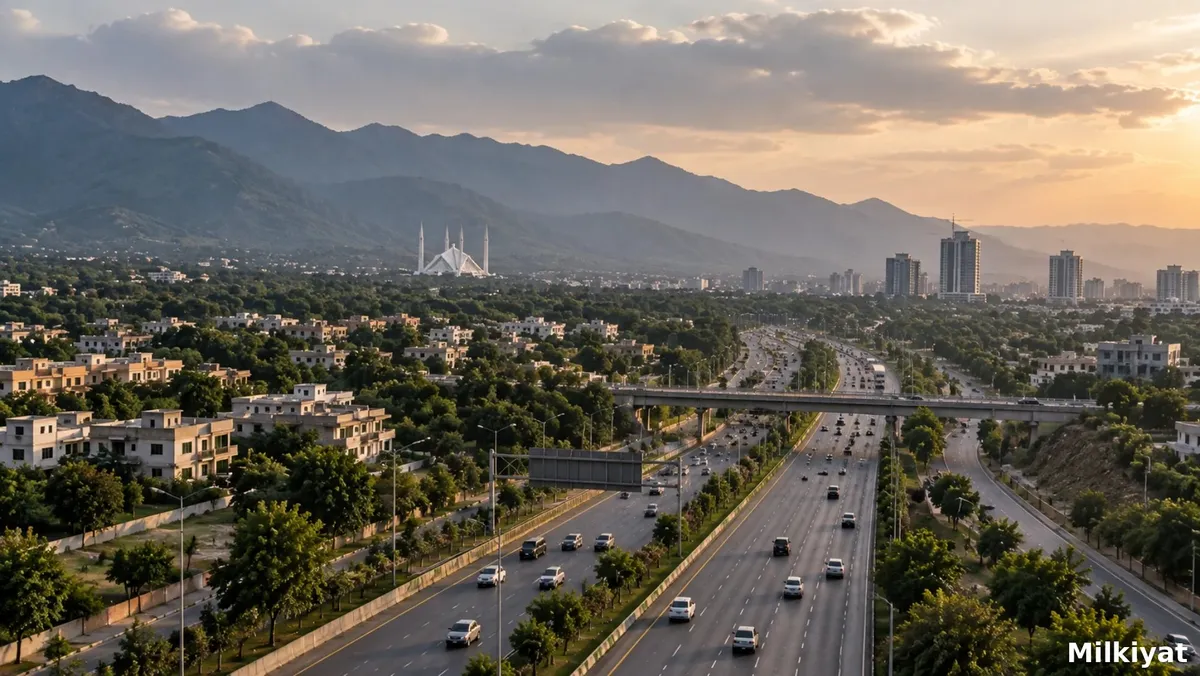
The Islamabad Expressway is a 28-kilometre CDA-maintained corridor connecting Zero Point with T-Chowk, Rawat, and providing access to several major housing societies, including Bahria Town, DHA, PWD, Naval Anchorage, Soan Gardens, Gulberg Greens, and CBR Town. However, accessibility varies by society because some have dedicated or independently developed interchanges, while others rely on nearby access points. Therefore, a society’s distance from the Islamabad Expressway does not necessarily reflect its actual travel time or ease of access.
The Islamabad Expressway is probably the single road most private housing societies in the city reference in their marketing, and for good reason it is the main north-south corridor connecting a large share of Islamabad’s newer residential development with Zero Point, Rawalpindi, and the wider motorway network. But “on the Expressway” covers a lot of ground, literally: the corridor stretches for around 28 kilometres and serves numerous distinct societies, each with its own access arrangement that is not always as direct as the marketing suggests.
For buyers, this distinction matters. A housing society being located near the Islamabad Expressway does not automatically mean residents have a direct interchange or a short commute. Access can depend on the nearest interchange, connecting road, traffic conditions, and the specific block within a society. Before comparing locations, it is also important to check a society’s legal status through the CDA Approved, Under Process, & Illegal Housing Societies List rather than relying solely on proximity or developer marketing.
This guide breaks down the major housing societies connected to the Islamabad Expressway, how residents actually access the road, and why Expressway proximity and real-world accessibility are not always the same thing.
By Bibi Masooma
Real Estate Analyst
11 min read
The Islamabad Expressway is a 28-kilometre CDA-maintained corridor connecting Zero Point with T-Chowk, Rawat, and providing access to several major housing societies, including Bahria Town, DHA, PWD, Naval Anchorage, Soan Gardens, Gulberg Greens, and CBR Town. However, accessibility varies by society because some have dedicated or independently developed interchanges, while others rely on nearby access points. Therefore, a society’s distance from the Islamabad Expressway does not necessarily reflect its actual travel time or ease of access.
The Islamabad Expressway is probably the single road most private housing societies in the city reference in their marketing, and for good reason it is the main north-south corridor connecting a large share of Islamabad’s newer residential development with Zero Point, Rawalpindi, and the wider motorway network. But “on the Expressway” covers a lot of ground, literally: the corridor stretches for around 28 kilometres and serves numerous distinct societies, each with its own access arrangement that is not always as direct as the marketing suggests.
For buyers, this distinction matters. A housing society being located near the Islamabad Expressway does not automatically mean residents have a direct interchange or a short commute. Access can depend on the nearest interchange, connecting road, traffic conditions, and the specific block within a society. Before comparing locations, it is also important to check a society’s legal status through the CDA Approved, Under Process, & Illegal Housing Societies List rather than relying solely on proximity or developer marketing.
This guide breaks down the major housing societies connected to the Islamabad Expressway, how residents actually access the road, and why Expressway proximity and real-world accessibility are not always the same thing.
The Islamabad Expressway, maintained by the Capital Development Authority (CDA), runs approximately 28 kilometres from the Zero Point Interchange at its northern end to T-Chowk in Rawat at its southern end. Its major junctions include Zero Point, Shakarparian, Faizabad, Sohan, Khanna, Koral, and Gulberg Greens, connecting outward to the Srinagar Highway, Murree Road, the airport and motorway network, and GT Road toward Rawalpindi and beyond.
The corridor has undergone major development and signal-free improvement works aimed at improving traffic flow, widening key sections, and providing better connectivity as development along the route has increased. For current road-development details, interchange status, and official project updates, readers should verify information through the Capital Development Authority (CDA) official website and its relevant project updates.
| Detail | Information |
|---|---|
| Maintained by | Capital Development Authority (CDA) |
| Length | Approximately 28 km |
| North end | Zero Point Interchange |
| South end | T Chowk, Rawat |
| Major interchanges | Zero Point, Shakarparian, Faizabad, Sohan, Khanna, Koral, Gulberg Greens |
| Connects to | Srinagar Highway, Islamabad Airport/M-1/M-2/GT Road, Murree Road |
Reporting on the Expressway's Zone-V catchment area describes it as connecting more than a quarter of a million residents across societies including PWD, Bahria Town, Police Foundation, Korang Town, Soan Gardens, Naval Anchorage, and DHA-II, among others. A broader look at Islamabad's private housing development along the corridor, from Faizabad down to GT Road, spans a wide stretch of the city's union councils and includes Bahria Town, DHA, Gulberg Greens, CBR Town, Jinnah Garden, PWD, and Soan Garden as some of the more prominent names.
| Society/Area | General Position |
|---|---|
| PWD Housing Scheme | Mid-corridor, near Koral area |
| Bahria Town (Islamabad/Rawalpindi phases) | Extends from mid-corridor toward Adiala Road |
| Naval Anchorage | Near PWD, mid-corridor |
| Soan Gardens | Mid-corridor |
| DHA (Islamabad/Rawalpindi) | Extends along and beyond the corridor toward Adiala Road |
| Gulberg Greens | Toward the southern end, near the Gulberg Greens Interchange |
| CBR Town, Jinnah Garden, Korang Town | Various points along the corridor |
This is the detail most marketing skips over. As the Expressway's signal-free expansion progressed, individual societies were, in a number of documented cases, expected to fund and build their own interchange or access infrastructure rather than simply being granted one by default. Naval Anchorage, for example, asked its own members for direct financial contributions toward a proposed interchange — reported at PKR 25,000 per 500-square-yard plot owner in one extension — specifically because building that access point wasn't guaranteed without it. Discussion around the same period noted that PWD's own interchange progress affected whether nearby Bahria Town residents would have convenient access too, given the overlapping catchment area. Where a society didn't build its own dedicated access, residents have had to rely on the nearest available interchange or underpass instead, sometimes involving a longer detour than the straight-line distance to their home would suggest — particularly after U-turns along the signal-free stretch were closed as part of the corridor's redesign.
| Scenario | What It Means for Residents |
|---|---|
| Society funded/built its own dedicated interchange | Generally more direct, reliable access |
| Society relies on a nearby society's interchange | Access depends on that interchange actually being completed and functional |
| No dedicated interchange, U-turns closed | Residents may need to travel to the next available interchange, adding real distance |
| Society straddles a boundary between two interchanges | Access quality can differ significantly by which side of the society you live on |
Given this pattern, evaluating a specific property along the Expressway means going a step beyond "how far is it from the Expressway" and asking "what is the actual, current route to the nearest functioning interchange from this specific block." Two identically priced plots in different societies, both technically "on the Expressway," can have meaningfully different real-world commute times depending on whether their society secured its own direct access or ended up dependent on a neighbouring interchange.
Before buying or renting a property marketed as being close to the Islamabad Expressway, buyers should verify the following:
| What to Check | Why It Matters |
|---|---|
| Exact access point | Confirms the actual route to the Expressway |
| Direct or indirect access | Shows whether the society has its own connection or depends on another route |
| Current road condition | A map connection may not mean a convenient, usable route |
| CDA/FGEHA approvals, where applicable | Helps verify the official status of relevant infrastructure |
| Interchange or underpass status | Confirms whether access is operational, under construction or only proposed |
| Distance from the actual entrance | Road distance matters more than straight-line map distance |
| Alternative access routes | Important if the main route becomes congested or restricted |
| Future road projects | Check whether proposed infrastructure is officially planned and funded |
| Property-specific location | Access can vary significantly between blocks and streets |
| Current traffic conditions | Helps assess the real commuting advantage of the location |
Bottom line: Do not value a property simply because it is advertised as "near Islamabad Expressway." Verify the actual access route, current infrastructure status and relevant approvals before making a purchase or rental decision.
Societies with confirmed, direct, and well-used access to the Expressway generally support steadier rental demand, since tenants—particularly those commuting to central Islamabad or Rawalpindi for work—place real value on a predictable, shorter commute. Societies still dependent on shared or indirect access may offer lower entry prices as a result, which can suit an investor with a longer time horizon willing to wait for access infrastructure to mature.
However, buyers should not assume that a society's advertised road connection is officially approved or permanently available. Before factoring Expressway access into rental or investment calculations, buyers should verify the relevant road network, access arrangements and development approvals through the Capital Development Authority (CDA) and other competent authorities, where applicable. This trade-off should therefore be a deliberate investment decision rather than an assumption based on the Expressway's name or a property's advertised distance from it.
| Access Profile | Typical Rental Demand | Best Suited To |
|---|---|---|
| Direct, confirmed interchange access | Generally steadier tenant demand | Buyers prioritising rental reliability |
| Shared or indirect access with a longer route | Moderate and commute-sensitive demand | Balanced buyers comfortable with some trade-off |
| Access dependent on unbuilt or proposed infrastructure | Weaker current demand, with potential upside if access improves | Long-term investors willing to wait |
Islamabad Expressway genuinely serves as a major transport backbone connecting a large share of the capital's newer residential and housing developments. However, the phrase "on the Expressway" can be much broader than it sounds. A society may be located close to the Expressway without having direct access to it.
Some housing societies have their own dedicated interchange or access connection, while others depend on neighbouring developments, service roads, underpasses or the nearest available entry point. These differences can significantly affect daily commuting time, convenience and the practical value of Expressway proximity.
For buyers and renters, the key point is simple: do not judge connectivity from a map pin alone. Before making a property decision, verify the exact access route for the specific society, block or street you are considering. Check whether the route is officially available, how far the actual entrance is, and whether access depends on another society's infrastructure.
Ultimately, the difference between "near the Expressway" and "directly connected to the Expressway" can be substantial. Confirming the real, current access route can help you distinguish between a genuinely well-connected property and one that only appears well-connected on a map.
Q1: Is every society along Islamabad Expressway equally well-connected?
No. Some societies built and funded their own dedicated interchange, while others rely on a neighbouring society's access point or the nearest available underpass, resulting in genuinely different real-world commute times.
Q2: Which interchanges are on Islamabad Expressway?
Major interchanges include Zero Point, Shakarparian, Faizabad, Sohan, Khanna, Koral, and Gulberg Greens, connecting the corridor from Zero Point down to T Chowk, Rawat.
Q3: Why did some societies have to pay for their own interchange?
As the Expressway's signal-free expansion progressed, dedicated access wasn't automatically guaranteed to every adjacent society some, like Naval Anchorage, asked their own members for direct financial contributions to fund their interchange.
Q4: How do U-turn closures affect residents along the Expressway?
As U-turns have been closed along the signal-free stretch, residents of societies without a nearby dedicated interchange may need to travel further to the next available interchange or underpass to cross to the other side of the road.
Q5: Should I trust a society's claim of "quick Expressway access"?
Verify it directly ask which specific interchange serves the property, confirm it's actually complete and open, and ideally drive the real route yourself before relying on the claim.
Q6: Is a society with weaker current Expressway access still worth considering?
It can be, particularly for a longer-horizon investor, since improving access infrastructure over time could support future appreciation but this should be a deliberate trade-off, not an assumption based on general Expressway proximity.
A complete guide to Warda Hamna Residencia in G-11/3, Islamabad, covering how the four towers differ, apartment sizes and layouts, current sale and rental prices, and whether it's a good investment for buyers and tenants.
F-5 is a CDA-administered sector, so ownership moves through the Authority's own transfer file rather than a private society office. This guide walks through allotment letter verification, dues clearance, the transfer NOC, stamp duty and registration, inherited-plot mutation, and the checks that stop a transfer from going wrong.
E-11 Islamabad offers Margalla Hills views and dense apartment stock, but its four sub-societies don't share one clean NOC history.
H-13 Islamabad has an active rental market near NUST, but large parts of the sector are officially restricted. Here's what to check first.
The Islamabad Expressway, maintained by the Capital Development Authority (CDA), runs approximately 28 kilometres from the Zero Point Interchange at its northern end to T-Chowk in Rawat at its southern end. Its major junctions include Zero Point, Shakarparian, Faizabad, Sohan, Khanna, Koral, and Gulberg Greens, connecting outward to the Srinagar Highway, Murree Road, the airport and motorway network, and GT Road toward Rawalpindi and beyond.
The corridor has undergone major development and signal-free improvement works aimed at improving traffic flow, widening key sections, and providing better connectivity as development along the route has increased. For current road-development details, interchange status, and official project updates, readers should verify information through the Capital Development Authority (CDA) official website and its relevant project updates.
| Detail | Information |
|---|---|
| Maintained by | Capital Development Authority (CDA) |
| Length | Approximately 28 km |
| North end | Zero Point Interchange |
| South end | T Chowk, Rawat |
| Major interchanges | Zero Point, Shakarparian, Faizabad, Sohan, Khanna, Koral, Gulberg Greens |
| Connects to | Srinagar Highway, Islamabad Airport/M-1/M-2/GT Road, Murree Road |
Reporting on the Expressway's Zone-V catchment area describes it as connecting more than a quarter of a million residents across societies including PWD, Bahria Town, Police Foundation, Korang Town, Soan Gardens, Naval Anchorage, and DHA-II, among others. A broader look at Islamabad's private housing development along the corridor, from Faizabad down to GT Road, spans a wide stretch of the city's union councils and includes Bahria Town, DHA, Gulberg Greens, CBR Town, Jinnah Garden, PWD, and Soan Garden as some of the more prominent names.
| Society/Area | General Position |
|---|---|
| PWD Housing Scheme | Mid-corridor, near Koral area |
| Bahria Town (Islamabad/Rawalpindi phases) | Extends from mid-corridor toward Adiala Road |
| Naval Anchorage | Near PWD, mid-corridor |
| Soan Gardens | Mid-corridor |
| DHA (Islamabad/Rawalpindi) | Extends along and beyond the corridor toward Adiala Road |
| Gulberg Greens | Toward the southern end, near the Gulberg Greens Interchange |
| CBR Town, Jinnah Garden, Korang Town | Various points along the corridor |
This is the detail most marketing skips over. As the Expressway's signal-free expansion progressed, individual societies were, in a number of documented cases, expected to fund and build their own interchange or access infrastructure rather than simply being granted one by default. Naval Anchorage, for example, asked its own members for direct financial contributions toward a proposed interchange — reported at PKR 25,000 per 500-square-yard plot owner in one extension — specifically because building that access point wasn't guaranteed without it. Discussion around the same period noted that PWD's own interchange progress affected whether nearby Bahria Town residents would have convenient access too, given the overlapping catchment area. Where a society didn't build its own dedicated access, residents have had to rely on the nearest available interchange or underpass instead, sometimes involving a longer detour than the straight-line distance to their home would suggest — particularly after U-turns along the signal-free stretch were closed as part of the corridor's redesign.
| Scenario | What It Means for Residents |
|---|---|
| Society funded/built its own dedicated interchange | Generally more direct, reliable access |
| Society relies on a nearby society's interchange | Access depends on that interchange actually being completed and functional |
| No dedicated interchange, U-turns closed | Residents may need to travel to the next available interchange, adding real distance |
| Society straddles a boundary between two interchanges | Access quality can differ significantly by which side of the society you live on |
Given this pattern, evaluating a specific property along the Expressway means going a step beyond "how far is it from the Expressway" and asking "what is the actual, current route to the nearest functioning interchange from this specific block." Two identically priced plots in different societies, both technically "on the Expressway," can have meaningfully different real-world commute times depending on whether their society secured its own direct access or ended up dependent on a neighbouring interchange.
Before buying or renting a property marketed as being close to the Islamabad Expressway, buyers should verify the following:
| What to Check | Why It Matters |
|---|---|
| Exact access point | Confirms the actual route to the Expressway |
| Direct or indirect access | Shows whether the society has its own connection or depends on another route |
| Current road condition | A map connection may not mean a convenient, usable route |
| CDA/FGEHA approvals, where applicable | Helps verify the official status of relevant infrastructure |
| Interchange or underpass status | Confirms whether access is operational, under construction or only proposed |
| Distance from the actual entrance | Road distance matters more than straight-line map distance |
| Alternative access routes | Important if the main route becomes congested or restricted |
| Future road projects | Check whether proposed infrastructure is officially planned and funded |
| Property-specific location | Access can vary significantly between blocks and streets |
| Current traffic conditions | Helps assess the real commuting advantage of the location |
Bottom line: Do not value a property simply because it is advertised as "near Islamabad Expressway." Verify the actual access route, current infrastructure status and relevant approvals before making a purchase or rental decision.
Societies with confirmed, direct, and well-used access to the Expressway generally support steadier rental demand, since tenants—particularly those commuting to central Islamabad or Rawalpindi for work—place real value on a predictable, shorter commute. Societies still dependent on shared or indirect access may offer lower entry prices as a result, which can suit an investor with a longer time horizon willing to wait for access infrastructure to mature.
However, buyers should not assume that a society's advertised road connection is officially approved or permanently available. Before factoring Expressway access into rental or investment calculations, buyers should verify the relevant road network, access arrangements and development approvals through the Capital Development Authority (CDA) and other competent authorities, where applicable. This trade-off should therefore be a deliberate investment decision rather than an assumption based on the Expressway's name or a property's advertised distance from it.
| Access Profile | Typical Rental Demand | Best Suited To |
|---|---|---|
| Direct, confirmed interchange access | Generally steadier tenant demand | Buyers prioritising rental reliability |
| Shared or indirect access with a longer route | Moderate and commute-sensitive demand | Balanced buyers comfortable with some trade-off |
| Access dependent on unbuilt or proposed infrastructure | Weaker current demand, with potential upside if access improves | Long-term investors willing to wait |
Islamabad Expressway genuinely serves as a major transport backbone connecting a large share of the capital's newer residential and housing developments. However, the phrase "on the Expressway" can be much broader than it sounds. A society may be located close to the Expressway without having direct access to it.
Some housing societies have their own dedicated interchange or access connection, while others depend on neighbouring developments, service roads, underpasses or the nearest available entry point. These differences can significantly affect daily commuting time, convenience and the practical value of Expressway proximity.
For buyers and renters, the key point is simple: do not judge connectivity from a map pin alone. Before making a property decision, verify the exact access route for the specific society, block or street you are considering. Check whether the route is officially available, how far the actual entrance is, and whether access depends on another society's infrastructure.
Ultimately, the difference between "near the Expressway" and "directly connected to the Expressway" can be substantial. Confirming the real, current access route can help you distinguish between a genuinely well-connected property and one that only appears well-connected on a map.
Q1: Is every society along Islamabad Expressway equally well-connected?
No. Some societies built and funded their own dedicated interchange, while others rely on a neighbouring society's access point or the nearest available underpass, resulting in genuinely different real-world commute times.
Q2: Which interchanges are on Islamabad Expressway?
Major interchanges include Zero Point, Shakarparian, Faizabad, Sohan, Khanna, Koral, and Gulberg Greens, connecting the corridor from Zero Point down to T Chowk, Rawat.
Q3: Why did some societies have to pay for their own interchange?
As the Expressway's signal-free expansion progressed, dedicated access wasn't automatically guaranteed to every adjacent society some, like Naval Anchorage, asked their own members for direct financial contributions to fund their interchange.
Q4: How do U-turn closures affect residents along the Expressway?
As U-turns have been closed along the signal-free stretch, residents of societies without a nearby dedicated interchange may need to travel further to the next available interchange or underpass to cross to the other side of the road.
Q5: Should I trust a society's claim of "quick Expressway access"?
Verify it directly ask which specific interchange serves the property, confirm it's actually complete and open, and ideally drive the real route yourself before relying on the claim.
Q6: Is a society with weaker current Expressway access still worth considering?
It can be, particularly for a longer-horizon investor, since improving access infrastructure over time could support future appreciation but this should be a deliberate trade-off, not an assumption based on general Expressway proximity.
A complete guide to Warda Hamna Residencia in G-11/3, Islamabad, covering how the four towers differ, apartment sizes and layouts, current sale and rental prices, and whether it's a good investment for buyers and tenants.
F-5 is a CDA-administered sector, so ownership moves through the Authority's own transfer file rather than a private society office. This guide walks through allotment letter verification, dues clearance, the transfer NOC, stamp duty and registration, inherited-plot mutation, and the checks that stop a transfer from going wrong.
E-11 Islamabad offers Margalla Hills views and dense apartment stock, but its four sub-societies don't share one clean NOC history.
H-13 Islamabad has an active rental market near NUST, but large parts of the sector are officially restricted. Here's what to check first.