By Maham Imtiaz
Real Estate Analyst
12 min read
Short Answer:
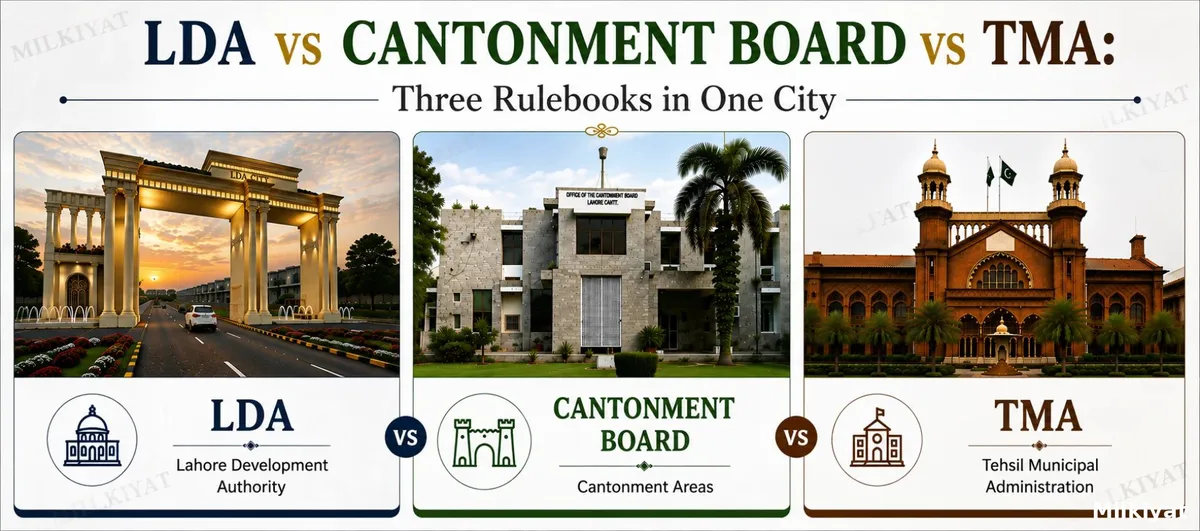
Lahore is not governed by one building authority. Three separate legal regimes operate side by side. The Lahore Development Authority (LDA) works under the LDA Act 1975 and controls planning, scheme approval, building plans and commercialisation across most of urban Lahore. Cantonment Boards, Lahore Cantonment Board and Walton Cantonment Board, work under the federal Cantonments Act 1924 and answer to the Ministry of Defence, not to Punjab. Tehsil Municipal Administrations (TMAs) work under the Punjab Local Government Act 2022 and cover the tehsil areas outside LDA's controlled area and outside cantonment limits. Which one applies to your plot decides your approval route, your fee schedule, your covered-area limits, your transfer paperwork and your appeal forum. It is a jurisdiction question, not a paperwork question, and buyers who guess wrong pay for it twice.
Most buyers in Lahore assume "approval" is one thing. You either have it or you don't. In practice, the word means three different things depending on which side of an invisible boundary your plot sits on.
A 10-marla plot in Johar Town, a 10-marla plot in Lahore Cantt and a 10-marla plot on Sue-e-Asal Road can all be legally held, legally built on and legally sold, under three different statutes, with three different regulators, three different fee tables and three different definitions of what "approved map" means. The documents look similar. They are not interchangeable.
This guide sets out what each authority actually controls, how to tell which one governs your plot, and where the overlaps cost people money.
The split is historical, not administrative tidiness.
Cantonments came first. The British established Mian Mir Cantonment in 1850, and cantonment administration across the subcontinent was later consolidated into the Cantonments Act 1924, a federal law that survives in Pakistan today. Cantonments were deliberately kept outside ordinary municipal law so the military could control land use around garrisons.
Municipal government for the rest of the city ran through local bodies legislation, which has been rewritten repeatedly, most recently as the Punjab Local Government Act 2022.
The LDA is the newest layer. Created by the provincial assembly under the LDA Act 1975 (successor to the Lahore Improvement Trust), it was designed to do what neither cantonments nor municipal committees could: plan and regulate large-scale urban expansion.
Block C-1 in Multi Gardens B-17 sits near the society lake with an RDA-approved layout, developed streets and possession-ready plots. Here is its location, plot sizes, prices and verification steps.
Park View City development charges fund roads, sewerage, water, electricity infrastructure and shared facilities. Learn why these charges may change after booking, which buyers might qualify for limited concessions, and how to verify outstanding dues before purchasing, transferring or taking possession of a plot.
LDA approved" is doing the work of three separate documents. An approved layout plan clears the developer's subdivision, a scheme NOC makes plot sale legitimate, and an approved building plan, yours, not the developer's, is what lets you construct. Here is what each one permits, what it does not, and how to check all three yourself before any token payment.
A Park View City NDC confirms that no dues remain against a plot and is essential for transfers, possession and many financing cases. This guide explains the expected cost, processing timeline, application steps and checks buyers and sellers should complete in 2026.
By Maham Imtiaz
Real Estate Analyst
12 min read
Short Answer:
Lahore is not governed by one building authority. Three separate legal regimes operate side by side. The Lahore Development Authority (LDA) works under the LDA Act 1975 and controls planning, scheme approval, building plans and commercialisation across most of urban Lahore. Cantonment Boards, Lahore Cantonment Board and Walton Cantonment Board, work under the federal Cantonments Act 1924 and answer to the Ministry of Defence, not to Punjab. Tehsil Municipal Administrations (TMAs) work under the Punjab Local Government Act 2022 and cover the tehsil areas outside LDA's controlled area and outside cantonment limits. Which one applies to your plot decides your approval route, your fee schedule, your covered-area limits, your transfer paperwork and your appeal forum. It is a jurisdiction question, not a paperwork question, and buyers who guess wrong pay for it twice.
Most buyers in Lahore assume "approval" is one thing. You either have it or you don't. In practice, the word means three different things depending on which side of an invisible boundary your plot sits on.
A 10-marla plot in Johar Town, a 10-marla plot in Lahore Cantt and a 10-marla plot on Sue-e-Asal Road can all be legally held, legally built on and legally sold, under three different statutes, with three different regulators, three different fee tables and three different definitions of what "approved map" means. The documents look similar. They are not interchangeable.
This guide sets out what each authority actually controls, how to tell which one governs your plot, and where the overlaps cost people money.
The split is historical, not administrative tidiness.
Cantonments came first. The British established Mian Mir Cantonment in 1850, and cantonment administration across the subcontinent was later consolidated into the Cantonments Act 1924, a federal law that survives in Pakistan today. Cantonments were deliberately kept outside ordinary municipal law so the military could control land use around garrisons.
Municipal government for the rest of the city ran through local bodies legislation, which has been rewritten repeatedly, most recently as the Punjab Local Government Act 2022.
The LDA is the newest layer. Created by the provincial assembly under the LDA Act 1975 (successor to the Lahore Improvement Trust), it was designed to do what neither cantonments nor municipal committees could: plan and regulate large-scale urban expansion.
Block C-1 in Multi Gardens B-17 sits near the society lake with an RDA-approved layout, developed streets and possession-ready plots. Here is its location, plot sizes, prices and verification steps.
Park View City development charges fund roads, sewerage, water, electricity infrastructure and shared facilities. Learn why these charges may change after booking, which buyers might qualify for limited concessions, and how to verify outstanding dues before purchasing, transferring or taking possession of a plot.
LDA approved" is doing the work of three separate documents. An approved layout plan clears the developer's subdivision, a scheme NOC makes plot sale legitimate, and an approved building plan, yours, not the developer's, is what lets you construct. Here is what each one permits, what it does not, and how to check all three yourself before any token payment.
A Park View City NDC confirms that no dues remain against a plot and is essential for transfers, possession and many financing cases. This guide explains the expected cost, processing timeline, application steps and checks buyers and sellers should complete in 2026.
The result is three parallel systems that were never merged. They meet at boundaries that are not marked on the ground.
The LDA is a statutory body of the Government of Punjab. Within its controlled area it is the planning regulator, the building-control authority and the scheme-approval authority all at once.
What LDA decides:
LDA governs the bulk of what people mean when they say "Lahore", Johar Town, Model Town, Gulberg, Faisal Town, Wapda Town, Iqbal Town, and the approved private schemes such as Bahria Town, Lake City, Park View City and Etihad Town. Its own developments, including LDA City, sit here too.
The scale of the enforcement problem is worth stating plainly. Dawn reported that of the roughly 3,715 housing societies across Punjab, around 3,119 were approved, and that in Lahore alone 171 societies were illegal with approval underway for another 135. A later Dawn report put the figure at 207 illegal schemes in Lahore city district and described a Board of Revenue proposal to regularise them under heavy fines. Both numbers point at the same thing: a very large share of land marketed as "Lahore property" has never passed through LDA's approval process at all.
The core LDA documents are covered in more depth in our guides on LDA commercialisation and land use conversion and the LDA completion certificate. The statutes themselves, the LDA Act 1975, the Land Use Rules 2020 and the Land Use Regulations 2020, are published on LDA's official downloads page.
Lahore Cantt is inside Lahore District, but it is not under Punjab's municipal law. It is administered by the Lahore Cantonment Board under the Cantonments Act 1924, with federal oversight through the Ministry of Defence and the Directorate General of Military Lands & Cantonments. Walton Cantonment Board was created in 1998 when Lahore Cantonment was bifurcated into two boards.
That single fact, federal statute, not provincial, changes everything downstream.
How building control works here: you file a notice for a new or re-erected building under section 179 of the Act. The Board sanctions or refuses under section 181. Sanction is not open-ended, it lapses under section 183, with extension of the completion period available under section 183-A. Unauthorised erection is dealt with under sections 184 and 185, which give the Board power to stop work or demolish. Each Board frames its own building bye-laws under section 186, approved by the federal government.
Those bye-laws are stricter than most people expect. Lahore Cantonment Board's published requirements include one-fourth open area for plots under 7 marla; one-fourth open area with a minimum 4-foot margin on three sides for plots between 7 and 10 marla; one-third open area with a 5-foot margin on four sides for plots of 10 marla and above; and a mumty capped at 120 square feet. Street width matters too, narrow streets restrict you to a single storey.
Transfers work differently as well. Section 73 requires notice of transfer of title to the Executive Officer. Cantonment land is classified, and Class B land transfers typically require Board approval and payment of transfer fees, with outstanding property tax, water charges and lease rent cleared first. Old Grant properties carry their own conversion history. None of this resembles an LDA-scheme transfer.
DHA is the complication. DHA Lahore is not an LDA-approved private scheme. It runs its own membership, transfer and building-control machinery under a 1999 provincial ordinance, while physically sitting within cantonment limits, so cantonment-level requirements interact with DHA's own Building Control Branch. Buyers routinely apply LDA logic to DHA files and get the wrong answer. Our DHA Lahore area guide sets out the four DHA ownership documents and how they differ.
Outside LDA's controlled area and outside the cantonments, municipal authority sits with tehsil-level local government under the Punjab Local Government Act 2022. Building control is defined in that Act as the standards and regulatory framework a local government enforces for building safety, and land-use control, including land subdivision, development and zoning, is a listed function of local governments.
In everyday market language this is still called "TMA approval", and the phrase does a lot of damage.
TMA-approved is a real thing. It is also a much lower bar than LDA approval, and it does not cover the same subject matter. A TMA may deal with a building or a small subdivision within its municipal limits. It is not the authority that approves a large private housing scheme inside LDA's controlled area. When a file is sold in a periphery scheme on the strength of "TMA approved" paperwork, the question to ask is not whether the document is genuine, it usually is, but whether the issuing body had jurisdiction over that land for that purpose.
Dawn's reporting on the regularisation proposal noted that a large volume of construction in illegal schemes was enabled by weak regulation and enforcement on the part of development authorities and the then town municipal administrations. That is the jurisdictional gap, described from the inside.
The problem is sharpest at Lahore's edges, Raiwind Road, Bedian Road, Ferozepur Road beyond the ring, and land that is administratively in Kasur or Sheikhupura tehsil but marketed with a Lahore address.
| LDA | Cantonment Board | TMA | |
|---|---|---|---|
| Governing law | LDA Act 1975 (provincial) | Cantonments Act 1924 (federal) | Punjab Local Government Act 2022 (provincial) |
| Reports to | Government of Punjab | Ministry of Defence / DG ML&C | Local Government & Community Development Dept |
| Area covered | LDA controlled area, most of urban Lahore and approved private schemes | Lahore Cantt and Walton Cantt limits | Tehsil municipal limits outside LDA area and cantonments |
| Scheme approval | LOP then NOC | Not applicable in the same form | Limited; not a substitute for LDA scheme approval |
| Building plan | LDA building plan sanction | Notice u/s 179, sanction u/s 181 | TMA building approval |
| Bye-laws | LDA building bylaws and land use regulations | Board's own bye-laws u/s 186 | Local government bye-laws |
| Completion | LDA completion certificate | Completion within the period fixed u/s 183-A | Varies by tehsil |
| Enforcement | Sealing, demolition, scheme dismantling | Stop-work and demolition u/s 184–185 | Municipal enforcement |
| Property tax | Excise & Taxation, Punjab | Cantonment Board | Excise & Taxation, Punjab |
Do this before the token payment, not after.
1. Check the revenue record first. Get the fard from the Arazi Record Centre and identify the mauza and tehsil. If the tehsil is not a Lahore tehsil, no Lahore-branded marketing changes that.
2. Ask which authority issued the layout approval, by name and number. "Approved" is not an answer. "LDA LOP number X dated Y" is. So is a cantonment board sanction reference.
3. Verify with the issuing authority directly. Not with the dealer, not with the site office, and not from a brochure. LDA's status can be confirmed with LDA. A cantonment sanction can be confirmed with the Board that issued it.
4. Match the document type to the authority. An LDA NOC on cantonment land, or a TMA letter offered as scheme approval inside LDA's controlled area, is a jurisdiction mismatch, regardless of how genuine the paper looks.
5. Price the construction under the correct bye-laws. Cantonment open-area rules will give you less covered area on the same plot size than you may be assuming. Run the numbers before you commit, using our Lahore construction cost calculator.
Buying a "Lahore" plot that is legally in another tehsil. The price discount looks like an opportunity. It is usually a jurisdiction problem, and it shows up at resale, at mortgage stage and at utility connection stage.
Designing to the wrong bye-laws. An architect who designs to LDA setbacks for a cantonment plot produces drawings that will not be sanctioned. Redesign is time and fee.
Assuming one approval carries over. It does not. A building sanctioned by a Cantonment Board is not an LDA-approved building, and vice versa.
Ignoring dues at transfer. Cantonment transfers stall on unpaid property tax, water charges and lease rent. These are not negotiable at the counter.
Treating enforcement risk as theoretical. LDA regularly dismantles infrastructure in unapproved schemes and seals properties for unpaid commercialisation dues. Houses built inside those schemes are exposed even when the demolition targets roads and site offices.
For a wider view of how approval status feeds into pricing and liquidity across the city, see our Lahore Property Market Guide 2026, and for budget-level implications, what Rs 1 crore actually buys in Lahore.
Q1. Is a Cantonment Board approval weaker than an LDA approval?
A. No — it is a different regime, not a lesser one. Within cantonment limits the Cantonment Board is the lawful building authority under a federal statute. What matters is that the approval came from the body with jurisdiction over that land.
Q2. My file says "TMA approved". Is that enough to build?
A. Only if the plot actually falls in that TMA's municipal jurisdiction and the approval covers what you intend to do. If the land sits inside LDA's controlled area, a TMA letter does not substitute for LDA scheme approval.
Q3. Does LDA approve buildings in DHA Lahore?
A. No. DHA operates its own building control under a 1999 provincial ordinance, within cantonment limits. LDA NOC checks do not apply to DHA in the way they apply to private schemes.
Q4. Who do I appeal to if my building plan is refused?
A. It depends on the authority. LDA refusals run through LDA's own appellate channels under the LDA Act; cantonment matters run through the appeal mechanism under the Cantonments Act, and ultimately the High Court's constitutional jurisdiction. TMA matters follow the local government law.
Q5. Can a plot fall under two authorities at once?
A. Jurisdiction over building control sits with one authority. But overlapping requirements do exist in practice, DHA is the clearest example, where an internal estate regime and cantonment-level administration operate together.
Q6. How do I check my property tax authority?
A. Cantonment properties are assessed and billed by the Cantonment Board under the Cantonments Act. Properties elsewhere in Lahore are assessed by Punjab's Excise, Taxation & Narcotics Control Department.
Do not ask "is it approved". Ask "approved by whom, under which law, for which purpose".
In a city where three statutes run in parallel and none of the boundaries are painted on the road, that single reframing catches most of the expensive mistakes before they happen. The dealer's file will not tell you. The revenue record and the issuing authority will.
Sources: LDA Act 1975 and Land Use Rules 2020 (LDA official downloads); Cantonments Act 1924 (Ministry of Defence); Lahore Cantonment Board published building bye-law requirements; Punjab Local Government Act 2022; Dawn reporting on illegal and unapproved housing schemes in Punjab (October 2025, November 2024); Milkiyat.com research, August 2026.
Disclaimer: General information only. Not legal advice. Verify jurisdiction and approval status directly with the relevant authority before any transaction.
The result is three parallel systems that were never merged. They meet at boundaries that are not marked on the ground.
The LDA is a statutory body of the Government of Punjab. Within its controlled area it is the planning regulator, the building-control authority and the scheme-approval authority all at once.
What LDA decides:
LDA governs the bulk of what people mean when they say "Lahore", Johar Town, Model Town, Gulberg, Faisal Town, Wapda Town, Iqbal Town, and the approved private schemes such as Bahria Town, Lake City, Park View City and Etihad Town. Its own developments, including LDA City, sit here too.
The scale of the enforcement problem is worth stating plainly. Dawn reported that of the roughly 3,715 housing societies across Punjab, around 3,119 were approved, and that in Lahore alone 171 societies were illegal with approval underway for another 135. A later Dawn report put the figure at 207 illegal schemes in Lahore city district and described a Board of Revenue proposal to regularise them under heavy fines. Both numbers point at the same thing: a very large share of land marketed as "Lahore property" has never passed through LDA's approval process at all.
The core LDA documents are covered in more depth in our guides on LDA commercialisation and land use conversion and the LDA completion certificate. The statutes themselves, the LDA Act 1975, the Land Use Rules 2020 and the Land Use Regulations 2020, are published on LDA's official downloads page.
Lahore Cantt is inside Lahore District, but it is not under Punjab's municipal law. It is administered by the Lahore Cantonment Board under the Cantonments Act 1924, with federal oversight through the Ministry of Defence and the Directorate General of Military Lands & Cantonments. Walton Cantonment Board was created in 1998 when Lahore Cantonment was bifurcated into two boards.
That single fact, federal statute, not provincial, changes everything downstream.
How building control works here: you file a notice for a new or re-erected building under section 179 of the Act. The Board sanctions or refuses under section 181. Sanction is not open-ended, it lapses under section 183, with extension of the completion period available under section 183-A. Unauthorised erection is dealt with under sections 184 and 185, which give the Board power to stop work or demolish. Each Board frames its own building bye-laws under section 186, approved by the federal government.
Those bye-laws are stricter than most people expect. Lahore Cantonment Board's published requirements include one-fourth open area for plots under 7 marla; one-fourth open area with a minimum 4-foot margin on three sides for plots between 7 and 10 marla; one-third open area with a 5-foot margin on four sides for plots of 10 marla and above; and a mumty capped at 120 square feet. Street width matters too, narrow streets restrict you to a single storey.
Transfers work differently as well. Section 73 requires notice of transfer of title to the Executive Officer. Cantonment land is classified, and Class B land transfers typically require Board approval and payment of transfer fees, with outstanding property tax, water charges and lease rent cleared first. Old Grant properties carry their own conversion history. None of this resembles an LDA-scheme transfer.
DHA is the complication. DHA Lahore is not an LDA-approved private scheme. It runs its own membership, transfer and building-control machinery under a 1999 provincial ordinance, while physically sitting within cantonment limits, so cantonment-level requirements interact with DHA's own Building Control Branch. Buyers routinely apply LDA logic to DHA files and get the wrong answer. Our DHA Lahore area guide sets out the four DHA ownership documents and how they differ.
Outside LDA's controlled area and outside the cantonments, municipal authority sits with tehsil-level local government under the Punjab Local Government Act 2022. Building control is defined in that Act as the standards and regulatory framework a local government enforces for building safety, and land-use control, including land subdivision, development and zoning, is a listed function of local governments.
In everyday market language this is still called "TMA approval", and the phrase does a lot of damage.
TMA-approved is a real thing. It is also a much lower bar than LDA approval, and it does not cover the same subject matter. A TMA may deal with a building or a small subdivision within its municipal limits. It is not the authority that approves a large private housing scheme inside LDA's controlled area. When a file is sold in a periphery scheme on the strength of "TMA approved" paperwork, the question to ask is not whether the document is genuine, it usually is, but whether the issuing body had jurisdiction over that land for that purpose.
Dawn's reporting on the regularisation proposal noted that a large volume of construction in illegal schemes was enabled by weak regulation and enforcement on the part of development authorities and the then town municipal administrations. That is the jurisdictional gap, described from the inside.
The problem is sharpest at Lahore's edges, Raiwind Road, Bedian Road, Ferozepur Road beyond the ring, and land that is administratively in Kasur or Sheikhupura tehsil but marketed with a Lahore address.
| LDA | Cantonment Board | TMA | |
|---|---|---|---|
| Governing law | LDA Act 1975 (provincial) | Cantonments Act 1924 (federal) | Punjab Local Government Act 2022 (provincial) |
| Reports to | Government of Punjab | Ministry of Defence / DG ML&C | Local Government & Community Development Dept |
| Area covered | LDA controlled area, most of urban Lahore and approved private schemes | Lahore Cantt and Walton Cantt limits | Tehsil municipal limits outside LDA area and cantonments |
| Scheme approval | LOP then NOC | Not applicable in the same form | Limited; not a substitute for LDA scheme approval |
| Building plan | LDA building plan sanction | Notice u/s 179, sanction u/s 181 | TMA building approval |
| Bye-laws | LDA building bylaws and land use regulations | Board's own bye-laws u/s 186 | Local government bye-laws |
| Completion | LDA completion certificate | Completion within the period fixed u/s 183-A | Varies by tehsil |
| Enforcement | Sealing, demolition, scheme dismantling | Stop-work and demolition u/s 184–185 | Municipal enforcement |
| Property tax | Excise & Taxation, Punjab | Cantonment Board | Excise & Taxation, Punjab |
Do this before the token payment, not after.
1. Check the revenue record first. Get the fard from the Arazi Record Centre and identify the mauza and tehsil. If the tehsil is not a Lahore tehsil, no Lahore-branded marketing changes that.
2. Ask which authority issued the layout approval, by name and number. "Approved" is not an answer. "LDA LOP number X dated Y" is. So is a cantonment board sanction reference.
3. Verify with the issuing authority directly. Not with the dealer, not with the site office, and not from a brochure. LDA's status can be confirmed with LDA. A cantonment sanction can be confirmed with the Board that issued it.
4. Match the document type to the authority. An LDA NOC on cantonment land, or a TMA letter offered as scheme approval inside LDA's controlled area, is a jurisdiction mismatch, regardless of how genuine the paper looks.
5. Price the construction under the correct bye-laws. Cantonment open-area rules will give you less covered area on the same plot size than you may be assuming. Run the numbers before you commit, using our Lahore construction cost calculator.
Buying a "Lahore" plot that is legally in another tehsil. The price discount looks like an opportunity. It is usually a jurisdiction problem, and it shows up at resale, at mortgage stage and at utility connection stage.
Designing to the wrong bye-laws. An architect who designs to LDA setbacks for a cantonment plot produces drawings that will not be sanctioned. Redesign is time and fee.
Assuming one approval carries over. It does not. A building sanctioned by a Cantonment Board is not an LDA-approved building, and vice versa.
Ignoring dues at transfer. Cantonment transfers stall on unpaid property tax, water charges and lease rent. These are not negotiable at the counter.
Treating enforcement risk as theoretical. LDA regularly dismantles infrastructure in unapproved schemes and seals properties for unpaid commercialisation dues. Houses built inside those schemes are exposed even when the demolition targets roads and site offices.
For a wider view of how approval status feeds into pricing and liquidity across the city, see our Lahore Property Market Guide 2026, and for budget-level implications, what Rs 1 crore actually buys in Lahore.
Q1. Is a Cantonment Board approval weaker than an LDA approval?
A. No — it is a different regime, not a lesser one. Within cantonment limits the Cantonment Board is the lawful building authority under a federal statute. What matters is that the approval came from the body with jurisdiction over that land.
Q2. My file says "TMA approved". Is that enough to build?
A. Only if the plot actually falls in that TMA's municipal jurisdiction and the approval covers what you intend to do. If the land sits inside LDA's controlled area, a TMA letter does not substitute for LDA scheme approval.
Q3. Does LDA approve buildings in DHA Lahore?
A. No. DHA operates its own building control under a 1999 provincial ordinance, within cantonment limits. LDA NOC checks do not apply to DHA in the way they apply to private schemes.
Q4. Who do I appeal to if my building plan is refused?
A. It depends on the authority. LDA refusals run through LDA's own appellate channels under the LDA Act; cantonment matters run through the appeal mechanism under the Cantonments Act, and ultimately the High Court's constitutional jurisdiction. TMA matters follow the local government law.
Q5. Can a plot fall under two authorities at once?
A. Jurisdiction over building control sits with one authority. But overlapping requirements do exist in practice, DHA is the clearest example, where an internal estate regime and cantonment-level administration operate together.
Q6. How do I check my property tax authority?
A. Cantonment properties are assessed and billed by the Cantonment Board under the Cantonments Act. Properties elsewhere in Lahore are assessed by Punjab's Excise, Taxation & Narcotics Control Department.
Do not ask "is it approved". Ask "approved by whom, under which law, for which purpose".
In a city where three statutes run in parallel and none of the boundaries are painted on the road, that single reframing catches most of the expensive mistakes before they happen. The dealer's file will not tell you. The revenue record and the issuing authority will.
Sources: LDA Act 1975 and Land Use Rules 2020 (LDA official downloads); Cantonments Act 1924 (Ministry of Defence); Lahore Cantonment Board published building bye-law requirements; Punjab Local Government Act 2022; Dawn reporting on illegal and unapproved housing schemes in Punjab (October 2025, November 2024); Milkiyat.com research, August 2026.
Disclaimer: General information only. Not legal advice. Verify jurisdiction and approval status directly with the relevant authority before any transaction.